According to the 2025 Boeing Pilot and Technician Outlook, the aviation industry requires 660,000 new qualified pilots through 2044 to maintain global flight operations. This massive demand represents an unprecedented opportunity for high-achievers ready to claim their seat in the cockpit. You likely understand that the journey is rigorous, yet the sheer volume of FAA regulations and commercial flying license requirements can feel like a barrier before you even take your first lesson. It’s common to feel overwhelmed by medical eligibility standards or the complexity of logging specific flight hours.
We’re here to replace that uncertainty with the confidence of an elite professional. This guide provides a definitive checklist for 2026, ensuring you understand exactly how to transition from a student to an airline-ready pilot. You’ll gain a clear perspective on the difference between meeting basic eligibility and achieving true technical proficiency. We’ll outline the essential aeronautical experience, certification milestones, and regulatory steps necessary to launch your global career with precision.
Key Takeaways
- Identify the legal privileges of the Commercial Pilot Certificate and how it serves as the definitive threshold for earning compensation as a professional aviator.
- Master the essential commercial flying license requirements, from fundamental age and language prerequisites to the specific aeronautical experience mandated by the FAA.
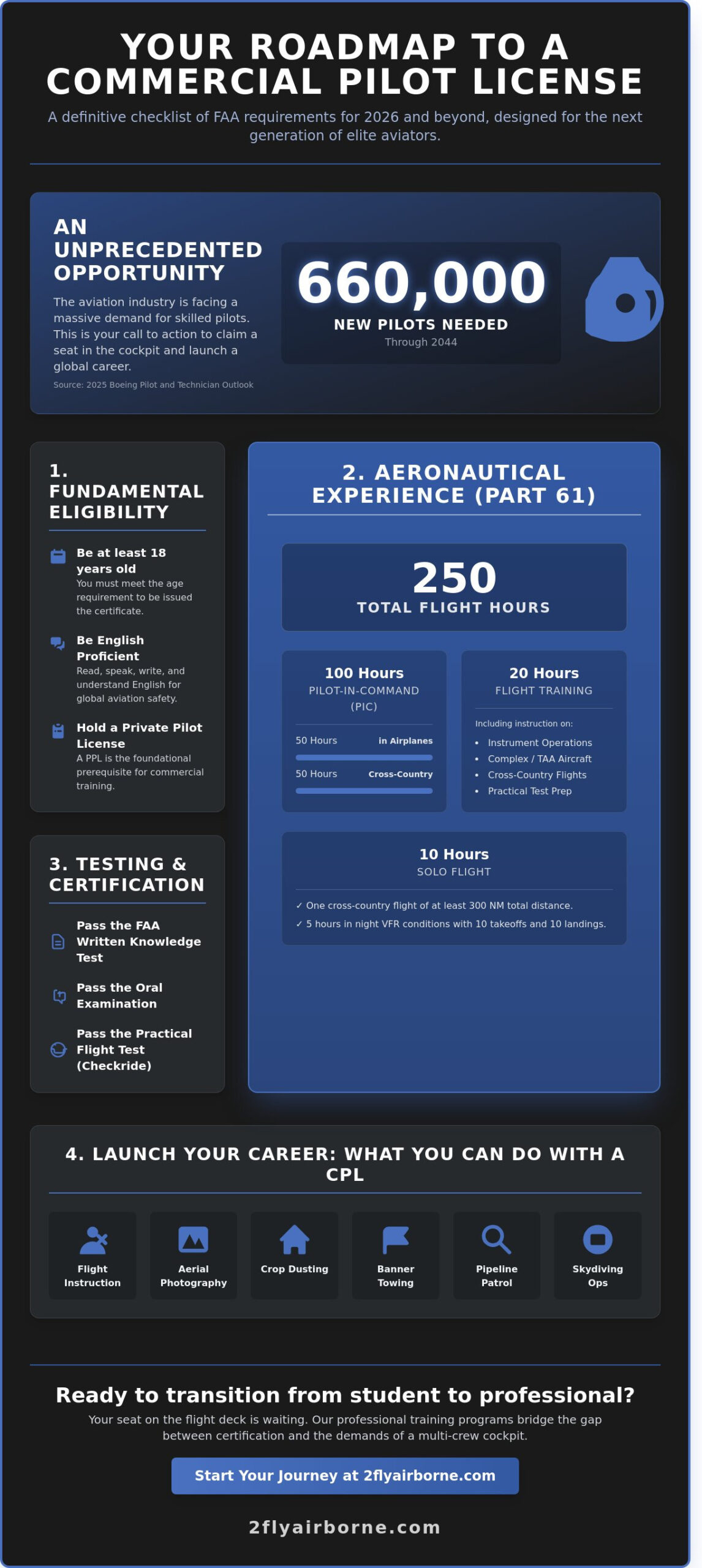
- Break down the Part 61 flight hour checklist, including the 250-hour total time requirement and the 100-hour Pilot-in-Command (PIC) milestone.
- Align your training with global industry demand, noting the 2025 Boeing Pilot and Technician Outlook’s projection of 660,000 new pilots needed through 2044.
- Learn how to transition from a newly licensed pilot to an airline-ready professional by securing the critical ratings needed for elite career placement.
Understanding the Commercial Pilot Certificate: Privileges and 2026 Outlook
Getting your Commercial Pilot Certificate (CPL) marks the definitive transition from hobbyist to professional. It’s the legal threshold for anyone seeking a career in the skies. Unlike a private pilot, a commercial pilot can act as pilot-in-command for compensation or hire. This means you can finally get paid for your time in the cockpit. Understanding the FAA pilot certification requirements is the first step toward this goal. You aren’t just learning to fly; you’re learning to operate as a disciplined professional within a highly regulated global industry.
The CPL is distinct from the Airline Transport Pilot (ATP) certificate. While the ATP is the highest level of certification required for scheduled airlines, the CPL is your professional foundation. It’s where you master precision, advanced maneuvers, and commercial regulations. You’ll use this license to build the flight hours necessary for the major carriers. It’s a critical phase where you transition from basic aircraft control to managing complex systems and commercial operations with the confidence of an industry leader.
To better understand how these requirements fit into your career path, watch this helpful video:
What Can You Actually Do with a CPL?
Earning a CPL opens doors to several vital entry-level roles. You can work in flight instruction, aerial photography, or crop dusting. Many pilots start their careers in banner towing, pipeline patrol, or skydiving operations. In the eyes of the FAA, compensation or hire means you’re receiving anything of value, like money or even free flight time, in exchange for your services. This license is a mandatory stepping stone for any ambitious aviator. It proves you have the technical skill to handle complex aircraft and the judgment to carry passengers or cargo safely for profit.
The Global Demand for Airline-Ready Pilots
The aviation industry is facing an unprecedented need for talent. The 2025 Boeing Pilot and Technician Outlook projects a demand for 660,000 new qualified pilots through 2044. This isn’t just a statistic; it’s a call to action for the next generation of elite aviators. Meeting the minimum commercial flying license requirements is just the beginning. In a competitive market, airlines prioritize candidates who are airline-ready. High-quality professional training programs accelerate this transition. They bridge the gap between basic certification and the rigorous demands of a multi-crew flight deck. If you’re ready to lead, speak with a training advisor at 2FLY Airborne for personalized guidance on your professional journey.
Fundamental Eligibility: The Basic Prerequisites for Professional Aviators
The journey to the flight deck begins with meeting strict federal standards. According to the 2025 Boeing Pilot and Technician Outlook, the industry requires 660,000 new qualified pilots through 2044. To join this elite workforce, you must first clear the fundamental eligibility hurdles. You can take the commercial knowledge test at 17, but you must be at least 18 years old to hold the certificate itself. English proficiency is a non-negotiable safety standard. You need to read, speak, write, and understand the language with total clarity to ensure safety in global airspace.
Before you can sit for your checkride, you must hold a Private Pilot License (PPL). The legal framework for these commercial flying license requirements is found in 14 CFR Part 61 Subpart F, which dictates the specific aeronautical experience you’ll need. Security is equally vital. Student pilots undergo TSA background checks and must provide proof of citizenship or flight training authorization before their first lesson. This ensures the integrity of the pilot pipeline from day one.
FAA Medical Certificate Standards
Professional pilots generally choose between a First-Class or Second-Class medical certificate. While a Second-Class certificate is the minimum for commercial privileges, we recommend securing a First-Class medical early. This ensures you meet the physical standards required for major airline operations before investing in your training. If you have a disqualifying condition, don’t assume your career is over. The FAA’s Statement of Demonstrated Ability (SODA) process allows you to prove you can fly safely despite certain medical limitations. This path has helped many dedicated aviators overcome historical barriers to entry.
Educational and Administrative Readiness
Most training paths require a high school diploma or GED as a baseline. While not always mandatory for the license itself, many pilots pursue a degree program with airline pilot training
Aeronautical Experience: The Flight Hour Requirements Checklist
The path to the flight deck is paved with logged hours and proven skill. According to the 2025 Boeing Pilot and Technician Outlook, the global industry requires 660,000 new qualified pilots through 2044. Meeting the commercial flying license requirements is your first major step toward joining this elite group. Under FAA Part 61 regulations, you must accumulate a minimum of 250 total flight hours. This isn’t just about time in the air; it’s about specific, high-quality experience that builds professional competency.
Your logbook must show 100 hours of Pilot-in-Command (PIC) time. This demonstrates you can handle the ultimate responsibility of the aircraft. Within those hours, you need 50 hours of cross-country flight time, with at least 10 of those hours performed as PIC. You also need 20 hours of training in specific areas, including 10 hours of instrument training to ensure you can navigate safely by reference to instruments alone. This AOPA Commercial Pilot Certificate guide provides a detailed look at how these hours translate to the real-world skills required for certification.
The Part 61 vs. Part 141 Distinction
Aspiring professionals often choose between Part 61 and Part 141 training environments. While Part 61 requires 250 hours, Part 141 schools follow a more rigid, FAA-approved syllabus that can reduce the total requirement to just 190 hours. For those aiming for a rapid career start, an FAA Airline Pilot Program offers a structured environment designed to move you through these milestones efficiently. This path is often the preferred route for high-achievers who value a disciplined, classroom-style setting to reach the airlines as quickly as possible.
Specific Commercial Flight Maneuvers
Commercial candidates must master advanced aircraft handling through specific training blocks. You’re required to log 10 hours of training in either a complex airplane or a Technically Advanced Aircraft (TAA). A TAA must include a primary flight display, a multifunction display, and a two-axis autopilot. One of the most rigorous commercial flying license requirements is the “Long Cross-Country” flight. This involves a solo trip of at least 300 nautical miles total distance, with landings at three points and one leg of at least 250 nautical miles. Additionally, you must complete 5 hours of night flying, including 10 takeoffs and landings at an airport with an operating control tower to prove your proficiency in busy airspace.
These requirements ensure you’re ready for the high standards of professional aviation. If you’re ready to begin your journey to the flight deck, contact a 2FLY Airborne training advisor for personalized guidance on your professional pilot career.
Testing and Knowledge: Mastering the FAA Standards
Transitioning from a private pilot to a professional requires a fundamental shift in mindset. You’re no longer flying for personal recreation; you’re flying for hire. This shift is codified in the FAA standards. Meeting the commercial flying license requirements means proving you can operate with the precision and reliability of an airline captain. According to the 2025 Boeing Pilot and Technician Outlook, the global industry needs 660,000 new qualified pilots through 2044. To join this elite group, you must first conquer the Commercial Pilot Knowledge Test. This computer-based exam consists of 100 multiple-choice questions. You have three hours to complete it. A passing score is 70%, but top-tier candidates aim for 90% or higher to demonstrate total command of the material to future employers.
Aeronautical Knowledge Areas
Ground school provides the theoretical framework for your professional career. It’s a rigorous deep dive into advanced aerodynamics and the mechanics of high-performance aircraft systems. Federal Aviation Regulations (FARs) take on new meaning here, specifically those governing commercial operations under Parts 61, 91, and 135. You’ll also master Crew Resource Management (CRM) and Aeronautical Decision Making (ADM). These skills allow you to manage complex cockpit environments and mitigate risks before they become emergencies. Your flight instructor must provide a signed endorsement certifying you’ve completed this training before you can sit for the official FAA exam.
The Practical Flight Test Breakdown
The checkride is the final hurdle in your journey. It’s a two-part evaluation conducted by a Designated Pilot Examiner (DPE). First, you’ll face a rigorous oral exam. Expect the DPE to challenge your knowledge of weather theory, cross-country planning, and aircraft limitations for several hours. Once you pass the oral portion, you’ll head to the flight deck. The flight portion focuses on mastery and “smoothness.” You must perform advanced maneuvers with surgical precision. This includes Power-off 180-degree accuracy landings, Chandelles, and Lazy Eights. The Airman Certification Standards (ACS) define the exact tolerances you must maintain. For a commercial pilot, there’s little room for error. You’re expected to stay ahead of the airplane at all times. Preparation is the only way to ensure success on this high-stakes day.
Becoming an airline-ready professional starts with the right mentorship and a structured path. If you’re ready to master these standards and launch your global career, speak with a training advisor about the FAA Airline Pilot Program today.
Beyond the License: Transitioning to an Airline Career
Earning your certificates is a monumental achievement, but meeting the initial commercial flying license requirements is just the beginning of your professional development. In the aviation industry, a Commercial Pilot License (CPL) is often described as a “license to learn.” It grants you the legal right to fly for compensation, yet the transition to a jet cockpit requires a higher level of technical mastery and psychological readiness. You’re moving from a training environment into a high-stakes corporate world where safety and precision are the only benchmarks for success.
Most commercial operations require a Multi-Engine Rating. This qualification allows you to command aircraft with more than one engine, a fundamental necessity for nearly every airline role. Once you’ve secured this rating, the focus shifts to building the 1,500 flight hours required for an Airline Transport Pilot (ATP) certificate. Many cadets choose the Certified Flight Instructor (CFI) path to reach this milestone. Teaching others doesn’t just build hours; it forces you to master every nuance of flight theory and maneuvers, making you a much sharper pilot when you finally sit for an airline interview. For those with ambitions to fly for a major carrier, our detailed United Airlines pilot career guide outlines the exact certifications, flight hour thresholds, and strategic training pathways required to reach the flight deck of one of the world’s largest carriers.
The 2FLY Airline-Ready Philosophy
Our FAA First Officer Program is designed to bridge the gap between basic flight training and professional employment. We prioritize the development of “soft skills” that airlines value most, including leadership, command presence, and crew resource management. While the commercial flying license requirements provide the legal framework for your career, our program focuses on the professional standards expected by major carriers. The 2025 Boeing Pilot and Technician Outlook projects a demand for 660,000 new qualified pilots through 2044. We ensure you’re ready to meet that demand with the discipline of a veteran aviator.
Financing Your Professional Journey
Investing in your future requires a clear financial strategy and an understanding of long-term returns. Exploring pilot training financing options allows cadets to focus on full-time training, which significantly accelerates the timeline to employment. The return on investment in today’s market is compelling, as airlines continue to offer competitive salaries and benefits to secure elite talent. We encourage you to take the next step in your career by contacting a 2FLY training advisor. Our team will help you build a personalized timeline and budget, ensuring you move from the classroom to the flight deck with confidence and clarity.
Launch Your Career as a Global Airline Pilot
Navigating the transition from student to professional requires a clear understanding of the commercial flying license requirements and a commitment to technical excellence. You’ve now reviewed the core prerequisites, the aeronautical experience milestones, and the rigorous testing standards established by the FAA. These benchmarks are the foundation of a safe career. The timing is ideal for dedicated aviators. The 2025 Boeing Pilot and Technician Outlook projects a global demand for 660,000 new qualified pilots through 2044. This massive growth creates an unprecedented window for those ready to begin their journey.
2FLY Airborne provides structured FAA Part 141 training paths designed to move you efficiently from the classroom to the cockpit. Our global recruitment network focuses on your end goal: becoming an airline-ready professional. Don’t leave your future to chance when you can train with an industry leader. It’s time to take the first step toward your seat on the flight deck. The sky isn’t the limit; it’s your workplace. Let’s get your career off the ground together.
Speak with a 2FLY Training Advisor to start your commercial journey
Frequently Asked Questions
How many hours are required for a commercial pilot license?
Under FAA Part 61 regulations, you need a minimum of 250 flight hours to earn your certificate. This total includes 100 hours of pilot-in-command time and 50 hours of cross-country flight. Meeting these commercial flying license requirements is a vital milestone in your professional journey. The 2025 Boeing Pilot and Technician Outlook projects a global demand for 660,000 new pilots through 2044, so every hour you log brings you closer to an elite career.
What is the difference between a private and commercial pilot license?
The primary distinction is your legal ability to fly for compensation or hire. A private pilot certificate allows you to fly for personal enjoyment or business travel, but you can’t be paid for your services. A commercial license transforms your passion into a professional career. It requires higher precision, more advanced maneuvers, and a deeper understanding of complex aircraft systems. You’ll move from being a recreational flyer to an airline-ready professional.
Do I need a college degree to be a commercial pilot?
You don’t need a college degree to obtain a commercial pilot license from the FAA. While many major airlines historically preferred a four-year degree, many have updated their hiring criteria to address the need for 660,000 new pilots through 2044. Technical proficiency and flight experience are the most critical factors for entry-level roles. You can focus on your flight training now and pursue a degree later if your career goals include management or specific legacy carriers.
Can I get a commercial pilot license with a medical condition?
You can often earn your license even with a medical condition, provided you can secure an FAA Second-Class Medical Certificate. An Aviation Medical Examiner will assess your vision, hearing, and cardiovascular health to ensure you meet safety standards. If you have a specific health history, you might qualify through a special issuance or a Statement of Demonstrated Ability. We encourage you to speak with a 2FLY Airborne training advisor to discuss how to navigate the medical certification process.
How much does it cost to meet the commercial pilot requirements?
The total investment depends on your current flight experience and how quickly you progress through the syllabus. Costs typically cover aircraft rental, instructor time, fuel, and examiner fees. Because every student’s path to the flight deck is different, we don’t provide a single fixed price. Instead, contact 2FLY Airborne for a personalized consultation. Our advisors will help you understand the resources required to meet all commercial flying license requirements and launch your global aviation career.
How long does it typically take to earn a commercial pilot certificate?
Most full-time students complete their training within 6 to 12 months. Your specific timeline will depend on your flight frequency, local weather patterns, and how quickly you master the commercial maneuvers. Accelerated programs are designed to keep you moving at a professional pace. By staying disciplined and following a structured training syllabus, you’ll minimize downtime and reach your career goals faster. Consistency is the key to becoming an airline-ready pilot.
Is there an age limit for becoming a commercial pilot?
You must be at least 18 years old to hold a commercial pilot certificate, but there’s no upper age limit for starting your training. While the mandatory retirement age for Part 121 airline pilots is currently 65, other sectors like cargo and charter often have more flexibility. The industry requires 660,000 new qualified pilots through 2044. This means there’s a significant window of opportunity for dedicated individuals to build a successful career regardless of when they start. For a complete chronological breakdown of every step from beginner to airline-ready professional, our step-by-step guide on how to become a commercial pilot walks you through the exact regulatory and educational milestones you need to reach the flight deck.
What is the “300-nautical-mile” cross-country requirement?
This is a mandatory solo flight that tests your ability to manage long-distance navigation and multiple landings. You must fly a total distance of at least 300 nautical miles with landings at a minimum of three points. One leg of the journey must consist of a straight-line distance of at least 250 nautical miles from the original departure point. It’s a challenging mission that prepares you for the rigors of professional cross-country flight operations in a global environment.
Article by
2FLY Airborne
2Fly Airborne is a professional flight training organization dedicated to developing the next generation of skilled, confident, and safety-focused pilots. With decades of combined aviation experience, our team of certified instructors provides structured, real-world training designed to prepare students for both checkrides and long-term success in the aviation industry.
Content Disclaimer
Some blog content is generated with the assistance of automated tools and may not always be fully accurate or up to date. Please verify all aviation-related information with official sources or a certified instructor. For additional guidance or clarification, we encourage you to contact one of our training advisors at 2Fly Airborne.