
Your success in the cockpit is determined long before you ever clear the runway for takeoff. It starts with how you internalize the foundational principles of flight. Most student pilots feel buried under technical jargon, yet the 2025 Boeing Pilot and Technician Outlook confirms that 660,000 new qualified pilots are needed through 2044. This massive demand means there’s no time for inefficient study habits. You’ve likely opened the airplane flying handbook and felt overwhelmed by its dense chapters. It’s common to struggle with connecting those diagrams to the physical sensations of a steep turn or a short-field landing.
We understand that you want to move from a student permit to a commercial pilot license with precision and confidence. This guide clarifies the manual’s structure so you can focus on the most critical maneuvers for your early training. You’ll discover how to effectively use the FAA’s primary text to master flight maneuvers and accelerate your journey to the commercial flight deck. We’ll outline exactly how to bridge the gap between the page and the plane. This sets the stage for you to become an airline-ready professional with a global perspective.
Key Takeaways
- Master the official FAA primary resource to build the technical foundation necessary for your journey from student pilot to the commercial flight deck.
- Learn how to effectively utilize the airplane flying handbook to perfect basic flight maneuvers and master critical energy management principles.
- Understand the vital distinction between the AFH and the PHAK to ensure you are applying the right technical knowledge at every stage of your training.
- Discover strategic study habits and visualization techniques designed to transform manual instructions into practical, checkride-ready cockpit skills.
- Position yourself for a global career by aligning your training with the industry demand for 660,000 new pilots identified in the 2025 Boeing Outlook.
What is the FAA Airplane Flying Handbook (FAA-H-8083-3C)?
The airplane flying handbook is the definitive technical manual published by the Federal Aviation Administration. It serves as the primary resource for every maneuver you’ll perform in the cockpit, from your first discovery flight to your commercial checkride. While an Aircraft Flight Manual provides specific operating data for a single tail number, the AFH establishes the universal standards for safe and proficient flight across the industry.
Aspiring aviators often call this text the “Bible” of flight training. It covers the entire spectrum of pilot operations, including ground operations, takeoffs, climbs, and emergency procedures. As the industry prepares for the massive demand highlighted in the 2025 Boeing Pilot and Technician Outlook, which projects a need for 660,000 new qualified pilots through 2044, mastering these fundamentals is your first step toward an elite global career.
To better understand the core concepts found in this manual, watch this helpful introductory video:
Standards for 2026 don’t change the laws of physics. The core principles of lift, weight, thrust, and drag remain constant, which is why the FAA continues to rely on these established principles. This handbook provides the practical “how-to” that supports the Airman Certification Standards (ACS). The ACS defines the metrics for your checkride, but the AFH provides the step-by-step instructions to meet those high standards. If the ACS requires you to maintain a heading within 10 degrees, this manual explains exactly how to coordinate your rudder and ailerons to achieve that precision.
The Purpose of the AFH in Modern Flight Training
Modern training at professional academies focuses on creating airline-ready professionals. The AFH facilitates this by standardizing flight procedures across all US-based flight centers. It helps you transition from the theoretical knowledge of ground school to the practical, hands-on control of the airplane. By following these standardized methods, you build a foundation of safety and proficiency that is essential for future commercial aviators. You’ll learn to translate abstract aerodynamic concepts into confident, disciplined actions on the flight deck.
Who Should Prioritize Reading the AFH?
Every student pilot needs to study this manual before their first solo or private pilot checkride. It’s also vital for certified pilots transitioning to complex, multi-engine, or jet-powered aircraft. Even experienced Flight Instructors (CFIs) use the airplane flying handbook as the official standard for teaching specific maneuvers. Success in professional aviation requires a commitment to these rigorous standards. If you’re ready to take the first step toward your goals, speak with a training advisor at 2FLY Airborne for personalized guidance on your career path.
Key Chapters and Core Competencies for Professional Pilots
The airplane flying handbook isn’t just a manual for passing a checkride. It’s the blueprint for a lifelong career in the cockpit. To reach the standards required by major carriers, you must move beyond surface-level reading and master the core competencies found in these specific chapters. Each section builds the technical foundation necessary to handle the sophisticated environments described in the 2025 Boeing Pilot and Technician Outlook, which forecasts a global demand for 660,000 new qualified pilots through 2044.
- Chapter 3: Basic Flight Maneuvers. These are the building blocks of every flight. You’ll learn to integrate straight-and-level flight, turns, climbs, and descents into a seamless display of aircraft control.
- Chapter 9: Approaches and Landings. This chapter focuses on mastering the most challenging phase of flight. Precision here separates the student from the professional.
- Chapter 13: Transition to Multiengine Airplanes. This serves as your bridge to professional airline careers. It covers the critical performance factors and emergency procedures unique to multiengine operations.
A deep dive into the Official FAA Airplane Flying Handbook ensures you develop the muscle memory and theoretical knowledge required for high-stakes environments. If you’re ready to turn these chapters into real-world skills, our FAA Airline Pilot Program provides the structured environment you need to succeed.
Mastering Energy Management and Aircraft Control
Chapter 4 introduces energy management, a critical concept for modern aircraft safety. You’ll learn to balance altitude, airspeed, and power settings to maintain the desired flight path. The airplane flying handbook teaches these principles to help pilots master Upset Prevention and Recovery Training (UPRT). By applying energy management correctly, you can effectively avoid Loss of Control In-flight (LOC-I) incidents. These skills are vital when operating at the edges of the flight envelope or during unexpected atmospheric disturbances.
Transitions: From Light Sport to Jet-Powered Aircraft
The handbook plays a pivotal role in helping you move up the career ladder. Transitioning from a light trainer to a commercial aircraft requires an understanding of increased weight, higher speeds, and different handling characteristics. You’ll move from simple systems to complex environments where decision-making speed is paramount. According to FAA-H-8083-3C standards, a complex aircraft is defined as an airplane that has a retractable landing gear, flaps, and a controllable pitch propeller, or is turbine-powered. Mastering these systems early prepares you for the rigorous training cycles found at major airlines.
Success in aviation requires more than just hours in the logbook. It demands a disciplined approach to technical study. For personalized guidance on how to navigate these requirements, speak with a 2FLY Airborne training advisor today.
AFH vs. PHAK: Navigating the FAA Primary Training Manuals
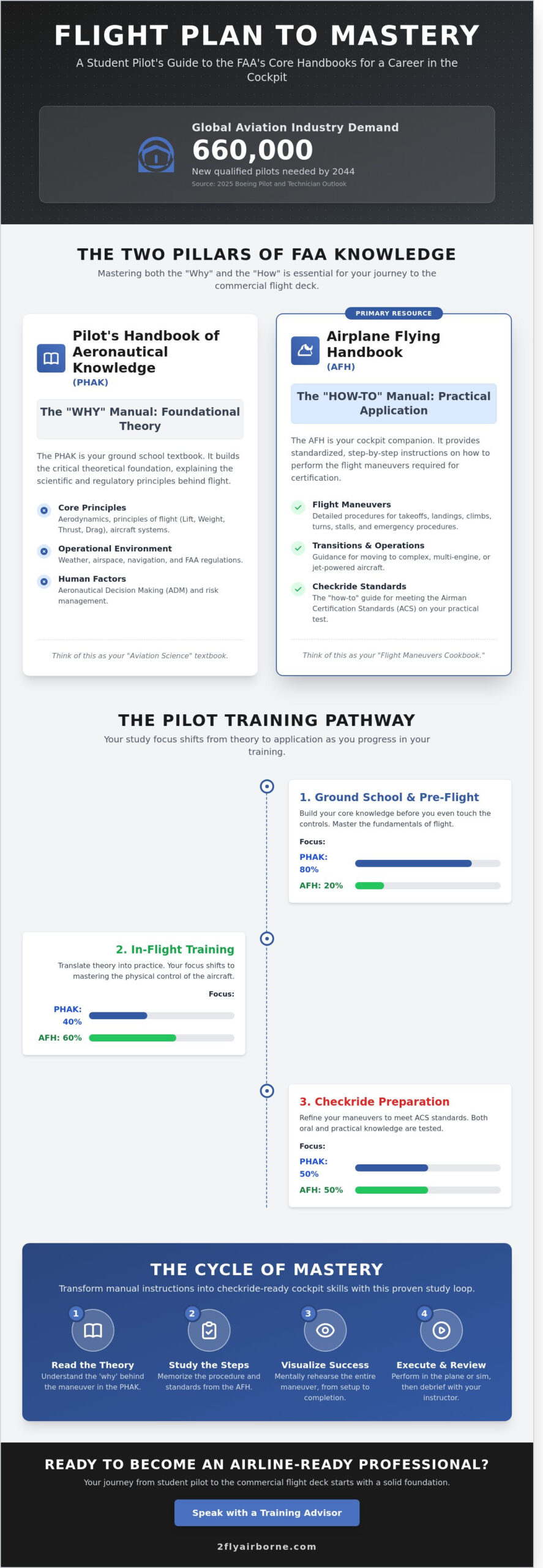
Every student pilot eventually faces two massive FAA volumes: the Pilot’s Handbook of Aeronautical Knowledge (PHAK) and the airplane flying handbook. While they look similar on a tablet, they serve distinct roles in your development as an airline-ready professional. The PHAK focuses on the “why,” providing the scientific and regulatory foundation of flight. The airplane flying handbook is the “how,” acting as a step-by-step guide for every maneuver you’ll perform in the cockpit.
Elite training programs, such as our FAA Professional Pilot Program, demand mastery of both texts. This isn’t just about passing a checkride; it’s about building the competency required for a long-term career. The 2025 Boeing Pilot and Technician Outlook projects a global demand for 660,000 new pilots through 2044. Meeting that demand requires a disciplined approach to technical study from your very first hour of ground school.
Theory vs. Technique: When to Reach for Each Book
Reach for the PHAK when you need to understand weather patterns, air traffic control logic, or the physics of high-speed aerodynamics. It builds the mental framework of an aviator. Conversely, use the airplane flying handbook for the physical mechanics of flight. This includes mastering steep turns, recovering from stalls, or executing eights-on-pylons. During oral exams, examiners often test your ability to bridge these resources. You might explain the theory of a stall using the PHAK and then detail the recovery procedure using the AFH. Mastery of both ensures you’re prepared for any scenario.
Integrated Study Methods for Rapid Progression
Don’t read these manuals cover-to-cover in isolation. Instead, align your reading with your flight syllabus. If your next lesson covers traffic patterns or landings, study the corresponding chapters in both books simultaneously. Understanding Visual Flight Rules (VFR) flight procedures is the first step in AFH mastery. This integrated method ensures you don’t just memorize facts but apply them in the cockpit. This structured approach helps you move through your ratings with greater confidence and efficiency.
Aviation standards and best practices are subject to change, so you should always verify you’re using the most current editions of these manuals. For personalized guidance on how to structure your training for maximum success, speak with a 2FLY Airborne training advisor today.
How to Study the Airplane Flying Handbook for Your Checkride
Success on checkride day requires more than rote memorization. It demands a strategic approach to the airplane flying handbook that aligns with your specific stage of training. Elite pilots don’t just read; they analyze. If you’re in the pre-solo phase, focus your energy on ground operations and basic maneuvers. As you progress toward your commercial certificate, shift your focus to complex systems and high-performance maneuvers. This targeted study ensures you’re building the mental framework necessary to join the 660,000 new pilots needed by 2044, according to the 2025 Boeing Pilot and Technician Outlook.
Visualization is your most powerful tool. As you read the FAA’s step-by-step instructions, close your eyes and walk through the cockpit flow. Match the AFH’s general procedures with the specific airspeeds and power settings found in your aircraft’s Pilot Operating Handbook (POH). The AFH provides the “why” and the “how,” while the POH provides the specific numbers for your tail number. You should also cross-reference every chapter with the Airman Certification Standards (ACS). The ACS tells you the testing tolerances, while the handbook explains how to stay within them. Pay close attention to “Special Emphasis Areas” like runway incursion avoidance and stall awareness, as these are high-priority items for every examiner.
- Phase-Based Reading: Don’t read the book cover-to-cover in one sitting; study the chapters that match your next three flight lessons.
- Procedural Comparison: Identify where your flight school’s Standard Operating Procedures (SOPs) might be more restrictive than the AFH.
- ACS Integration: Use the AFH to find the solution for every “Knowledge” and “Risk Management” task listed in the ACS.
From Ground School to the Flight Line
Bridging the gap between theory and the cockpit requires deliberate practice. Use flight simulators to execute procedures found in the airplane flying handbook in a risk-free environment, allowing you to perfect your configuration changes before burning fuel. This builds the muscle memory needed for high-stakes maneuvers. A stabilized approach is the foundation of every safe landing, requiring constant airspeed, descent rate, and flight path alignment before reaching your final approach gate. Mastering this concept early separates the amateurs from the professionals. To better understand what each training flight session looks like in practice and how each lesson builds toward your commercial career, review the full breakdown of the professional aviation instruction experience.
Preparing for the Oral Examination
The oral portion of the checkride tests your ability to apply FAA standards to real-world scenarios. Examiners often pull questions directly from the AFH regarding safety margins and emergency procedures. You must be ready to explain the aerodynamic factors behind a power-on stall or the recovery steps for an accelerated stall. During a checkride dispute, the AFH serves as the final authority. If your technique is questioned, citing the official handbook demonstrates professional discipline and deep technical knowledge. Prepare to be the expert the industry demands.
Beyond the Manual: Professional Flight Training in 2026
Mastering the fundamentals within the airplane flying handbook isn’t just a requirement for a checkride. It’s the first step toward joining a high-stakes global industry that demands absolute precision. The aviation world is facing a historic shift. According to the 2025 Boeing Pilot and Technician Outlook, the industry will require 660,000 new qualified pilots through 2044. This massive demand means airlines aren’t just looking for people who can fly; they’re looking for elite professionals who can lead.
Elite flight schools emphasize AFH fundamentals because they form the basis of a long-term career. Every steep turn and power-off stall you practice today builds the muscle memory and situational awareness needed for tomorrow’s commercial flight deck. You aren’t just learning to control a small trainer. You’re developing the technical foundation that global carriers expect from their first officers. Success in this field requires a transition from a student mindset to a professional one. This starts by treating the airplane flying handbook as a professional standard rather than just a textbook. If you want a comprehensive overview of what this journey looks like in today’s industry, explore our guide on pilot training in 2026 and the professional path to a commercial aviation career.
The Path to a Global Airline Career
Airlines don’t just hire pilots; they hire disciplined decision-makers. Mastering the AFH leads to significantly higher success rates in airline interviews and simulator evaluations. When you can explain the physics of a turn or the mechanics of a landing with technical accuracy, you demonstrate “airline-ready” potential. This professional discipline begins the moment you step onto the flight line. For those who want to combine this technical mastery with a formal education, the Degree Program with Airline Pilot Training provides a structured path to the cockpit. It’s designed for high-achievers who value both technical skill and career longevity.
Choosing a Professional Training Environment
Your training environment dictates your career trajectory. You need a syllabus that doesn’t cut corners and utilizes official FAA resources to the fullest. 2FLY Airborne mentors cadets through the complexities of FAA regulations, ensuring every maneuver meets commercial standards. Our FAA First Officer Program is specifically built to bridge the gap between basic flight training and the demands of a professional airline career. We focus on the granular details that make the difference during a career-defining checkride. Don’t wait for the future to happen. Contact a training advisor today to start your journey toward a global career in the sky.
Take Command of Your Professional Pilot Career
Mastering the airplane flying handbook is about more than passing a checkride. It’s the first step in building the technical discipline required for a seat on a commercial flight deck. By understanding the nuances between the AFH and the PHAK, you’ve established a foundation that meets the highest industry expectations. This technical proficiency is your ticket into a rapidly expanding global market. You’ve learned how to study effectively for 2026 and how to move beyond the manual into real-world application.
The 2025 Boeing Pilot and Technician Outlook highlights a critical demand for 660,000 new pilots through 2044. At 2FLY Airborne, we bridge the gap between student training and professional employment through elite FAA and EASA standards. Our global network of airline recruitment partners looks for candidates who aren’t just licensed but are truly airline-ready. You have the ambition, and we provide the structured, world-class environment needed to reach your goals.
Success in aviation requires a proactive mindset and a clear flight plan. Speak with a 2FLY Training Advisor to launch your aviation career and transform your passion for flight into a lifelong profession. We’re ready to help you navigate the path to becoming a global pilot.
Frequently Asked Questions
Is the Airplane Flying Handbook (FAA-H-8083-3C) the most current version?
Yes, FAA-H-8083-3C is the latest official revision of the airplane flying handbook, published by the FAA in 2021. This version remains the primary standard for flight training through 2026. It replaces the older 3B edition and includes essential updates on safety and modern maneuvers. You can verify current versions on the FAA website to ensure your study materials meet the latest regulatory requirements.
Can I use the Airplane Flying Handbook for EASA pilot training?
You can use this manual as a supplemental resource for EASA training, though it’s primarily designed for FAA certification. Aerodynamics and basic flight maneuvers don’t change across borders. However, EASA students must prioritize their specific syllabus and regional regulations. Using both resources helps you become a global pilot, which is vital as the 2025 Boeing Pilot and Technician Outlook predicts a demand for 660,000 new pilots through 2044.
How much of the Airplane Flying Handbook do I need to memorize?
You don’t need to memorize the entire manual word for word. Focus your energy on understanding the “why” behind flight maneuvers and mastering the step by step procedures. Memorize critical safety items like emergency checklists and airspeeds, but use the text to build a deep conceptual foundation. This approach ensures you’re career-ready rather than just prepared for a single exam.
What is the difference between the AFH and the Airman Certification Standards (ACS)?
The AFH provides the instructional “how-to” for flying, while the Airman Certification Standards (ACS) define the “how well” for your checkride. Think of the text as your primary textbook and the ACS as your final exam rubric. You’ll use the handbook to learn maneuvers like steep turns and the ACS to understand the specific altitude and heading tolerances required to pass your pilot certifications.
Is there a digital version of the Airplane Flying Handbook available?
A free digital version of the airplane flying handbook is available for download directly from the FAA official website. Most students prefer the PDF version because it allows for quick keyword searches and easy access on tablets in the cockpit. These digital files are updated by the FAA whenever revisions occur, ensuring you always have access to the most recent safety data and training techniques.
How does the AFH address modern glass cockpit technology?
The current manual includes dedicated sections covering electronic flight displays and automated systems found in modern glass cockpits. It transitions from traditional “round dial” instruments to the advanced avionics you’ll use in a professional aviation career. Mastering these systems is vital, as the industry continues to move toward highly integrated flight decks. This training ensures you’re prepared for the technical demands of 21st-century commercial flying.
Can I buy a hard copy of the Airplane Flying Handbook?
You can purchase a printed hard copy of the manual from major aviation retailers like ASA, Gleim, or Amazon. Many cadets find that a physical book is easier for highlighting and annotating during ground school sessions. While the digital version is convenient for travel, a high-quality printed manual serves as a reliable reference on your desk as you work toward your commercial pilot license.
What should I do if my flight instructor’s technique differs from the AFH?
You should prioritize the techniques outlined in the manual, but always discuss differences with your flight instructor. Instructors sometimes adapt methods for specific aircraft types or local environmental conditions. If a conflict arises, ask your mentor to explain the reasoning behind their technique. For personalized guidance on mastering these standards, contact 2FLY Airborne to speak with a professional training advisor today.
Article by
2FLY Airborne
2Fly Airborne is a professional flight training organization dedicated to developing the next generation of skilled, confident, and safety-focused pilots. With decades of combined aviation experience, our team of certified instructors provides structured, real-world training designed to prepare students for both checkrides and long-term success in the aviation industry.
Content Disclaimer
Some blog content is generated with the assistance of automated tools and may not always be fully accurate or up to date. Please verify all aviation-related information with official sources or a certified instructor. For additional guidance or clarification, we encourage you to contact one of our training advisors at 2Fly Airborne.