
The dream of commanding a commercial flight deck shouldn’t stall because of your passport or your bank balance. You’ve likely found that most traditional lenders hesitate when they see an M-1 or F-1 visa designation. It’s a common frustration to possess the drive for an aviation career but lack the local credit history required by domestic banks. We recognize that securing flight school loans for international students is the primary bridge to achieving global professional mobility.
This guide will show you how to navigate these financial complexities and secure the funding necessary for your professional pilot training. You’ll identify specific lenders that cater to international candidates and understand the nuances of visa-based financing requirements. We’ll also outline how to construct a realistic financial plan for your 12 to 18 month training syllabus. This journey begins with a clear vision of your future and ends with the technical mastery of the skies.
Key Takeaways
- Understand why US-based training is considered the global benchmark for professional mobility and how it positions you for a worldwide aviation career.
- Identify the specialized flight school loans for international students that bridge the gap when traditional domestic financing is unavailable.
- Learn how your M-1 visa status directly impacts loan disbursement and why timing your application is critical for a seamless enrollment.
- Discover the step-by-step process for building a merit-based application using your academic and professional history to secure favorable lending terms.
- Explore how partnering with an established academy provides the institutional support needed to navigate the complexities of international pilot financing.
Navigating the Financial Skies: Why International Students Seek US Flight Training
Imagine sitting in a classroom in Dubai or London, calculating the years it will take to save for a local flight program. The numbers often don’t add up, leaving many talented candidates grounded before they ever reach the cockpit. Choosing to train in the United States is a strategic move that aligns your skills with the highest global standards.
It’s about more than just flying; it’s about securing a credential that carries weight in every major aviation hub. Achieving various FAA pilot certification levels is widely regarded as the definitive gateway to an international career. This path ensures your training meets the rigorous expectations of the world’s leading airlines.
To better understand the landscape of aviation funding, watch this helpful video. It outlines the primary financing strategies used by candidates entering professional training programs.
The Global Demand for FAA-Certified Pilots
FAA licenses are the gold standard for a reason. Airlines across the globe respect the rigorous standards and the high-traffic experience gained in American airspace. Training in the U.S. ensures you are proficient in aviation English, which is the official language of international flight. To further prepare for a truly global career, many candidates also invest in learning additional languages through online programs provided by Lingua Learn Vietnam.
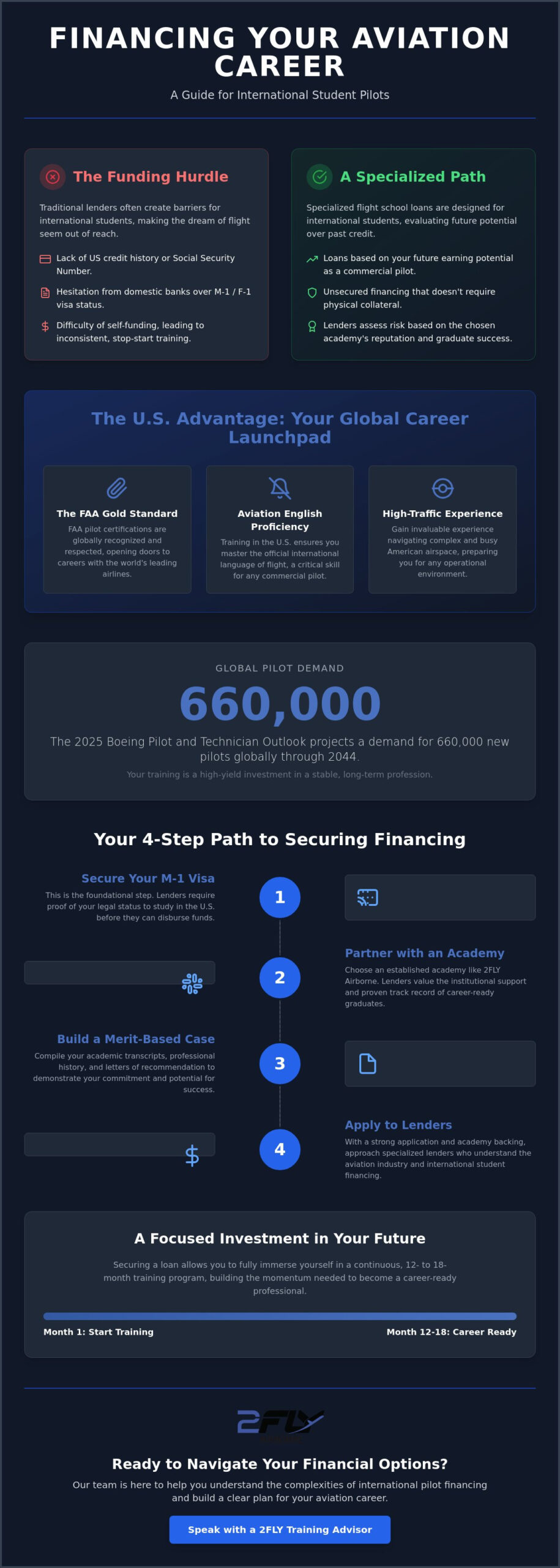
The 2025 Boeing Pilot and Technician Outlook projects a demand for 660,000 new pilots globally through 2044. This massive requirement means your training is a high-yield investment in a stable, long-term profession. It positions you as a competitive candidate for carriers from Europe to Asia.
The Challenge of Self-Funding International Training
Self-funding an international move and professional flight training is a massive undertaking. To manage the cost of your airfare, you can use FlightLayaway to book your journey and pay in weekly or bi-weekly installments. Relying on personal savings or family contributions often leads to stop-start training. This inconsistency can erode your technical proficiency and significantly delay your career start date.
It’s better to view this as a capital-intensive vocational investment rather than a standard expense. By utilizing specialized flight school loans for international students, you can focus entirely on your studies for 12 to 18 months. This momentum is what separates a student pilot from a career-ready professional.
You can explore various financing resources to determine which structure fits your long-term goals. Lenders look for students who demonstrate a clear path to employment. Your academic background and commitment to a professional syllabus serve as proof of your potential.
When you treat your training like a business venture, you inspire confidence in those providing the capital. This disciplined approach transforms the daunting cost into a manageable step toward an elite career. It ensures that your focus remains on mastering the aircraft rather than worrying about the next tuition payment.
Understanding Loan Options for Non-US Resident Pilot Candidates
Many international candidates believe that without a US Social Security Number, the cockpit remains an unreachable dream. This is a common misconception that stalls many promising careers before they even begin. While traditional domestic banks often restrict their lending to citizens, a specialized market for flight school loans for international students has emerged to serve global talent. These products are specifically designed to accommodate the unique circumstances of non-resident vocational students who are pursuing high-yield aviation careers.
Lenders typically categorize these as unsecured loans, meaning they don’t require physical collateral like property or aircraft. Instead, specialized institutions often evaluate your future earning potential as a commercial pilot. They look at your chosen academy’s reputation and the historical success of its graduates to determine risk. Before you can access these funds, you must meet specific U.S. student visa requirements, as lenders need proof that you are legally authorized to train in the country.
Lenders for Students Without a US Co-signer
Securing funding without a local contact is challenging but possible through merit-based lenders. Organizations like MPOWER Financing and Prodigy Finance have established themselves as vital resources for international aviators in 2026. They analyze your academic history and professional trajectory rather than relying solely on a US credit score. These loans often feature different interest structures, sometimes including fixed rates that account for the risk of lending across borders without a local guarantor.
The Advantage of a US-Based Co-signer
Having a US citizen or permanent resident as a co-signer significantly changes your financial landscape. This connection opens doors to established lenders like Sallie Mae, who offer some of the most competitive terms in the industry. Data indicates that students with a creditworthy co-signer were nearly four times more likely to receive approval for their applications last year. A co-signer provides the lender with a safety net, which typically results in lower interest rates and more flexible repayment options.
If you have family or close professional contacts in the US, explain your career path with total transparency. Show them your training syllabus and long-term employment outlook to build the necessary trust. It’s also helpful to explore the specific financing resources provided by your academy to see which lenders have the strongest relationships with international programs. This proactive approach ensures you’re looking at the most reliable options for your specific situation.
The Role of Visas and Career Path in Securing Financing
Lenders view your visa status as a critical indicator of your ability to complete training and enter the workforce. For most students, the M-1 visa serves as the standard authorization for vocational flight training in the United States. It’s a specific legal designation that signals you’re committed to a full-time, structured program rather than casual lessons. However, you should prepare for a common administrative hurdle: many financial institutions require proof of an approved visa before they’ll release the final disbursement of funds.
Securing flight school loans for international students often depends on your ability to prove a stable legal status in the U.S. A comprehensive FAA Professional Pilot Program often appeals more to lenders than modular training. This is because a structured syllabus provides a clear timeline for completion and a predictable budget. Lenders are more likely to approve funding for a student who has a defined trajectory from zero hours to commercial certification.
Many industry organizations, such as the Aircraft Owners and Pilots Association, provide detailed resources on AOPA flight training loans that include eligibility details for non-citizens. Understanding these nuances early helps you avoid delays in your I-20 processing or SEVIS documentation. Aligning your financial application with your visa timeline is the key to a seamless start in the cockpit.
M-1 vs. F-1 Visa: Financial Implications
The choice between visa types carries significant financial weight. The M-1 visa is strictly for vocational training and doesn’t typically allow for off-campus employment. In contrast, an F-1 visa is usually associated with degree-seeking students at accredited colleges and may offer different loan options or work-study opportunities. We provide extensive support in administrative processing for SEVIS and the necessary documentation to ensure your paperwork aligns with lender expectations.
Time Building and ROI
In the aviation industry, seniority is everything. The sooner you complete your training, the sooner you can begin building the hours necessary for a major carrier position. Finishing your program quickly saves money on living expenses and interest accrual. It’s a strategic move that maximizes your long-term earning potential and accelerates your career progression.
Becoming a Certified Flight Instructor (CFI) is a pivotal step in this process. It allows you to build flight hours while earning a living, providing a direct return on your educational investment. Our FAA First Officer Program is designed as a complete career bridge to move you efficiently from the classroom to the cockpit. This structured path ensures that every dollar spent on training is an investment in your future seniority.
Step-by-Step Guide to Applying for International Flight School Loans
Success in the cockpit begins with meticulous planning on the ground. You should ideally begin your application for flight school loans for international students four to six months before your intended start date. This window allows for the rigorous documentation process and the time required for international background checks. Lenders view your application as a business proposal, so presenting a professional image is vital.
Gathering academic transcripts and a current resume helps prove your merit to potential lenders. They aren’t just looking at numbers; they’re evaluating your discipline and likelihood of completing a demanding syllabus. A formal Letter of Acceptance from your chosen academy is the final piece that validates your intent. This document confirms you’ve met the school’s entry requirements and are ready to begin your professional journey.
Preparing Your Financial Portfolio
Your portfolio serves as the foundation for both your loan approval and your visa application. You’ll need to provide proof of funds to secure your I-20 document, which is the prerequisite for an M-1 visa. A clear, detailed Training Estimate from the school is essential for this step. It provides the lender with a concrete figure for the capital required to complete your program.
Ensure you have the following documents ready for review:
- Valid passport with at least six months of future validity.
- Certified and notarized English translations of all foreign academic records.
- Bank statements from the last three to six months to show financial stability.
- A professional resume highlighting any previous technical or leadership experience.
Finalizing the Loan and Visa Process
Once your preliminary application is approved, the lender will communicate directly with the academy’s admissions department. This coordination ensures that the disbursement of funds aligns with your training milestones. Disbursement typically moves directly from the lender to the school, covering your tuition and related training costs in phases. This structure protects the investment and ensures funds are available exactly when you need them.
If your visa application is denied after loan approval, most specialized lenders will cancel the agreement without penalty. It’s a safety net that allows you to reapply once your documentation is in order. To ensure you have the most current information on available programs, you should explore the financing resources provided by our team. Taking these steps methodically transforms a complex financial hurdle into a manageable part of your career progression.
Maximizing Your Investment with 2FLY Airborne
Since 1994, 2FLY Airborne has served as an expert mentor for international aviators looking to bridge the gap between ambition and the flight deck. We don’t just provide training; we position our students as the definitive gateway to an international career. Our institution understands the rigorous demands of the industry and the specific hurdles faced by non-resident candidates.
Navigating the various financing resources available is significantly easier when you have institutional backing. We help you understand how flight school loans for international students fit into a long-term professional strategy. By aligning your financial plan with our structured training syllabus, you create a roadmap that lenders find credible and secure.
One of the most effective ways to protect your investment is by controlling the “hidden costs” of living abroad. Our on-campus housing options eliminate the volatility of local rental markets and the need for daily commuting expenses. This proximity to the flight line allows for total immersion in the training environment and ensures every hour is dedicated to your progression.
Comprehensive Support for International Students
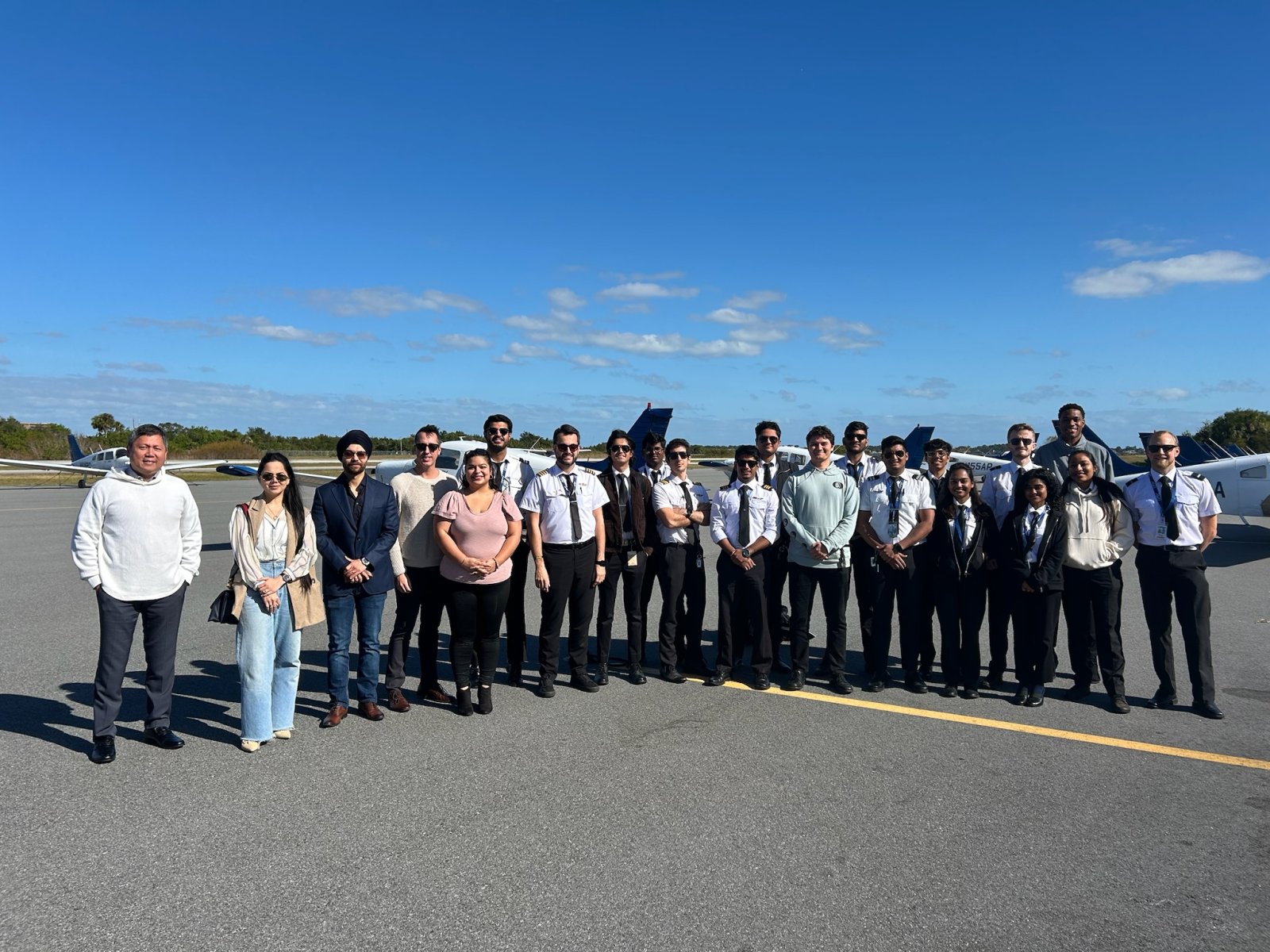
Our global network of recruitment offices provides local support in your home region long before you arrive in Florida. This international perspective ensures that your transition is seamless and that your documentation meets all regulatory standards. We also offer fixed-price structures for specific programs to provide the financial certainty that lenders require.
This predictability is a major advantage when applying for flight school loans for international students, as it eliminates the budget creep common in modular programs. We encourage you to attend 2FLY events to experience our world-class setting and speak with our training staff firsthand. These interactions provide a clear view of the professional standards we maintain.
The Path Forward
While the financial side of professional pilot training is complex, it is a manageable part of your professional development. Choosing a school with a proven track record of international success is the most critical decision you’ll make in this process. The 2025 Boeing Pilot and Technician Outlook projects a demand for 660,000 new pilots globally through 2044, reinforcing the value of this career path.
In summary, securing your future as a commercial pilot requires a strategic alignment of visa status, specialized financing, and elite training. Safe, structured training remains the essential foundation of a lucrative and enduring career in the skies. Please reach out to a 2FLY Training Advisor with any remaining questions about launching your international career.
Take Command of Your Professional Aviation Future
Securing your place in the cockpit requires a tactical approach to both financing and international regulations. By identifying specialized lenders and aligning your application with M-1 visa requirements, you transform a complex process into a clear flight plan. Choosing a mentor with a global training network since 1994 ensures you have the institutional expertise needed to navigate flight school loans for international students successfully.
We offer specialized M-1 visa sponsorship support and fixed-price professional pilot pathways to provide the financial certainty you deserve. This structured environment is designed to move you efficiently from a student pilot to an industry-prepared professional. Speak with a 2FLY Training Advisor today to discuss your international financing options and begin your journey.
Your ambition to reach the highest levels of the profession deserves a world-class training setting. Reach out to a 2FLY Training Advisor with any remaining questions about launching your career in the United States.
Frequently Asked Questions
Do I need a US co-signer to get a flight school loan as an international student?
You don’t always need a US-based co-signer, but having one significantly increases your chances of approval and lowers your interest rates. Specialized lenders like MPOWER Financing and Prodigy Finance offer no-cosigner options by evaluating your future earning potential and academic merit. However, data from 2025 shows that students with a creditworthy US citizen as a co-signer were nearly four times more likely to secure funding through traditional lenders like Sallie Mae.
Which US lenders provide loans to students on an M-1 visa?
Several specialized institutions provide flight school loans for international students holding an M-1 visa, including Sallie Mae and the AOPA Flex Aviation Loan. Sallie Mae typically requires a US co-signer for non-citizens, while AOPA considers international applicants on a case-by-case basis. It’s important to note that loan terms for M-1 students cannot exceed the length of the student’s visa, making a structured training timeline essential for approval.
Can I use a loan to cover my living expenses and housing during flight school?
Yes, most professional pilot training loans allow you to borrow up to the total cost of attendance, which includes tuition, housing, and living expenses. This comprehensive funding ensures you can focus entirely on your 12 to 18 month training syllabus without the distraction of financial gaps. Lenders usually require a detailed “Training Estimate” from the academy to verify these costs before they finalize the disbursement of funds to your student account.
What is the typical interest rate for an international pilot training loan?
Interest rates for international students in 2026 typically range from 3.75% to 17.64% APR depending on the lender and your credit profile. Variable rates often start lower, while fixed rates provide the security of a stable monthly payment throughout the life of the loan. Your rate is heavily influenced by the presence of a US co-signer; those with a local guarantor generally qualify for the most competitive interest structures available in the market.
How does the I-20 “Proof of Funds” requirement work if I am taking out a loan?
Your official loan approval letter serves as the primary “Proof of Funds” required by the school to issue your I-20 document. The US government needs to see that you have the financial capacity to cover both tuition and living expenses for the duration of your vocational program. Once the lender provides a commitment letter, the academy’s admissions department uses this documentation to process your SEVIS record and move your visa application forward.
Are there scholarships available for international students to supplement a loan?
International students can supplement their flight school loans for international students with scholarships from global aviation organizations such as Women in Aviation International (WAI) or the Organization of Black Aerospace Professionals (OBAP). While these awards don’t usually cover the entire cost of training, they are excellent tools for reducing the total amount you need to borrow. Most scholarship committees look for candidates who demonstrate a clear commitment to an international aviation career and high academic standards.
Can I work in the US to help pay off my loan while I am a student?
M-1 visa holders are generally not permitted to work in the United States during their studies, as the visa is strictly for vocational training. This is why securing a comprehensive loan that covers living expenses is so critical for your financial stability. If you are on an F-1 visa, you may be eligible for up to 12 months of Optional Practical Training (OPT) after graduation, which allows you to build hours and earn an income as a flight instructor.
What happens to my loan if I decide to complete my training in a different country?
Most flight school loans are school-specific and tied to the institution listed on your original application. If you decide to transfer your training to a school outside the US, the lender will typically stop further disbursements and may require immediate repayment of the balance. It’s vital to choose an academy with a proven track record of international success to ensure your training remains continuous and your funding stays secure until you reach your career goals.
Article by
2FLY Airborne
2Fly Airborne is a professional flight training organization dedicated to developing the next generation of skilled, confident, and safety-focused pilots. With decades of combined aviation experience, our team of certified instructors provides structured, real-world training designed to prepare students for both checkrides and long-term success in the aviation industry.
Content Disclaimer
Some blog content is generated with the assistance of automated tools and may not always be fully accurate or up to date. Please verify all aviation-related information with official sources or a certified instructor. For additional guidance or clarification, we encourage you to contact one of our training advisors at 2Fly Airborne.