Have you ever wondered why some aviators reach the flight deck of a major carrier in just a few years while others struggle to bridge the gap between training and a steady paycheck? It’s natural to feel a sense of anxiety about the 1,500-hour rule or the specific order of certifications needed to climb the ladder. You’re looking for a clear, predictable roadmap that removes the guesswork from your professional development. Mastering the airline pilot career path timeline is essential for any high-achiever who values technical precision and wants to reach the highest levels of the aviation industry.
We understand that the transition from a trainee to an industry-prepared professional requires more than just hours in a logbook. You need to know exactly when you can expect to start earning a salary and how to navigate the shift from student to flight instructor. This article provides a comprehensive breakdown of the milestones required to reach a major airline cockpit in 2026. We’ll preview the journey from your initial Private Pilot Certificate through the rigorous demands of Commercial and Multi-Engine ratings, giving you the certainty you need to take that first step.
Key Takeaways
- Gain a clear understanding of the airline pilot career path timeline, which typically spans three to five years from your first lesson to a major airline seat.
- Learn how to complete your initial certifications in as little as 10 to 14 months by choosing a focused, professional training structure.
- Master the transition from 250 to 1,500 flight hours by leveraging roles like flight instruction to build the decision-making skills airlines demand.
- Discover the critical steps for moving from regional operations to major carriers, including the final ATP certification process.
- Understand the advantages of training in a high-density environment to ensure you are industry-ready and prepared for the rigors of a professional cockpit.
Mapping Your Path to the Flight Deck: An Overview
The journey to the left seat of a Boeing or Airbus is a highly structured progression. It requires a disciplined approach to meeting specific regulatory milestones that every commercial aviator must achieve. While individual progress varies, the typical airline pilot career path timeline involves roughly two years for initial training and hour building, followed by one to three years gaining experience at the regional airline level.
Success in this field is defined by three distinct phases. First, you focus on the Certification Sprint to earn your commercial privileges and instructor ratings. Next comes the Time-Building Phase, where you bridge the gap to the 1,500-hour requirement. Finally, you enter the Professional Advancement Phase, moving from regional jets to major international carriers.
To better understand this concept, watch this helpful video:
Understanding the Regulatory Framework
Choosing the right training environment is your first major decision. FAA Part 61 programs offer flexibility for those training part-time, while Part 141 schools follow a more rigid, FAA-approved syllabus often preferred by full-time students. Regardless of the school, you must eventually secure an Airline Transport Pilot (ATP) certificate to fly for a major airline.
A critical hurdle in the airline pilot career path timeline is the 1,500-hour rule. This regulation mandates that pilots accumulate significant flight time before they can act as a captain or first officer for a scheduled air carrier. Before you even begin, you’ll need to obtain a First Class Medical certificate to ensure you meet the physical standards required for this demanding profession.
Factors Influencing Your Personal Timeline
Your personal speed through these phases depends heavily on your training frequency. Full-time students in an accelerated program often reach their commercial ratings in less than a year. Part-time students may find their progress stretched over several years. Consistency is the key to retaining knowledge and keeping costs manageable.
External variables like local weather patterns and aircraft availability also play a role. Training in a location with consistent sunshine helps avoid seasonal delays that can stall your momentum. Enrolling in a structured airline pilot program with a large fleet ensures you aren’t waiting weeks for a maintenance check or an open slot on the schedule.
Phase One: The Certification Sprint (0–250 Hours)
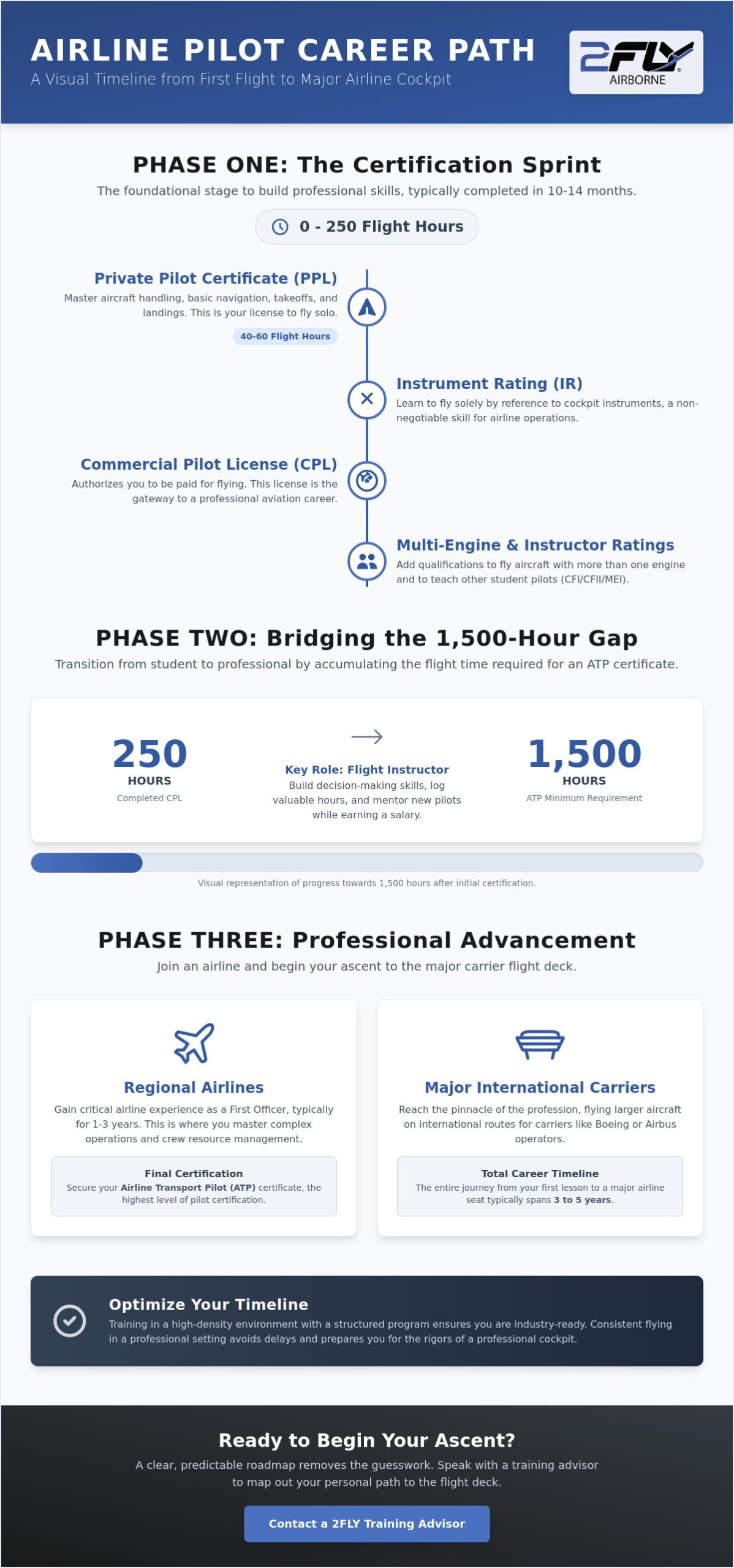
The “Certification Sprint” is the engine of your professional development. This phase is where you transform from a civilian into a licensed aviator. In an accelerated FAA Airline Pilot Program, this typically spans 10 to 14 months. It’s a foundational ladder where each rung must be secured before moving to the next. You can’t skip these steps, as each rating builds the technical skills required for the airline pilot career path timeline.
The pace of an accelerated program is designed to mimic the training environment of a major airline. You’ll move from ground school to the cockpit with high frequency. This intensity ensures that your skills don’t have time to erode between lessons. Graduates of structured academies often feel more prepared for the professional world because of this immersive approach.
The Private Pilot and Instrument Milestones
Your journey begins with the Private Pilot Certificate (PPL). This initial milestone focuses on aircraft handling, takeoffs, landings, and basic navigation. Most students complete this in 40 to 60 hours of flight time. It’s the first time you’ll experience the freedom of the skies as a pilot in command, but it’s only the beginning of your technical training.
Once the PPL is secured, you move immediately into the Instrument Rating (IR). This phase teaches you to fly solely by reference to your cockpit instruments, which is a non-negotiable skill for airline operations. Many pilots find the IR to be the most challenging part of the process because it demands extreme mental discipline. Mastering flight in low visibility is what truly separates professional aviators from hobbyists.
Commercial Certification and Multi-Engine Ratings
After mastering instrument flight, you’ll work toward your Commercial Pilot Certificate (CPL). By the time you reach the 250-hour mark, your maneuvers must meet professional standards of accuracy and smoothness. This license is your legal entry point into the industry, allowing you to fly for compensation. A positive pilot career outlook suggests that those who reach this milestone with high proficiency are well-positioned for the next phase of their career.
The final piece of the sprint is the Multi-Engine Rating (ME). Transitioning from a single-engine trainer to a complex aircraft with two engines is a major leap in responsibility. You’ll learn to manage engine failures and increased speeds, which is essential preparation for the jet environment. Multi-engine training isn’t just about extra power; it’s about understanding risk management and the aerodynamics of asymmetrical thrust.
If you’re looking to maximize your efficiency during these first 250 hours, speaking with an advisor about an FAA Professional Pilot Program is a great next step to ensure you stay on schedule.
Phase Two: Bridging the 1,500-Hour Gap
Reaching your commercial checkride is a landmark achievement; yet for many, it marks the start of a period of uncertainty. You’ve earned the right to fly for compensation, but you’re still far from the flight deck of a major airline. This stage is known as the “1,500-hour gap,” the period between your initial 250 hours and the minimum requirements for an ATP certificate. It’s the most critical segment of the airline pilot career path timeline because it’s where you transition from a student into a seasoned professional.
The industry’s demand for qualified captains and first officers remains high. The 2025 Boeing Pilot and Technician Outlook projects a demand for 660,000 new pilots globally through 2044. This long-term need ensures that those who efficiently navigate this time-building phase will find ample opportunity at the finish line. This phase typically lasts between 12 and 24 months, depending on how aggressively you pursue flight time. You aren’t just “grinding” for hours; you’re developing the command presence and decision-making skills that recruiters look for.
The Vital Role of the Certified Flight Instructor (CFI)
Most aviators choose to become a Certified Flight Instructor to bridge this gap. Teaching others is widely considered the best way to master your own knowledge of aerodynamics, regulations, and systems. You’re getting paid to fly while simultaneously refining your communication skills and patience. It’s a role that forces you to anticipate mistakes before they happen, a trait that’s invaluable in a multi-crew cockpit environment.
Instructing also helps you internalize the use of standard operating procedures (SOPs). Airlines operate with strict adherence to manuals and checklists, and a CFI role mirrors this professional discipline. It ensures you meet the FAA requirements for experience while building a reputation for safety and reliability within the industry. By the time you reach your hour goals, you’ll have hundreds of hours of experience managing a cockpit and overseeing the safety of others.
Alternative Professional Time-Building Strategies
While instruction is the most common path, it isn’t the only way to build a professional resume. Some pilots find success in aerial photography, banner towing, or pipeline patrol. These roles often involve long hours and require a high degree of stick-and-rudder skill in diverse environments. They offer a different perspective on the industry and can be an excellent way to see the country while building your logbook.
Others look toward Part 135 charter operations or cargo flights as a first officer. These positions provide exposure to turbine engines and complex flight operations earlier in the airline pilot career path timeline. Regardless of the job you choose, the goal is to remain active in the cockpit. Consistency in your flying habits is far more important to future employers than the specific type of aircraft you flew during this time-building phase. Staying active ensures your skills remain sharp for the eventual transition to a regional jet.
Phase Three: Regional Entry and the Move to Major Carriers
What happens once you finally log that 1,500th hour? For many, it’s the most exhilarating shift in the airline pilot career path timeline. You move from the familiar vibrations of a light piston aircraft to the sophisticated systems of a regional jet or turboprop. This transition begins with the ATP-CTP (Airline Transport Pilot Certification Training Program). It’s a mandatory course that prepares you for the high-altitude environment and multi-crew coordination required for your final ATP check-ride.
This phase is where your previous years of discipline pay off. You’re no longer just building time; you’re operating as a professional first officer in a highly regulated environment. The timeline for this phase typically spans one to three years at a regional carrier before you become eligible for a major airline. It’s a period of rapid growth where you’ll gain the turbine time necessary to be competitive at the highest levels of the industry.
The First Officer Experience at Regional Airlines
Initial training at a regional airline is a rigorous introduction to professional standards. You’ll spend weeks in intensive ground school followed by hours in full-motion simulators. This is where you’ll earn your first type rating, a certification that allows you to fly a specific model of large aircraft. Regional carriers are the backbone of the industry, serving as the primary pipeline for the world’s largest airlines. For a deeper look at the foundational steps that lead here, check our guide on how to become a pilot.
The lifestyle of a regional pilot is demanding but rewarding. You’ll navigate complex weather systems and busy international airspaces, often flying multiple legs a day. This high-frequency environment is designed to sharpen your technical skills and decision-making. Building turbine time is the currency of this phase, as major carriers prioritize pilots with experience in heavy, complex machinery.
Transitioning to Legacy and Major Carriers
The ultimate goal for most aviators is a seat at a legacy or major carrier like Delta, United, or American. Most pilots reach this milestone after proving their reliability and skill at the regional level. Some airlines offer internal flow-through agreements that provide a direct, guaranteed pathway to a major seat. Others hire through competitive cycles where your total flight time, safety record, and leadership qualities are scrutinized.
The 2025 Boeing Pilot and Technician Outlook projects a demand for 660,000 new pilots globally through 2044. This sustained demand ensures that the move to a major carrier remains a viable and rewarding target for those with the right experience. Once you reach this level, you’ve arrived at the pinnacle of the profession, enjoying the highest salaries and the opportunity to fly the world’s most advanced long-haul aircraft.
If you’re ready to take the first step toward these elite opportunities, explore our FAA First Officer Program to begin building your professional resume today.
Optimizing Your Timeline with a Professional Training Program
Choosing the right environment for your flight training is the most significant variable in your airline pilot career path timeline. While some attempt to navigate this journey through modular, decentralized training, high achievers often find that a structured academy provides the momentum needed to reach their goals. In an industry where seniority dictates your quality of life and earning potential, reaching the flight deck even a few months earlier can have a profound impact on your long-term career trajectory.
A professional training program operates with the end goal in mind: your transition into a commercial cockpit. This environment fosters a culture of discipline and technical excellence that mirrors the standards of major airlines. By immersing yourself in a high-density training setting, you develop the situational awareness and professional habits required to manage complex operations from day one.
Structured vs. Modular Training Paths
A career-focused program removes the friction that often stalls progress in “pay-as-you-go” models. By utilizing fixed-price programs, you can focus entirely on your technical mastery rather than worrying about fluctuating costs or financial uncertainty. This “Zero to Hero” approach ensures a seamless transition from one rating to the next, effectively minimizing the downtime that leads to skill erosion.
The operational infrastructure of a professional academy is another critical advantage. Having access to a dedicated fleet and on-site maintenance means you spend more time in the air and less time waiting for aircraft availability. When your training is managed as a direct pipeline to employment, every hour in the cockpit is optimized for your professional development and vocational preparedness.
Global Mobility and International Opportunities
Training in the United States offers a unique advantage for those seeking an international career. The complexity of U.S. airspace and the rigor of FAA standards are recognized by aviation authorities across the globe. 2FLY Airborne specializes in bridging the gap between FAA requirements and international professional standards, ensuring your certifications provide maximum mobility across different regions.
Your professional timeline is a commitment to excellence, not just a calendar of events. Surrounding yourself with expert mentors and a community of driven peers builds the networking foundation necessary for long-term success. Safe, structured training remains the bedrock of a successful 40-year career, providing you with the stability and expertise to excel in a world-class aviation setting.
Securing Your Future in the Flight Deck
Reaching the pinnacle of the aviation industry requires more than just passion; it demands a strategic commitment to a proven airline pilot career path timeline. By understanding the transition from initial certification to regional jet operations, you can navigate your training with absolute certainty. A structured approach ensures you build the necessary turbine time and command experience without unnecessary delays, allowing you to reach seniority faster.
Founded in 1994, our organization provides the expertise and resources needed to transform trainees into industry-prepared professionals. Our comprehensive FAA Professional Pilot Program leverages a large training fleet and state-of-the-art simulators to provide a world-class environment for your development. This rigorous foundation is essential for a stable and rewarding career in the global skies.
Ready to start your journey? Speak with a 2FLY Training Advisor today to build your personalized career timeline. If you have any remaining questions about certifications or hour-building milestones, we suggest reaching out to a 2FLY Training Advisor for expert guidance. The flight deck is waiting; it’s time to take the first step toward your international career.
Frequently Asked Questions
How long does it take to become a commercial pilot from scratch?
It typically takes between 10 and 14 months to earn your commercial certificates when enrolled in an accelerated professional program. However, the journey to a major airline seat usually spans three to five years in total. This duration includes the time spent building the 1,500 flight hours required for your airline transport pilot privileges.
Can I become an airline pilot in 2 years?
Reaching an airline flight deck in two years is possible but requires an exceptionally disciplined and intensive full-time schedule. You’d need to complete all initial ratings in under a year and immediately begin flying 100 hours per month as an instructor. Most aviators find a three-year airline pilot career path timeline to be a more predictable and sustainable pace.
What is the fastest way to get 1,500 flight hours?
Working as a Certified Flight Instructor (CFI) is the most efficient way to accumulate the 1,500 hours required by the FAA. Instructors at high-volume flight schools can log between 80 and 100 hours of flight time every month. This path allows you to earn a professional salary while mastering the complex decision-making skills that airlines prioritize during the hiring process.
Do I need a college degree to be an airline pilot in 2026?
You don’t legally require a college degree to fly for regional airlines, but a four-year degree remains a significant competitive advantage for major legacy carriers. While some airlines have softened their stance to address the pilot shortage, a degree reflects the academic discipline and technical mastery expected of elite captains. Many pilots choose to complete their degrees online while working at the regional level.
Is there a specific age limit to start the pilot career path?
There’s no upper age limit to begin flight training, provided you can pass the FAA First Class Medical examination. You must be at least 23 years old to hold an ATP certificate, and the mandatory retirement age for airline pilots in the United States is 65. Many professionals successfully transition into aviation in their 30s or 40s and still enjoy a long, rewarding career.
What happens if I fail a check-ride during my training timeline?
Failing a check-ride is a manageable hurdle that requires additional training and a subsequent re-test with an examiner. While airlines review training records, a single failure doesn’t end your career prospects if you demonstrate improvement and consistency afterward. The key is to maintain a professional attitude and work closely with your instructors to correct any technical or knowledge deficiencies.
How much does the entire career path timeline cost?
The total investment for a “zero to hero” program typically ranges between $70,000 and $110,000 depending on the school and location. This cost covers aircraft rentals, instructor fees, and the various FAA written and practical exams required for certification. Once you reach the 250-hour mark and secure your commercial license, you transition from paying for flight time to earning a professional salary.
Can I work a full-time job while completing my flight training?
Working a full-time job is possible under a flexible Part 61 syllabus, but it will significantly extend your airline pilot career path timeline. Accelerated career programs require a full-time commitment that often leaves little room for outside employment. Students who dedicate themselves entirely to their training tend to progress faster and retain technical skills more effectively than those training on a part-time basis.
Article by
2FLY Airborne
2Fly Airborne is a professional flight training organization dedicated to developing the next generation of skilled, confident, and safety-focused pilots. With decades of combined aviation experience, our team of certified instructors provides structured, real-world training designed to prepare students for both checkrides and long-term success in the aviation industry.
Content Disclaimer
Some blog content is generated with the assistance of automated tools and may not always be fully accurate or up to date. Please verify all aviation-related information with official sources or a certified instructor. For additional guidance or clarification, we encourage you to contact one of our training advisors at 2Fly Airborne.