Earning your wings as a private pilot is a personal achievement, but securing your commercial certificate is a complete professional transformation. Understanding the specific commercial pilot license requirements Florida demands is the vital first step in moving from the cockpit of a trainer to the flight deck of a regional jet. It’s the moment you stop paying for flight time and start getting paid to fly.
You’ve likely felt the weight of the decision between FAA Part 61 and Part 141 pathways, or perhaps you’re anxious about hitting that 250-hour flight time milestone. It’s common to feel uncertain about which medical certification you actually need to hold to exercise your new privileges. This guide clears the fog, offering a definitive checklist to master the FAA prerequisites and flight hour milestones necessary to launch your career in 2026.
We’ll examine the legal requirements for certification, the difference between being licensed and being truly career-ready, and the exact timeline you can expect. By the end, you’ll have a clear, actionable map to master the Florida aviation landscape with the confidence of a professional aviator.
Key Takeaways
- Identify the mandatory eligibility criteria, including the minimum age of 18 and the FAA standards for English proficiency required for professional operations.
- Evaluate the flight time milestones between Part 61 and Part 141 pathways to identify the most efficient way to meet commercial pilot license requirements florida.
- Understand the critical difference between Second-Class and First-Class medical certificates and why your long-term career goals should dictate your choice today.
- Gain insights into the CPL checkride process, focusing on the technical depth required for the oral exam and the precision needed for commercial flight maneuvers.
- Learn how a structured training architecture in Florida helps you build necessary hours quickly while preparing you for the demands of a global aviation career.
Essential Eligibility: What You Need Before Starting CPL Training
Before you can fly for hire, you must satisfy specific legal and educational benchmarks. These Essential Eligibility: What You Need Before Starting CPL Training criteria ensure that every pilot entering the commercial sector possesses the maturity and foundational skills required for high-stakes operations. Understanding the commercial pilot license requirements florida enforces is the first step toward a professional career.
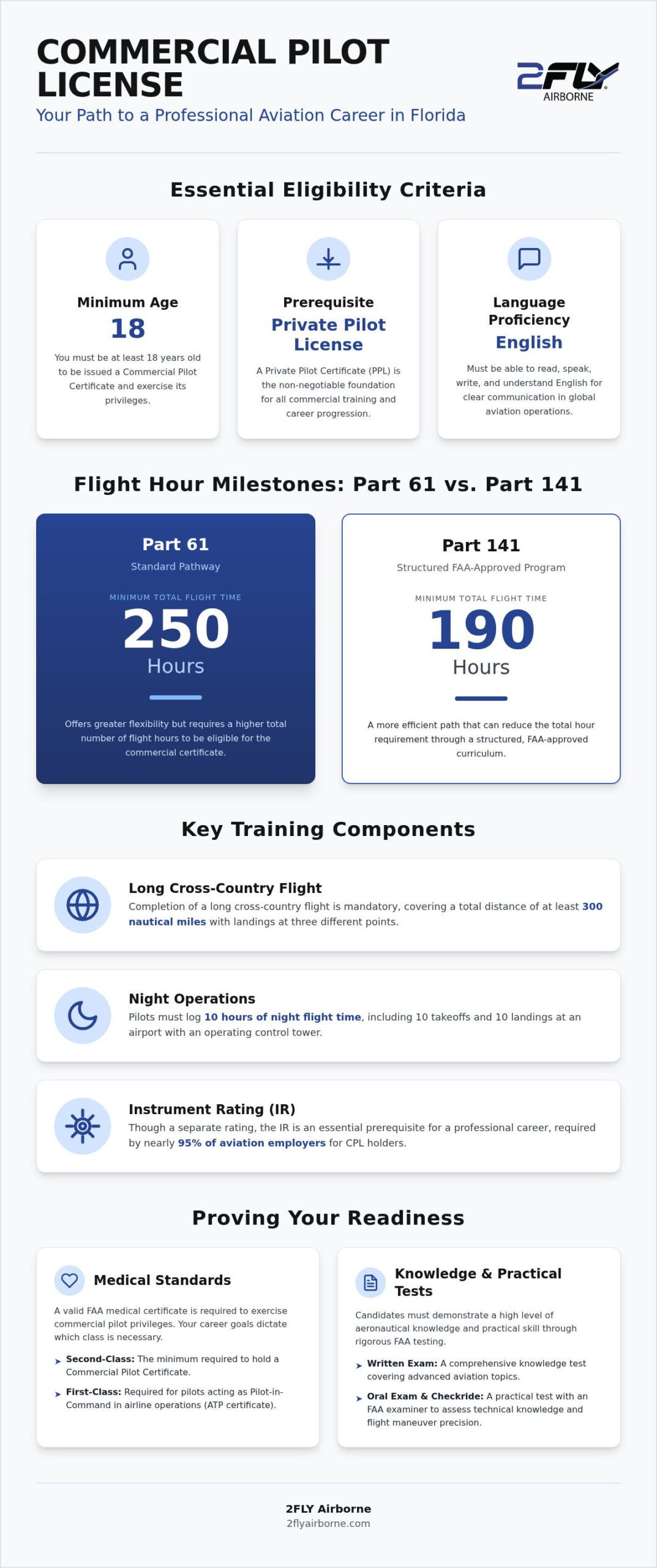
The FAA mandates a minimum age of 18 years to receive a Commercial Pilot Certificate. While you can begin your training earlier, you won’t be legally permitted to take the practical exam or exercise commercial privileges until your 18th birthday. This requirement aligns with the increased responsibility of carrying passengers or cargo for compensation.
The Role of the Private Pilot Certificate
You cannot simply jump into commercial maneuvers without first mastering the basics of airmanship. The Private Pilot Certificate (PPL) serves as the non-negotiable foundation for your entire career. It’s during this phase that you learn fundamental aircraft control, navigation, and emergency procedures. Transitioning from a PPL to a CPL requires a shift in mindset. You’re no longer flying for recreation; you’re developing the disciplined habits of a professional. For those pursuing a career, the FAA Professional Pilot Program provides a seamless bridge from these initial hours to advanced commercial standards.
English Language and Communication Standards
Aviation is a global industry, and English is its universal language. To meet the commercial pilot license requirements florida flight schools must verify your ability to read, speak, write, and understand English. This isn’t just a formality. Florida’s airspace is some of the busiest in the world. Clear, concise radio communication is essential for maintaining safety in multi-crew environments and complex traffic patterns. International students must prove this proficiency to meet FAA standards before they can progress through their certifications.
Security is a top priority in Florida aviation training. All students must provide proof of citizenship or undergo a TSA background check before starting flight training. If you’re an international candidate, you’ll also need to secure the appropriate visa. An M1 visa approved flight school can assist with the necessary documentation to ensure your legal status while you focus on your training goals.
FAA Hour Requirements: Breaking Down the 250-Hour Milestone
Reaching the required flight hour thresholds is often the most time-intensive phase of your training. Under the standard FAA Hour Requirements: Breaking Down the 250-Hour Milestone, Part 61 regulations mandate a minimum of 250 total flight hours. Many students opt for the efficiency of a Part 141 school instead, which can reduce this requirement to 190 hours through a more structured, FAA-approved curriculum.
The 250-hour total isn’t just about time spent in the air. You must prove your ability to lead as Pilot-in-Command (PIC). This involves logging specific solo hours where you’re the sole manipulator of the controls and the final authority for the flight’s safety. Meeting the commercial pilot license requirements florida pilots face means mastering the diverse and busy airspace found across the peninsula.
Specific Cross-Country and Night Milestones
A significant portion of your training involves cross-country navigation. You’ll need to complete a long cross-country flight covering at least 300 nautical miles, with landings at three different points. Florida’s unique geography provides an ideal corridor for these missions, allowing you to fly between the Atlantic coast and the Gulf with ease while navigating complex weather patterns.
Night operations are equally critical for commercial safety. You must log 10 hours of night flight time, including 10 takeoffs and 10 landings at an airport with an operating control tower. Florida’s consistent year-round weather minimizes cancellations, helping you log these specific night hours without the seasonal delays found in northern states.
Instrument Rating: The Unofficial Requirement
While technically a separate rating, the Instrument Rating (IR) is essential for any professional career. Approximately 95% of aviation employers require a CPL candidate to also hold an IR. This certification proves you can fly safely in Instrument Meteorological Conditions (IMC) using only your cockpit displays. It transforms you from a fair-weather pilot into a versatile professional ready for 24/7 operations.
Integrating this training into a cohesive path is the smartest way to build your resume. If you want to maximize your efficiency while meeting these milestones, consider speaking with an advisor about the FAA Professional Pilot Program to see how a structured syllabus saves time. This approach ensures every hour you log contributes directly to your ultimate goal of a commercial cockpit.
Medical Standards and Knowledge Testing: Proving Your Readiness
Proving your readiness for a professional cockpit involves more than just stick-and-rudder skills. You must meet specific health and academic benchmarks before the FAA grants you commercial privileges. Meeting the commercial pilot license requirements florida mandates starts with your physical certification and ends with a rigorous assessment of your aeronautical knowledge.
The Second-Class Medical Certificate is the baseline for commercial flight. It verifies that you possess the vision, hearing, and physical health necessary to operate safely while being paid for your services. If your ultimate goal is the captain’s seat at a major airline, we recommend securing a First-Class Medical Certificate immediately. This proactive step confirms you can meet the highest industry health standards before you commit to a full training path.
Understanding FAA Medical Classes
FAA medical classes differ primarily in their depth of testing and validity periods. A Second-Class medical is valid for 12 months for commercial duties, regardless of your age. In contrast, a First-Class medical requires renewal every six months for pilots over age 40. Florida’s extensive aviation infrastructure makes it easy to locate an authorized Aviation Medical Examiner (AME) to manage your renewals and ensure you stay flight-legal.
Understanding these commercial pilot license requirements florida establishes for medical fitness is vital for your long-term career planning. An AME will check for specific conditions that could impact flight safety, such as untreated cardiovascular issues or neurological disorders. Being proactive about your health ensures that your career isn’t grounded before it truly takes off.
Acing the CPL Knowledge Test
Academic excellence is just as vital as physical health. The FAA Commercial Pilot Knowledge Test is a comprehensive written exam that evaluates your grasp of professional aviation principles. It’s a key milestone within the framework of Mastering the CPL Checkride: FAA Practical Test Standards. You’ll need to demonstrate a deep understanding of advanced meteorology, complex aircraft systems, and Federal Aviation Regulations.
Preparation is the difference between passing and excelling. Ground school modules focus on high-altitude operations, emergency procedures, and commercial flight planning. Many students find that our FAA Professional Pilot Program integrates this theory naturally with flight hours. Using state-of-the-art simulators allows you to practice these complex scenarios repeatedly, ensuring you’re ready for both the written exam and the subsequent oral evaluation with an examiner.
Mastering the CPL Checkride: FAA Practical Test Standards
The checkride is the final gateway to your professional career. It is a rigorous evaluation where a Designated Pilot Examiner (DPE) verifies that you meet every commercial pilot license requirements florida mandates. This practical test is divided into two distinct phases: a thorough oral examination and a flight portion that tests your precision under pressure. In Florida, DPE fees for a single-engine commercial checkride typically range from $850 to $1,300, reflecting the high demand for examiners in this global training hub.
You must demonstrate mastery of a Technically Advanced Aircraft (TAA). The FAA defines this as an airplane equipped with an advanced electronic primary flight display, a multifunction display, and a two-axis autopilot integrated with a GPS. Modern professional training focuses on these systems because they mirror the technology you will encounter in regional and major airline cockpits. Mastering these tools is essential for proving you can manage the complex workload of a commercial aviator.
Commercial Maneuvers Explained
The flight portion of the checkride focuses on maneuvers that demonstrate superior aircraft control and energy management. You will perform Chandelles, Lazy Eights, and Steep Spirals. These aren’t just technical exercises; they are designed to prove you can maintain masterly coordination while dividing your attention between the cockpit and the environment. You must maintain strict FAA tolerances, often keeping your altitude within 100 feet and your heading within 10 degrees during high-performance turns.
The power-off 180-degree accuracy landing is often considered the ultimate test of a pilot’s skill. You must glide the aircraft from the downwind leg to a specific touchdown point on the runway without using engine power. Florida’s consistent sea-level density altitude provides a stable environment for practicing these maneuvers. This consistency allows you to refine your sight pictures and glide paths more effectively than in regions with volatile mountain weather or extreme elevation changes.
The Practical Test Experience
Preparation for checkride day begins weeks in advance. You must ensure your logbooks are meticulously organized and all endorsements are in order. The oral exam will challenge your knowledge of aircraft systems, emergency procedures, and federal regulations. Common pitfalls often involve a lack of depth in technical knowledge or failing to properly clear the area for traffic before starting flight maneuvers. Staying focused on the Pilot-in-Command mindset is your best defense against these errors.
Your examiner is looking for more than just stick-and-rudder skills; they are evaluating your professional judgment. Decision-making and situational awareness are the hallmarks of a safe commercial pilot. When you successfully complete this test, you transition from a student to a certified professional ready for the global stage. Secure your future by enrolling in our FAA Professional Pilot Program, where we prepare you to exceed these standards with confidence.
The 2FLY Advantage: Streamlining Your Path to a Commercial Cockpit
Navigating the complex commercial pilot license requirements florida mandates requires more than just a list of flight hours. It demands a structured training architecture that transforms a student into an industry-prepared professional. Our FAA Professional Pilot Program is designed to provide this exact pipeline, moving you through every certification with precision and speed.
We eliminate the financial uncertainty that often stalls flight training through our fixed-price tuition model. You won’t have to worry about fluctuating costs or hidden fees as you build your hours. This transparency allows you to dedicate your full mental energy to mastering advanced maneuvers and technical knowledge. Our large fleet of modern aircraft and state-of-the-art simulators ensures you always have the resources needed to stay on schedule.
Florida’s aviation landscape offers a unique competitive edge for our trainees. The combination of consistent flying weather and complex, high-volume airspace creates a world-class training ground. You’ll log your required hours in an environment that mirrors the challenges of professional airline operations. This immersion is why Florida remains the premier destination for those serious about a long-term career in the skies.
Career Trajectory and Market Demand
The global aviation industry is entering a period of unprecedented growth. The 2025 Boeing Pilot and Technician Outlook projects a demand for 660,000 new pilots globally through 2044. Meeting the commercial pilot license requirements florida enforces today places you directly in the path of this massive recruitment wave. Our training doesn’t just aim for a license; it prepares you for international professional mobility.
We leverage an extensive recruitment network to help you transition from the classroom to your first commercial job. By training at an elite institution, you benefit from the reputation of a program that airlines trust. Every hour you log in our program is a step toward becoming a highly disciplined, knowledgeable pilot ready for the demands of a global career.
Next Steps for Aspiring Aviators
Your journey begins with a clear assessment of your current eligibility and goals. We provide on-campus residential accommodation to help you focus entirely on meeting rigorous FAA standards. Living and training in a dedicated aviation community fosters the drive and passion necessary for technical mastery. This immersive environment is particularly beneficial for international students who are training under our M-1 or F-1 visa sponsorship.
Don’t let confusion over regulations delay your progress. We invite you to speak with a training advisor to map out your specific 2026 timeline and training path. We’ll help you evaluate your current flight time and choose the most efficient route to your commercial certificate. Take the first step toward your professional future by reaching out to 2FLY Airborne today.
Launch Your Professional Aviation Career in Florida
Mastering the commercial pilot license requirements florida pilots must fulfill is the definitive turning point in your aviation journey. By understanding the shift from recreational flight to professional precision, you position yourself for success in a high-growth global market. You’ve learned how structured Part 141 training can streamline your flight hour milestones and why early medical certification is a critical strategic move for your long-term health and career stability.
Success in this industry depends on choosing a training environment that mirrors the demands of the cockpit you intend to occupy. Our Fixed-Price Professional Pilot Program provides the certainty you need to focus on technical mastery without financial distraction. With on-campus residential accommodation and M-1 and F-1 visa sponsorship available, we provide a stable and world-class setting for both domestic and international high-achievers.
The flight deck is waiting for those with the discipline to meet these rigorous standards. Speak with a 2FLY Training Advisor today to start your journey and take the first step toward your international career. Your professional future starts with a single, decisive action toward technical mastery and professional development.
Frequently Asked Questions
What is the difference between a Part 61 and Part 141 commercial pilot license?
Part 141 programs are FAA-approved, highly structured curricula that allow you to earn your certificate in as few as 190 hours. In contrast, Part 61 training is more flexible and self-paced but requires a minimum of 250 total flight hours. Choosing a Part 141 school is often the most efficient way to meet the commercial pilot license requirements florida students face, as it provides a direct, syllabus-driven pipeline toward professional employment.
Can I get a commercial pilot license without an instrument rating?
Yes, you can obtain a Commercial Pilot License without an Instrument Rating, but your privileges will be severely limited. The FAA will restrict you from carrying passengers for hire on cross-country flights longer than 50 nautical miles or flying at night. Because most professional employers require an Instrument Rating, it’s considered an essential component of any career-focused flight training program to ensure you are fully marketable to airlines.
How much does it cost to get a commercial pilot license in Florida?
The total investment for a commercial pilot license in Florida depends on your starting experience and training frequency. Students starting with no prior flight time should plan for a comprehensive professional program that covers all certifications. Those who already hold a private certificate and instrument rating will focus on a standalone commercial add-on. Total costs are highly dependent on individual progress, your choice of flight school, and the specific aircraft used for training.
What are the vision requirements for an FAA Second-Class Medical?
To pass an FAA Second-Class Medical examination, you must meet specific standards for distance and near vision, with or without correction. You also need to demonstrate sufficient color vision to distinguish between aviation signal lights and pass a hearing assessment. If you require glasses or contacts to meet these standards, you must wear them while exercising your commercial pilot privileges. Finding an authorized Aviation Medical Examiner in Florida is a simple first step in this process.
How long does it take to log the 250 hours required for a CPL?
Logging 250 hours typically takes between six and twelve months in a dedicated, full-time professional pilot program. This timeline depends on your training frequency and Florida’s favorable year-round weather, which allows for more consistent flight scheduling than other regions. Students who fly three to four times per week often see better knowledge retention and reach their hour milestones faster than those training on a part-time or hobbyist schedule.
Do I need a college degree to get a commercial pilot license?
No, a college degree is not a legal requirement to obtain an FAA Commercial Pilot License. You can start your professional career in regional aviation, charter, or flight instruction with just your certifications. However, many major international airlines still prefer or require a bachelor’s degree for their competitive first officer positions. Many students choose to combine their flight training with a degree program to maximize their long-term career mobility and employment opportunities.
Can international students get a commercial pilot license in Florida?
Yes, Florida is a premier global destination for international students seeking FAA certification. To train legally, you must enroll in an M1 visa approved flight school that can provide the necessary I-20 documentation. International candidates must also undergo a TSA background check and demonstrate English language proficiency. These programs often include on-campus housing to support students as they transition from trainees to industry-prepared professionals ready for global employment.
What kind of jobs can I get with a commercial pilot license?
A commercial pilot license allows you to be compensated for flying, opening doors to diverse entry-level roles. Many graduates begin as a flight instructor to build the 1,500 hours required for airline work. Other opportunities include aerial photography, banner towing, corporate charter, and agricultural flying. Holding this certificate is the essential bridge between flying for personal pleasure and launching a high-level career in the international aviation industry.
Article by
2FLY Airborne
2Fly Airborne is a professional flight training organization dedicated to developing the next generation of skilled, confident, and safety-focused pilots. With decades of combined aviation experience, our team of certified instructors provides structured, real-world training designed to prepare students for both checkrides and long-term success in the aviation industry.
Content Disclaimer
Some blog content is generated with the assistance of automated tools and may not always be fully accurate or up to date. Please verify all aviation-related information with official sources or a certified instructor. For additional guidance or clarification, we encourage you to contact one of our training advisors at 2Fly Airborne.