

What if a commercial checkride pass rate tells you more about the data than about your chances? The latest figure for faa commercial pilot checkride pass rates is 76.7% for initial Commercial Pilot practical tests in 2025, according to MockCheckride.com’s analysis of FAA Airmen Statistics. It’s a useful benchmark, not a forecast of how any one applicant will perform.
It’s understandable to look for a clear number when a failed checkride could affect your training plans. The challenge is that published figures can vary in scope. Some describe initial attempts, while others may include different test categories or repeat attempts. A practical-test pass rate also isn’t the same as a Commercial Pilot knowledge-test pass rate.
This article explains how to assess the available data, what the Commercial Pilot Airman Certification Standards (ACS) ask you to demonstrate, and how structured preparation can turn the numbers into a practical training plan. You’ll find a clearer way to judge the evidence and choose a purposeful next step toward your commercial pilot certificate.
Key Takeaways
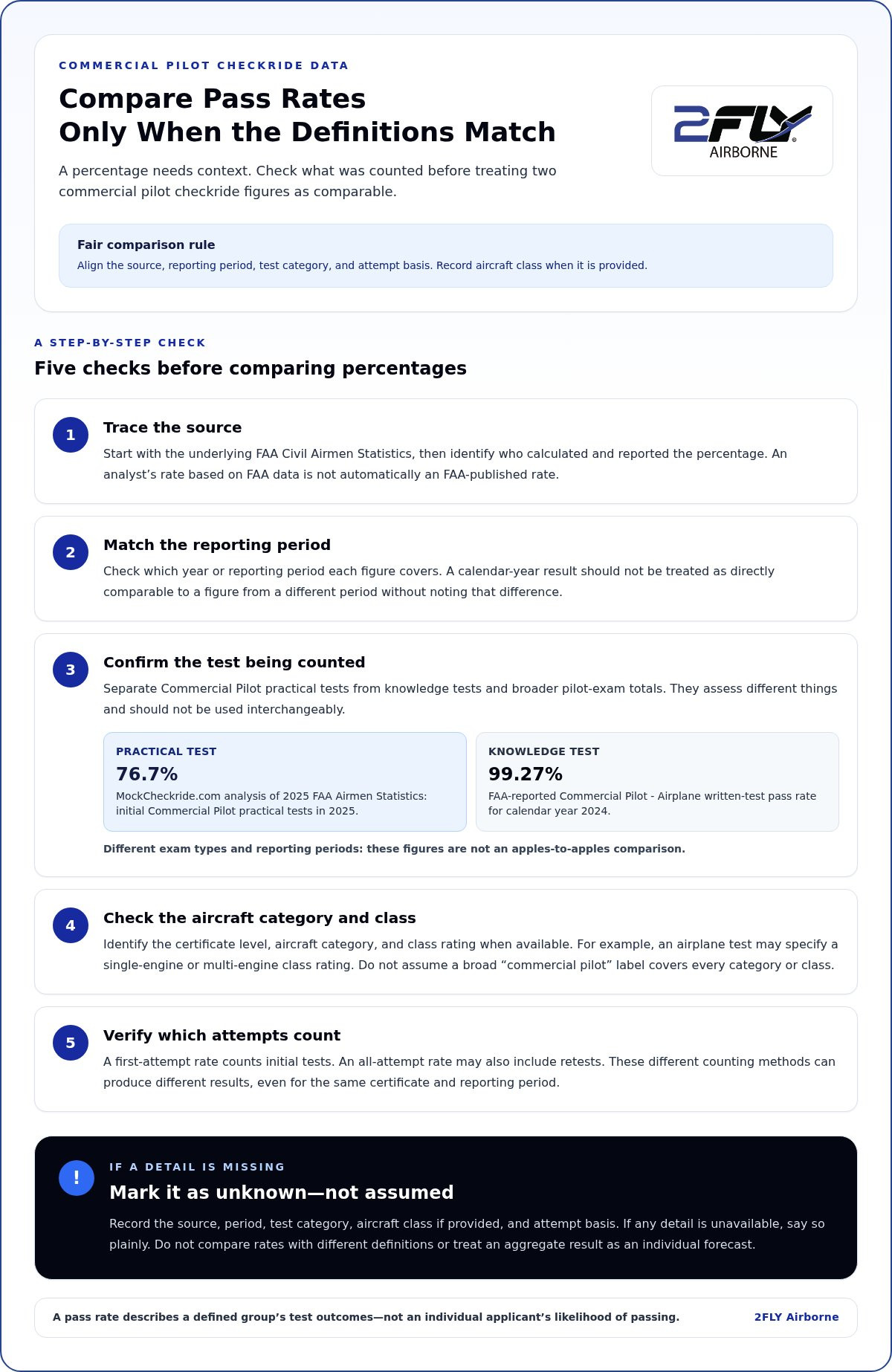
- Read faa commercial pilot checkride pass rates in context: check the source, reporting period, test category, and whether the figure covers initial attempts.
- Distinguish practical-test results from knowledge-test scores, applicants, and certificates issued before drawing conclusions.
- Compare figures only when their definitions match. Treat unavailable details as unknown rather than making assumptions.
- Use the Commercial Pilot Airman Certification Standards to guide preparation and identify the knowledge and skills you need to demonstrate.
- Build readiness through a structured cycle of reviewing standards, addressing gaps, deliberate practice, and reassessment.
What Does the FAA Commercial Pilot Checkride Pass Rate Measure?
Does a published pass rate predict whether you’ll pass your commercial checkride? No. It describes results across a defined group of practical tests, not the likelihood that a particular applicant will pass. The figure is useful only when you know which tests it counts and how the rate was calculated.
A pass rate is the share of counted tests that ended in a pass. The denominator matters: a dataset might count completed practical tests, first attempts only, or multiple attempts by the same applicant. That’s different from counting people who applied for a certificate or certificates issued, neither of which necessarily tells you how many tests were passed.
Commercial pilot certification includes specific practical-test categories and aircraft ratings. The overview of pilot certification in the United States explains how checkrides fit into the certification system. To interpret a rate, check the underlying FAA dataset and its definitions.
Which Commercial Pilot Practical Test Does the Figure Cover?
Start by identifying the certificate level and aircraft category, then look for any class rating specified in the data. For example, an airplane test may be associated with a single-engine or multi-engine class rating. Don’t combine these results casually: the tests involve different aircraft configurations and may represent different applicant groups.
If a source labels its figure only as “commercial pilot,” don’t assume it applies to every category or class. If the dataset doesn’t identify the relevant category and rating, note that limitation rather than presenting the number as a precise commercial-airplane benchmark.
Does the Number Mean First-Time Passes or All Attempts?
Check whether the reported rate covers initial attempts, all completed attempts, or another measure. A first-attempt rate counts each applicant’s initial test; an all-attempt rate may also include retests. These methods can produce different results even when they refer to the same certificate and reporting period.
Before relying on faa commercial pilot checkride pass rates, record the source, reporting period, test category, aircraft class if provided, and attempt basis. If any detail is missing, mark it as unavailable. Don’t compare a figure with a rate calculated using a different denominator, and don’t treat an aggregate result as an individual forecast.
Include a numerical rate only when its source and scope are clear. That keeps the benchmark in perspective: it describes a group’s test outcomes, while your preparation and demonstrated performance matter to your own checkride.
Where to Find FAA Commercial Pilot Checkride Pass-Rate Data
Start with the source, not the percentage. The FAA’s FAA Civil Airmen Statistics is the primary reference for U.S. civil airmen data. A published pass rate may be an analyst’s calculation from FAA data, so distinguish the underlying dataset from the organization that calculated and reported the rate.
For example, MockCheckride.com reported a 76.7% pass rate for initial Commercial Pilot practical tests in 2025, based on its analysis of 2025 FAA Airmen Statistics. It published the analysis on April 27, 2026. This describes a practical-test result, not a written-test score, the number of certificates issued, or the outcome an individual applicant should expect.
How to Check a Published Rate’s Source and Scope
Trace secondary articles back to the original FAA publication or dataset, then check how the author calculated the rate. Confirm the reporting period and whether the metric concerns commercial practical tests, rather than knowledge tests or a broader group of pilot examinations.
Record the test category and aircraft class when the source provides them. If those details or the attempt basis are unavailable, say so plainly. Don’t infer a commercial-specific result from a broader FAA total.
Why Published Figures May Differ
Two percentages can look comparable while counting different things. One may cover initial tests in a calendar year; another may count all attempts, use a different reporting period, or combine test categories. School-level figures may describe a different population from a national dataset.
Before comparing faa commercial pilot checkride pass rates, note the source, period, test category, attempt-counting method, and any missing details. Don’t claim a trend unless the figures use comparable definitions.
Citation-ready example: “MockCheckride.com’s analysis of 2025 FAA Airmen Statistics reported a 76.7% pass rate for initial Commercial Pilot practical tests in 2025.” The FAA dataset is the underlying reference; the percentage is attributed to the named analysis, not presented as an FAA-published rate.
For a separate knowledge-test measure, the FAA reported a 99.27% pass rate for the Commercial Pilot – Airplane written test in calendar year 2024. Keep that figure separate from practical-test results: the exams assess different things and shouldn’t be used interchangeably.
Use careful sourcing to understand the benchmark, then focus preparation on your own progress. If you’re planning a Commercial Pilot Certificate pathway, a 2FLY Training Advisor can help you discuss how it fits into structured pilot training.
How to Compare Commercial Pilot Checkride Pass Rates Fairly
A percentage is meaningful only alongside its definition. To compare faa commercial pilot checkride pass rates, align the source, reporting period, practical-test category, and attempt basis. If any of these differ or aren’t reported, treat the figures as separate pieces of information, not an apples-to-apples comparison.
| Source | Reporting period | Test category | Attempt basis | Limitations |
|---|---|---|---|---|
| MockCheckride.com analysis of FAA Airmen Statistics | 2025 | Initial Commercial Pilot practical tests | Initial tests, as reported | Secondary analysis; check its methodology before comparing with other figures. |
| FAA knowledge-test data | Calendar year 2024 | Commercial Pilot – Airplane written test | Unavailable here | Written-test pass rate, not a practical-test rate. |
| Individual flight-school result | Unavailable | Unavailable | Unavailable | Not comparable without a stated population, period, test scope, and calculation method. |
The first row reports a 76.7% pass rate, while the FAA’s 2024 written-test data reports a 99.27% pass rate. These figures measure different exams and periods, so they shouldn’t be ranked or treated as competing estimates of the same outcome.
National Data Versus Flight-School Results
A national figure can provide context for a defined group of tests, but it can’t establish how a specific school’s applicants perform. School-reported rates may describe a narrower population. To support a fair comparison, they need clear definitions, a reporting period, and the number and type of tests counted.
Pilot organizations such as the Aircraft Owners and Pilots Association (AOPA) offer broader aviation resources. For a specific rate, cite the dataset or analysis that supplies the figure and its methodology. Avoid ranking schools using figures that measure different populations or rely on undisclosed calculations.
First Attempt, Retest, and Reporting Period
A first-attempt rate answers how often initial tests result in passes. A rate that includes retests describes outcomes across a different set of test events. Neither measure is automatically more useful, but each answers a different question. Older results also need their reporting year; don’t present them as current without context.
A rate is comparable only when its scope and denominator match. If the attempt basis, reporting period, or test category is unknown, label it “unavailable” rather than filling in the gap. To connect pass-rate context with a structured commercial pilot training pathway, explore 2FLY commercial pilot training.
What Pass Rates Can, and Cannot, Tell You About Readiness
An overall pass rate can offer context, but it can’t tell you whether you’re ready for your own checkride. A high or low aggregate result doesn’t account for your training, consistency, or ability to apply knowledge and skills on the day. Treat faa commercial pilot checkride pass rates as background, not a personal prediction.
Assess readiness against the standards for your specific test and your demonstrated performance. For the commercial airplane practical test, the FAA identifies FAA-S-ACS-7B as the applicable Airman Certification Standards (ACS). The ACS organizes what an applicant must know, do, and consider, including risk management. Check the FAA’s current publication before preparing, since standards can be revised.
How the Commercial Practical Test Evaluates a Candidate
The practical test includes an oral evaluation and a flight evaluation. The ACS provides the framework for assessing the knowledge and flight tasks relevant to the certificate and rating, including how a pilot manages risks while applying that knowledge and skill. Review the current FAA ACS for the detailed standards; a pass-rate article isn’t a substitute.
The examiner evaluates performance against the applicable standards. Preparation should focus on understanding the tasks and demonstrating sound judgment, rather than trying to predict a particular examiner’s questions.
A Failed Attempt Is Information, Not a Career Verdict
A result that falls short can be disappointing, especially when you’re working toward professional goals. It doesn’t define your potential. Use the evaluator’s feedback to identify what needs attention, then review those areas with your instructor and make a focused practice plan.
Before scheduling another practical test, review current FAA materials for the applicable retest procedures and any conditions that apply to your situation. Procedures can change, so don’t rely on old timelines or informal accounts. Your instructor can help you assess progress without treating a broad national statistic as a readiness test.
Use this readiness check with your instructor:
- Can you perform relevant flight tasks consistently, not just once under ideal conditions?
- Can you explain the knowledge behind your decisions and identify risks as they arise?
- Have you addressed recurring gaps and discussed your mock-checkride feedback?
Look for steady performance and clear understanding, not a promise of a particular outcome. For guidance on preparing for a Commercial Pilot Certificate through structured training, speak with a 2FLY Training Advisor.
Build Commercial Checkride Readiness Through Structured Training
Use pass-rate data as context, then bring your attention back to the work you can control. A national figure can’t replace an instructor’s assessment of your knowledge, skills, and readiness against the standards for your specific practical test.
Use a repeatable preparation cycle:
- Review the current standards. Use the applicable FAA Airman Certification Standards (ACS) to organize your preparation and understand what the test evaluates.
- Identify gaps. With your instructor, note areas where your knowledge or flight performance needs more consistency.
- Practice deliberately. Focus each study session or flight on specific gaps, then apply what you’ve learned in realistic scenarios.
- Reassess readiness. Review observed performance and instructor feedback against the standards, rather than aiming for a particular pass-rate statistic.
Turn the Data Into a Personal Preparation Plan
Use verified faa commercial pilot checkride pass rates as a broad benchmark, not as a target or personal forecast. Keep track of recurring knowledge questions, flight tasks that need refinement, and instructor feedback. A focused plan helps you see whether practice is addressing the underlying gap, not just producing a temporary improvement.
Then review progress with your instructor. Readiness should reflect consistent performance and sound decision-making under the applicable standards, not confidence based solely on an aggregate figure.
Connect Commercial Training to Your Career Path
The Commercial Pilot Certificate builds on earlier training, including private-pilot and instrument knowledge and skills. It’s one stage in a broader professional progression, which may continue into additional ratings or instructor certifications depending on your goals. For an overview of a structured training path, explore the FAA Airline Pilot Program.
2FLY Airborne’s FAA Professional Pilot Program connects pilot certifications through a structured training pathway. Whatever route you follow, keep the emphasis on safe habits, deliberate practice, and standards-based assessment. These are more useful measures of progress than trying to predict your result from a national rate.
Key takeaway: Check the data’s scope, but base your checkride plan on current standards, focused practice, and demonstrated readiness. For questions about a structured pathway toward a Commercial Pilot Certificate, reach out to a 2FLY Training Advisor.
Turn Pass-Rate Data Into a Purposeful Next Step
Use faa commercial pilot checkride pass rates as context, not as a forecast of your individual result. A figure is useful only when its source, reporting period, test category, and attempt basis are clear. Assess your readiness through current standards, instructor feedback, and consistent performance.
Commercial training builds on earlier pilot certifications and develops the knowledge, practical skills, and judgment needed for the next stage. Safe, structured preparation keeps that progression grounded in your demonstrated abilities, not a national percentage.
2FLY Airborne offers Commercial Pilot Certificate training and a structured FAA Professional Pilot Program. Explore how a training pathway could fit your goals, then discuss your next step with an advisor.
Explore the FAA Airline Pilot Program and reach out to a 2FLY Training Advisor with questions. Focused preparation and steady progress help you work toward your aviation goals.
Frequently Asked Questions
What is the FAA commercial pilot checkride pass rate?
There isn’t one figure to quote responsibly without explaining its source and scope. The faa commercial pilot checkride pass rates reported in different places may cover different reporting periods, practical-test categories, or attempt bases. Keep practical-test outcomes separate from written-test scores and broad checkride statistics. Before using a numerical rate, verify what it counts and name the source so readers can interpret it accurately.
Where can I find official FAA commercial pilot checkride pass-rate data?
Start with current FAA publications or datasets that report practical-test outcomes, then check whether they separate commercial tests by certificate category and aircraft class. Confirm the reporting period and whether the measure counts first attempts or another set of test events. If the source doesn’t offer a commercial-specific breakdown, identify that limitation rather than presenting a broader practical-test figure as a commercial pass rate.
Are commercial pilot checkride pass rates first-attempt rates?
Not necessarily. A published figure may count initial attempts, all completed practical tests, or another defined measure. These approaches use different denominators, so their results aren’t directly interchangeable. Before comparing rates, look for an explanation of whether retests are included and exactly which tests are counted. If the source doesn’t state its method, describe the attempt basis as unknown instead of assuming it represents first-time results.
Can a flight school’s pass rate predict whether I will pass?
No school-level aggregate rate can reliably predict an individual result. A school statistic may reflect a particular period, test mix, or calculation method, while your readiness depends on your own knowledge and demonstrated flying skills. Treat published school figures as context, not a personal forecast. Use the current standards for your test, consistent performance, and your instructor’s feedback to guide preparation and identify areas that need more work.
What happens if I fail a commercial pilot checkride?
A failed attempt doesn’t determine your potential as a pilot. Review the examiner’s feedback with your instructor, identify the specific areas that need attention, and build a focused plan for further practice. Before planning another practical test, verify current FAA procedures and any requirements that apply to your situation. Rules and procedures may change, so avoid relying on old timelines or informal accounts when deciding what to do next.
Is the commercial pilot checkride harder than the private pilot checkride?
There isn’t a simple answer that applies to every candidate. The certificates have different privileges and evaluation standards, and a pass-rate comparison alone can’t establish which checkride is harder for you. Preparation, experience, aircraft category, and individual strengths also matter. Compare the current standards for each certificate and discuss your progress with your instructor. That gives you a more useful basis for planning than a broad difficulty label.
How can I prepare for a commercial pilot checkride?
Begin with the current standards for your certificate and aircraft category. Work with your instructor to identify gaps, then practice those areas deliberately and review your knowledge and flight performance. Use pass-rate data as background, not as a study plan or readiness test. Keep preparation focused on safe, consistent performance, and check current FAA materials for regulatory details that may affect your training or practical test.
Key takeaway: Interpret pass-rate data carefully, and build readiness through current standards, instructor feedback, and safe, structured practice. For questions about your commercial training pathway, reach out to a 2FLY Training Advisor.

Article by
2FLY Airborne
2Fly Airborne is a professional flight training organization dedicated to developing the next generation of skilled, confident, and safety-focused pilots. With decades of combined aviation experience, our team of certified instructors provides structured, real-world training designed to prepare students for both checkrides and long-term success in the aviation industry.
Content Disclaimer
Some blog content is generated with the assistance of automated tools and may not always be fully accurate or up to date. Please verify all aviation-related information with official sources or a certified instructor. For additional guidance or clarification, we encourage you to contact one of our training advisors at 2Fly Airborne.