

The lower-hour option isn’t automatically the faster or less expensive route. In the part 141 vs part 61 flight training decision, the better fit depends on how you learn, how much time you can commit, and where you want your pilot career to lead.
It’s understandable to wonder whether one path carries more weight or leads to a different certificate. Both frameworks can lead to the same pilot certifications, but they organize instruction differently: Part 141 follows an approved course structure, while Part 61 allows more flexibility in how training is delivered. Minimum-hour figures are only a starting point. You still need to build the proficiency required for each stage.
This guide explains what each framework governs and how the differences may affect your schedule, learning preferences, and professional plans. You’ll also see why a structured career-training plan matters when progressing through certificates and ratings such as Private Pilot, Instrument, Commercial, and instructor qualifications. Compare the practical trade-offs, then use your goals to identify the path that makes sense for you.
Key Takeaways
- Understand what Part 61 and Part 141 govern before comparing flight schools’ training structures.
- Use the part 141 vs part 61 flight training comparison to weigh syllabus structure, scheduling flexibility, progress monitoring, and adaptability.
- Separate regulatory minimums from the training time you may personally need to reach proficiency.
- Match your training path to your career objective, preferred learning structure, schedule, and need for support.
- Bring your goals and questions to a 2FLY Training Advisor as you plan your next step toward professional pilot training.
Part 141 vs. Part 61 Flight Training: What Do the Two Parts Govern?
Imagine comparing two pilot schools: one describes a flexible training framework, while the other emphasizes a formal course syllabus. The labels can sound like competing credentials, but they describe different ways flight training is regulated and organized, not separate pilot careers.
In brief: Part 61 covers rules for pilot certification and training, while Part 141 sets requirements for certificated pilot schools and their approved training courses. Both frameworks can lead to FAA pilot certificates. Neither label alone determines the quality of instruction or a student’s results.
For a visual introduction to the comparison, watch this overview:
What does Part 61 mean for pilot training?
Part 61 is the regulatory framework that addresses pilot certification and the training needed to qualify for certificates and ratings. It sets the rules instructors and students work within, but it doesn’t prescribe one identical day-to-day learning experience at every school. Lesson sequence, scheduling, and support can vary with the instructor, student, and training plan.
For authoritative requirements, consult current FAA regulations. Specific eligibility and training details can change, so verify the applicable rules before relying on a particular requirement.
What does Part 141 mean for a flight school?
Part 141 relates to FAA-certificated pilot schools and their approved training courses. A course follows an accepted structure, but that framework doesn’t promise how quickly an individual will progress or what career outcome they’ll achieve. Each student must develop the knowledge and flying proficiency needed to meet the applicable standards.
To understand the broader setting, the Flight School Overview describes the general role of flight schools. The regulatory framework is only one part of a training decision. School quality, instructor fit, learning support, and a coherent plan toward professional goals matter too.
That distinction is useful when comparing part 141 vs part 61 flight training: Part 61 primarily frames certification and training rules, while Part 141 applies to a school’s certification and approved courses. Neither is a pilot certificate in itself, and the framework alone doesn’t establish whether instruction is a strong fit for you.
For example, a prospective professional pilot might compare how each training plan supports progression through private, instrument, and commercial certificates. 2FLY’s degree program with airline pilot training is one example of a broader career-training plan that brings education and pilot training together. Consider the training structure alongside your learning needs and long-term direction.
Use this overview to frame your questions, then review current FAA regulations for authoritative details. Regulations can change, and individual progress varies. A safe, structured training plan remains central whichever framework applies.
How Part 141 and Part 61 Shape Curriculum, Pace, and Flexibility
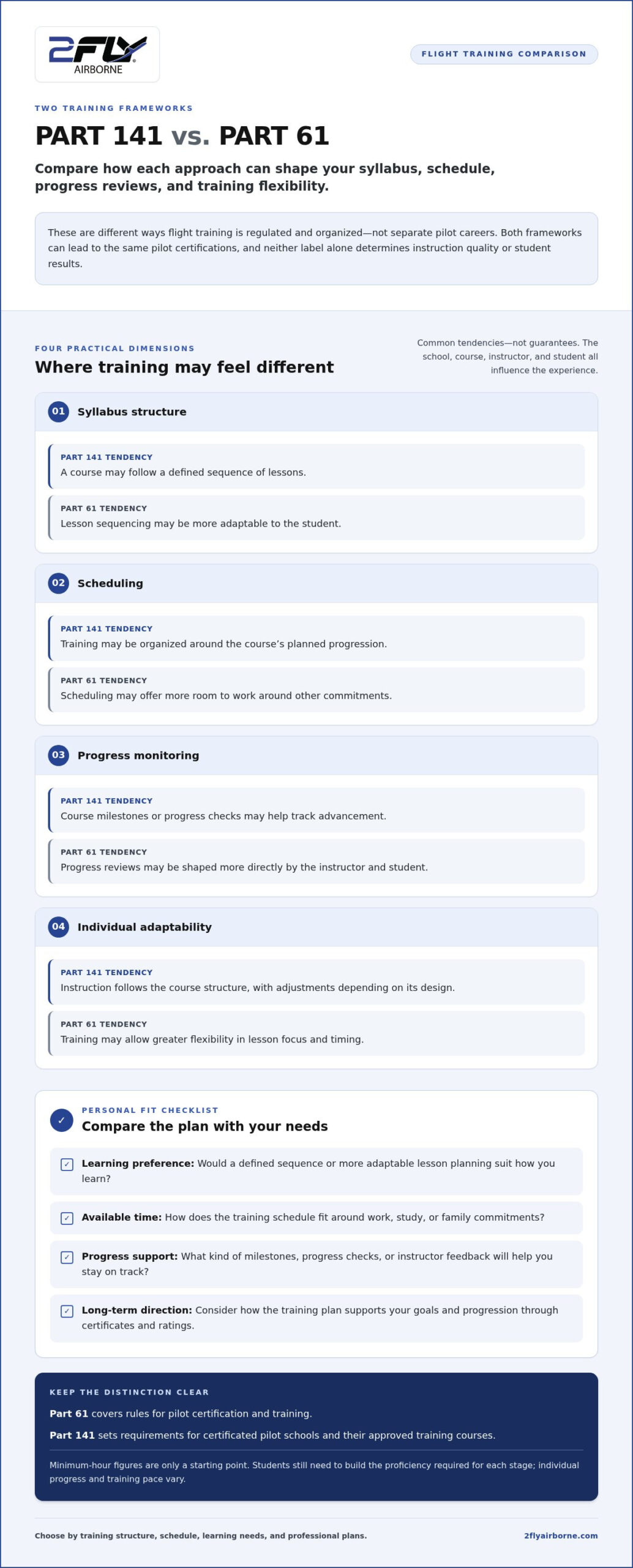
The practical differences often show up in how training is planned, scheduled, and reviewed. A defined sequence can make the next step clear, while a more adaptable arrangement may better accommodate changing availability. These are common tendencies, not guarantees: the school, course, instructor, and student all influence the experience.
Use the comparison as a starting point, then consider how the actual training plan fits your week and learning habits. AOPA’s Guide to Choosing Flight Training also offers useful context for comparing training options.
| Area | Part 141 tendency | Part 61 tendency |
|---|---|---|
| Syllabus structure | A course may follow a defined sequence of lessons. | Lesson sequencing may be more adaptable to the student. |
| Scheduling | Training may be organized around the course’s planned progression. | Scheduling may offer more room to work around other commitments. |
| Progress monitoring | Course milestones or progress checks may help track advancement. | Progress reviews may be shaped more directly by the instructor and student. |
| Individual adaptability | Instruction follows the course structure, with adjustments depending on its design. | Training may allow greater flexibility in lesson focus and timing. |
How does a structured syllabus affect training?
A structured course can lay out what to study and practice before moving to the next phase. For example, a student working toward an instrument rating may benefit from seeing how ground study, flight lessons, and progress reviews fit into the overall sequence. The details vary by course; no single lesson plan or timeline applies everywhere.
Clear sequencing can help students prepare for upcoming lessons and identify areas that need more work. It supports planning, but doesn’t ensure faster completion. Weather, aircraft and instructor scheduling, readiness, and individual progress can all affect the pace.
How much flexibility can Part 61 offer?
With Part 61 training, scheduling and lesson focus may be more adaptable, depending on the instructor and school. That can help a student balance flight lessons with work, study, or family commitments. Flexibility still calls for consistent preparation and practice; it isn’t a substitute for disciplined training or meeting required standards.
Consider a student whose work schedule changes week to week. Adaptable lesson planning could help them keep training moving, while a student who prefers a clear sequence may feel more at ease with a defined course plan. Either way, steady study and communication with the instructor matter.
Training structure shapes the learning process; it doesn’t determine the quality of instruction. In the part 141 vs part 61 flight training comparison, focus on how each plan supports your progress, not just its label. Ask how lessons are sequenced, how progress is reviewed, and how instruction responds when you need more practice in a particular area.
If your goal is a professional career, consider how early flight training fits into a longer plan for certificates and ratings. Explore how a degree program with airline pilot training connects education with pilot training, then compare that structure with your preferred pace and schedule.
Part 141 vs. Part 61: Does Either Route Guarantee Better or Faster Training?
No. Neither Part 61 nor Part 141, by itself, guarantees better instruction, lower total cost, or faster completion. The framework sets the training context; your progress also depends on proficiency, lesson continuity, and the details of the course and instruction. A lower regulatory minimum is not a promise that you’ll finish at that number.
Minimums can still help you understand the rules behind a course. Commonly cited figures include 40 hours of flight time for a private pilot certificate under Part 61 and 35 hours within an approved Part 141 course. For commercial pilot certification, the figures are 250 hours under Part 61 and 190 hours in some approved Part 141 programs. These figures are regulatory context, not personal forecasts. Check current FAA regulations for authoritative requirements and applicable conditions.
Do lower minimum flight hours mean you finish sooner?
A minimum is a threshold, not a personal completion forecast. It describes a regulatory floor for a particular route or course, not how much training you’ll need to demonstrate proficiency or how long training will take on the calendar.
Consider two students enrolled in the same course. One may be ready to progress after a lesson, while another may benefit from additional practice with a maneuver or procedure. That difference doesn’t mean one route failed; students develop skills at different rates.
Progress can also be affected by practical factors such as weather, aircraft and instructor availability, and how consistently lessons are scheduled. Gaps between lessons may mean more review before a student is ready to move forward. These factors make it unwise to treat a minimum-hour figure as a guaranteed finish line.
Does Part 141 automatically cost less or provide better instruction?
No universal cost or quality verdict follows from the Part number. Total training cost depends on individual progress and the details of the program, so a lower minimum doesn’t automatically translate into a lower total. Compare what the training plan includes and how progress is supported rather than relying on a headline hour figure.
Approval and structure are distinct from the quality of day-to-day teaching. Instructor communication, feedback, preparation, and how well lessons address areas where you need practice all shape your experience. A structured course can be well delivered, and adaptable training can be equally disciplined; the label alone can’t establish either.
For career-focused students, assess the whole pathway, not just the first certificate. A private certificate is one stage, while instrument, commercial, multi-engine, and instructor qualifications may form later parts of a professional plan. A minimum for one stage doesn’t describe the time or preparation required across the broader path.
As you compare part 141 vs part 61 flight training, separate three questions: What minimum applies to the specific certificate or course? What training plan supports your proficiency? How does that plan fit your career objective? To connect your goals with a broader professional training pathway, explore 2FLY’s FAA airline pilot program.
How to Choose Between Part 141 and Part 61 for Your Goals
The right choice starts with your destination, not a label. Use this decision process to compare the training framework with your career objective, learning habits, schedule, and the support you’ll need to progress safely.
- Define your immediate goal. Identify the certificate or rating you want to pursue first, such as a Private Pilot Certificate or Instrument Rating. If you’re aiming for a professional aviation career, map the stages that may follow, including commercial and instructor qualifications, rather than judging a route by its first course alone.
- Choose the learning structure that fits you. Do planned sequencing and regular progress checkpoints help you stay focused, or do you need adaptable lesson scheduling to work around other responsibilities? Be honest about how you study and prepare. Flexibility can be useful, but consistent effort matters in either framework.
- Assess your real schedule. Consider the time you can reliably dedicate to lessons, study, and practice. A plan that fits your commitments is more useful than an ambitious schedule you can’t sustain. Ask how the course handles changes in availability and how you’ll maintain continuity if lessons are interrupted.
- Compare the actual course and student support. Look beyond the Part number. Review how lessons are sequenced, how progress is assessed, how instructors communicate areas to strengthen, and what support helps students prepare between lessons. The details of a specific course can matter more to your experience than a broad assumption about a regulatory framework.
- Verify requirements and possible transitions. Check current FAA requirements for the certificate or rating you intend to pursue. If you might change schools or training frameworks, ask how prior training and records may apply to the next course. Don’t assume that credit or progress transfers automatically; the implications depend on the applicable requirements and course.
Which training structure matches your learning style?
If you make progress with a clear sequence and planned checkpoints, a structured course may help you see what comes next and prepare accordingly. If your responsibilities change often, adaptable scheduling may be a priority. Either way, flight training demands regular study, practice, and communication with your instructor. Choose a structure that supports those habits rather than expecting the structure to create them for you.
How should your career goal shape the decision?
Start with the qualification you need now, then consider how it connects to your longer-term professional plan. For example, someone working toward airline-pilot training may want to understand how early certificates and ratings relate to later stages. A structured career-training pathway, such as 2FLY’s FAA Professional Pilot Program, can be part of that wider planning process.
Write down your goal, preferred learning structure, realistic schedule, and questions about support or transitions. That gives you a practical basis for weighing part 141 vs part 61 flight training. For guidance connecting your priorities with a professional training plan, speak with a 2FLY Training Advisor.
Plan Your Next Step: Turn the Part 141 vs. Part 61 Comparison Into a Training Path
The part 141 vs part 61 flight training decision is a starting point for planning, not a decision about your potential as a pilot. Compare how training is organized with your learning needs, available time, and the professional pathway you want to pursue. A clear plan helps you focus on the next qualification while keeping future stages in view.
What should you clarify before beginning flight training?
Before committing to a course, write down the details that will shape your training experience:
- Your first goal: Name the certificate or rating you plan to pursue, such as a Private Pilot Certificate or Instrument Rating.
- Your preferred structure: Decide whether planned sequencing and progress checkpoints suit you, or whether adaptable scheduling better fits your responsibilities.
- Your study commitment: Consider how consistently you can prepare for lessons and make time for practice alongside other commitments.
- Your course expectations: Understand the training sequence, how progress is reviewed, and what support is available as you work toward each stage.
Requirements can change, and personal timelines vary. Review current FAA requirements for your intended certificate or rating, and clarify how previous training may apply if you later change courses or training frameworks. Don’t assume that a transfer will work the same way in every case.
How can a Training Advisor help you plan?
A conversation with a Training Advisor can help you connect your immediate training goal to a wider professional pathway. Bring your questions about course structure, study expectations, and how certificates and ratings may fit together. The aim is to understand the training plan and its demands, not to assume a particular completion date or career outcome.
For aspiring professional pilots, consider how early certificates may lead into later training, including commercial, multi-engine, and instructor qualifications. 2FLY’s FAA Professional Pilot Program is one pathway to explore as you think through a career-focused plan. Match the program sequence to your goals and learning preferences.
Before your discussion, prepare a short list: what you want to earn first, how you learn best, what schedule you can maintain, and what you want your training to support long term. Those priorities make the comparison practical and help keep the next step focused.
Both frameworks call for commitment, sound instruction, and progress grounded in proficiency. Choose a training path that supports safe, structured learning and your individual development. Reach out to a 2FLY Training Advisor with your questions and goals.
Build Your Pilot Training Plan With Confidence
Your next step is to turn your career ambition into a practical training plan. Use your priorities to guide that conversation: the skills you want to develop, the structure that helps you learn, and the professional direction you’re working toward. The part 141 vs part 61 flight training choice can help shape your approach, but your commitment to safe, consistent learning will carry forward throughout your aviation career.
2FLY Airborne’s professional pilot program brings together training across pilot certificates and ratings, within an organization that adheres to FAA and EASA standards. Discussing your goals with a Training Advisor can help you explore how a structured training pathway may relate to your ambitions, while keeping individual progress and current requirements in view.
Take the next step with purpose. Speak with a 2FLY Training Advisor about your pilot training goals, bring your questions, and start shaping a path toward the cockpit. Your aviation future begins with a thoughtful decision and a commitment to keep learning.
Frequently Asked Questions
Is a Part 141 certificate different from a Part 61 certificate?
No. There isn’t a pilot certificate called a “Part 141 certificate” or a “Part 61 certificate.” As you plan, focus on the certificate or rating you intend to earn and the privileges it provides, rather than the training label. Before enrolling, check the current requirements for that specific credential and make sure the course you’re considering supports your intended next step.
Can you switch from Part 61 to Part 141 flight training?
A switch may be possible, but plan it as a transition rather than assuming you can simply continue at the same point. Gather your logbook and available training records, then ask how the new plan would map your completed work to its remaining stages. This gives you a clearer view of what comes next and helps you make a considered decision before changing your training arrangements.
Does Part 141 training always require fewer flight hours?
No. A lower minimum for a particular course, where applicable, doesn’t establish how much flight time an individual student will need. For a useful progress discussion, focus on the skills you’ve demonstrated and the areas your instructor says need more practice. Check current FAA requirements for the specific course rather than relying on a general comparison or an hour figure detached from its conditions.
Is Part 61 flight training more flexible than Part 141?
It can be, but your practical experience depends on the arrangements available in the specific course. Before deciding, consider how lesson booking works with your responsibilities, how you’ll maintain a regular study routine, and what happens if your availability changes. Those details can reveal whether a training plan is workable for you more clearly than the Part number alone.
Does choosing Part 141 guarantee a faster path to becoming a pilot?
No framework can promise when you’ll be ready to complete training. Instead of building plans around a guaranteed finish date, identify the next learning milestones and leave room for your progress to vary. If you’re balancing training with other commitments, consider what routine you can sustain over time. Consistency and safe skill development are more useful planning priorities than an assumed completion timeline.
Do Part 61 and Part 141 pilots earn different commercial pilot certificates?
No. The training route doesn’t give a commercial pilot certificate a different title. If your goal involves a particular kind of flying, identify the certificate and ratings relevant to that goal, then review the current requirements and any applicable limitations. This keeps your planning focused on the qualification you need rather than assuming the framework itself changes what the credential allows.
Which flight training route is better for a future airline pilot?
Neither route is automatically best for every aspiring airline pilot. Compare how a training plan connects its early learning stages to the qualifications you may pursue later, and consider whether its study and scheduling demands suit your circumstances. The part 141 vs part 61 flight training choice is one planning consideration, not a hiring promise. Keep your career goals in view as you evaluate the full pathway.
Choose a training plan that supports steady, safe progress toward your goals. For help discussing your pilot training questions and professional pathway, reach out to a 2FLY Training Advisor.

Article by
2FLY Airborne
2Fly Airborne is a professional flight training organization dedicated to developing the next generation of skilled, confident, and safety-focused pilots. With decades of combined aviation experience, our team of certified instructors provides structured, real-world training designed to prepare students for both checkrides and long-term success in the aviation industry.
Content Disclaimer
Some blog content is generated with the assistance of automated tools and may not always be fully accurate or up to date. Please verify all aviation-related information with official sources or a certified instructor. For additional guidance or clarification, we encourage you to contact one of our training advisors at 2Fly Airborne.