Is dual flight instruction worth the investment in commercial pilot training? It can be an important part of developing the skills and experience needed for professional flying, but the total cost depends on more than cockpit time. Understanding dual flight instruction fee schedules for commercial candidates means seeing how aircraft use, instructor time, and ground briefings fit together.
It’s reasonable to want a clear picture of training costs before committing to the next stage of your aviation career. This guide explains how aircraft and instructor charges shape a training budget, what dual flight and ground instruction involve, and why costs differ by training path and aircraft. You’ll have a practical framework for assessing the investment and planning your progress toward a Commercial Pilot Certificate.
Key Takeaways
- Separate aircraft rental, instructor time, and ground instruction when assessing commercial training costs.
- Compare single-engine and multi-engine training as distinct paths, since aircraft choice and training needs affect the budget.
- Understand how prior flight experience and qualifications shape the remaining commercial training requirements.
- Account for both flight and ground instruction when planning the training schedule.
- Explore how 2FLY Airborne’s Commercial Pilot Certificate and FAA Professional Pilot Program fit your career goals.
Commercial single-engine and multi-engine training prices
Commercial-stage costs depend on the aircraft, instructor time, and training still required. A single-engine lesson and a multi-engine lesson use different aircraft, so their hourly charges differ. The total may also include ground instruction, briefings, and extra practice needed to meet course objectives. Look for a schedule that separates these items: a combined figure can obscure what drives the budget.
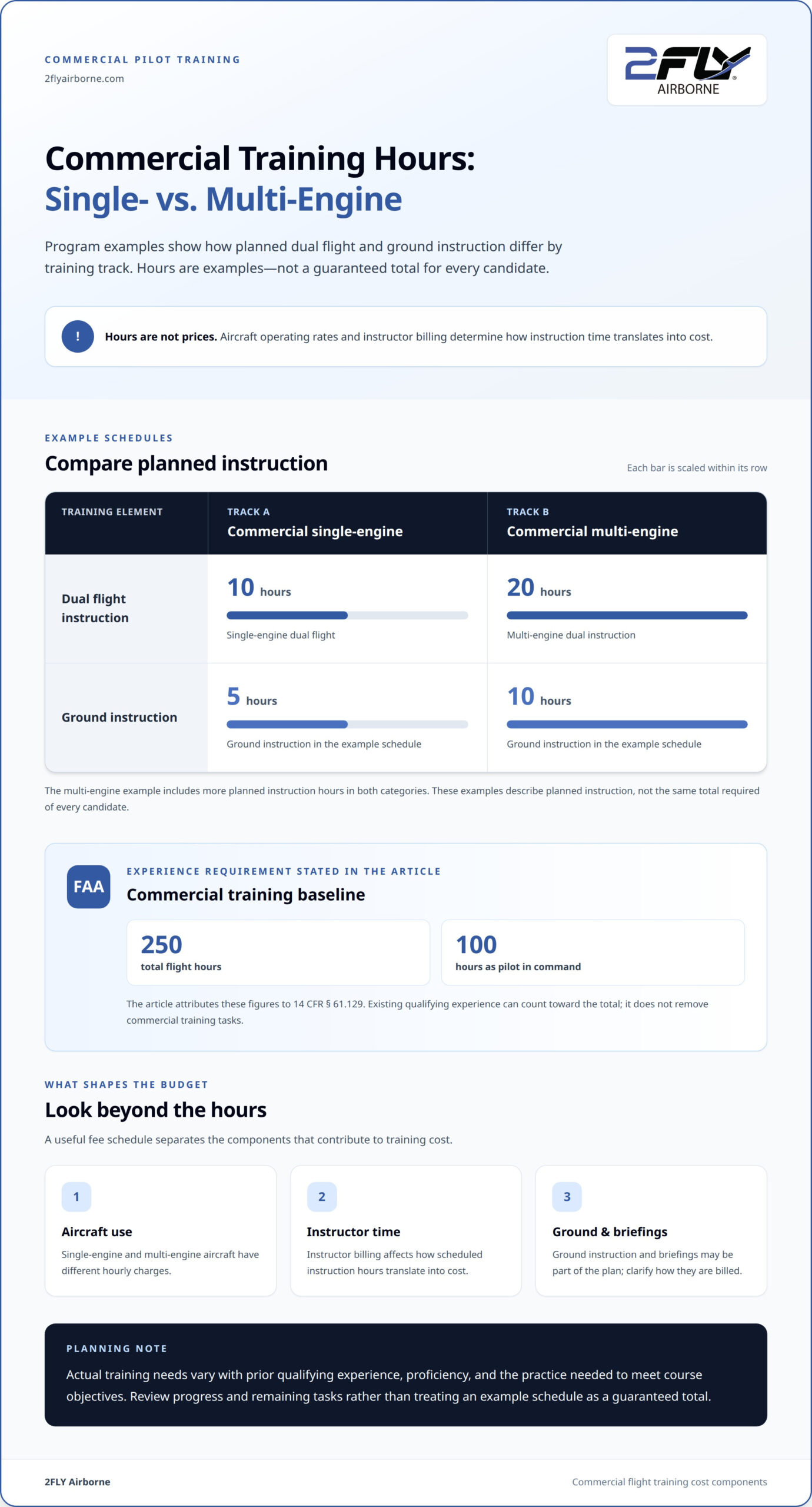
Program examples show how training hours differ by track. A commercial single-engine schedule example includes 10 hours of dual flight instruction and 5 hours of ground instruction. A commercial multi-engine example includes 20 hours of multi-engine dual instruction and 10 hours of ground instruction. These examples describe planned instruction, not a guaranteed total for every candidate. The aircraft’s operating rate and instructor billing determine how hours translate into cost.
Training from zero involves a longer path than completing the commercial stage after earlier certificates and experience. Candidates first build the foundation for later pilot certifications, then progress through commercial flight training. Under 14 CFR § 61.129, the Federal Aviation Administration (FAA) requires 250 total flight hours, including 100 hours as pilot in command, for U.S. commercial pilot training. Existing qualifying experience can reduce how much time remains to build, but it doesn’t remove commercial training tasks.
Individual progress also affects the training plan. A candidate who consistently meets lesson objectives may need fewer repeat sessions than someone who needs more practice with maneuvers or procedures. In multi-engine training, lessons cover aircraft-specific handling and coordination, with time for areas that need reinforcement. Reviewing progress after each lesson helps clarify what is complete and what remains, without assuming every candidate will need the same hours.
South Florida training routes also shape each lesson’s plan. Weather, traffic, airspace, and the day’s training objective influence where the aircraft flies and how much time goes to each exercise. A route lesson may combine navigation practice with commercial-level maneuver work, while another session focuses on a specific skill near the training area. The school’s schedule should show how route time supports the syllabus rather than treating every flight as identical.
Materials and avionics subscriptions belong in the budget alongside flight and ground instruction. A headset, kneeboard, and sectional charts are examples of personal equipment; ForeFlight is an electronic flight-planning tool. Subscription choices and required materials depend on the training setup. Clarify which items support lessons, which are personal purchases, and whether ground briefings are billed separately from cockpit instruction. That breakdown makes a fee schedule easier to compare with the training plan.
Commercial training costs for pilots with private and instrument qualifications
A Private Pilot Certificate and Instrument Rating provide a foundation for commercial training. The remaining workload depends on logged experience, course structure, and proficiency in required maneuvers. These factors shape the amount of dual instruction, solo practice, and ground school still needed.
Under 14 CFR § 61.129, the Federal Aviation Administration (FAA) requires 250 total flight hours, including 100 hours as pilot in command, for U.S. commercial pilot training. Those figures are experience requirements, not a promise that every pilot will need the same additional training. A pilot’s existing qualifying hours count toward the total, while unfinished training tasks still require attention.
Part 61 and Part 141 organize training differently. Part 61 sets aeronautical experience requirements, while Part 141 uses an FAA-approved course syllabus with defined training elements. For an airplane single-engine course, the Federal Aviation Administration (FAA) specifies 55 hours of flight training from a certificated flight instructor on the approved areas of operation. The course format affects how instruction is organized, so compare the applicable syllabus and requirements rather than treating the two paths as interchangeable.
Commercial training in the United States includes 10 hours in a complex, turbine-powered, or technically advanced aircraft, according to the Federal Aviation Administration (FAA). Complex aircraft have features that require additional operating knowledge; technically advanced aircraft use integrated electronic displays and navigation systems. A candidate’s logbook and course record help the instructor identify how this requirement fits the broader training plan.
Dual and solo time serve different purposes. In an illustrative Part 61 example, a candidate with 120 qualifying flight hours needs 130 additional hours to reach 250; the total does not mean all 130 hours are commercial dual instruction. One cost example assigns 20 additional dual hours to commercial training. The remainder of a candidate’s plan depends on qualifying experience, solo tasks, and the required instruction.
Commercial lessons build precision in maneuvers and decision-making. In the cockpit, students practice commercial standards such as steep turns, chandelles, lazy eights, and power-off accuracy approaches. Ground school and preflight briefings connect each maneuver to performance planning, limitations, and sound decisions. Instructors also use simulated abnormal or emergency scenarios to develop appropriate responses without treating a practice event as an actual emergency.
Progress reviews help pilots understand what remains: required experience, course elements, and areas needing more practice. A written training plan can separate dual instruction, solo flight, and ground lessons, clarifying cost drivers without confusing regulatory minimums with an individual’s full training path.
Dual flight instruction and ground instructor fees
Dual instruction combines teaching in the aircraft with preparation and review on the ground. Charges may be combined or listed separately, so read each line to understand what the fee covers. Comparing dual flight instruction fee schedules for commercial candidates can clarify how a school bills instruction and which activities are included.
Comparing Fees Across Schools and Regions
Dual instruction fees vary among U.S. regions and flight schools, reflecting differences in aircraft, operating expenses, and instructor qualifications. Instructor experience and additional ratings may also affect the listed rate.
This comparison matters because lesson rates that look alike may cover different services. Check whether the charge includes cockpit instruction, ground briefings, and aircraft use, or whether those items are billed separately. Compare similar aircraft and lesson types for a meaningful comparison.
Comparing Flight School Fee Schedules
A flight school fee schedule lists training charges and billing assumptions. Compare aircraft time, instructor time, ground sessions, and how additional practice is charged.
Also clarify whether the schedule uses individual lessons or prepaid blocks, and what each option includes. Compare the same training scope across schools rather than relying on a headline hourly rate that may omit separate charges.
For commercial candidates, dual flight instruction means an instructor teaches and evaluates the pilot during aircraft training. Cockpit instruction can include demonstrations, coaching, and feedback on commercial maneuvers. Preflight and postflight briefings support the lesson by setting objectives and reviewing performance. Fee schedules should state whether these sessions are included or charged separately.
An independent multi-engine instructor’s fee may be separate from aircraft rental. The instructor’s qualifications and teaching scope affect how the charge fits into the training plan. Clarify whether the stated fee covers flight instruction only or includes briefing and debriefing time. These distinctions help explain differences between multi-engine schedules.
Books, examination fees, written tests, and checkride expenses may add charges beyond routine instruction. Keep them as separate budget items unless the schedule clearly includes them. The FAA does not publish a fee schedule for the multi-engine checkride; each examiner sets their own fee. Aircraft rental for the checkride may also be billed separately.
Reviewing these line items before training begins can reveal where costs may change. Extra practice, separately billed briefings, and assessment expenses can push the total beyond the lesson estimate. A schedule that identifies each charge and billing basis gives candidates a clearer view of the financial commitment through training completion.
Hourly rates for aircraft rental and flight instruction
A commercial dual lesson may include aircraft rental, instructor time, and fuel-related charges. The total depends on aircraft type, location, and instructor qualifications. A wet rental rate includes fuel and oil in the aircraft charge, but instructor time may be billed separately. This explains why schools can show different hourly totals for lessons that appear similar.
Separate aircraft and instructor charges before comparing rates. These are aircraft rental rates, not combined dual-instruction prices. The instructor’s fee may be added separately.
Multi-engine aircraft have distinct hourly ranges. The listed range varies by model, so a rate for one twin does not represent every multi-engine lesson.
“Wet” means fuel and oil are included in the aircraft rental charge. It does not mean the instructor is included. To assess dual flight instruction fee schedules for commercial candidates, identify the aircraft rate, instructor charge, and any other billed lesson components separately.
Time measurement also affects aircraft charges. A Hobbs meter may record time based on different triggers, such as engine operation or electrical power, and typically displays tenths of an hour. The aircraft’s billing policy determines how the recorded time is charged, so billed aircraft time can differ from time spent airborne. The schedule should specify which time basis applies to lessons and checkride aircraft rental. This helps candidates understand how recorded time becomes a charge.
Approved simulators or training devices offer another way to practice procedures. A simulator session and an aircraft lesson serve different purposes, so compare their roles in the syllabus rather than treating their hours as interchangeable.
Aircraft rental also affects time-building toward a commercial aviation career. The aircraft should fit the training objective, whether the lesson focuses on single-engine procedures or multi-engine operations. A lower rental rate may not suit every objective, while a more advanced aircraft may have a different hourly charge.
To interpret a fee schedule, note the aircraft model, wet or dry rental basis, instructor charge, simulator use, and time-recording method. Keep checkride aircraft rental separate from the examiner fee. These details show what each hourly amount covers and help candidates plan a budget without confusing aircraft expenses with instruction charges.
Dual flight instruction and ground instruction hours
A commercial training schedule divides instruction between cockpit practice and focused ground learning. One Commercial Pilot License program description allocates 20 hours of dual flight instruction and 10 hours of focused ground instruction. Those scheduled hours give candidates a framework, while lesson objectives determine how each session is used.
Dual instruction places a flight instructor in the aircraft with the candidate. The instructor demonstrates, observes, and coaches as the candidate applies commercial-level procedures. A lesson may focus on maneuver accuracy, aircraft control, or planning and decision-making. Preflight briefings establish the objective; postflight debriefings identify what to develop in the next lesson.
Ground instruction supports cockpit training. A commercial candidate may review aircraft performance, weather interpretation, navigation, regulations, and risk management with an instructor. Connecting these subjects to a planned flight helps students understand why a procedure matters, rather than simply memorizing it for an examination. Schools may schedule ground lessons separately from flights.
Scheduled hours and individual progress are different measures. A syllabus assigns time to specific training objectives, but a candidate’s pace depends on performance and retained skills. If a maneuver needs more practice, the instructor can revisit it before moving on. This keeps proficiency and safe procedures central instead of treating a listed hour total as a guaranteed finish point.
Advanced training adds another hours category. Multi-Engine Instructor training involves 10-20 hours of multi-engine dual instruction in the estimate provided for that course. This is instructor-level preparation, not a substitute for commercial certificate instruction. It illustrates why candidates should identify which certificate or instructor qualification a schedule covers before comparing its listed hours.
Part 141 students follow an approved course structure, while Part 61 training organizes instruction under a different framework. The applicable syllabus helps explain how dual flight, ground school, and progress reviews fit together. For an instrument-qualified pilot, the commercial plan should distinguish required experience already logged from lessons still needed to meet the course objectives.
Use the schedule to separate cockpit instruction, ground lessons, and additional practice. Ask how instructors document progress and connect each debrief to the next lesson. That record helps candidates see whether their training plan is progressing toward the commercial certificate with clear, safety-focused objectives.
Explore structured commercial pilot training to see how a defined training pathway can support your next aviation qualification.
2FLY Airborne: Commercial Pilot Certificate (CPL)
2FLY Airborne provides a Commercial Pilot Certificate (CPL) pathway for pilots ready to advance from earlier qualifications toward professional aviation. If you hold a Private Pilot Certificate and Instrument Rating, the next step is understanding how commercial instruction fits your experience and goals.
The FAA Professional Pilot Program offers a structured route through pilot training. Candidates can discuss their current certificates, flight experience, and remaining training needs with a 2FLY Training Advisor. This helps connect the commercial stage with the qualifications already earned, without treating every candidate’s path as identical.
For a clear next step, contact 2FLY Airborne with questions about commercial pilot training and your progression.
Turn Your Training Plan Into Your Next Step
Your commercial aviation goal becomes more actionable when your training plan reflects your experience, learning priorities, and professional direction. Reviewing dual flight instruction fee schedules for commercial candidates can help you prepare focused questions and understand how instruction fits into your broader development.
In your next conversation with a training advisor, discuss the path ahead, the skills you want to strengthen, and how structured training can support progress. A clear plan keeps safety and proficiency central as you work toward the responsibilities of a professional pilot.
2FLY Airborne can help you explore how its pilot training pathways fit your goals. Contact 2FLY Airborne about training to discuss your next step and questions about your aviation training journey.
Frequently Asked Questions
Is It Worth the Cost?
Dual instruction can be worthwhile when it builds skills for commercial flying and gives candidates structured feedback. Its value depends on how well lessons address individual training goals, not simply on hours flown. For example, a focused session that identifies a weak maneuver can guide later practice. Consider whether the training supports your certification objectives and professional plans alongside its overall cost.
Quick Answer: How Much Does Commercial Pilot Training Cost?
There isn’t one total that fits every commercial candidate. The budget depends on prior experience, remaining flight-hour requirements, aircraft type, and the balance of dual, solo, and ground training. For example, a pilot with private and instrument qualifications may have a different training plan from someone still building experience. Separate instruction, aircraft use, exams, and checkride expenses to understand what a quoted total includes.
What are current dual flight instruction hourly rates at U.S. flight schools?
Rates vary by location, aircraft, and instructor qualifications, so one hourly figure won’t represent every U.S. flight school. Distinguish a combined dual rate from a schedule that bills instructor and aircraft time separately. For a useful comparison, identify the lesson type and aircraft, then check whether ground briefings appear as separate charges. The hourly rate alone doesn’t show the full session cost.
What aircraft are commonly used for commercial pilot dual instruction, and what are their hourly rates?
Commercial dual instruction may use single-engine aircraft such as a Cessna 172 or Piper Arrow, while multi-engine training can use a Piper Seminole, Beechcraft Duchess, Diamond DA42, or Tecnam P2006T. Hourly rental rates vary by model and school, and the aircraft’s role matters as much as its rate. A candidate should compare aircraft suited to the specific training objective, not unlike categories.
Do flight schools offer package rates or block-time discounts for commercial dual instruction?
Some flight schools offer prepaid block-time arrangements, which can change the effective hourly rate compared with individual lessons. Their value depends on whether the planned hours match the candidate’s training needs and how the package handles unused time. Compare the included aircraft and instruction with the expected syllabus, and account for ground lessons and other charges separately. A lower listed rate alone doesn’t establish better overall value.
What additional fees may apply, such as simulator, landing, dispatch, or checkride costs?
Additional charges can include simulator sessions, examination materials, written tests, and aircraft rental for a checkride. Landing or dispatch charges depend on the flight school’s fee structure, so distinguish them from instructor and aircraft time in any estimate. For a multi-engine checkride, the examiner sets the fee, separate from aircraft rental. Reviewing these line items helps reveal costs beyond routine lessons.
Article by
2FLY Airborne
2Fly Airborne is a professional flight training organization dedicated to developing the next generation of skilled, confident, and safety-focused pilots. With decades of combined aviation experience, our team of certified instructors provides structured, real-world training designed to prepare students for both checkrides and long-term success in the aviation industry.
Content Disclaimer
Some blog content is generated with the assistance of automated tools and may not always be fully accurate or up to date. Please verify all aviation-related information with official sources or a certified instructor. For additional guidance or clarification, we encourage you to contact one of our training advisors at 2Fly Airborne.