
How much should you budget to rent an aircraft solo in Arizona while building flight time? The rate is only part of the total, though.
It’s natural to focus on the hourly figure when estimating how far your budget will go. Compare rates for similar aircraft, then account for rental terms, airport charges, insurance, and any instruction. Your choice between a single-engine trainer and a multi-engine aircraft also affects the budget, so match the aircraft to your hour-building goals.
Key Takeaways
- Compare typical wet rates across single-engine trainers and twin-engine aircraft to match your rental choice to your hour-building goals.
- Separate fuel-included wet rates from dry rates, and understand whether billing uses Hobbs time or tach time.
- Include insurance, instruction, landing charges, and overnight fees when estimating the full cost of a flight.
- Account for aircraft equipment, airport location, and possible minimum daily charges when planning longer rentals.
- Explore whether 2FLY Airborne’s Hour Building Packages fit your next stage of aviation training.
Average wet hourly rental rates by aircraft type
Wet rental rates vary by aircraft, airport, and local demand.
When planning to build hours, compare rates for similar trainers rather than treating all aircraft rental rates as equivalent.
Single-Engine Trainer Rental Rates
Single-engine trainers such as the Cessna 152, Cessna 172, and Piper Warrior are common aircraft for building flight time.
When estimating trainer costs, account for the aircraft model and equipment, which affect the hourly rate.
Single-engine rental rates differ by model and configuration. Newer avionics may add capabilities, but can also place an aircraft in a higher rental-rate range.
Twin-engine rentals cost more than comparable single-engine trainers.
Hourly and Block-Time Pricing
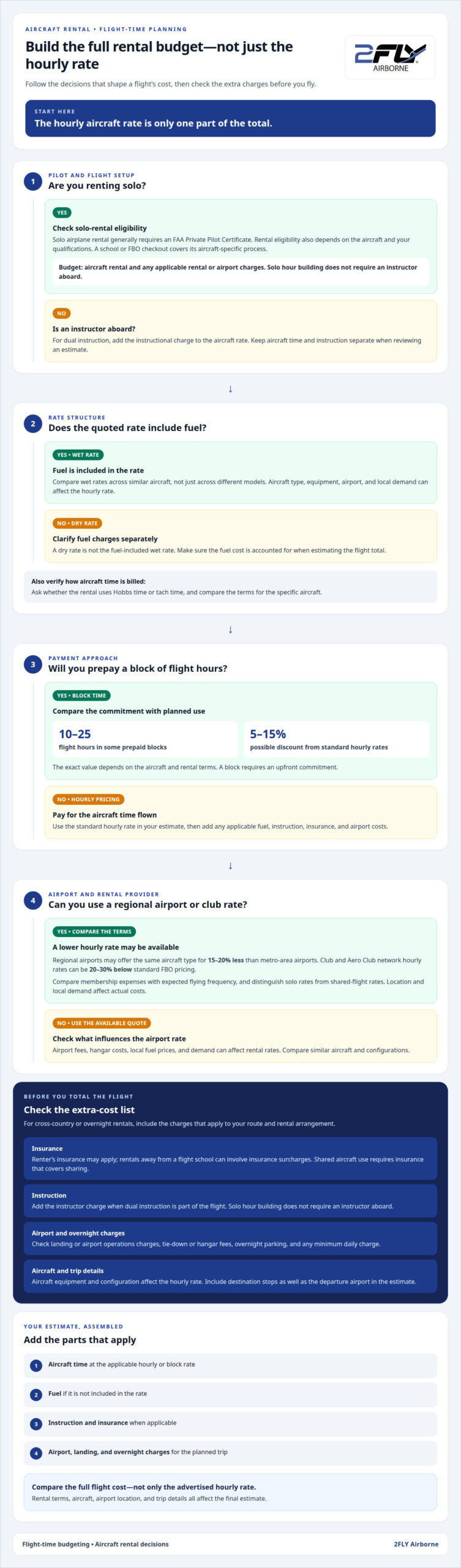
Hourly pricing charges for the aircraft time flown. Block-time pricing may offer a lower hourly rate in exchange for prepaying for a set number of hours. A block can reduce the rate for pilots building time, but requires an upfront commitment to planned use.
Some prepaid blocks of 10-25 flight hours receive a 5-15% discount from standard hourly rates. The exact value depends on the aircraft and rental terms, so compare the block’s total commitment with the hours you expect to fly.
Airport location also changes the cost. Regional airports may offer the same aircraft type for 15-20% less than metro-area airports, where airport fees, hangar costs, local fuel prices, and demand can influence rates. In specific FAA contexts, the cross-country threshold is an airport more than 50 nautical miles from the starting point. Longer flights can make rental terms, including any minimum daily charge, especially relevant.
How Much Does It Cost to Rent a Plane as a Private Pilot in Arizona?
Solo rental, dual instruction, and shared flights have different cost structures. To estimate solo aircraft rental costs for hour building, separate the aircraft charge from instruction and other flight-related expenses.
Rental Costs in Training Estimates
A private-pilot training estimate combines aircraft rental with other training expenses, so the hourly aircraft rate is only one part of the budget. A U.S. training estimate covers more than solo rental time, and the balance of dual instruction and independent flying affects the total.
Training flights with an instructor add an instructional charge to the aircraft rate. Separate aircraft time, ground school, and instruction to see what an estimate includes and how each flight contributes toward a certificate.
Pilot Fees and Self-Flying Requirements
When flying solo, the renter operates the aircraft rather than paying for a pilot to fly it.
Solo airplane rental generally requires an FAA Private Pilot Certificate. Rental eligibility depends on the aircraft and the pilot’s qualifications, and student pilots typically fly with an instructor rather than renting independently. A flight-school or FBO checkout covers the operator’s aircraft-specific rental process, but does not replace the required pilot certificate.
Safety pilots matter when pilots share simulated-instrument flights. Under 14 CFR 91.109, a safety pilot is a required crewmember during simulated instrument flight. Under 14 CFR 61.51, a pilot may log PIC time in that setting only when their qualifications and the applicable logging requirements allow it; being the sole manipulator of the controls does not by itself establish eligibility. PIC means pilot in command, the pilot responsible for the flight.
Sharing an aircraft can spread rental expenses, but cost-sharing requires clear roles. Pilots building PIC time together can alternate who acts as PIC and safety pilot between flights. Put aircraft use, fuel, liability, and repair costs in a written agreement, and make sure insurance covers sharing.
As you plan flight hours, consider how rental time fits into a broader training path. Structured FAA pilot training can help you plan your next certification and connect your flying goals with a longer-term aviation career.
Additional fees, insurance, and instruction costs
The aircraft’s hourly rate is only one part of a flight’s total cost. A student renting for training may also pay for instruction, renter’s insurance, airport operations, and overnight parking. For example, a cross-country flight may involve landing at another airport and paying tie-down or hangar charges before departure. These costs vary by location and rental arrangement, so include them in your trip budget.
Pilots sharing an aircraft need insurance that covers sharing, along with a written agreement on liability, repairs, aircraft use, and fuel. An hourly split alone doesn’t explain how partners will handle damage or operating expenses. Review the insurance and agreement together before treating shared flying as a simple division of the rental bill.
Airport charges can add to the cost of each flight. An overnight hangar may mean another charge, and renting away from a flight school can involve insurance surcharges. Local airport fees and facilities determine which costs apply, so include destination stops as well as the departure airport in trip estimates.
Club and Aero Club network hourly rates can be 20-30% below standard FBO pricing. Compare membership expenses with expected flying frequency, and distinguish solo rates from shared-flight rates.
Instruction and crew arrangements also affect the bill. Dual instruction applies when a student needs an instructor aboard; solo hour building does not require that setup. The type of flight determines which fees apply.
For a cross-country or overnight rental, account for the aircraft rate, equipment, landing operations, tie-down, and any minimum daily charge. These line items give you a more complete estimate than the advertised hourly rate alone, whether you rent through a club or an FBO.
Cessna 152 and Piper Warrior trainer rental costs
The Cessna 152 and Piper Warrior are single-engine trainers used for flight training and hour building. Their rental rates can help pilots compare aircraft costs, but the lowest hourly price alone doesn’t show which aircraft best supports a training goal.
Rental estimates vary by date and source. U.S. figures represent different snapshots, not a guaranteed rental quote.
Compared with the newer Cessna 152 market band, those estimates overlap only partly. The aircraft model, rental terms, and local airport affect the rate, so a useful comparison looks at the specific aircraft and its full terms, not just its name.
For an affordable hour-building plan, calculate the expected flight-hour total using the aircraft’s current hourly rate. Then account for any applicable rental conditions, including prepaid blocks. Blocks of 10-25 flight hours have commonly received 5-15% discounts from standard hourly rates. A lower rate can help, but prepaying makes sense only when the planned hours fit the pilot’s schedule and training needs.
Safety standards deserve equal attention. Compare the aircraft checkout process, the condition and maintenance status of the specific aircraft, and the procedures used before dispatch. A checkout builds familiarity with that aircraft, but does not replace safe decision-making or required qualifications. Clear briefings and consistent preparation also help make each flight hour purposeful.
Rental and training expenses can extend beyond the aircraft’s listed rate. Those amounts apply to different cost items, so avoid treating them as interchangeable or automatically applicable to every Cessna 152 or Piper Warrior rental.
Compare each aircraft’s billing method and rental conditions before estimating a total. Hobbs time and tach time can accrue differently, changing the billed flight time. For overnight or cross-country plans, minimum daily charges may also affect the total. A Cessna 172 offers another single-engine reference point, but its rate and equipment should be assessed separately from a Cessna 152 or Piper Warrior.
Cessna 172 and Piper Archer rental costs
A Cessna 172 can provide a useful benchmark for comparing trainer rental costs. Rental rates vary by aircraft configuration and location, so use the rate and billing terms for the specific model when budgeting to build hours.
Arizona rental rates can differ from those in other U.S. markets. A Cessna 172SP with a G1000 is a distinct configuration, and its rental price may differ from other Cessna 172 models. Comparing aircraft names alone can obscure meaningful differences in configuration and local rental pricing.
The Piper Archer is another model you may encounter when comparing trainers. Don’t apply a Piper Warrior rental rate to an Archer: they are distinct models, and the Warrior rate does not establish the Archer’s price. For either airplane, total cost depends on the applicable hourly rate, whether fuel is included, and how flight hours are billed.
Equipment can change the rental total. A Garmin G1000 is specifically associated with the Cessna 172SP rate above, so compare aircraft configurations rather than assuming every Cessna 172 has identical equipment or pricing.
Billing method matters when building hours. Aircraft rental may use Hobbs time or tach time, which can accrue differently. A block rental requires prepaying for set flight hours in exchange for a reduced hourly price. Cross-country or overnight rentals may also have minimum daily charges, raising the total when daily flight time is limited.
Build your cost comparison around the flight’s purpose. A pilot focused on accumulating hours may prioritize the rental rate and billing basis; a pilot working toward a certificate may also need to budget for instruction. Airport fees, local fuel prices, hangar costs, and market demand can affect rental rates, too.
For pilots pursuing a commercial pilot certificate under FAA Part 61 through the airplane single-engine path, the Federal Aviation Administration requires at least 250 flight hours. The aircraft’s hourly rate therefore matters across repeated flights, not just one booking. Compare the specific Cessna 172 or Piper Archer, its equipment, and rental terms before estimating the total cost of building those hours.
2FLY Airborne: Hour Building Packages
2FLY Airborne offers Hour Building Packages for pilots planning their next stage of aviation training. They’re a relevant next step when you’ve estimated rental expenses and want to connect accumulated flight time with a broader professional training path.
Hour building packages complement the FAA Professional Pilot Program, Private Pilot Certificate (PPL), and Instrument Rating (IR). Consider how hour building fits into your progression toward additional pilot certifications, rather than treating it as an isolated rental decision. Explore these options when mapping your current certificates and ratings to your training goals.
For a clearer view of how hour building could fit your plans, contact 2FLY Airborne.
Turn Your Flight-Time Plan Into a Career Path
Understanding solo aircraft rental costs by the hour for hour building is one part of a larger decision: how each flight supports your development as a pilot. Set goals that account for both accumulated experience and the skills you want to strengthen. A purposeful plan keeps hour building connected to your next step in aviation.
2FLY Airborne offers an FAA Professional Pilot Program, a Private Pilot Certificate (PPL), and an Instrument Rating (IR). These options can help you shape a structured training path around your current qualifications and long-term professional ambitions.
Choose your next step with intention. Contact 2FLY Airborne to discuss your training goals and explore a path forward. Keep building experience with a clear purpose, and let each flight move you closer to the pilot career you’re working toward.
Frequently Asked Questions
Are There Extra Fees Beyond the Hourly Rate?
Yes, a rental flight can involve charges beyond aircraft time. Renter’s insurance is another budget item, while instruction applies when an instructor joins the flight. For a trip with multiple stops, account for each landing and any overnight parking rather than estimating from flight time alone.
How Can You Reduce the Cost of Renting an Airplane?
Prepaid blocks, shared flights, and flying clubs can lower the effective hourly expense. Blocks of 10-25 hours have commonly received 5-15% discounts, while club rates can run 20-30% below standard FBO pricing. Compare any savings with prepaid commitments or monthly membership fees. Sharing costs also requires agreed roles and suitable insurance, so the arrangement should account for fuel, aircraft use, and responsibility for repairs.
Is Renting a Plane Cheaper Than Owning One?
Renting may cost less for pilots who fly occasionally because it avoids ongoing aircraft ownership expenses. Ownership may make sense for frequent flying, but its total cost includes more than the purchase price or flight time. Hangar expenses, maintenance, insurance, and periods when the airplane cannot fly all affect the calculation. Compare expected use with recurring ownership obligations and the rental terms for the aircraft you need.
What Factors Affect Airplane Rental Prices?
Rental prices reflect aircraft type, model, equipment, airport, fuel terms, and local demand. A glass-cockpit Cessna 172SP, for example, can have a different rate from an older trainer. Location matters too: the same aircraft type may cost 15-20% less at a regional airport than at a metro-area airport. Billing method and minimum daily charges can also change the total for a longer trip or overnight rental.
How much does it cost to rent a Cessna 150 or 152 per hour?
A separate market snapshot collected November 12, 2026, places Cessna 152 offers between $154 and $161 per hour, with a median of about $160. These figures reflect different time periods and samples. For a Cessna 150, the applicable rate depends on its model, equipment, location, and rental terms.
How much does it cost to rent a Cessna 172 or Piper PA-28 per hour?
Don’t assume Warrior pricing applies to the Piper Archer, a different model.
Are aircraft rental rates wet or dry, and what fuel costs are included?
A wet rate includes fuel in the aircraft rental price; a dry rate excludes it, leaving fuel costs separate. For a dry rental, include expected fuel use in your flight budget rather than comparing its rate directly with a wet rate. Avgas at many U.S. airports is priced separately. The aircraft’s fuel consumption and local fuel price affect what you spend on a dry rental.
What additional fees apply to solo aircraft rental, such as insurance, checkout, or landing fees?
Common additional expenses include renter’s insurance, airport landing charges, and any required aircraft checkout. Checkout costs depend on the aircraft and rental process, so account for any required aircraft or instructor time. Overnight parking or hangar charges may also apply when a solo flight includes a stop away from home base.
Article by
2FLY Airborne
2Fly Airborne is a professional flight training organization dedicated to developing the next generation of skilled, confident, and safety-focused pilots. With decades of combined aviation experience, our team of certified instructors provides structured, real-world training designed to prepare students for both checkrides and long-term success in the aviation industry.
Content Disclaimer
Some blog content is generated with the assistance of automated tools and may not always be fully accurate or up to date. Please verify all aviation-related information with official sources or a certified instructor. For additional guidance or clarification, we encourage you to contact one of our training advisors at 2Fly Airborne.