
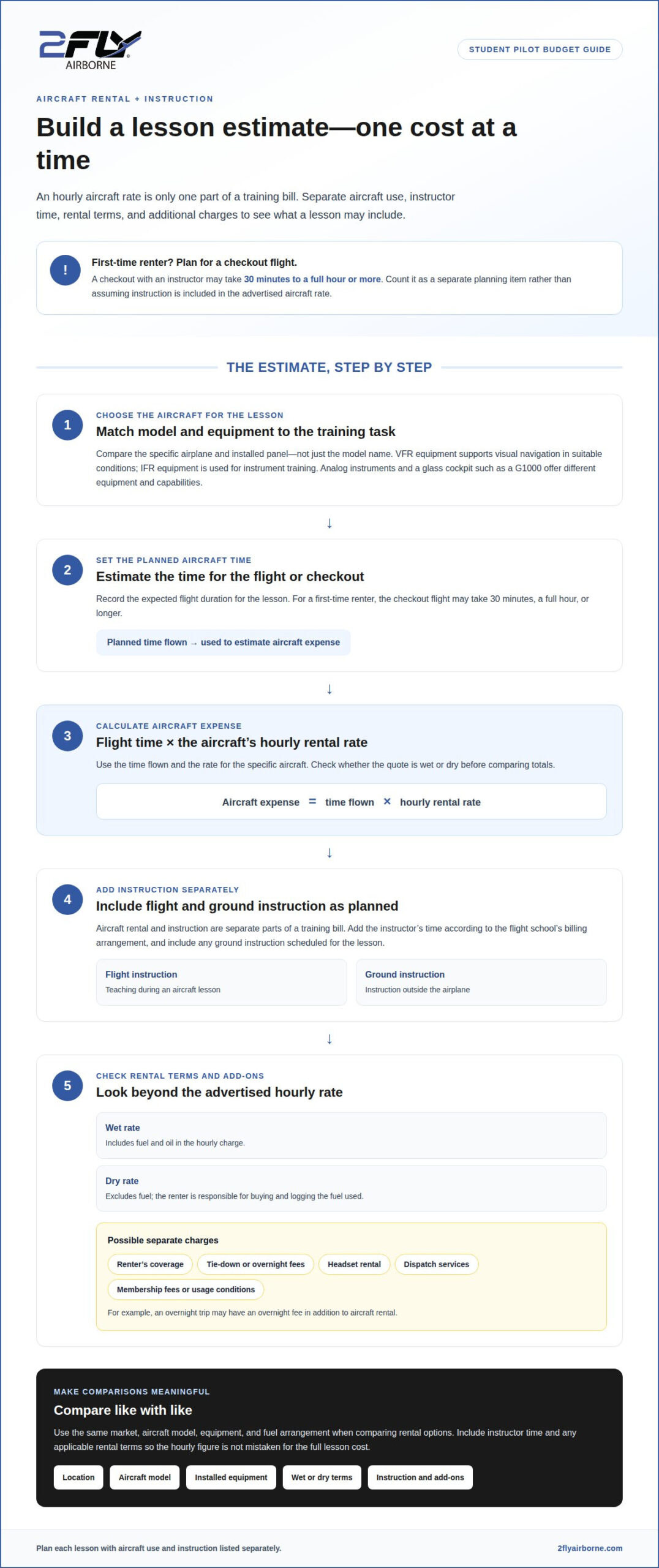
What if the hourly rental rate is only part of the cost of getting into the air? A first-time renter may also need a checkout flight with an instructor, which can take 30 minutes to a full hour or more.
When planning a lesson, the aircraft rate is only part of the picture. Total training costs can also include instructor time, aircraft equipment, and separate rental charges. Knowing how these costs are billed helps you set a realistic budget and compare training options.
This guide covers rental terms, avionics, instructor charges, and common add-ons to consider when comparing Cessna and Piper aircraft rental fees for student pilots. Use the details to understand what a rental quote includes and how it fits your flight training plan.
Key Takeaways
- Compare aircraft equipment as well as the hourly rate: VFR and IFR setups can affect rental costs, and wet rates include fuel and oil while dry rates exclude fuel.
- Budget for instructor time, since a first-time renter may need a checkout flight lasting 30 minutes to a full hour or more.
- Look beyond the advertised aircraft rate when planning: insurance, tie-down or overnight fees, headset rental, and dispatch services may add charges.
- Understand how rental arrangements such as packages or block-hour rates affect your training budget before choosing a plan.
Typical NYC-Area Hourly Rental Rates for Cessna 172s and Piper Warriors
These ranges give student pilots a concrete starting point for comparing aircraft.
Piper Warrior and Cherokee 140 Rates
That range overlaps with Cessna 172 pricing, so the model name alone doesn’t identify the lower-cost choice. Compare the specific airplane, its equipment, and how the rental rate is structured. A Piper Cherokee 140 is another model to assess, but don’t assume its rate matches the Warrior. Compare rates for the particular aircraft and rental terms.
Rate Variation by Location and Flight School
Rental rates vary by location, airport, and flight school across the United States. Airport costs, aircraft equipment, and rental arrangements can affect the amount charged. A NYC rate shouldn’t be treated as a national rate. For instance, a Cessna 172S equipped with a G1000 panel has a U.S. That figure applies to this model and equipment, not every Cessna 172.
To compare Cessna and Piper aircraft rental fees for student pilots, use the same market, aircraft model, equipment, and fuel arrangement. Comparing like with like makes differences between rental options easier to understand.
Rental Rate Affordability
Affordability depends on how the rate fits your planned training, not just on the lowest starting figure. A difference between advertised rates does not, by itself, show which aircraft will cost less overall.
A Cessna 152 or Piper Cherokee 140 should be compared using its own rental terms, rather than assumptions based on another model. For student pilots planning lessons, the relevant comparison includes the aircraft, equipment, and rental arrangement. This gives a more useful budget picture than choosing by model name alone.
To assess Cessna and Piper aircraft rental fees for student pilots, compare each aircraft’s hourly rate within the same location and rental setup. Keep model-specific rates separate, especially when comparing a Cessna 172 with a 172S. That approach helps show whether a rate difference reflects the aircraft, installed equipment, or the rental terms.
Rental Rates by VFR and IFR Equipment
Avionics can affect both an aircraft’s rental rate and its suitability for a lesson. Compare the panel and rental terms, not just the aircraft model.
VFR and IFR Equipment
A VFR-equipped aircraft supports visual navigation in suitable conditions. IFR equipment is used for instrument training, where pilots practise flying by reference to cockpit instruments. Different avionics can affect the rental rate because the aircraft offers different equipment.
For an analog-panel Cessna 172, the U.S. A glass cockpit, such as a G1000 panel, presents different instruments and capabilities. Compare the installed equipment with the flight’s purpose before choosing an aircraft.
Wet Versus Dry Rates and Surcharges
A wet rental rate includes fuel and oil in the hourly charge. A dry rate excludes fuel, leaving the renter responsible for buying and logging the fuel used. Compare both arrangements on the same basis to understand the total aircraft expense.
Separate charges may include renter’s coverage, tie-down or overnight fees, headset rental, and dispatch services. For example, an overnight trip may incur an overnight fee in addition to the aircraft rental. These charges are not part of the hourly rate.
Flight and Ground Instruction
Aircraft rental and instruction are separate parts of a training bill. Flight instruction covers teaching during an aircraft lesson, while ground instruction takes place outside the airplane. A certified flight instructor’s time may be billed separately from aircraft use.
For an IFR lesson, budget for the aircraft and the instructor’s flight time. Ground preparation may also be part of the training plan. The total depends on the instruction required and how the flight school bills that time.
Club-Member Aircraft Rates
Compare club-member rates with the full membership and rental terms. A lower hourly rate alone does not show the overall cost if membership fees or usage conditions also apply.
Compare the aircraft’s equipment, wet or dry terms, and any membership charges together. An IFR-capable aircraft may suit instrument practice, while a VFR-equipped model may fit another lesson. Match the aircraft to the training task before comparing rental totals.
Aircraft Rental and Instructor Time in Training Estimates
A training budget needs to account for both aircraft use and instructor time. For a first-time renter, a checkout flight with an instructor may take 30 minutes to a full hour or more.
A checkout helps establish how the renter handles the aircraft before flying it on later trips. Include it as a separate planning item rather than assuming the advertised rental rate covers instruction.
Estimate the Checkout Flight
Start with the checkout duration, then identify the aircraft’s hourly rate and the instructor’s billing arrangement. The checkout may take 30 minutes, a full hour, or longer, so the total depends on both flight time and any separately billed instruction.
A renter can estimate aircraft expense by multiplying the time flown by the rental rate, then account separately for the checkout instructor. This illustrates the calculation, not a complete training quote.
Build a Training Estimate by Lesson
For each flight toward a license, separate aircraft time from instructor time. Record the planned aircraft, expected flight duration, and whether instruction will take place in the airplane or on the ground. Keeping these costs distinct makes your estimate easier to update as lessons change.
A practical estimate can use this sequence:
- Identify the aircraft and its hourly rental rate.
- Estimate the flight time planned for the lesson.
- Add instructor time according to the flight school’s billing structure.
- Include any ground instruction scheduled for that lesson.
This method avoids treating one hourly figure as the full cost. It also helps compare training plans that use different aircraft or instructor schedules.
Plan for Training to Progress
Training toward a license involves multiple lessons, each with a different focus. A flight introducing a new task may require more instructor guidance than one practising familiar skills. Build your estimate around the planned lesson rather than assuming every flight takes the same amount of time.
Keep a running record of actual aircraft and instructor time. After each lesson, compare it with your estimate and adjust the remaining plan. This gives you a clearer picture of budget changes without assuming a fixed number of flights or hours.
For a first rental, include the checkout flight before estimating later aircraft use. Then calculate aircraft and instructor time separately for each planned lesson. A 30-minute checkout and a DA40 rental provide concrete starting points, while the full training estimate depends on the aircraft and instruction scheduled.
Additional Rental Charges
Insurance or renter’s coverage may be an additional aircraft-rental charge. There is no single liability price across rentals: the amount depends on the coverage and rental terms.
Before budgeting, separate the aircraft rate from each listed add-on. An overnight trip may involve an overnight fee, while a headset rental may apply if you need one. Dispatch services can also be charged separately. Group these costs by flight or booking, since each affects the total differently.
Minimum flight-hour requirements can change the cost of a booking. Some rental providers set minimums for weekend flights, full-day rentals, or overnight trips. A weekend reservation, for example, may have a minimum billed time even if weather or plans shorten the actual flight. Find out how the minimum applies when estimating the trip.
- Insurance or renter’s coverage: Identify whether coverage is an additional charge and what the rental arrangement includes.
- Tie-down or overnight fees: Account for aircraft parking or overnight stays during a trip.
- Headset rental: Include equipment rental when you don’t bring a headset.
- Dispatch services: Note any separate charge associated with dispatch.
Possible charges depend on the type of flight. A short local lesson may involve headset rental, while a full-day booking could have a flight-hour minimum. An overnight trip may add overnight or tie-down fees. Treat these as possible charges, not fees that apply to every renter.
For insurance and liability planning, distinguish aircraft coverage from renter’s coverage. The renter’s coverage charge depends on the selected arrangement, while the rental’s insurance terms determine what coverage applies. Include the stated coverage charge in your budget, separate from aircraft time and other fees.
Build a clear estimate in three steps: list the planned flight, add any applicable booking minimum, then record each separate charge. Include a weekend minimum if one applies. For an overnight trip, account for overnight or tie-down fees. Add headset rental or dispatch services only if they apply to that booking.
This approach makes rental comparisons more useful across providers and country-specific arrangements. Compare the same trip type, aircraft use, and listed charges rather than relying on the hourly rate alone. A written breakdown of aircraft time, minimums, coverage, and trip-related fees gives you a fuller picture of the rental cost.
Do Flight Schools Offer Student Pilot Rental Discounts, Packages, or Block-Hour Rates?
Some flight schools offer student discounts, prepaid packages, or block-hour arrangements. Terms vary by school, aircraft, and training plan. A block-hour arrangement generally means paying for aircraft time in advance, while a package may combine several training elements. Compare what each option includes before assessing its value.
A lower hourly rate does not automatically mean lower overall training costs. A package may bundle aircraft time with other items, while another arrangement may cover only aircraft rental. Check what the advertised amount includes, how unused time is handled, and whether other charges remain separate.
Compare the offer with your likely training needs. A student planning regular Cessna 172 lessons may value predictable access to that model, while someone alternating between a Cessna and a Piper should understand which aircraft the arrangement covers. Matching the commitment to the training plan helps avoid paying ahead for time that doesn’t fit.
- Student discount: Find out which rental charges the discount applies to, and whether it covers the aircraft, instruction, or both.
- Block-hour rate: Compare the prepaid hours with the hourly rental arrangement, including restrictions on aircraft or scheduling.
- Training package: Identify each included element and any separate charge, such as instructor time or aircraft-related fees.
- Club membership: Include membership costs and aircraft access terms when comparing a club rate with school rentals.
Before choosing a prepaid option, compare it with your training sequence. A student beginning private pilot training, for example, may need consistent practice in one aircraft before considering another. A plan tied to a specific model could support that consistency but offer less flexibility if training needs change.
Check how scheduling, cancellations, and unused hours affect the arrangement. These terms shape the practical value of a block purchase as much as its hourly calculation. Compare wet or dry rental terms, too, since fuel treatment changes what the aircraft rate covers.
Use a simple comparison: list the total commitment, included aircraft time, models, instruction, and separate charges. Then compare those details with your expected training schedule. A discount is useful only if its terms match your aircraft access and lesson plan. Assess the full training-cost structure, not just the reduced rate.
2FLY Airborne
2FLY Airborne offers structured pilot training for students working toward certificates and ratings. If aircraft rental has raised questions about how to plan your training, consider the goal behind each lesson and the qualifications you want to pursue. A defined path can help connect individual flight-training decisions with longer-term aviation ambitions.
The Private Pilot Certificate (PPL) is a starting point for pilot training. The Instrument Rating (IR) adds another milestone, while the Commercial Pilot Certificate (CPL) supports students progressing toward professional flying. Each addresses a different stage, so your intended outcome can guide where to begin.
For students considering a broader career-training path, 2FLY Airborne also offers an FAA Professional Pilot Program. It provides another route to consider alongside individual certificates and ratings. The choice depends on whether you’re looking for a specific qualification or a structured program toward a professional aviation career.
Rental costs are one part of a training decision, but they do not define the whole path. Your training objective, aircraft experience, and progress through lessons also matter when planning how to build skills. Connecting each step to a clear goal can help you evaluate which training option fits your ambitions.
Consider the qualification you’re pursuing and the kind of aviation career you want to build. A student beginning with private pilot training may have different priorities from one preparing for commercial qualifications. 2FLY Airborne’s training options provide a starting point for discussing those goals and how structured instruction may support your next stage.
For questions about training options or how to plan your next step, contact a 2FLY Training Advisor at 2FLY Airborne.
Frequently Asked Questions
Does Your Training Aircraft Choice Actually Matter?
Yes. The aircraft is where you practise each lesson’s tasks, and changing models may mean adjusting to different cockpit layouts and controls. Align your rental choice with the instructor’s lesson plan and the skills you are practising. Consistent access to a suitable training aircraft can help you prepare more effectively.
How Do These Aircraft Compare Side by Side?
Compare a Cessna 172 and Piper Warrior using the same rental basis and training purpose. Their NYC-area rate ranges are already covered above; a side-by-side decision should also consider which aircraft fits the planned lesson and the student’s experience. Avoid treating a different model variant as identical. For instance, a quote for a Warrior doesn’t establish the rental terms for every Piper PA-28.
How Much Does It Cost to Rent a Cessna 172 per Hour in Most Places?
A market range for Cessna 172 rentals is $192–$215 per hour, with a median of about $208. This is a broad market snapshot, not a guaranteed rate for every location or aircraft. “Most places” can obscure meaningful differences between markets and aircraft configurations. Use the market range as context, then compare it with the specific airplane and rental terms relevant to your planned flight.
What Affects the Cost of Renting a Cessna 172?
The aircraft’s condition, configuration, and rental arrangement shape the value of a Cessna 172 quote. For a useful comparison, record the exact model designation and panel, then make sure each quote uses the same billing basis. Also distinguish a standalone rental from a training arrangement that includes instruction. This helps identify whether two advertised hourly figures cover comparable aircraft use.
What’s the Difference Between Wet and Dry Rates?
A wet rate includes fuel and oil; a dry rate excludes fuel. With a dry arrangement, track fuel spending separately from billed aircraft time. Record aircraft time, fuel purchased, and any documentation required by the rental terms for each flight. This makes it easier to reconcile costs and compare actual spending with your estimate.
What Is the Typical Hourly Rental Rate for a Cessna 152 for Student Pilots in the United States?
There isn’t one dependable U.S. rate that applies to every Cessna 152 rental. The amount depends on the specific aircraft and the rental arrangement, including how fuel is handled. For a student comparing a 152 with another trainer, use quotes for the same location and billing basis. That comparison avoids assuming the 172’s price or equipment category applies to the smaller model.
What Is the Typical Hourly Rental Rate for a Cessna 172 for Student Pilots in the United States?
A typical U.S. Other listed rates vary by aircraft configuration and rental context, so don’t treat one range as the universal price. For a student’s budget, match the quote to the exact aircraft and fuel terms. That distinction helps explain why published figures may differ across listings.
What Is the Typical Hourly Rental Rate for a Piper PA-28 Cherokee or Warrior for Student Pilots?
A Piper Warrior’s rate shouldn’t be used as a blanket price for every PA-28 Cherokee. Identify the specific variant in the rental quote, since the aircraft name matters when comparing rates. The NYC Warrior range appears earlier in this article; use a quote for the exact Cherokee or Warrior being considered. This avoids carrying one model’s rate into a different aircraft comparison.
Article by
2FLY Airborne
2Fly Airborne is a professional flight training organization dedicated to developing the next generation of skilled, confident, and safety-focused pilots. With decades of combined aviation experience, our team of certified instructors provides structured, real-world training designed to prepare students for both checkrides and long-term success in the aviation industry.
Content Disclaimer
Some blog content is generated with the assistance of automated tools and may not always be fully accurate or up to date. Please verify all aviation-related information with official sources or a certified instructor. For additional guidance or clarification, we encourage you to contact one of our training advisors at 2Fly Airborne.