

What if the airline transport pilot multi engine checkride is less a test of memorized maneuvers and more an assessment of your readiness to make sound decisions as pilot in command? It is natural to focus on flight tasks, but questions about the applicable standards, oral exam, aircraft preparation, and documents can make it hard to know where to begin.
A focused plan starts with understanding what the practical test evaluates and how an ATP multiengine test differs from a multiengine rating or an aircraft type rating. This guide explains how to use the applicable FAA Airman Certification Standards as a reference, prepare for the oral and flight portions, and organize aircraft and document checks with instructor feedback. It also explains the difference between an initial ATP multiengine test and adding a multiengine rating to an existing certificate. Treat the checkride as a readiness assessment, not a maneuver recital, and build confidence through deliberate, safety-focused preparation.
Key Takeaways
- Use the current test standard that applies to your airline transport pilot multi engine checkride to shape a focused preparation plan.
- Clarify whether you are pursuing an initial ATP certificate, a multiengine class rating, or an aircraft-specific type rating.
- Review knowledge, aircraft readiness, personal readiness, and examiner-day organization as separate parts of preparation.
- Connect ground study, aircraft or simulator practice, and instructor debriefs to build consistent readiness.
What the airline transport pilot multi engine checkride actually evaluates
An airline transport pilot multi engine checkride is a practical test for an applicant seeking an Airline Transport Pilot (ATP) certificate with a multiengine class rating, or completing another eligible ATP-related pathway. It assesses how you apply aeronautical knowledge and piloting skills to the test. Flight time may be part of eligibility, but hours alone do not demonstrate checkride readiness.
The test standard and the certificate or rating sought define what will be evaluated. The FAA’s Airline Transport Pilot and Type Rating for Airplane Airman Certification Standards (ACS) is the standard for the ATP practical test and replaced the earlier Practical Test Standards (PTS). Confirm the applicable standard and application pathway using current FAA materials, since requirements can change.
For a visual introduction to multiengine aircraft operations, watch this overview of takeoffs and landings:
ATP certificate, multiengine rating, and practical test: how they relate
The ATP certificate represents a certificate level. A multiengine rating identifies the aircraft class privileges attached to a certificate, while the practical test assesses the requested certification or rating. A type rating is separate and applies to a specific aircraft type. The Airline Transport Pilot (ATP) license overview provides broader international context, while U.S. applicants should check current FAA requirements for their circumstances.
The test can differ depending on whether you are pursuing an initial ATP certificate with a multiengine rating or adding a rating to an existing certificate. Before studying individual tasks, identify the certificate or rating on your application and the standard that applies.
What “multiengine” adds to the checkride picture
Multiengine evaluation brings aircraft-specific systems and handling considerations into focus. One core concept is asymmetric thrust: when engine output differs, unequal forces can affect aircraft control. Understand the systems and limitations of the aircraft you will use, then prepare to demonstrate the knowledge and skills required by the applicable test standard. Exact tasks depend on the aircraft and test document.
The checkride evaluates integrated knowledge and piloting: how well you connect aircraft systems, procedures, and sound decisions with the flying tasks required for your certificate or rating.
Prepare from the correct standard rather than relying on a generic maneuver list. Review its tasks and evaluation criteria, then discuss with your instructor how they apply to your aircraft and application. Structured multiengine training can put the checkride in the context of broader professional pilot preparation.
How to prepare for the ATP multiengine oral and flight evaluation
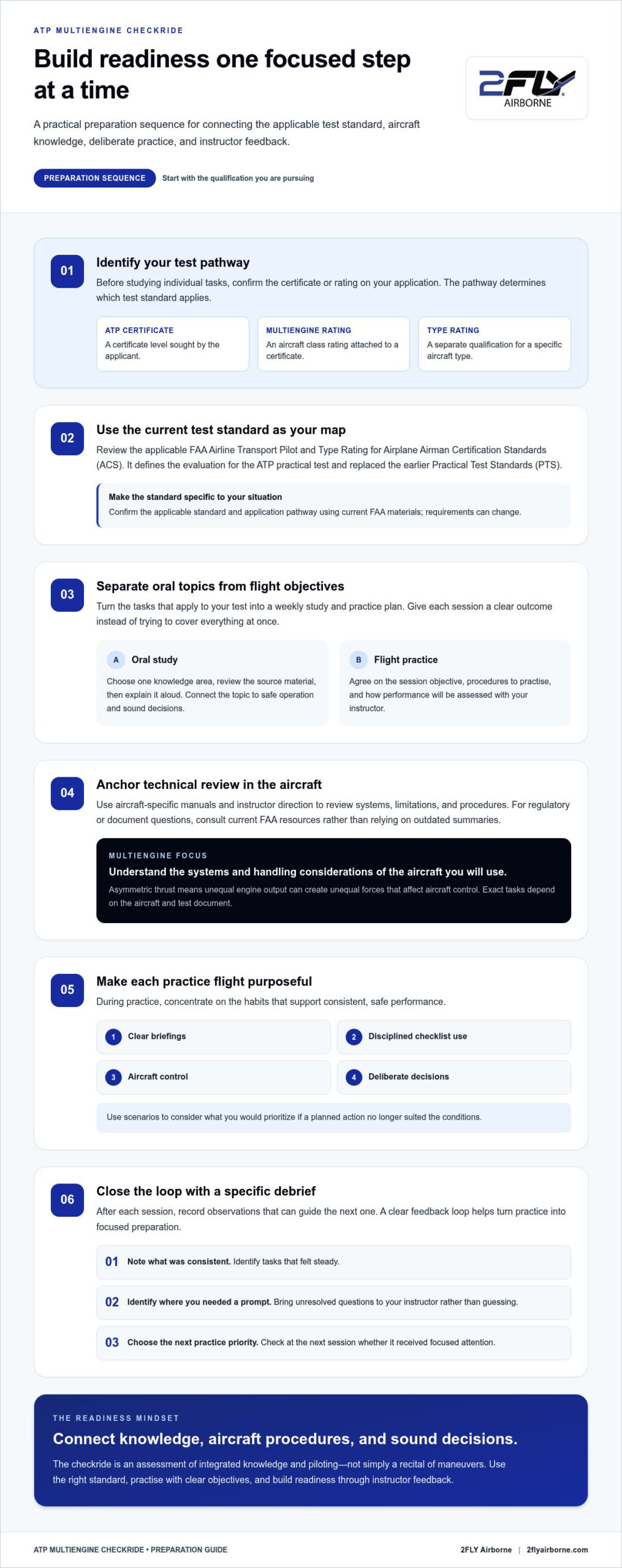
Turn the tasks that apply to your test into a weekly study and practice plan. Separate preparation into oral topics and flight objectives, and give each session a clear outcome. For example, an oral study block might end with you explaining a system’s normal operation, limitations, and relevant procedures without relying on notes.
Use aircraft-specific manuals and your instructor’s direction to anchor technical review. For regulatory or document questions, consult current FAA resources, including its pilot training and testing resources. This helps keep your preparation grounded in current information rather than outdated summaries.
Build an oral-exam study plan from the current test standard
Keep each session focused. Choose one knowledge area, review the source material, then explain the topic aloud as if briefing another pilot. Ask how the information connects to safe operation and sound decision-making. This can expose gaps that rereading alone may not reveal.
Keep a short list of questions to resolve, such as a regulation, document requirement, or aircraft-specific limitation. Bring them to your instructor instead of guessing. The FAA airline pilot program provides context for how ATP preparation can fit into professional training.
Make flight practice purposeful and scenario-aware
Before each flight session, agree with your instructor on the objective, procedures to practise, and standard for assessing performance. During practice, focus on clear briefings, disciplined checklist use, aircraft control, and deliberate decisions. A scenario can help you explain what you would prioritize if a planned action no longer suited the conditions.
Afterward, record specific observations instead of a general impression. Note which task felt consistent, where you needed a prompt, and what you will target next time. At the next session, check whether that priority received focused practice. This creates a feedback loop between preparation and performance while keeping each session purposeful and safety-focused.
ATP multiengine checkride vs. commercial multiengine and type-rating tests
These tests can involve similar aircraft and procedures, but they do not lead to the same qualification. The key distinction is what the applicant is seeking: a certificate level, an aircraft class rating, or qualification for a specific aircraft type. Use the applicable test standard and current FAA requirements to determine the scope for your pathway.
| Test | Purpose | Applicant context | Test documentation |
|---|---|---|---|
| ATP multiengine | Evaluates an applicant seeking an ATP certificate with a multiengine rating, or an applicable ATP-related qualification. | A pilot pursuing an initial ATP or an eligible addition to an existing certificate. | Applicable Airline Transport Pilot and Type Rating for Airplane ACS. |
| Commercial multiengine | Evaluates the commercial certificate or multiengine privileges being sought. | A pilot pursuing a commercial-level certificate or rating, depending on the application. | Applicable Commercial Pilot test standard. |
| Type-rating practical test | Evaluates qualification for a specific aircraft type. | A pilot seeking a type rating for an aircraft that requires one under applicable rules. | Applicable type-rating test standard and requirements. |
This table is a general guide, not a substitute for identifying the current document and requirements for your application. Review FAA materials and discuss your pathway with your instructor before building a study plan.
How an ATP multiengine test differs from a commercial multiengine test
A commercial multiengine test addresses the commercial certificate or rating requested. An ATP multiengine test addresses the ATP certificate level and associated rating sought. Do not assume that completing one test automatically grants every other certificate, class rating, or qualification. The application and applicable standard determine what is evaluated.
Professional knowledge matters at both levels, but avoid relying on broad claims about what an examiner will emphasize. Read the relevant ACS task descriptions and evaluation criteria. For broader professional-training context, 2FLY’s FAA airline pilot program connects ATP training with a wider pilot-development pathway.
When a type rating is a separate consideration
A type rating is an aircraft-specific qualification, distinct from a multiengine class rating. The class rating applies to an aircraft category or class, while a type rating identifies qualification for a particular aircraft type when required. The aircraft and certificate circumstances determine whether a type rating is part of the test.
An ATP practical test may be combined with a type-rating test in some circumstances, but the qualifications remain distinct. Before assuming a combined test applies, verify the applicable standard and current rules for the aircraft and certificate sought. The AOPA Airline Transport Pilot overview offers additional context on ATP certification. Use current FAA materials for regulatory details.
A practical ATP multiengine checkride readiness checklist
A checklist turns broad preparation into specific actions. Use this self-review to identify unfinished work, then address weak areas with your instructor before treating one strong practice session as proof that you are ready for the airline transport pilot multi engine checkride.
- Confirm eligibility and test scope. Review your application pathway, current eligibility rules, and applicable test standard using current FAA materials. Resolve questions with your instructor before organizing the rest of your preparation.
- Check knowledge readiness. Can you explain relevant systems, limitations, procedures, and decisions clearly, rather than relying on memorized phrases? Note topics that need further study or instructor review.
- Review aircraft readiness. Confirm the planned test aircraft and review its systems, limitations, and normal procedures using the appropriate aircraft materials and instructor guidance.
- Assess practical performance. Compare recent practice with the applicable tasks and criteria. Identify recurring gaps and agree on targeted practice instead of assuming one successful session resolves them.
- Prepare personally. Plan to arrive rested and ready to focus. Organize your preparation so you can prioritize safe, deliberate decisions during the evaluation.
- Organize examiner-day details. Create a document checklist based on current FAA requirements and your instructor’s guidance. Confirm the briefing plan and ground preparation with your instructor or training team.
Before the checkride: documents, knowledge, and aircraft coordination
Complete your document review well before the test date, using current requirements rather than an old checklist copied from another applicant. Understand what each item is for and where to find it. Keep aircraft preparation specific to the airplane planned for the evaluation, since systems and operating details can vary.
Confirm the ground briefing and preparation plan with your instructor or training team. Weather, aircraft status, and examiner decisions can affect scheduling or the conduct of a test, so be prepared to follow updated instructions and keep safety ahead of the calendar.
During and after the practical test
Listen carefully to each instruction. If you are unsure what is being asked, request clarification when appropriate, then follow the examiner’s directions and applicable procedures. Maintain safe priorities throughout. Do not let pressure to complete a task distract you from sound judgment and aircraft control.
After the evaluation, make time for a structured debrief. Record what went well, any feedback you received, and the next steps, whether that means continued study or work on a specific skill. A clear follow-up plan keeps preparation purposeful, regardless of the outcome.
For structured ATP and multiengine training, contact a 2FLY Training Advisor with your preparation questions.
How structured ATP training supports checkride preparation
Preparation is more effective when ground study, aircraft practice, simulator sessions, and instructor feedback work together. Study builds understanding, practice develops consistency, and debriefs turn performance into clear next steps. For the airline transport pilot multi engine checkride, a structured approach keeps preparation connected to the applicable test and your individual needs.
2FLY Airborne provides FAA professional pilot training, including ATP and multiengine training, with aircraft and flight simulators as part of its training operation. These resources support a broader professional pilot pathway, while the training plan should reflect your experience, the certificate or rating you seek, and instructor feedback.
Use consistent instruction to identify and close readiness gaps
Instructor feedback is most useful when it leads to a specific practice priority. A debrief might identify a systems explanation that needs more clarity, a procedure that needs more consistent execution, or a decision-making area that deserves another scenario discussion. Ground review, aircraft practice, and simulator work can reinforce the same objective from different angles.
Keep a simple record of instructor observations, practice goals, and follow-up results. The school’s aircraft and flight simulators provide different settings for structured learning, and your instructor can help connect each session to the skills you are developing. For a broader view of how certificates and ratings fit into a career plan, explore FAA First Officer training in the context of professional pilot development.
Choose a next step that fits your professional training path
Your next step depends on where you are now. An applicant with an existing multiengine rating may have different preparation priorities from a pilot pursuing an initial ATP certificate. Bring your current certificates, relevant experience, goals, and questions to a training advisor so the conversation can focus on your pathway rather than a generic checklist.
Structured training can also help connect checkride preparation with longer-term professional development. Keep study and flight practice grounded in current requirements and safe operating habits, and verify regulatory details against current FAA materials. Training plans and progress vary by individual, so approach each stage deliberately rather than assuming a fixed timeline or outcome.
Strong preparation comes from clear objectives, consistent practice, and thoughtful instructor debriefs. If you are planning ATP or multiengine training, reach out to a 2FLY Training Advisor with questions about your goals and next steps.
Turn your preparation into a clear next step
Move forward with a clear understanding of the test, a preparation plan matched to its requirements, and a realistic view of how your certificate or rating fits your professional goals. Ground each step in current information, instructor feedback, and safe decision-making.
Consistent, structured preparation builds a stronger foundation than rushing toward a checkride date. Review your next steps carefully and adjust your plan as your training progresses.
Speak with a 2FLY Training Advisor about your ATP training path and take your next step with purpose.
Frequently Asked Questions
How long does an ATP multiengine checkride take?
There is no fixed duration for every checkride. The oral evaluation, flight portion, preflight preparation, and scheduling or operational delays all affect how long the appointment takes. Ask your instructor or training team what schedule to expect for your test, and leave flexibility in your plans. Appointment time may differ from time spent flying.
What happens if I do not pass part of the ATP practical test?
If a task or portion is unsatisfactory, the examiner will explain the outcome and areas that need attention. Applicable FAA rules and your test circumstances determine what can be credited and what must be repeated. Review the examiner’s documentation with your instructor and verify current retest requirements using FAA materials before making new plans. Use the feedback to build a focused practice plan before attempting the evaluation again.
Can weather postpone an ATP multiengine checkride?
Yes. Weather can affect whether a practical test can safely proceed, particularly if conditions do not support the planned flight evaluation. The examiner may delay, reschedule, or adjust the test in accordance with applicable requirements and circumstances. Keep your schedule flexible, monitor updates from your training team, and remember that a postponement is not a readiness setback. Safety and the conditions needed to conduct the evaluation take priority.
Can an international pilot take an FAA ATP checkride?
An international pilot may pursue FAA ATP certification if they meet the applicable eligibility and application requirements. A certificate issued by another country should not be assumed to automatically qualify as an FAA ATP certificate. Confirm the appropriate FAA pathway for your circumstances, including current documentation and testing requirements, before scheduling. Eligibility details can depend on an applicant’s background, so use current FAA materials and discuss your situation with an instructor.
Is the ATP multiengine checkride difficult?
It can be demanding because it assesses how an applicant applies knowledge and flying skills to the required tasks, not simply whether they can recite procedures. Difficulty varies with experience, preparation, aircraft familiarity, and the specific test pathway. For the airline transport pilot multi engine checkride, ask your instructor to identify areas where your explanations or performance remain inconsistent. Focused practice and honest debriefs can make preparation more deliberate.
What should I do if an aircraft discrepancy appears on checkride day?
Report the discrepancy to the appropriate instructor or training team member and follow established aircraft procedures. Do not assume it is acceptable to proceed, and do not attempt to resolve or dismiss it outside your authorization. The aircraft’s status and applicable procedures determine whether the test can continue in that aircraft. The examiner may also need to adjust the plan. Safety comes first; scheduling concerns never justify overlooking a discrepancy. For questions about ATP or multiengine training, reach out to a 2FLY Training Advisor.

Article by
2FLY Airborne
2Fly Airborne is a professional flight training organization dedicated to developing the next generation of skilled, confident, and safety-focused pilots. With decades of combined aviation experience, our team of certified instructors provides structured, real-world training designed to prepare students for both checkrides and long-term success in the aviation industry.
Content Disclaimer
Some blog content is generated with the assistance of automated tools and may not always be fully accurate or up to date. Please verify all aviation-related information with official sources or a certified instructor. For additional guidance or clarification, we encourage you to contact one of our training advisors at 2Fly Airborne.