

Could a single medical appointment really ground your dreams before they even take flight? For many aspiring aviators, the walk into an Aviation Medical Examiner’s office feels like the highest-stakes moment of their journey. It’s easy to worry that a past health hurdle or a confusing regulation will permanently block your path to the cockpit. You’ve invested time and passion into your goal, and the thought of a “denied” status is understandably daunting.
Understanding the common reasons for FAA medical denial is the first step toward securing your future in the skies. While the FAA maintains rigorous standards under 14 CFR Part 67 to ensure safety, a deferral isn’t necessarily the end of your career. Most certification challenges are manageable with the right documentation and a clear strategy. You’ll soon discover exactly which conditions require extra attention and how to leverage the Special Issuance process to keep your professional goals on track.
We’ll demystify the medical standards for first, second, and third-class certificates so you can book your appointment with certainty. From vision requirements to mental health history, this guide provides the professional perspective you need to transition from an applicant to a prepared pilot. It’s time to gain the clarity required to navigate the regulatory landscape and protect your investment in flight training.
Key Takeaways
- Recognize the First-Class Medical as the essential benchmark for your professional aviation career and learn how the Aviation Medical Examiner evaluates your readiness.
- Identify how to manage cardiovascular concerns like hypertension through proper documentation to avoid unnecessary delays in your certification.
- Discover the common reasons for FAA medical denial and the evolving standards that offer pathways for pilots with a history of mental health support or SSRI use.
- Understand the critical reporting requirements for legal history and substance use to ensure your records remain transparent and compliant.
- Learn the exact steps to take if your application is deferred, focusing on gathering clinical data to secure a Special Issuance and keep your training on track.
The FAA Medical Exam: Your Gateway to a Professional Pilot Career
The Aviation Medical Examiner (AME) serves as a vital gatekeeper for the national airspace. These specialized physicians ensure every pilot operating a complex aircraft possesses the physical and mental resilience required for safe flight. While the process feels intimidating, the AME’s primary goal is safety rather than exclusion. You don’t need to be a world-class athlete to pass your physical. Many successful airline pilots wear glasses or manage minor health conditions with approved treatments.
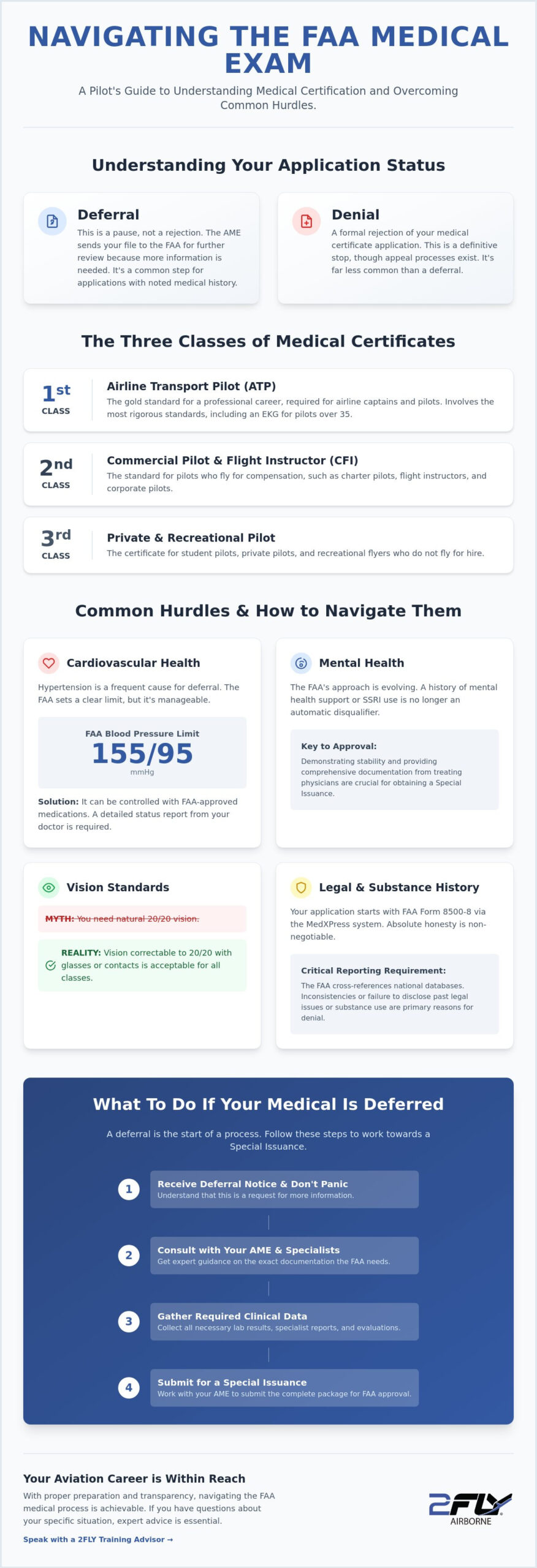
Understanding the distinction between a deferral and a denial is crucial for managing your expectations. A deferral occurs when an AME lacks the authority to issue a certificate on the spot and sends your file to the FAA for a deeper look. A denial is a formal rejection of the application. Many people assume they’ve been rejected when they’ve actually just been deferred. Knowing the FAA Medical Certificate Classes and their specific requirements helps you prepare for this evaluation.
The Three Classes of Medical Certificates
Pilots pursuing an FAA Professional Pilot Program should aim for the First-Class Medical Certificate. This is the gold standard required for Airline Transport Pilots (ATP) and involves the most rigorous testing, including an EKG for older applicants. The Second-Class certificate is the standard for commercial pilots and flight instructors, while the Third-Class serves the needs of private pilots. Securing a First-Class certificate early proves you meet the long-term health standards required by major airlines.
The MedXPress Application Process
Your certification journey begins with FAA Form 8500-8 via the MedXPress system. Absolute honesty is mandatory. The FAA cross-references your medical history with national databases before you even step into the AME’s office. Inconsistencies on this form are among the common reasons for FAA medical denial because they suggest a lack of integrity or a failure to disclose pertinent health data.
Consider booking a consultation rather than a formal exam if you have concerns about your history. During a consultation, the AME reviews your records without opening an official FAA file. This proactive step allows you to gather necessary specialist reports before the clock starts ticking on a formal application. It’s a strategic way to protect your aviation career from avoidable setbacks and ensure you’re fully prepared for the official review.
Cardiovascular Health and Physical Disqualifiers
Does a diagnosis of high blood pressure mean your flying career is over before it starts? Not at all. Hypertension is actually one of the most common reasons for FAA medical denial or deferral. Many candidates walk into their exam unaware that their blood pressure exceeds the FAA’s limit of 155/95. While this often results in a deferral rather than a permanent denial, it requires a structured response from your treating physician.
Coronary heart disease also requires significant documentation. The FAA doesn’t automatically ground you for heart issues, but they do demand evidence of a successful, stable recovery. This typically involves a waiting period after a procedure and a comprehensive cardiovascular evaluation. Similarly, the FAA has modernized its approach to insulin-treated diabetes mellitus (ITDM). Pilots can now maintain certification through a specific protocol that involves continuous glucose monitoring (CGM).
Managing Hypertension in the Cockpit
If you’re diagnosed with high blood pressure, the FAA allows a wide range of approved medications. Most beta-blockers, ACE inhibitors, and diuretics are acceptable, provided they don’t cause adverse side effects like dizziness. Your AME will require a detailed status report from your doctor confirming the dosage and the absence of side effects. Maintaining a healthy lifestyle through diet and exercise is the best way to ensure your 1st-class medical longevity. For more detailed support on specific health protocols, the AOPA Guide to Airman Medical Certification provides an excellent breakdown of required clinical data.
Vision and Hearing: Myths vs. Reality
A common misconception is that you need perfect, natural 20/20 vision to become a professional pilot. In reality, the FAA allows for vision correction with glasses or contact lenses. As long as you can reach 20/20 in each eye with correction, you meet the standard for a First-Class certificate. Hearing is also tested, but you don’t need perfect ears. Most pilots pass by demonstrating they can hear a conversational voice at a distance of six feet.
Color blindness is another area where myths persist. While it can limit certain night-flying privileges, many pilots successfully navigate this through a Statement of Demonstrated Ability (SODA). This involves a practical “light gun test” at an airport tower to prove you can distinguish aviation-specific colors. If you’re ready to begin your journey despite these hurdles, enrolling in a structured FAA Professional Pilot Program ensures you have the mentorship to navigate these regulatory requirements. Understanding these physical standards early prevents surprises and keeps your career path clear.
Mental Health, SSRIs, and the Evolving FAA Standards
Does seeing a therapist for situational stress or marriage counseling disqualify you from the cockpit? Many pilots believe it does, but that is a common misconception. The FAA focuses on specific clinical diagnoses rather than the act of seeking professional support. In many cases, proactive mental health care is viewed more favorably than allowing a condition to worsen. The FAA Medical Standards and Certification guidelines provide the legal framework for these evaluations. Mental health history is now among the most common reasons for FAA medical denial, primarily when applicants fail to provide enough clinical data to prove stability.
The industry needs healthy, capable aviators to meet future needs. The 2025 Boeing Pilot and Technician Outlook projects a demand for 660,000 new pilots globally through 2044. This demand has pushed the FAA to modernize its approach, ensuring that mental health support doesn’t have to mean the end of a career. You can review the 2025 Boeing Pilot and Technician Outlook to understand how this global demand is shaping the future of aviation training.
The SSRI Decision Path
The FAA has approved a specific list of Selective Serotonin Reuptake Inhibitors (SSRIs) for pilots, including Fluoxetine, Sertraline, Citalopram, and Escitalopram. If you’re on one of these medications, you must undergo a period of observed stability, typically lasting six months. Your AME will guide you through the process of obtaining a special issuance. This often involves a comprehensive evaluation by a HIMS-trained psychiatrist or a neuropsychologist. These experts assess your cognitive function to ensure the medication doesn’t interfere with your ability to make split-second decisions. Pilots have a professional responsibility to ground themselves if they experience side effects or a change in their mental health status.
ADHD and History of Diagnosis
ADHD is one of the most misunderstood areas of aviation medicine. While active use of stimulant medications like Ritalin or Adderall is disqualifying, a history of ADHD is not an automatic “no.” If you’ve been off medication for a significant period, you may qualify for a fast-track pathway. You’ll need to demonstrate that you can function at a high level in professional environments without these aids. Providing transcripts, work evaluations, and personal statements can help build a strong case. This evidence is crucial for those entering an FAA Professional Pilot Program. It shows you have the focus and discipline required for advanced training and a long-term career path.
Substance Use and Legal History Compliance
Integrity is the foundation of the aviation profession. The FAA views your legal history, particularly substance-related incidents, as a direct reflection of your judgment and reliability. While a past mistake doesn’t always lead to a permanent “no,” failure to disclose it almost certainly will. Substance-related issues and disclosure failures remain among the most common reasons for FAA medical denial, yet many pilots successfully navigate these challenges through structured recovery programs.
The Human Intervention Motivation Study (HIMS) program is the industry’s gold standard for addressing substance use. It is a collaborative effort between the FAA, pilot unions, and medical professionals. HIMS provides a clear, monitored pathway for pilots to demonstrate long-term recovery and return to flight duties safely. It distinguishes between “misuse” and “dependence,” offering a supportive framework for those committed to maintaining the high standards of an international aviation career.
The Impact of a DUI on Your Certificate
A DUI or DWI conviction triggers specific FAA reporting requirements that you must handle with precision. Under the 60-day rule, you’re required to report any motor vehicle action involving alcohol or drugs to the FAA’s Security and Hazardous Materials Safety Office. This is a separate requirement from your MedXPress application. A single offense usually requires a clinical evaluation and a detailed statement from the pilot. Multiple offenses signal an escalating concern for the FAA and will lead to a more intensive review process. These incidents can significantly impact your employment prospects at major airlines, where a clean record is a hallmark of professional preparedness.
The Dangers of Falsification
Professional pilots understand that transparency is the only way to protect their investment. The FAA routinely cross-checks MedXPress applications with the National Driver Register (NDR) to verify legal and driving history. If an applicant intentionally omits a DUI conviction or a license suspension, they face a “falsification” charge. This is often far more damaging than the original medical or legal condition itself. Falsification can lead to the emergency revocation of all current pilot certificates and a permanent ban from future certification. Providing false information on a federal document carries serious legal consequences that can end an aviation career instantly.
If you’re ready to commit to the professional standards and rigorous demands of the industry, explore our FAA Professional Pilot Program to begin your journey with expert guidance and support.
What to Do if Your Medical is Deferred or Denied
What happens if your AME doesn’t hand you a certificate at the end of the exam? First, stay calm. A deferral simply means the FAA needs more information to make a safe determination. While cardiovascular issues or mental health history are common reasons for FAA medical denial, they are often resolved through the formal review process. You’re entering a phase of data collection, not necessarily a career-ending event.
Wait for the official letter from the Aeromedical Certification Division before taking action. This document is your roadmap. It will list the specific clinical data or specialist reports required to advance your application. Gathering this information promptly shows the FAA that you’re proactive about your health and professional standards. The 2025 Boeing Pilot and Technician Outlook projects a demand for 660,000 new pilots globally through 2044. This massive global need means the FAA is committed to keeping qualified pilots in the air, provided they meet safety standards.
Consulting with a senior AME or an aviation medical advocacy group helps you interpret the FAA’s request. They ensure your response is comprehensive and formatted correctly for the reviewers in Oklahoma City. This professional guidance is essential for navigating the complexities of the Special Issuance and SODA pathways.
Understanding Special Issuance
A Special Issuance is a discretionary certificate granted to those with disqualifying conditions that are well-managed. This pathway is common for pilots with heart stents, certain treated cancers, or specific neurological conditions. You’ll likely need to provide periodic follow-up reports to maintain this waiver. It proves that your condition doesn’t pose a risk to flight safety while allowing you to continue your professional development.
The SODA Pathway for Static Disabilities
A Statement of Demonstrated Ability (SODA) is different from a Special Issuance. It applies to static disabilities that don’t change over time, such as color vision deficiency, hearing impairment, or the loss of a limb. To earn a SODA, you must perform a practical test to prove the condition doesn’t interfere with your piloting duties. Once issued, a SODA usually doesn’t expire, providing a permanent solution for your aviation career.
Your Professional Future Starts with Health
A structured training environment is your best asset for staying compliant and prepared. Training in a professional setting ensures you have the support needed to navigate regulatory hurdles and maintain your medical readiness. If you’re ready to take the next step toward a commercial career, explore our FAA Professional Pilot Program.
In summary, securing your medical certificate is about preparation, honesty, and persistence. While the process has its hurdles, most conditions have a clear pathway to approval through documentation or practical demonstrations. Safe, structured training is the foundation of a long and successful career in the skies. Reach out to a 2FLY Training Advisor with any remaining questions about starting your journey.
Secure Your Seat in the Cockpit
Your journey to becoming a professional pilot is a marathon that requires both technical skill and physical readiness. While we’ve explored the common reasons for FAA medical denial, it’s clear that most hurdles are surmountable with the right documentation and persistence. By addressing potential issues early and maintaining transparency with your AME, you protect your career and your investment in flight training.
2FLY Airborne provides the structured environment and expert guidance necessary to navigate these complex regulatory demands. Our FAA and EASA accredited training programs are designed to transition you from a student into an industry-prepared professional with a clear path to the airlines. We understand the rigors of the certification process and offer the mentorship needed to keep your professional goals on track.
Speak with a 2FLY Training Advisor to plan your career path and ensure you’re ready for the professional demands of the cockpit. If you have any remaining questions about the medical process or our programs, our team is here to help. Contact a 2FLY Training Advisor today to take the first step toward your future in the skies.
Frequently Asked Questions
Can I still be a pilot if I take medication for anxiety?
Yes, you can fly while taking specific FAA-approved medications for anxiety or depression. The FAA currently allows a select list of SSRIs, such as Sertraline or Fluoxetine, provided you demonstrate a six-month period of stability. You’ll need to undergo a neuropsychological evaluation to ensure the medication doesn’t interfere with your cognitive performance in the cockpit.
What is the most common reason the FAA denies a medical certificate?
Cardiovascular conditions and untreated mental health history are among the most common reasons for FAA medical denial. However, many denials are actually the result of incomplete documentation rather than the medical condition itself. Providing thorough clinical data from the start often prevents a permanent rejection of your application.
What happens if my AME defers my application?
A deferral means your Aviation Medical Examiner (AME) doesn’t have the authority to issue your certificate immediately and must send your file to the FAA for review. This isn’t a denial; it’s a request for more information. You must wait for a formal letter from the FAA that specifies exactly which additional tests or records they require.
Is color blindness an automatic disqualification for commercial pilots?
Color blindness is not an automatic disqualification for a career as a commercial pilot. While it may initially limit your night flying privileges, you can remove these restrictions by earning a Statement of Demonstrated Ability (SODA). This involves a practical test where you prove your ability to identify signal light colors at an airport.
Can I get a pilot license with high blood pressure?
You can obtain a pilot license with high blood pressure as long as it’s controlled and remains below 155/95. The FAA approves most standard blood pressure medications, including many beta-blockers and ACE inhibitors. Your doctor will need to provide a status report confirming that your blood pressure is stable and the medication causes no adverse side effects.
How long does it take for the FAA to process a medical deferral?
Processing times for a medical deferral typically range from three to six months depending on the complexity of the case. Submitting a complete package of medical records as soon as you receive your FAA letter helps avoid further delays. Accuracy in your clinical documentation is the best way to speed up the Aeromedical Certification Division’s review.
Do I need a First-Class Medical before starting flight school?
We highly recommend securing a First-Class Medical certificate before you begin professional flight training. This confirms you meet the physical standards required for an airline career before you make a significant financial investment. It’s a strategic move that ensures your long-term goals are attainable from day one.
Can a past DUI stop me from getting an FAA medical?
A past DUI doesn’t necessarily stop you from getting a medical certificate, but it does require absolute transparency and disclosure. The FAA cross-checks your application with the National Driver Register to verify your history. A single offense usually requires a detailed personal statement and clinical evaluation to prove you meet the professional standards of the industry.

Article by
2FLY Airborne
2Fly Airborne is a professional flight training organization dedicated to developing the next generation of skilled, confident, and safety-focused pilots. With decades of combined aviation experience, our team of certified instructors provides structured, real-world training designed to prepare students for both checkrides and long-term success in the aviation industry.
Content Disclaimer
Some blog content is generated with the assistance of automated tools and may not always be fully accurate or up to date. Please verify all aviation-related information with official sources or a certified instructor. For additional guidance or clarification, we encourage you to contact one of our training advisors at 2Fly Airborne.