
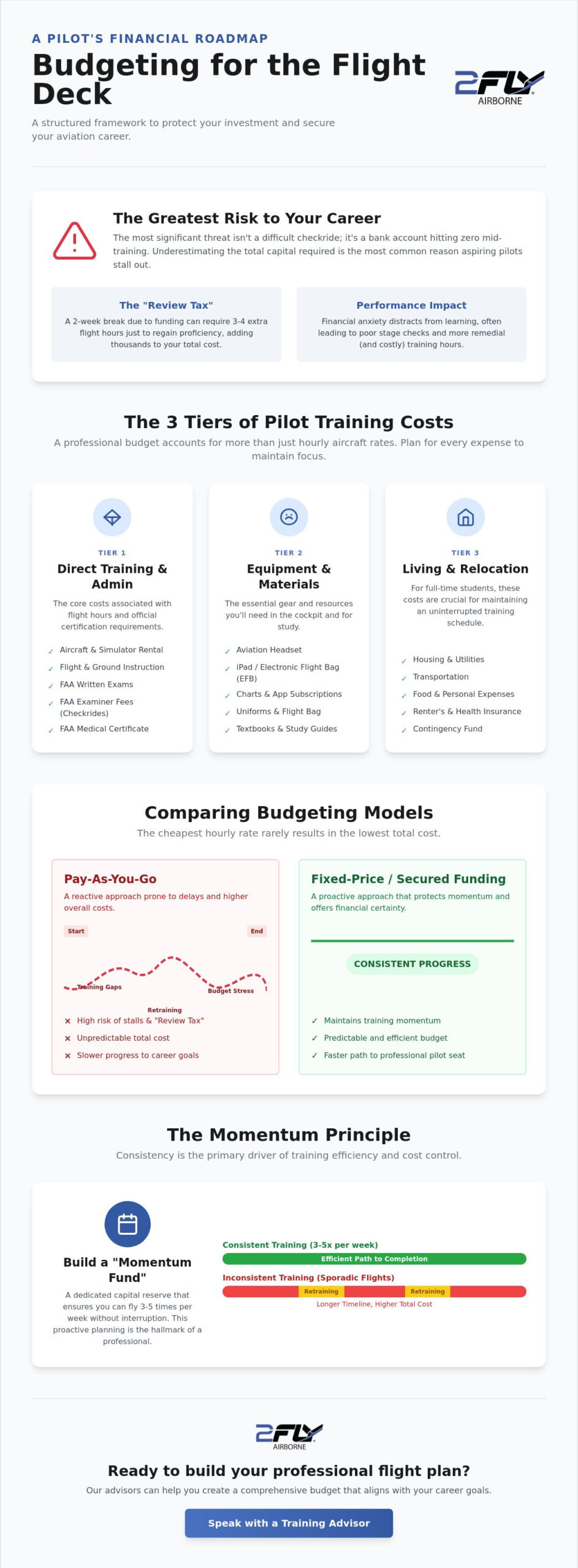
The most significant risk to your aviation career isn’t a difficult checkride or a complex landing; it’s a bank account that hits zero when you’re only forty hours into your training. Many aspiring pilots start with enthusiasm but stall out because they underestimated the total capital required to reach the flight deck. Learning how to budget for flight school requires looking beyond the sticker price to ensure your training momentum remains unbroken.
You’ve probably felt that familiar anxiety when looking at loan interest rates or hearing about hidden fees for headsets and examiner costs. It’s natural to worry about debt-to-income ratios when you’re aiming for a seat at a major airline. This guide provides a professional roadmap to master these financial complexities, offering a structured framework to protect your investment and your future.
We’ll explore a clear line-item budget that accounts for everything from FAA medical certificates to multi-engine ratings. You’ll also discover a strategic approach to financing and training frequency that minimizes the need for costly retraining. By the end, you’ll have the certainty needed to transition from a student to an industry-prepared professional.
Key Takeaways
- Learn why professional pilot training should be treated as a comprehensive career investment rather than a series of disconnected hourly expenses.
- Identify the “invisible” costs, such as examiner fees and FAA medical certifications, that often derail students who only focus on aircraft rental rates.
- Discover how to budget for flight school by comparing the financial predictability of fixed-price programs against the variable risks of modular training.
- Master the “75% Rule” to ensure you have the necessary capital secured to maintain training momentum and avoid costly retraining gaps.
- Understand the specific requirements for specialized aviation loans and how your credit profile impacts your path to a professional flight deck.
Understanding the Financial Landscape of Modern Pilot Training
Professional pilot training is a high-stakes investment in your future earning potential. When you analyze how to budget for flight school, you must distinguish between recreational flying and a professional career path. Many students look specifically at flight schools in Florida because the year-round flying weather helps maintain a consistent schedule. However, even in ideal conditions, a “pay-as-you-go” approach often turns into a financial trap that delays your progress and increases your total expenditure.
To better understand the practical steps for funding your journey, watch this helpful video:
A successful strategy relies on building a “Momentum Fund.” This is a dedicated capital reserve that ensures you can fly three to five times per week without interruption. By securing your funding upfront, you protect yourself against the training stalls that occur when bank balances dip. This proactive financial planning is the hallmark of an industry-prepared professional who values technical mastery and long-term career stability. It’s the difference between hope and a structured roadmap.
The High Cost of Training Gaps
Consistency is the primary driver of training efficiency and cost control. If you take even a two-week break due to funding issues, you’ll likely spend the next three or four flight hours simply regaining lost proficiency. This “Review Tax” can add thousands of dollars to your total bill over the course of your training. It’s a hidden expense that many students fail to anticipate until their progress slows to a crawl.
Setting Realistic Career Expectations
It’s tempting to search for the school with the lowest hourly rental rate. However, the cheapest hourly rate often results in the highest total cost if the school lacks a structured environment or modern equipment. You need a budget that accounts for the entire journey through various FAA pilot certification requirements, from your private certificate to your commercial ratings.
Choosing a program that aligns with airline standards ensures you’re prepared for the transition from a trainee to a professional pilot. Professional programs often utilize structured syllabi that help you reach your goals in fewer total hours than a loosely organized school. Exploring specialized financing options early in the process ensures you have the capital needed for an accelerated, structured syllabus. This approach maximizes your return on investment by getting you into a paying pilot seat sooner.
Identifying the “Invisible” Costs of Earning Your Wings
Mastering the aircraft is only one part of your journey. Many students fail to realize that training fees represent just one tier of a professional financial roadmap. When you learn how to budget for flight school, you must account for the administrative, equipment, and lifestyle costs that accompany intensive training. Overlooking these “invisible” expenses can lead to unexpected delays just as you’re reaching critical milestones.
A professional budget should be divided into three distinct tiers to ensure total financial coverage. This structured approach mirrors the discipline required in a professional cockpit. It allows you to maintain your focus on the Occupational Outlook for pilots rather than worrying about minor administrative fees. By planning for every line item, you position yourself as a proactive and prepared candidate for the industry.
Tier 1: Direct Training and Administrative Fees
Your training budget must include the essential fees that occur outside of the aircraft. This includes ground school materials and digital subscriptions for navigation charts, such as ForeFlight. You should also set aside funds for the FAA Knowledge Test, which typically costs around $175 per attempt, and the FAA Third-Class Medical Certificate, which generally ranges from $100 to $200. These are non-negotiable requirements for progress.
The most significant administrative expense is the practical test, or checkride, with a Designated Pilot Examiner (DPE). These examiners are third-party professionals, and their fees for single-engine aircraft often range from $700 to $1,200. For international students, this tier also includes SEVIS registration and visa processing fees. A structured FAA Professional Pilot Program often helps clarify these administrative requirements early in the process.
Tier 2: Equipment and Professional Gear
Investing in quality equipment is a hallmark of a serious pilot. Initial gear for a student, including a flight bag, kneeboards, and study resources like the Airplane Flying Handbook, typically costs between $400 and $800. A high-quality aviation headset is your most important tool; while expensive, a mid-range noise-canceling model protects your hearing and improves communication clarity during complex maneuvers. Professional academies may also require specific uniforms to maintain a standard of excellence that reflects airline environments.
Tier 3: The “Life” Budget for Full-Time Students
If you’re training away from home, your living expenses are a critical component of your roadmap. You must decide between the convenience of on-campus student housing or the independence of external rentals. Intensive flight schedules often leave little time for long commutes, making proximity to the airfield a valuable asset. Your “life” budget should also cover the following essentials:
- Transportation to and from the flight line and meal planning for long training days.
- Health insurance coverage that meets both personal needs and academy requirements.
- An emergency contingency fund to cover unexpected personal expenses without dipping into your training capital.
Comparing Budgeting Models: Fixed-Price Programs vs. Pay-As-You-Go
Many trainees select their school based on the lowest hourly rental rate they can find. This is often a significant financial error that ignores the “Final Invoice” reality of professional training. When you’re determining how to budget for flight school, you’ll encounter two primary financial models: the modular, pay-as-you-go approach and the structured, fixed-price career program. Each has distinct implications for your total investment and your timeline to a professional cockpit.
The “sticker price” of a modular school often looks attractive because it only shows the cost of the FAA minimum hours. However, the national average for a Private Pilot License is sixty to seventy-five hours, not the forty-hour minimum. This discrepancy means the initial estimate you receive may be thousands of dollars short of the actual requirement. Choosing a model that prioritizes predictability over a low entry price is a critical step in learning how to budget for flight school effectively.
The Pay-As-You-Go (Modular) Trap
Modular training often carries hidden risks that can derail a student’s finances. Fuel surcharges are a primary concern; these fluctuating fees can inflate a training budget by 15% or more in the middle of a program. Because these costs are tied to global oil prices, they are impossible to predict and can quickly exhaust a student’s capital reserves. This volatility makes it much harder to maintain the training momentum discussed in previous sections.
Lenders also view unstructured training with more scrutiny. It’s often difficult to secure professional-grade financing for hourly training because there’s no guaranteed completion date or total cost. Without a fixed schedule, students often experience gaps that lead to the “Review Tax,” where they must pay for extra hours just to regain lost skills. These inefficiencies can make the modular path the most expensive option in the long run.
The Fixed-Price Career Path Advantage
A structured career program provides a level of financial certainty that modular training cannot match. Comprehensive programs like the FAA Professional Pilot Program typically include flight hours, simulator sessions, and ground school in a single, transparent fee. This approach locks in your rates, protecting you from inflation and sudden fuel price hikes during your training. It allows you to focus on achieving technical mastery rather than checking your bank balance before every flight.
These programs are designed to take you from zero experience to being an industry-prepared professional. For example, the FAA First Officer Program offers a clear pathway with predictable milestones. Even with a structured program, students should actively seek out AOPA flight training scholarships to offset their initial investment. This combination of fixed-price tuition and outside funding creates the most stable financial foundation for your aviation career.
Building Your Momentum Fund: Strategic Saving and Scheduling
A common debate among aspiring aviators is whether to save the entire cost of training before starting or to begin as soon as the first lesson is affordable. A professional approach favors the “75% Rule.” This strategy suggests you should have at least three-quarters of your total estimated capital secured before your first flight. By having this “Momentum Fund” ready, you ensure that unexpected weather or minor maintenance delays don’t lead to a total financial stall. It’s about protecting the investment you’ve already made.
Understanding how to budget for flight school involves more than just stacking cash; it requires managing your time as a financial asset. The 2025 Boeing Pilot and Technician Outlook projects a demand for 660,000 new pilots globally through 2044. Every month you spend in training is a month you aren’t earning a senior pilot’s salary. Delaying your entry into the industry has a massive long-term opportunity cost that far outweighs the interest on a well-structured loan. Speed to the flight deck is your greatest financial ally.
Scheduling for Financial Efficiency
Flying three to four times per week is significantly more cost-effective than flying once a week. Frequent lessons improve muscle memory and knowledge retention, which directly reduces the total number of hours you’ll need to reach proficiency. You can also utilize advanced simulators to master complex procedures before you ever step into an aircraft. This allows you to burn “digital fuel” while perfecting your flows, saving your actual flight hours for high-value maneuvers and certifications.
Adopt the “3-hour block” rule for your training sessions to maximize your investment. This involves one hour of pre-flight briefing, one hour of intensive flight time, and one hour of thorough post-flight debriefing. This structure ensures you extract the maximum learning value from every dollar spent on the aircraft and instructor. If you’re ready to maximize your training efficiency, consider enrolling in a structured FAA Professional Pilot Program that prioritizes intensive scheduling and professional standards.
Lifestyle Adjustments and Side Hustles
Reaching the highest levels of the profession often requires temporary sacrifices in discretionary spending. Prioritize your flight hours over luxury purchases or expensive vacations during your training phase. You might also consider aviation-adjacent jobs, such as working as a ramp agent or in flight dispatch. These roles keep you in the airport environment and provide valuable networking opportunities with industry professionals. Alternatively, some students explore CDL A Training to create a high-earning financial foundation for their flight hours. Treat scholarships and grants as “budget boosters” that accelerate your timeline rather than your only source of funding.
Financing Your Future: Professional Pathways to the Flight Deck
Securing the capital for your training is the final, critical step in your professional roadmap. While some candidates use personal savings, most career pilots leverage specialized financing to maintain the training frequency required for technical mastery. Learning how to budget for flight school means understanding that your training is a financed asset that pays dividends through a high-earning international career. The 2025 Boeing Pilot and Technician Outlook projects a demand for 660,000 new pilots globally through 2044, making the return on investment for well-funded training exceptionally strong.
Specialized aviation loan providers understand the unique career trajectory of a pilot. Unlike traditional banks, these lenders often offer products that account for the time you’ll spend building hours before reaching the airlines. To secure the most competitive rates, you’ll typically need a strong credit score or a reliable co-signer. Preparing your financial profile is just as essential as your pre-flight inspections; it ensures your training remains uninterrupted and your focus stays on the cockpit.
For those seeking alternative funding routes, a degree program with airline pilot training can be a strategic choice. These programs often allow students to access federal student aid and grants that aren’t available to independent flight schools. This structure provides a dual benefit: you earn a university degree while completing your flight certifications. You can explore these and other professional financing resources to determine which pathway aligns with your long-term career goals.
Navigating Aviation Loans and Credit
Aviation loans often include “deferment” periods, which are vital for career-track pilots. These periods allow you to delay full principal payments while you’re completing your intensive training or working as a flight instructor to build the required hours for airline entry. You should prepare a “Financial Flight Plan” for your lender. This document should outline your training milestones, expected completion dates, and your strategy for transitioning into a professional pilot role.
Finalizing Your Budgetary Checklist
Successful flight training requires a balance of financial discipline and technical dedication. As you finalize your roadmap, remember that maintaining training momentum is your best defense against rising costs. A professional budget must account for the following key elements:
- The Momentum Fund: Secure the majority of your capital upfront to avoid the “Review Tax” caused by training gaps.
- Invisible Costs: Include line items for FAA medical certificates, examiner fees, and high-quality professional gear.
- Fixed-Price Predictability: Prioritize structured programs that lock in tuition rates and protect you from fuel surcharges.
Your journey to the flight deck should be built on a foundation of safe, structured training rather than short-term “shortcut” methods. A methodical approach to your finances reflects the discipline required of a captain. If you have remaining questions about your specific financial roadmap, reach out to a 2FLY Training Advisor for a personalized cost breakdown and professional guidance.
Take Command of Your Financial Flight Plan
Mastering the financial side of your training is just as important as mastering the cockpit. You now have a comprehensive roadmap that prioritizes training momentum through a secured capital fund while accounting for the often overlooked invisible costs. By choosing a structured path over a modular one, you protect your investment from the volatility of fuel surcharges and the “Review Tax” caused by scheduling gaps.
Understanding how to budget for flight school is the first step toward a seat at a major airline. This proactive approach ensures you’re prepared for the technical demands of the industry without the distraction of financial instability. It positions you as an elite candidate ready for the rigors of an international career. Your discipline on the ground directly reflects your potential as a captain in the air.
2FLY Airborne provides the definitive gateway to this profession through FAA and EASA compliant training paths. You’ll benefit from state-of-the-art flight simulators for cost-efficient learning and a global recruitment network designed for career placement. Speak with a 2FLY Training Advisor to build your personalized financial flight plan. Reach out to a 2FLY Training Advisor with any remaining questions to ensure your future on the flight deck starts with a single, disciplined decision.
Frequently Asked Questions
Is it better to save the full cost of flight school or take out a loan?
Securing a loan is often the preferred strategy for career-track pilots because it allows for uninterrupted, intensive training. While saving the full cost avoids interest, the delay in entering the workforce can cost you more in lost seniority and salary. A well-structured loan ensures you maintain a consistent training momentum, getting you to the flight deck much faster.
What are the most common hidden costs in flight training?
Students frequently overlook the fees for Designated Pilot Examiners (DPEs), which can reach over $1,000 per checkride. Other invisible expenses include FAA medical certifications, written exam fees, and annual subscriptions for navigation software like ForeFlight. Quality aviation headsets and professional attire also represent significant upfront investments that must be included in your comprehensive roadmap.
Can I work a full-time job while attending professional flight school?
Working full-time is generally discouraged during an intensive professional program because it significantly slows your training progress. Splitting your attention between a full-time job and the cockpit often leads to the “Review Tax,” where you spend more money relearning skills due to training gaps. Most successful candidates treat flight school as their primary occupation to maximize their total learning efficiency.
How much should I budget for FAA checkrides and written exams in 2026?
You should budget approximately $1,200 to $1,500 per certification level to cover both the written exam and the practical checkride. FAA written exams typically cost $175 per attempt, while examiner fees for single-engine checkrides generally range from $700 to $1,200. Planning for these specific administrative costs is a vital part of learning how to budget for flight school effectively.
Does a fixed-price program really cover everything needed for a commercial license?
A fixed-price program typically covers all required flight hours, simulator time, and ground school instruction but may exclude individual administrative fees. You must verify if items like medical exams, checkride fees, and personal equipment are included in the specific quote. These all-inclusive models are designed to protect you from fuel surcharges and inflation, ensuring your final invoice stays predictable.
How do I budget for the 1,500-hour requirement after finishing flight school?
Most pilots budget for this phase by securing a position as a Certified Flight Instructor (CFI) to earn a salary while building hours. Instead of paying for 1,500 hours of flight time, professional pilots transition into roles that pay them to fly. This phase should be viewed as the beginning of your professional earning years rather than a continuation of your training expenses.
What happens to my budget if I fail a checkride or need extra training hours?
Failing a checkride or needing extra hours requires you to budget for additional remedial training and a second examiner fee. Most professional budgeting frameworks recommend a 10% to 15% contingency fund to cover these possibilities. Maintaining this financial buffer ensures that a single setback doesn’t end your career journey prematurely, as individual timelines often vary based on weather and progress.
Are there specific scholarships available for international student pilots?
Yes, several international aviation organizations and private foundations offer scholarships specifically for students training in the United States. Organizations like the Aircraft Owners and Pilots Association (AOPA) provide numerous funding opportunities that can help offset the cost of a pilot school. While many federal grants are restricted to domestic students, international trainees can often find merit-based awards through private industry sponsors.
Article by
2FLY Airborne
2Fly Airborne is a professional flight training organization dedicated to developing the next generation of skilled, confident, and safety-focused pilots. With decades of combined aviation experience, our team of certified instructors provides structured, real-world training designed to prepare students for both checkrides and long-term success in the aviation industry.
Content Disclaimer
Some blog content is generated with the assistance of automated tools and may not always be fully accurate or up to date. Please verify all aviation-related information with official sources or a certified instructor. For additional guidance or clarification, we encourage you to contact one of our training advisors at 2Fly Airborne.