What if performing and recovering from a spin isn’t enough to earn your CFI spin endorsement? For an initial flight instructor certificate in the airplane or glider category, the cfi spin endorsement training requirements call for flight training and a logbook endorsement addressing stall awareness, spin entry, spins, and recovery. Under 14 CFR § 61.183(i), applicants must also demonstrate instructional proficiency in these areas.
It’s understandable to wonder who needs the endorsement, what the training should cover, and how to document it. This guide explains the requirement’s scope, the difference between completing training and receiving an endorsement, and practical ways to prepare safely. The standard focuses on your ability to teach, not simply demonstrate, these skills. As you work toward becoming a flight instructor, treat this milestone as one part of developing the knowledge, flight proficiency, and teaching ability required for CFI training.
Key Takeaways
- The cfi spin endorsement training requirements apply to initial CFI applicants in the airplane or glider category, not every instructor applicant or add-on rating.
- Prepare for ground study and supervised flight training focused on recognizing and teaching stall awareness, spin entry, spins, and recovery.
- Training must use an aircraft certificated for intentional spins, and its limitations shape what can be done in the session.
- Review relevant materials, brief your learning goals, and use the debrief to identify progress before your instructor records an endorsement.
- Spin training is one milestone in a wider CFI pathway that develops knowledge, flight proficiency, and teaching skills.
What the CFI spin endorsement requirement means for instructor candidates
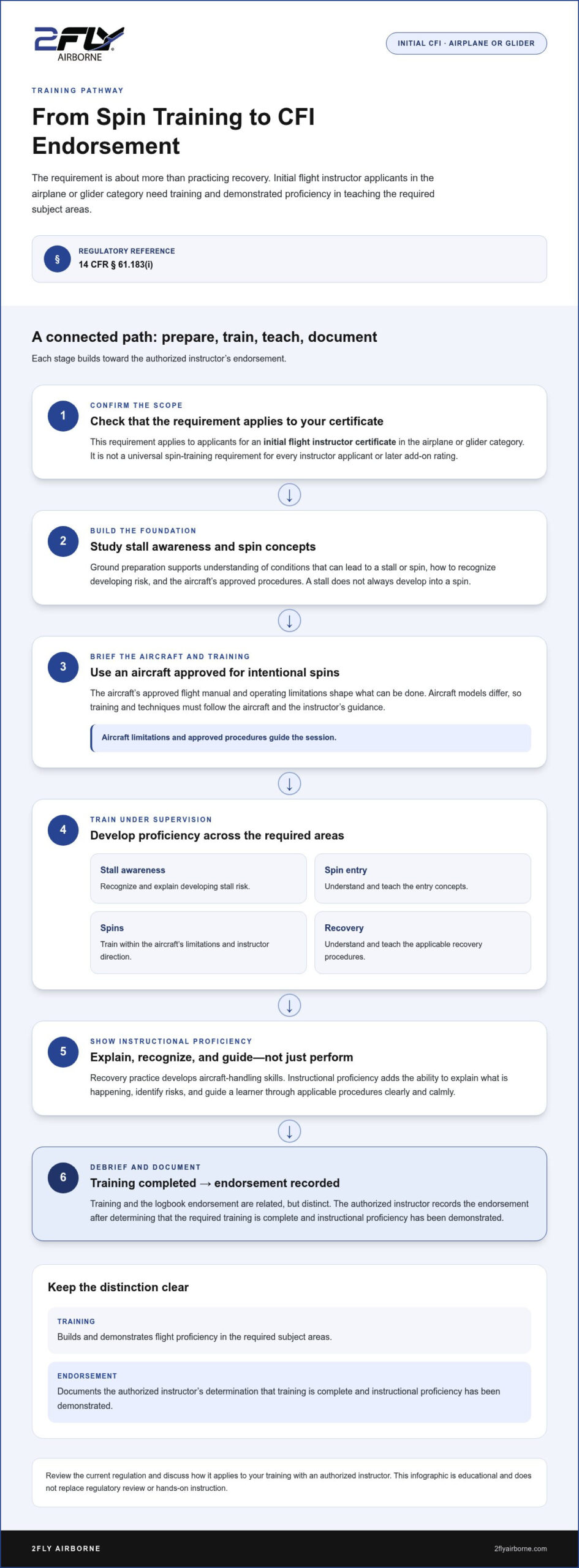
A CFI candidate must do more than experience a spin or practice recovering from one. Applicants for an initial flight instructor certificate in the airplane or glider category need training that prepares them to teach stall awareness, spin entry, spins, and recovery. The cfi spin endorsement training requirements connect flight training with the ability to explain and instruct these skills.
Training and receiving a logbook endorsement are related, but distinct steps. Training develops and demonstrates proficiency. The endorsement records an authorized instructor’s determination that the required training has been completed and that the applicant has demonstrated the necessary instructional proficiency.
What does the CFI spin endorsement certify?
In plain language, the spin endorsement documents that an eligible CFI applicant has received the required flight training and demonstrated proficiency in teaching stall awareness, spin entry, spins, and spin recovery. That goes beyond experiencing the procedures as a student. A flight instructor must be ready to explain what’s happening, recognize developing risks, and teach appropriate actions.
The regulation to review is 14 CFR § 61.183(i). It addresses flight training and a logbook endorsement from an authorized instructor, including demonstrated instructional proficiency. For background on the aerodynamic principles involved, review this explanation of the aerodynamics of a spin, then study applicable training material with your instructor. Reading can support preparation, but it doesn’t replace flight instruction or a proficiency assessment.
Which CFI applicants should examine this requirement?
Section 61.183(i) applies to applicants for an initial flight instructor certificate with the airplane or glider category. It shouldn’t be treated as a universal spin-training requirement for every instructor applicant or later instructor rating. Add-on qualifications, such as CFII or MEI, have their own requirements, so review the current regulation for the certificate or rating you’re pursuing.
Certification circumstances can vary, and regulations may be revised. Read the current eCFR text and discuss how it applies to your training with an authorized instructor. This article is educational, not official FAA guidance, and it doesn’t replace regulatory review or hands-on instruction.
Spin training is one milestone in a broader progression of flight proficiency, aviation knowledge, and teaching skill. Candidates considering how CFI preparation fits into a longer professional pathway can explore 2FLY’s degree program with airline pilot training.
How CFI spin training develops stall awareness and recovery-teaching skills
Spin training links aerodynamic understanding with sound instructional judgment. A stall occurs when a wing exceeds its critical angle of attack and loses lift. A spin involves a stalled aircraft rotating as it descends. Under the 14 CFR § 61.183(i) framework, CFI candidates develop proficiency in stall awareness, spin entry, spins, and recovery so they can teach these subjects, not simply perform them.
Preparation has two connected parts. Ground study builds understanding of conditions that can lead to a stall or spin and of the aircraft’s approved procedures. Supervised in-air training develops the ability to recognize and respond to the aircraft’s behavior. The sequence and techniques must follow the aircraft’s approved flight manual and the instructor’s guidance.
How stall awareness supports spin prevention and recognition
Stall awareness helps a flight instructor recognize changing conditions and make timely instructional decisions. A candidate should be able to explain how an aircraft’s attitude, coordination, and angle of attack relate to stall risk, without assuming that every stall develops into a spin. A spin involves a stalled condition with autorotation, meaning the aircraft rotates around its vertical axis as it descends.
That distinction matters when teaching. The goal isn’t to encourage spin entry outside a supervised training environment. It’s to recognize developing risk and understand the aircraft’s approved response. Aircraft models differ, so don’t assume that a technique learned in one aircraft applies to another.
What instructional proficiency adds beyond recovery practice
Recovery practice develops aircraft-handling skills. Instructional proficiency also requires explaining the aerodynamic conditions, identifying risks, and guiding a learner through applicable procedures clearly and calmly. A CFI candidate should connect what the aircraft is doing with why a response is needed, while keeping the lesson within the aircraft’s limitations and the instructor’s direction.
There is no single maneuver sequence that applies across all aircraft types. Use the approved flight manual, operating limitations, and instructor briefings for the aircraft you’re flying. Your instructor determines how training is conducted and assesses whether you can explain and teach the required concepts, rather than rely on a memorized sequence alone.
Approach the cfi spin endorsement training requirements as part of developing knowledge, judgment, and teaching skill. Candidates considering how this work fits into CFI preparation can explore 2FLY’s flight instructor training pathway.
Spin endorsement training options: compare structure, aircraft, and instructor feedback
Spin training may be integrated into a broader CFI course or scheduled separately as supplemental training. Neither format is automatically better. Compare whether the session provides a clear learning sequence, supervised practice, and feedback that develops your proficiency and your ability to explain the subject.
The 14 CFR § 61.183(i) requirement sets the training and instructional-proficiency standard. The session sequence and duration can vary with the training plan, aircraft, and individual progress. Focus on the objectives and assessment rather than assuming a standard number of hours.
What to compare in a structured versus supplemental training session
A structured CFI course can connect spin topics with your wider instructor preparation. Supplemental training may focus more narrowly on the spin-related learning objectives. In either format, look for a purposeful briefing, supervised flight practice, a debrief, and clear training records.
Use these points to understand how training is organized:
- Briefing: Are the objectives and applicable aircraft procedures reviewed before flight?
- Practice: Is the flight supervised and directed toward the agreed training objectives?
- Feedback: Does the debrief address both aircraft handling and how you explain the concepts as an instructor?
- Records: Is your progress documented, with readiness and endorsement decisions left to the authorized instructor?
A useful learning sequence addresses personal proficiency and instructional explanation together. For example, a debrief can help you identify what you observed in flight and how you would communicate that information to a learner. Your training plan should reflect your progress, not a one-size-fits-all timeline.
Why aircraft suitability and limitations matter
Intentional spin training requires an aircraft certificated for spins. That certification doesn’t make every loading or operating condition suitable. The aircraft’s limitations and required procedures govern how training can be conducted.
Before flight, review the applicable approved aircraft documentation with your instructor. Don’t carry a procedure or maneuver from one aircraft into another by assumption. The aircraft, its operating limitations, and the session’s instructional goals shape the training plan. Meeting the cfi spin endorsement training requirements calls for disciplined preparation, supervised practice, and feedback tied to the specific aircraft.
To see how instructor preparation can fit into a broader training pathway, explore 2FLY’s CFI training.
How to prepare for CFI spin endorsement training and document progress
A deliberate preparation sequence helps you get more from each session and keep your records clear. Use this progression with your authorized instructor:
- Review: Study the applicable regulation, current FAA training references, and the aircraft’s approved flight manual.
- Brief: Confirm the session’s learning objectives, aircraft limitations, and procedures with your instructor.
- Train: Complete flight training under instructor supervision, following the approved procedures for that aircraft.
- Debrief: Discuss what you recognized, how you responded, and how you would explain the concepts to a learner.
- Record: Make training entries as directed, and receive an endorsement only when your instructor determines you meet the required standard.
The current text of 14 CFR § 61.183(i) describes the relevant flight training and logbook endorsement. Review it alongside current FAA training material, since regulatory language and advisory references may change.
What to review before the flight
Before the briefing, note questions about stall and spin recognition, risk management, aircraft procedures, and how to teach each concept clearly. Review the applicable operating limitations with your instructor, then agree on what the session is intended to develop. Preparation should support the flight, not replace instructor-led training or the aircraft’s approved documentation.
Aircraft procedures are specific. Don’t rely on memory from another model or a generic maneuver sequence when the flight manual and instructor provide the applicable guidance.
How to debrief and record training accurately
After the flight, use the debrief to identify demonstrated strengths, areas for further practice, and questions to resolve before the next session. Personal study notes can help track these points, but keep them distinct from formal logbook entries and endorsements. Follow your authorized instructor’s direction and applicable recordkeeping requirements.
Training records should reflect the instruction actually received. The authorized instructor determines readiness and the appropriate endorsement wording. Attendance or personal notes alone don’t prove that an endorsement has been earned. FAA Advisory Circular 61-65K includes sample endorsement language, but verify the current reference and applicable requirements before relying on it.
Careful preparation and accurate records are part of professional CFI development. Explore 2FLY’s CFI training pathway as you plan your instructor training.
Connect the CFI spin endorsement to a structured flight-instructor pathway
The spin endorsement is one milestone in CFI preparation, not a substitute for the broader knowledge, flight proficiency, and teaching skills expected of an instructor. Candidates build readiness by connecting regulatory understanding with sound flying and the ability to explain procedures clearly. The cfi spin endorsement training requirements fit within that progression, alongside the other preparation needed for an initial CFI certificate.
Where the endorsement fits in CFI preparation
2FLY Airborne’s CFI training is part of a structured development pathway. As you plan, consider how each milestone supports your next step: strengthening aviation knowledge, refining flight skills, and learning to teach with clarity and sound judgment. The spin endorsement addresses a specific training requirement. Earning it alone doesn’t qualify someone for a particular job or airline position.
For candidates planning a wider training progression, the FAA Professional Pilot Program provides a broader program context. Keep the goals distinct: instructor certification, additional pilot qualifications, and career opportunities each involve their own requirements and preparation.
Plan the next step in your instructor development
Map the spin endorsement against your overall CFI preparation plan. Identify what you’ve completed, what still needs instructor review, and how the training fits alongside your ground preparation, flight proficiency, and teaching practice. If you’re also considering a wider path to the cockpit, use a reliable career guide to understand how pilot training milestones relate to one another.
Keep the priorities clear: meet the applicable requirement, develop genuine instructional readiness, and follow safe, structured training under authorized instruction. The endorsement is meaningful when it reflects demonstrated preparation, not simply a checked box.
In short, treat spin training as one step in becoming a capable flight instructor, while keeping your broader CFI objectives in view. For guidance on how CFI training can fit your professional development plan, reach out to a 2FLY Training Advisor with your questions.
Build your CFI skills with purpose
The cfi spin endorsement training requirements are one part of preparing to teach safely and effectively. Eligible initial CFI applicants need training that develops flight proficiency and the ability to teach stall awareness, spin entry, spins, and recovery. The endorsement documents that preparation; it isn’t simply proof that you’ve experienced the procedures.
Keep your training structured: study the applicable requirements, follow the approved procedures and limitations for the aircraft, and use instructor feedback to guide your progress. Make sure records reflect the training received, and rely on your authorized instructor to determine readiness and appropriate endorsement wording.
2FLY Airborne offers Certified Flight Instructor training as well as a broader FAA Professional Pilot Program, connecting instructor preparation with a wider aviation pathway. For help understanding how CFI training may fit your goals, speak with a 2FLY Training Advisor.
Approach each milestone with care, curiosity, and a commitment to safe, structured learning. Your development as an instructor starts with the habits you build now.
Frequently Asked Questions
Is spin training required for every CFI applicant?
No. The requirement applies to applicants for an initial flight instructor certificate in the airplane or glider category under 14 CFR § 61.183(i). It doesn’t apply in the same way to every instructor applicant or add-on rating. Certification circumstances can vary, so review the current eCFR text and discuss how it applies to your situation with an authorized instructor.
What does a CFI spin endorsement need to show?
The endorsement documents that you received the required training and that an authorized instructor found you competent and instructionally proficient in stall awareness, spin entry, spins, and spin recovery procedures. It reflects more than attendance or exposure: it records proficiency in the specified areas, including the ability to teach them. Check current FAA endorsement guidance for applicable wording, and rely on your instructor to assess readiness.
Can spin training be completed in any airplane?
No. Intentional spin training must take place in an airplane or glider certificated for spins. The aircraft’s approved procedures and operating limitations govern how training can be conducted, and certification doesn’t make every loading or operating condition suitable. Review the applicable aircraft documentation with your instructor, and don’t assume that a procedure from one aircraft applies to another.
How should I prepare for CFI spin endorsement training?
Review the applicable regulation, current FAA training references, and the aircraft’s approved flight manual before your session. Brief the learning objectives and operating limitations with your instructor, and prepare questions about recognizing stall and spin risks, following aircraft-specific procedures, and teaching the concepts. After training, use the debrief to identify what you’ve developed and what may need further practice before an endorsement decision.
Does spin recovery practice alone satisfy the CFI endorsement requirement?
No. The requirement covers more than recovery practice. Under 14 CFR § 61.183(i), the applicant must receive training and demonstrate competency and instructional proficiency in stall awareness, spin entry, spins, and recovery procedures. That means being prepared to teach the subject matter, not just perform a recovery. Your authorized instructor assesses your proficiency and determines whether the training and endorsement are appropriate.
How long does CFI spin endorsement training take?
The regulation doesn’t set a minimum number of flight hours or spins. Training is proficiency-based, so the time required depends on your progress and your instructor’s assessment of your ability to perform and teach the required subject areas. Plan your training with your instructor rather than assuming a standard duration. An endorsement should be recorded only after the instructor determines you’ve met the applicable standard.
Is a CFI spin endorsement a separate pilot rating?
No. A spin endorsement is a logbook record associated with the applicable initial flight instructor certificate requirement, not a separate pilot rating. It documents the required training and demonstrated instructional proficiency in the specified areas. It doesn’t replace other CFI certificate requirements, and by itself it doesn’t qualify a pilot for a particular job or instructor position.
Keep the key points in view: understand whether the requirement applies to your certificate, prepare to teach as well as perform, and follow safe, structured training under authorized instruction. For questions about how CFI preparation fits your goals, reach out to a 2FLY Training Advisor.
Article by
2FLY Airborne
2Fly Airborne is a professional flight training organization dedicated to developing the next generation of skilled, confident, and safety-focused pilots. With decades of combined aviation experience, our team of certified instructors provides structured, real-world training designed to prepare students for both checkrides and long-term success in the aviation industry.
Content Disclaimer
Some blog content is generated with the assistance of automated tools and may not always be fully accurate or up to date. Please verify all aviation-related information with official sources or a certified instructor. For additional guidance or clarification, we encourage you to contact one of our training advisors at 2Fly Airborne.