

What if the strongest answer on your initial CFI checkride isn’t a polished maneuver, but a clear explanation that helps someone else fly it safely? That shift is at the heart of faa initial cfi checkride preparation: you’re being evaluated not only as a pilot, but as an instructor who can explain, demonstrate, and assess. It’s natural to focus on recalling answers and sharpening maneuvers, yet neither alone shows how you’ll teach.
A focused plan can turn uncertainty into a repeatable process. This guide explains how instructor-focused preparation differs from pilot-only practice and how to organize oral and flight work around teaching, not recitation. You’ll learn to build lessons from checkride topics, respond to questions with clear reasoning, and practice a consistent cycle: brief the task, demonstrate it, then debrief performance and risk. The goal isn’t to sound rehearsed. It’s to make sound aeronautical knowledge understandable and useful as you prepare for the flight instructor stage of your aviation career.
Key Takeaways
- Make faa initial cfi checkride preparation a repeatable workflow: review current standards, identify gaps, plan lessons, rehearse, and track progress.
- Shape oral responses around a learner’s objective, a clear explanation, a demonstration, and a check for understanding.
- Rehearse each flight lesson from briefing through demonstration and debrief, keeping communication and sound judgment in focus.
- Use deliberate review and instructor feedback to address unresolved gaps and strengthen practical readiness.
- Balance independent study with structured coaching to build a preparation approach that fits your needs.
Why FAA Initial CFI Checkride Preparation Requires a Teaching Mindset
You can fly a maneuver accurately and still struggle to teach it. A future flight instructor must do more than complete the task: they need to explain its purpose, describe what to notice, and help a learner understand what to improve. That change in responsibility is why faa initial cfi checkride preparation calls for a different approach from practicing pilot skills alone.
A Certified Flight Instructor teaches and evaluates other pilots, as outlined in this general overview of the Certified Flight Instructor (CFI) role. In practical terms, readiness means combining clear instruction with sound flying and judgment. A candidate should be able to adjust an explanation to the learner, maintain awareness during flight, and recognize when safety requires attention or intervention.
What changes when a pilot becomes the instructor?
As a pilot, your attention centers on performing the maneuver and managing the aircraft. As an instructor, you must also explain its purpose, identify useful cues, and describe safe execution in language a learner can follow. Communication and observation become part of the flying task, not activities reserved for after landing.
For example, during a practice maneuver, you might notice a learner fixing their attention inside the cockpit. You need to explain why outside references matter, monitor the aircraft, and offer a timely correction. The exact situation will vary; the point is to demonstrate teaching judgment alongside aircraft control.
What does checkride readiness look like in practice?
A ready candidate can set a clear learning objective, explain the concept, demonstrate it, observe the learner’s performance, and give specific, constructive feedback. The explanation should connect actions to reasons, helping the learner understand what to look for and how to improve instead of simply copying a sequence.
- Explain: Use plain language and connect the task to its purpose.
- Demonstrate: Show the relevant actions while maintaining safe aircraft operation.
- Observe: Notice performance and identify where support is needed.
- Debrief: Give focused feedback and a practical next step.
Confident delivery helps, but confidence isn’t a substitute for sound reasoning. A memorized answer may sound polished until a follow-up question changes the context. Instead, explain the principle, apply it to the situation, and acknowledge uncertainty when you need to verify a detail. Checkride standards and individual preparation needs can change, so review current FAA materials as you plan. This teaching mindset supports focused preparation and safer instruction beyond the evaluation.
Build an FAA Initial CFI Checkride Preparation Plan Around Current Standards
Good preparation needs more than a stack of notes. Use current FAA materials to set the scope, then turn each applicable topic into a teaching task you can practice and evaluate. This makes faa initial cfi checkride preparation more focused: you can direct study time toward genuine gaps instead of giving every subject equal attention.
Requirements and testing standards can change. Check current FAA publications for the documents and requirements relevant to your application; this article is educational guidance, not official FAA guidance. The FAA Aviation Instructor’s Handbook can help you strengthen teaching methods. Use current FAA materials to confirm the applicable certification requirements and testing standards.
Turn current standards into a focused study map
For each applicable topic, record what you need to explain, demonstrate, observe, and assess. Keep knowledge gaps separate from subjects you can already teach to your instructor’s expected standard. That distinction turns a broad syllabus into a manageable study map.
Create a practice cycle that exposes gaps early
Use short rehearsals to test whether your lesson is understandable without relying on a script. Ask your recommending instructor to identify priorities and give specific feedback, then revise and rehearse again. Track recurring questions and explanations that feel unclear; they point to focused follow-up work.
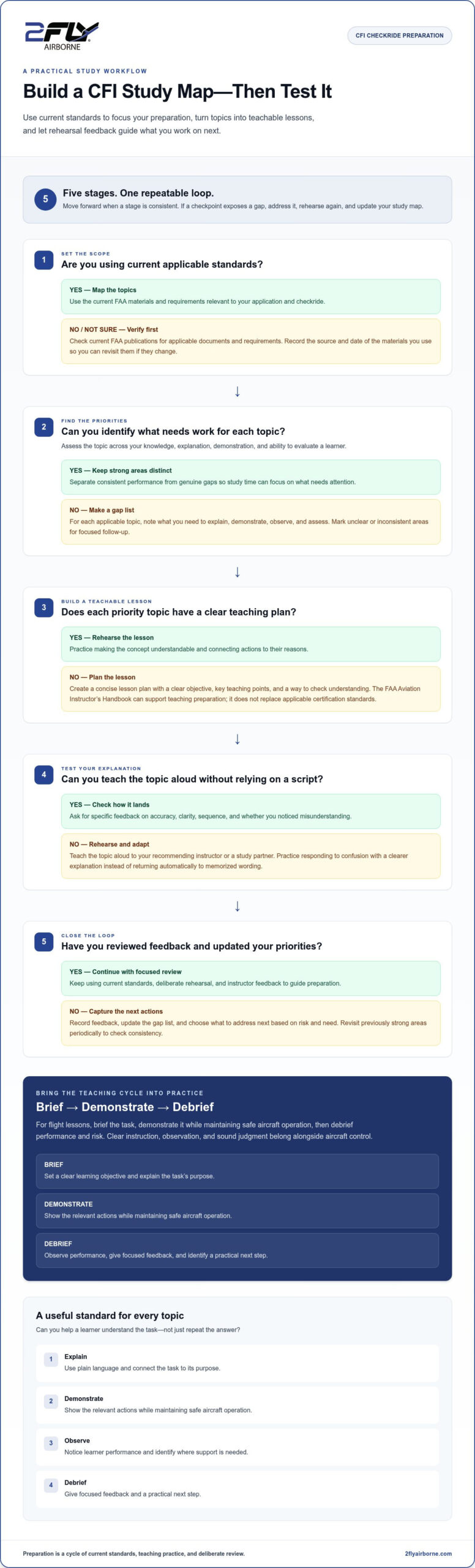
- Review current standards. Identify the current FAA documents and requirements that apply to your checkride. Note the source and date of the materials you use so you can revisit them if they change.
- Identify gaps. For each topic, assess your knowledge, explanation, demonstration, and ability to evaluate a learner. Mark what needs work and what is already consistent.
- Plan lessons. Turn priority topics into concise lesson plans with a clear objective, key teaching points, and a way to check understanding. Use the FAA instructor handbook to support teaching preparation, not as a replacement for applicable certification standards.
- Rehearse instruction. Teach a topic aloud to your recommending instructor or a study partner. Practice adapting when a question reveals confusion rather than returning automatically to memorized wording.
- Review progress. After each rehearsal, record feedback, update the gap list, and choose the next topic based on risk and need. Revisit previously strong areas periodically to make sure your performance remains consistent.
Ask your instructor to make feedback specific: Was the explanation accurate? Could a learner follow its sequence? Did you identify an important misunderstanding? Prioritize issues that affect safety, accuracy, or the learner’s ability to apply the concept. A minor wording preference may need less attention than a missing explanation of why a procedure matters.
Preparation checklist:
- Have I checked current, applicable FAA materials?
- Can I explain and demonstrate each priority topic?
- Have I recorded instructor feedback and recurring questions?
- Does my next study session address a specific gap?
Repeat the cycle until you can teach the material clearly and respond thoughtfully to feedback. If structured CFI training is part of your plan, a conversation with a 2FLY Training Advisor can help you understand how it fits into your aviation training pathway.
Prepare for the CFI Oral by Teaching Concepts, Not Reciting Answers
A strong oral response does more than supply a correct fact. It helps a learner understand an idea, apply it, and recognize whether they’ve understood it. For faa initial cfi checkride preparation, practice turning knowledge into instruction rather than rehearsing answers as isolated lines.
Use current, applicable FAA testing standards and knowledge requirements to organize oral study. They help connect the topics you need to know with the knowledge, risk management, and performance expectations being evaluated. Check current FAA materials before relying on a particular document or requirement, since standards can change.
Make each lesson plan usable in a live teaching situation
Build each lesson around a clear objective, such as explaining how a pilot recognizes and responds to a developing situation. Arrange the material in an order a learner can follow, and use a diagram or example when it makes a difficult point easier to understand.
A lesson plan is a guide, not a speech to read aloud. Keep key prompts, teaching points, and questions on the page, then practice explaining them naturally. Referring to notes selectively can help you stay organized without interrupting the conversation or losing sight of the learner.
Rehearse explanations and respond constructively to questions
Practice with someone who has less experience than you do. A fellow instructor candidate may already know the terminology, while a newer learner can reveal where you’ve skipped a step or assumed too much. Ask them to explain the idea back in their own words.
For each topic, rehearse a simple sequence:
- Set the objective: State what the learner should understand or be able to do.
- Explain: Introduce the idea in plain language, defining technical terms as needed.
- Demonstrate: Use a practical example, diagram, or demonstration to make the concept concrete.
- Check understanding: Ask a question that shows whether the learner can apply the idea, not just repeat your words.
Follow-up questions are useful tests of whether your explanation holds together. If a listener asks why a step matters, explain the reason rather than repeating the step. If you notice an assumption, define it and rebuild the explanation from a point the learner understands.
Stay composed if you catch an error or can’t recall a detail. Correct the explanation plainly, acknowledge what you need to verify, and use a reliable reference before presenting the information as fact. This demonstrates a disciplined approach to accuracy, not weakness.
After each rehearsal, note which explanation confused the listener, which question exposed a gap, and what you’ll change next time. That feedback loop turns lesson plans into working teaching tools and makes study time more purposeful. The goal is not a perfect speech; it’s accurate, adaptable instruction that helps another pilot learn.
Practice the CFI Flight Portion as an Instructor from the First Briefing
Flight practice should feel like a lesson, not a maneuver session with explanations added afterward. In faa initial cfi checkride preparation, rehearse the full teaching flow: set an objective, explain and demonstrate the task, observe the learner, and debrief. Keep practice aligned with applicable current standards and give appropriate attention to aircraft control and safety throughout each flight.
Brief and demonstrate with the learner in mind
Start by stating what the learner should understand or be able to do. Explain what to watch for during the demonstration, using plain language to describe relevant cues and safety considerations. Adapt the example to the topic and training scenario rather than memorizing a fixed script.
A useful briefing also gives the learner a way to stay engaged. Invite them to look for a specific cue or explain what they expect to happen next. That creates a reason to listen and gives you a point to revisit during the debrief.
Observe, coach, and debrief without losing the teaching thread
While the learner practices, pay attention to their actions and explanations while maintaining appropriate awareness of the flight. Give feedback tied to the stated objective, and keep it respectful and specific. Ask the learner to summarize the key points before closing the debrief; their response can reveal what needs another explanation.
- Brief the objective. State the lesson goal, explain why it matters, and tell the learner what cues or decisions to notice.
- Explain and demonstrate. Describe the task in a clear sequence, then demonstrate it while highlighting the teaching points. Keep the explanation concise enough to support safe flight operations.
- Observe the learner. Watch for performance that relates to the objective and listen to the learner’s reasoning. Use calm prompts when appropriate, while maintaining the awareness and judgment needed to manage the training situation.
- Debrief and check understanding. Identify what went well, choose a specific area to improve, and ask the learner to explain the key lesson in their own words.
Make practice realistic without pretending to predict an examiner’s exact behavior. A role-playing learner can ask an unexpected question, overlook a cue, or make a plausible error in a controlled training scenario. Your task is to notice what matters, communicate clearly, and respond in a way that supports learning while prioritizing safety. Discuss scenarios with your instructor and keep simulated errors within an appropriate, supervised practice setting.
After each rehearsal, note whether the briefing prepared the learner, the demonstration made the task understandable, and the debrief gave a useful next step. If the learner remains confused, adjust the explanation instead of repeating it word for word. This process builds instructional judgment as well as consistency.
For a structured path into the flight instructor stage, explore 2FLY’s FAA training and consider how guided practice can support your preparation.
Finish CFI Checkride Preparation with Deliberate Review and Structured Training
The final stage of faa initial cfi checkride preparation is about confirming readiness, not simply adding more study hours. Use your review to find recurring gaps, check that practice has addressed their causes, and make sure you can teach clearly while maintaining sound judgment. Your preparation pace will depend on your experience, feedback, and progress, so there’s no universal timeline to follow.
Use the final review to strengthen weak areas
Return to the topics that have caused difficulty during oral or flight rehearsals. Ask whether the issue is missing knowledge, an unclear explanation, a weak demonstration, or difficulty assessing a learner. Address the underlying issue, then practice again and seek feedback on whether your performance has improved.
A focused review might include:
- Unresolved gaps: Revisit concepts or skills that still need clearer explanation or more consistent practice.
- Teaching rehearsals: Choose representative topics and practice delivering them without relying on memorized wording.
- Instructor feedback: Review notes from your recommending instructor and confirm that earlier concerns have been addressed.
- Practical readiness: Assess whether you can explain, demonstrate, observe, and debrief while making safe, considered decisions.
Avoid cramming unfamiliar material at the expense of clear instruction and safe performance. If a review identifies a genuine knowledge gap, use current, reliable references and ask your instructor to help you understand and apply the information. If the topic is familiar but your delivery is unclear, rehearse the explanation instead of rereading notes without a specific goal.
Balance independent study with structured coaching
Independent study gives you control over when and how you review, and it can help consolidate knowledge. Coaching adds an outside perspective: an instructor can question your reasoning, identify weak explanations, and help you prioritize what to practice next. Use each approach where it contributes most, and adjust the balance as your needs change.
2FLY Airborne’s FAA training pathway covers private pilot, commercial pilot, and flight instructor certifications. The FAA airline pilot program connects pilot training with the broader progression toward professional aviation. The management team brings over 50,000 combined flight hours and 35 years of aviation experience, providing relevant leadership context, not a promise of any checkride outcome.
As you close out preparation, keep your focus on accurate knowledge, responsive teaching, sound judgment, and safe, structured practice. Review what remains unresolved, use feedback to guide your next steps, and allow your readiness to develop at an individual pace. For questions about CFI preparation or how it fits into your training pathway, reach out to a 2FLY Training Advisor.
Take the Next Step Toward Your Instructor Career
Your path from pilot to instructor is a professional transition: you’re preparing not only to demonstrate what you know, but to help another person build sound habits and judgment. Let that responsibility guide your next step. Treat faa initial cfi checkride preparation as a chance to shape an instructional approach you can carry into your career, not simply a short-term effort to get through an evaluation. Much like licensed professionals in other regulated fields who rely on continuing education resources like educationpathways.biz to keep their credentials current, flight instructors must commit to lifelong learning and clear professional standards.
Consider where you are in your training and what support would help you progress. A conversation about your goals can help you understand how CFI preparation fits into a broader FAA training pathway and what questions to explore as you plan. Your readiness will develop through safe, structured practice and feedback tailored to your needs.
Speak with a 2FLY Training Advisor about your FAA training path and take a considered next step toward becoming a flight instructor.
Frequently Asked Questions
Is the initial CFI checkride harder than the commercial pilot checkride?
Neither checkride is automatically harder; they assess different responsibilities, and difficulty depends on the candidate. Commercial checkride experience can help you manage evaluation pressure, but the CFI evaluation asks you to think from an instructor’s perspective. For example, practice explaining why a maneuver matters and how you’d recognize a learner’s misunderstanding, not only recalling how to perform the task yourself.
How long should I prepare for an initial CFI checkride?
There’s no single preparation timeline that fits every candidate. Your faa initial cfi checkride preparation depends on your experience, familiarity with applicable standards, lesson development, and ability to explain and demonstrate topics clearly. Work with your recommending instructor to set milestones, review your progress, and adjust the plan if gaps remain. Treat calendar estimates as planning tools, not proof of readiness or a guarantee of a checkride result.
What happens if I cannot answer a question clearly during the CFI oral?
Pause and make sure you understand what’s being asked before responding. Explain the part you can support accurately, and don’t bluff or present a guess as fact. If a question reveals that you’re unsure about a detail, say so calmly and identify how you would verify it using a reliable reference. Practice responding this way so uncertainty doesn’t lead to rushed or unsupported explanations.
Can my commercial pilot checkride experience help me prepare for the initial CFI checkride?
Yes, it can give you useful experience with evaluation pressure and help you recall flight tasks, but it doesn’t replace instructor-focused preparation. Use that foundation to identify where your approach needs to change. For example, revisit a maneuver you know well and practice explaining its purpose and likely learner challenges. Ask your instructor to assess whether your explanation is accurate and understandable to someone still learning.
What should I do if my practice teaching keeps exposing the same weakness?
Find the source of the problem before repeating the lesson. A recurring difficulty might involve subject knowledge, lesson organization, word choice, or adapting an explanation to the listener’s experience. Note the exact point where your practice listener loses the thread, revise that part, and rehearse again. If the issue involves technical accuracy, consult a reliable, current training reference and discuss your understanding with your instructor.
How should I choose between self-study and structured CFI checkride preparation?
Self-study can help you review knowledge and organize lesson materials, while structured practice adds feedback on your teaching and responses to questions. The right balance depends on your experience and identified gaps. Try preparing a lesson independently, teaching it to another person, and reviewing your performance with your instructor. Choose methods for the learning they provide, not for a promised timeline or outcome.
Strong CFI preparation depends on accurate instruction, sound judgment, and safe, structured practice. Keep using feedback to guide your next steps, and reach out to a 2FLY Training Advisor with questions about your FAA training path.

Article by
2FLY Airborne
2Fly Airborne is a professional flight training organization dedicated to developing the next generation of skilled, confident, and safety-focused pilots. With decades of combined aviation experience, our team of certified instructors provides structured, real-world training designed to prepare students for both checkrides and long-term success in the aviation industry.
Content Disclaimer
Some blog content is generated with the assistance of automated tools and may not always be fully accurate or up to date. Please verify all aviation-related information with official sources or a certified instructor. For additional guidance or clarification, we encourage you to contact one of our training advisors at 2Fly Airborne.