

Flight instruction can provide paid work while you build experience, but it is not a guaranteed route to an airline cockpit. If you’re weighing the flight instructor salary and career progression usa can offer, look beyond a posted rate: earnings may depend on paid teaching hours, student demand, weather, and the ratings you hold.
It’s reasonable to want clear figures and a realistic timeline before committing to training. A salary estimate, however, may not show how much work an instructor actually gets, and career milestones vary from pilot to pilot. CFI, CFII, and MEI qualifications can expand the types of instruction you’re qualified to provide, but they don’t guarantee a particular income or next job.
This guide explains common compensation structures, factors that can affect earnings, and ways flight instruction may fit into a broader aviation career. You’ll also find a practical framework for comparing career paths and evaluating training choices. A structured foundation in flight training and instructor certifications can help you plan your next step with a clearer view of both the opportunities and the variables.
Key Takeaways
- Compare hourly, salaried, contract, and mixed pay arrangements to understand what an annual income estimate may leave out.
- See how CFI, CFII, and MEI qualifications can broaden instructional opportunities without guaranteeing a specific career step.
- Assess flight instructor salary and career progression in the USA alongside workload, paid hours, and schedule reliability.
- Compare flight instruction with other early-career pilot routes by the experience they provide, schedule variability, and hiring considerations.
- Learn how structured FAA training in private, commercial, and flight instructor certifications can support an individual career plan.
What Does a Flight Instructor Salary in the USA Actually Measure?
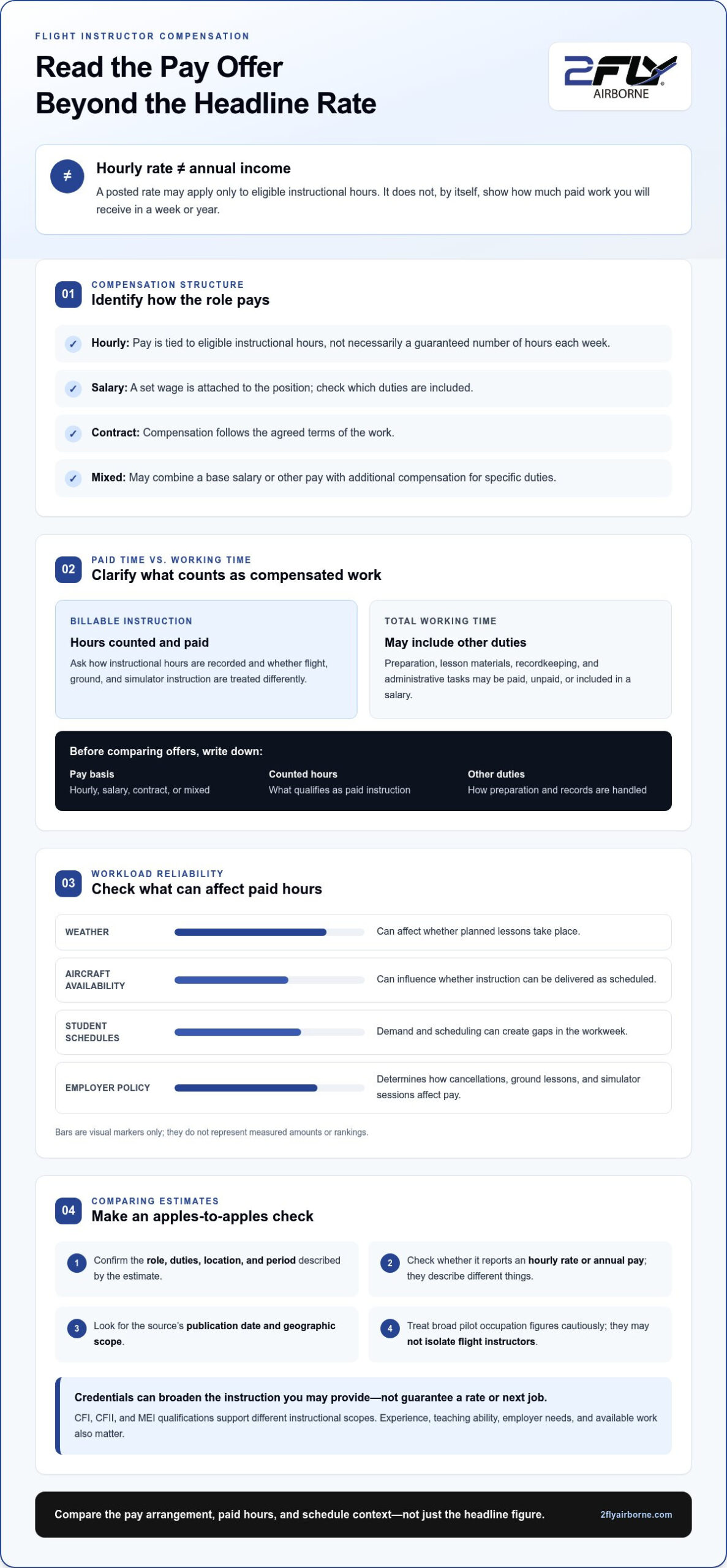
An aspiring instructor sees an hourly rate in a job listing and starts estimating a dependable annual income. But that rate may apply only to eligible instructional hours, not every hour spent at the school or preparing for a lesson. To assess the flight instructor salary and career progression usa can offer, first identify exactly what the quoted compensation covers.
Flight instructor compensation is pay for instructional work under a particular arrangement. It may be hourly, salaried, contract-based, or mixed. Any salary estimate is most useful when you know the role, duties, location, and period it describes. A general overview of the profession, including U.S. instructor roles, appears in Flight Instructor (CFI) in the USA; it isn’t a source for current pay estimates.
Billable instruction time is time an employer or client counts and pays as instruction. Total working time can also include preparation, recordkeeping, and other duties, which may or may not be compensated separately. Keeping these measures distinct makes it easier to compare a quoted rate with the work involved.
How are flight instructors typically paid?
With hourly pay, compensation is tied to eligible instructional hours rather than a guaranteed number of hours each week. Salaried roles offer a set wage for the position, while contract work pays according to agreed terms. Mixed arrangements may combine a base salary or other pay with additional compensation for specific duties.
Flight, ground, and simulator instruction can be treated differently under an employer’s policy. Preparation and administrative tasks, such as organizing lesson materials or completing records, may be paid, unpaid, or included in a salary. Before comparing offers, identify which duties count as paid work and how instructional hours are recorded.
For a clearer comparison, write down the pay basis, what counts as an instructional hour, and how non-teaching duties are treated. Then consider how the schedule affects the amount of paid work you can reasonably expect. A rate without this context doesn’t tell you what a typical week or year might look like.
Why do salary estimates vary so widely?
Pay estimates can differ because they describe instructors with different experience, qualifications, employers, and schedules. A full-time salaried role and a part-time hourly position are not directly comparable. Local demand can influence how much work is available, while an instructor’s ratings may affect which students and lessons they can teach.
Even a strong hourly rate may not translate into steady annual earnings if the schedule has gaps. Weather, aircraft availability, and student scheduling can affect whether planned lessons take place. Employer policies also determine how cancellations, ground lessons, simulator sessions, and non-instructional duties affect pay.
Read salary figures as estimates, not promises. Check whether the source identifies the job category, publication date, and geographic scope, and whether it reports hourly rates or annual pay. Broad Bureau of Labor Statistics categories for pilots may not isolate flight instructors, so avoid treating a wider occupation figure as a CFI-specific salary. A fair comparison starts with the same kind of role and a realistic view of paid work volume.
When two figures appear far apart, check whether they describe different occupations or compensation types before drawing conclusions. An annual estimate may assume a particular amount of work, while an hourly rate describes only the pay attached to eligible hours. These details matter more than comparing headline numbers alone.
How CFI, CFII, and MEI Experience Shapes Career Progression
Flight instruction can build teaching skill and flight experience, but it isn’t a fixed rung-by-rung ladder to an airline position. The credentials you hold influence the instruction you may be qualified to provide. The work you gain and the roles you later qualify for depend on your experience, applicable requirements, employer standards, and hiring conditions.
For readers weighing flight instructor salary and career progression usa, keep two questions separate: What instruction can your qualifications support, and what does a prospective employer require for its position? Experience gained in one role may be valuable, but it doesn’t automatically satisfy another employer’s hiring criteria.
What do CFI, CFII, and MEI add to an instructor’s profile?
A CFI, or Certified Flight Instructor, is qualified to provide specified flight instruction. A CFII, or Certified Flight Instructor Instrument, adds an instrument-instruction qualification. An MEI, or Multi-Engine Instructor, supports instruction in multi-engine aircraft. The scope of each credential is subject to applicable requirements and limitations, so pilots should consult current authoritative FAA materials rather than rely on a shorthand description.
These qualifications may broaden the types of students and training an instructor can work with. They don’t guarantee more students, a higher pay rate, or a particular job. An instructor’s value also depends on teaching ability, experience, employer needs, and available work.
When considering an additional qualification, connect it to a specific goal. For example, ask whether the type of instruction it supports matches the work you want to do and the qualifications employers list for relevant roles. That makes the decision more practical than assuming each additional rating will automatically increase income.
What career options may follow flight instruction?
Instructing is one possible way to gain experience, not a promise of an airline role. Some pilots pursue regional or other airline positions; others explore charter, corporate, or cargo operations. Each path has distinct operating environments and hiring criteria, and the relevant certificates and experience depend on the specific role.
The U.S. Bureau of Labor Statistics discusses airline and commercial pilot occupations, but its broad categories shouldn’t be treated as a flight-instructor-specific salary measure. Its pilot occupation and salary information can help readers understand the wider field, while individual employers’ current standards determine eligibility for particular openings.
Think of progression as a series of decisions, not a guaranteed sequence:
- Build instructional experience and strengthen teaching skills in the work available to you.
- Consider whether an additional instructor qualification aligns with the aircraft or training you want to teach.
- Compare future roles against their current experience, certification, and hiring requirements.
- Revisit your plan as your qualifications, goals, and industry conditions change.
For wider context on how training can connect to airline career goals, see Pilot Training Programs 2026: Your Pathway to a Global Airline Career. To explore how structured FAA career training can fit your own progression plan, review 2FLY’s FAA airline pilot program. Training can prepare you for the next step, but employment and timing depend on individual qualifications and hiring conditions.
Flight Instructor Work Compared with Other Early-Career Pilot Routes
Flight instruction is one way to develop as a pilot, but it’s not the only route into professional aviation. Compare the day-to-day work and the experience each path may offer, rather than assuming one leads to higher pay or a quicker next step.
What can flight instruction offer beyond pay?
Teaching asks an instructor to explain procedures clearly, assess a learner’s understanding, and make sound decisions as conditions change. Those responsibilities can strengthen communication and operational judgment while keeping the instructor engaged in flying. They also carry real accountability: learners depend on clear guidance, sound preparation, and a consistent focus on safety.
The work can involve variable schedules and fluctuating workloads. Other pilot roles may also build relevant experience, but their duties and operating environments differ. No route guarantees higher pay or faster progression; compensation, benefits, schedules, and qualifications depend on the employer and position.
When comparing routes, think about the work you will do each day, not only the job title you hope to reach later. Consider how much teaching, customer interaction, schedule flexibility, or operational structure you want. The best fit depends on your priorities and the qualifications required for the roles you’re considering.
How do airline and non-airline routes differ?
Airline work generally involves operating within an airline’s procedures and network. In U.S. regulation, Part 121 covers domestic, flag, and supplemental airline operations, while Part 135 covers commuter and on-demand operations. These categories describe operating rules, not a promise about a pilot’s schedule, pay, or career development.
Charter and corporate flying can involve different kinds of customer travel and operating schedules; cargo work focuses on transporting freight. The exact duties vary between operators. Hiring standards vary too, so experience that’s useful in one setting may not meet another employer’s requirements.
| Work route | Work and experience | Schedule and hiring considerations |
|---|---|---|
| Flight instruction | Teaches learners and develops instructional communication and judgment. | Workload can depend on student activity and operating conditions; employers set their own qualifications. |
| Airline | Operates within an airline’s procedures and network. | Schedules, compensation, benefits, and hiring standards vary by airline and position. |
| Charter or corporate | Supports customer or business travel in distinct operating environments. | Trip patterns and hiring criteria depend on the operator and role. |
| Cargo | Focuses on freight operations. | Schedules and required experience are employer-specific. |
Use this comparison as a starting point, not a ranking. For each position, look at the duties, qualifications, schedule expectations, and compensation structure together. The FAA Regulations for Flight Instructors (14 CFR Part 61) provide the regulatory framework for flight-instructor qualifications and privileges; requirements and hiring conditions can change, so consult current authoritative sources when planning.
For a grounded view of the flight instructor salary and career progression usa may involve, compare the work itself as carefully as the potential next role. If you’re weighing instructor training against other career goals, speak with a 2FLY Training Advisor about how a structured training plan may fit your objectives.
How to Evaluate Flight Instructor Earnings and Plan Your Next Step
A useful career plan looks beyond a headline pay figure. Compare what a position pays with the work it includes, how reliably that work is available, and whether the role supports your longer-term goals. This framework can help you evaluate opportunities without assuming a fixed schedule, hiring timeline, or career outcome.
Which salary details should aspiring CFIs check?
Before using a pay figure, identify what it measures. An hourly rate, annual estimate, median, average, and single employer’s advertised rate are different kinds of information. Record the source date, geographic area, occupation definition, and whether the figure includes benefits; otherwise, comparisons may mix unlike roles.
Then examine how the compensation relates to actual work. An hourly rate alone doesn’t tell you how many paid instructional hours will be available, which duties count as paid time, or how scheduling disruptions affect workload. Treat advertised pay as one piece of evidence, not a forecast of your personal annual earnings.
A simple comparison worksheet can help: note the role, pay format, included duties, expected schedule, benefits, and source date for each figure. If one listing describes a salaried position and another gives an hourly rate, keep them separate until you understand what each arrangement includes.
How can qualifications fit an individual career plan?
Start with the work you want to do. Consider whether you enjoy teaching, which training environments interest you, and how much schedule variability you’re prepared to manage. Then compare those preferences with the credentials and experience that current employers require for relevant roles. Requirements and hiring conditions can change, so use current employer information and authoritative sources when reviewing eligibility.
Use these four steps to turn the research into a plan:
- Verify pay data. Check the figure’s source, date, location, job category, and pay format. Keep employer-specific advertisements separate from broader salary estimates.
- Estimate work volume. Consider the duties that are paid and how much instructional work may realistically be available. Avoid building an annual projection on assumed fixed hours.
- Compare roles. Weigh compensation alongside schedule reliability, benefits, responsibilities, and the experience each position may provide. Look at the full employment arrangement, not just the highest quoted rate.
- Reassess your goals. As your qualifications and priorities develop, revisit which roles fit. A plan can change as opportunities, employer requirements, and personal preferences change.
For a broader look at the financial side of becoming a pilot, consult the article Flight School Costs: A Full Financial Guide for Aspiring Pilots. Keep training investment and future earnings as separate planning questions: neither an estimated salary nor a career pathway guarantees a particular return.
A realistic approach to flight instructor salary and career progression usa means comparing verified pay information with the work conditions behind it, then aligning your training choices with your own objectives. If an airline career is part of your plan, explore 2FLY’s FAA airline pilot program and reach out to a 2FLY Training Advisor with questions about how structured training may fit your next step.
How 2FLY Airborne Training Fits an Instructor-to-Pilot Career Plan
Career planning starts with your priorities: the kind of flying you want to do, the work environment that suits you, and the qualifications relevant to your goals. 2FLY Airborne’s FAA training covers private pilot, commercial pilot, and flight instructor certifications. This structured sequence prepares students to pursue instructor work, but it doesn’t guarantee a job, earnings level, or timeline.
How does structured FAA training support career planning?
Training can progress from foundational pilot skills to commercial qualifications and instructor preparation. Each stage builds on earlier learning, while the pace and individual experience vary. An instructor certification can prepare you to pursue teaching opportunities and build experience, but employment depends on qualifications, employer requirements, available work, and hiring conditions.
2FLY’s management team brings over 50,000 combined flight hours and 35 years of aviation experience. That experience informs a structured training environment, while each pilot’s career path remains individual. If an airline career is one of your goals, review the FAA airline pilot program information as part of comparing training options with your longer-term objectives.
What should readers do before choosing their next step?
Translate your goals into practical criteria before committing to a path. Compare realistic compensation expectations with the work you want to do, the schedule you can manage, and the experience that may support a later move. Revisit the plan as your qualifications develop and as regulations, employer requirements, and hiring conditions change.
- Compensation: Distinguish quoted rates from dependable work volume and consider the terms of the role.
- Work fit: Decide whether teaching, airline operations, or another aviation setting aligns with your strengths and preferences.
- Career direction: Identify the qualifications and experience relevant to your next intended role, then verify current requirements.
Flight instructor salary and career progression in the USA are not one-size-fits-all. Instructor earnings can vary with paid work and employment terms, while instruction is one possible route among several. Make decisions with current information and a safe, structured training plan, not assumptions about guaranteed outcomes.
For questions about how FAA career training may fit your goals, reach out to a 2FLY Training Advisor.
Turn Your Career Goals into a Practical Next Step
Aviation careers develop through choices made over time, not by following a guaranteed script. Treat your understanding of flight instructor salary and career progression usa as a starting point for deciding what kind of work you want, what skills you want to strengthen, and which step makes sense now. Revisit that plan as your experience grows and employment conditions change.
Choose training that supports sound judgment, professional discipline, and safe operating habits. A clear plan can help you pursue ambitious goals while staying realistic about the work and uncertainty involved.
Your next step can be a focused conversation about your goals, training options, and questions. Speak with a 2FLY Training Advisor and take the next step toward an aviation career built on preparation and purpose.
Frequently Asked Questions
How much does a flight instructor make in the USA?
There isn’t one reliable figure that represents every U.S. flight instructor job. Estimates can combine different locations, work arrangements, experience levels, or aviation occupations, so a national average may not match a specific CFI position. For a useful comparison, look for recent data that identifies the job category and geography, then compare it with current employer postings. Actual earnings depend on the position and work available.
Are flight instructors paid hourly or on salary?
Flight instructors may be paid hourly, salaried, as contractors, or under a combination of arrangements. For example, a school might pay an instructor for eligible teaching hours, while a salaried role may cover a broader set of duties. Review the written compensation terms for how ground lessons, simulator instruction, cancellations, and non-teaching responsibilities are handled. The arrangement can matter as much as the advertised rate.
Can a flight instructor become an airline pilot?
Yes. Flight instruction can be one part of a pilot’s experience-building path before pursuing airline work, but holding instructor credentials alone doesn’t qualify someone for an airline position. A pilot must meet the certificates, experience, medical, and hiring criteria applicable to the role. For the flight instructor salary and career progression usa can offer, treat airline employment as a possible goal, not an automatic next step.
Do CFII and MEI ratings increase flight instructor salary?
CFII and MEI qualifications may make an instructor eligible to teach additional types of training, but neither guarantees a raise. Compensation depends on the employer’s pay structure and whether there’s demand for that instruction. Before pursuing an additional rating, consider what kind of teaching you want to do and compare current job descriptions to see whether employers value that qualification for the roles you’re pursuing.
How many flight hours do you need before becoming an airline pilot?
For an unrestricted Airline Transport Pilot certificate, the standard total-time threshold is 1,500 flight hours. Restricted ATP eligibility can allow lower thresholds for certain qualifying applicants, so the applicable requirement depends on the pilot’s circumstances and approved pathway. These are regulatory requirements, not a hiring guarantee. Check current FAA materials and the specific airline’s qualifications before using a flight-hour target to plan your career.
Is flight instruction a good way to build experience?
It can be a practical way to develop experience while strengthening skills that go beyond aircraft handling, such as briefing, explaining decisions, and adapting to a learner’s needs. For instance, preparing a clear lesson and responding to a student’s questions can build habits relevant to professional cockpit communication. Whether instructing fits depends on your interests, available work, and career goals; it isn’t the only possible route.
What affects a flight instructor’s annual earnings?
Annual earnings reflect more than the rate on a job posting. Examine how the employer treats canceled lessons, weather disruptions, required meetings, benefits, and time between scheduled students. Also consider whether the position is full-time or part-time and how compensation is calculated across flight, ground, or simulator instruction. These details can make two roles with similar quoted rates produce different annual results.
For questions about your training and career goals, reach out to a 2FLY Training Advisor.

Article by
2FLY Airborne
2Fly Airborne is a professional flight training organization dedicated to developing the next generation of skilled, confident, and safety-focused pilots. With decades of combined aviation experience, our team of certified instructors provides structured, real-world training designed to prepare students for both checkrides and long-term success in the aviation industry.
Content Disclaimer
Some blog content is generated with the assistance of automated tools and may not always be fully accurate or up to date. Please verify all aviation-related information with official sources or a certified instructor. For additional guidance or clarification, we encourage you to contact one of our training advisors at 2Fly Airborne.