Planning a commercial flying career means separating the certificate milestone from the longer path that may follow. In the United States, the Federal Aviation Administration (FAA) sets the commercial pilot certificate minimum at 250 total flight hours.
That total is only one part of the planning. Your logbook must also show the required kinds of experience, so 250-hour commercial pilot time building means tracking more than a single number.
This guide explains how commercial and ATP flight-hour requirements differ, and how flight instruction and pilot-in-command experience can shape your next steps. You’ll also learn how to assess which logged flight time applies to commercial pilot requirements.
Key Takeaways
- Separate the commercial certificate minimum from the higher flight-hour threshold associated with ATP eligibility.
- Plan for required categories of experience, not just a target total in your logbook.
- Consider CFI training as a structured way to build experience while teaching other pilots.
- Track pilot-in-command time carefully, since it contributes to specific experience requirements.
- Review your logbook and training plan regularly to keep each flight aligned with your next certification goal.
1. How many Flight Hours do I ACTUALLY need to build for my CPL?
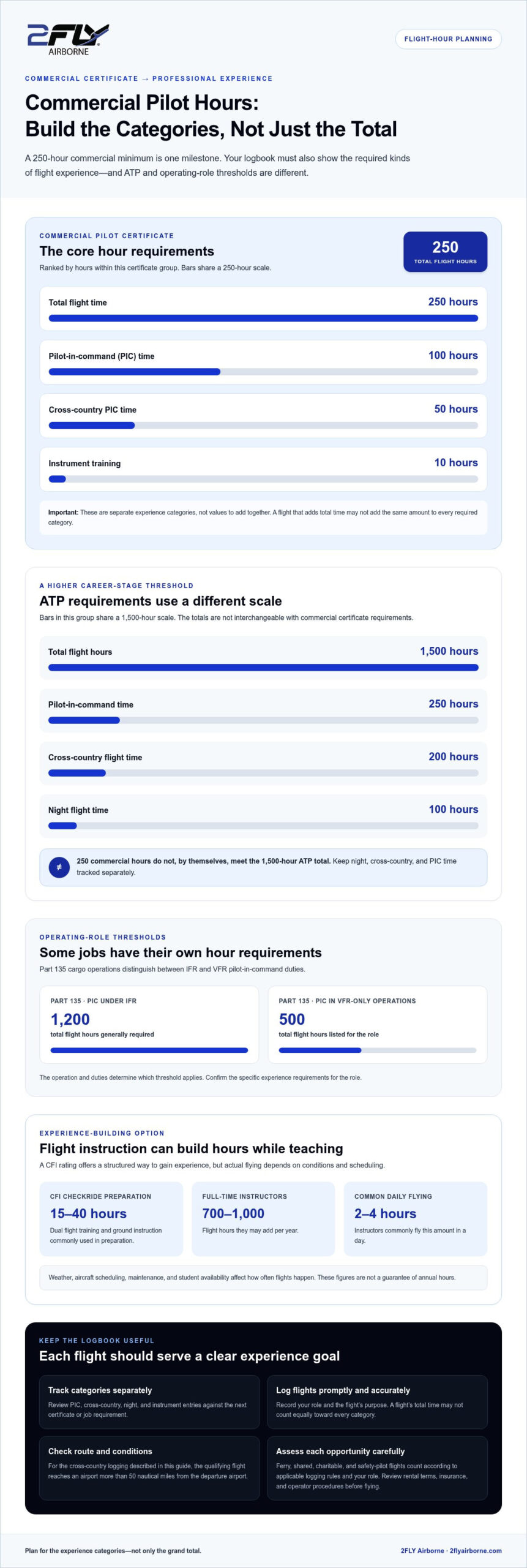
According to the Federal Aviation Administration (FAA), a pilot needs 250 total flight hours to qualify for a commercial pilot license. The FAA also lists 100 hours of pilot-in-command time and 10 hours of instrument training as Commercial Pilot License requirements. Meeting the total matters, but your logbook must also show the required experience categories.
Build a plan around both the overall total and the experience still missing. For example, review your logbook after earning a private pilot certificate and instrument rating. Separate PIC, cross-country, night, and instrument entries so each next flight has a clear purpose. That is the foundation of effective 250-hour commercial pilot time building.
To explore how low-time pilots may build experience after training, watch this video:
Flight instructing is a common way to build experience while teaching other pilots. Full-time instructors may add 700–1,000 flight hours per year, and instructors commonly fly 2–4 hours a day. Weather, aircraft scheduling, maintenance, and student availability affect how often flights happen. Plan around those constraints instead of assuming every available day will produce flying time.
Other opportunities include ferry flights, shared flights, and charitable missions. A charitable purpose alone does not determine how a flight counts. Record the flight accurately, including your role and its purpose, then compare it with the requirements you still need to meet.
Can pilots build commercial hours through safety-pilot, ferry, or time-sharing flights? Yes, when the flight and the pilot’s role meet applicable logging rules. Under 14 CFR 91.109, a safety pilot is a required crewmember during simulated instrument flight; noncommercial pilots may share operating costs with passengers in some situations under the Federal Aviation Regulations.
What risks and insurance considerations should you weigh when renting an aircraft to build flight time? Read the rental agreement and understand its insurance terms, deductibles, and pilot qualification conditions before flying. Clarify responsibility for aircraft damage and liability, and follow the operator’s dispatch, weather, and return procedures.
Schedule flights with a defined objective, and check weather and aircraft availability before setting your pace. Log each flight promptly, then review your totals and categories. A clear 250-hour commercial pilot time-building plan turns each flight hour into a deliberate step toward the commercial certificate.
2. FAA commercial pilot and ATP hour requirements
A commercial certificate and an Airline Transport Pilot (ATP) certificate serve different career stages. For the commercial pilot license, the Federal Aviation Administration (FAA) lists 50 hours of cross-country pilot-in-command time as a requirement. Cross-country time involves flights between airports, and the applicable definition matters when you log each trip.
The ATP threshold is higher. Under 14 CFR 61.159, the Federal Aviation Administration (FAA) requires at least 1,500 total flight hours for an ATP certificate. The research facts also list 250 hours of pilot-in-command time, 200 hours of cross-country flight time, and 100 hours of night flight time for ATP applicants.
These totals are not interchangeable. Reaching 250 hours may support commercial certification, but it doesn’t by itself meet the ATP total. Build flight hours with the next certificate or job requirement in mind, and track night, cross-country, and pilot-in-command time separately.
For cross-country logging, the qualifying flight described here reaches an airport more than 50 nautical miles from the departure airport. Plan routes that meet that distance, and record departure and destination airports accurately. A flight that adds total time may not add the same amount to every required category.
Part 135 cargo work has its own operating requirements. Under 14 CFR 135.243, a pilot generally needs 1,200 total hours to act as pilot in command under IFR in Part 135 operations. The listed threshold for pilot-in-command duties in VFR-only Part 135 operations is 500 total hours. Cargo roles and operating conditions therefore shape which hour requirement matters.
Banner towing can be a lower-time opportunity, but employers set experience expectations. Typical postings may call for 250–500 total hours and a tailwheel endorsement. These market figures aren’t FAA certificate requirements; the aircraft, operator, and job duties affect hiring criteria.
Night flying also deserves deliberate planning. ATP applicants need 100 hours of night flight time, so schedule nighttime trips when weather and aircraft availability support safe operations. Keep those entries distinct in your logbook rather than relying on total flight hours alone.
Before pursuing a cargo or banner-towing role, compare its stated experience requirements with your logbook. Confirm that each flight is recorded accurately and that your certificate, aircraft qualifications, and experience match the specific operation. This makes hour building a focused progression toward your next professional opportunity.
3. CFI training and paid hour building
A Certified Flight Instructor (CFI) rating can turn a commercial pilot’s knowledge into teaching work. Instructing gives pilots the opportunity to explain procedures, demonstrate maneuvers, and help students develop sound decision-making habits. It also calls for preparation, clear communication, and close attention to each learner’s progress.
CFI preparation combines flight practice with ground instruction. Most certified flight instructors require 15 to 40 hours of dual flight training and ground instruction while preparing for the checkride. Use that preparation to practice presenting a lesson, demonstrating a maneuver, and explaining common errors in plain language.
Teaching requires a different mindset from flying alone. A CFI observes the student, identifies what needs correction, and decides when to intervene. For example, during a lesson on turns, an instructor can ask the student to describe the next step, observe the maneuver, and then offer focused feedback rather than taking over immediately.
Before starting instructor training, organize your certificates, logbook, and training records. Review the maneuvers and procedures you may need to teach, then identify where your explanations need work. Practice turning technical knowledge into concise briefings a student can follow in the aircraft and discuss on the ground.
When instructing, plan each lesson around a specific objective. Brief the student before flight, explain how the exercise will be assessed, and leave time afterward to discuss performance. A written note identifying the next lesson’s focus can make the training sequence more consistent and help the student understand what to practice.
CFI work also builds professional skills beyond flight technique. Instructors learn to adapt explanations to different students, manage cockpit workload, and communicate clearly when conditions change. These habits are useful throughout an aviation career, including in roles that call for teamwork and sound judgment.
CFIs at busy flight schools typically earn between $30,000 and $50,000 annually, depending on how often they fly. Actual teaching schedules and income depend on lesson demand and flying opportunities. Treat the role as both employment and a responsibility to deliver safe, structured instruction.
As you gain experience, you may pursue additional teaching qualifications. A Certified Flight Instructor Instrument (CFII) focuses on instrument flying instruction, while a Multi-Engine Instructor (MEI) teaches in multi-engine aircraft. Consider which subjects match your interests and strengths, then develop the knowledge and instructional skills to teach them effectively.
Approach CFI work as a cycle: prepare the lesson, brief the student, teach, and debrief. Track instructional duties and flight experience accurately in your records. This disciplined routine helps you develop as an instructor while keeping each student’s training focused and purposeful.
4. Pilot-in-command time
Pilot-in-command (PIC) time records a pilot’s role and responsibility during a flight. For hour building, distinguish PIC from total flight time in your logbook, and track cross-country PIC separately. Clear records help you identify which experience supports each certificate goal.
FAA experience requirements make this distinction important. Cross-country PIC time is relevant to commercial and instrument certification, but the categories are not interchangeable. A flight may add total time without contributing equally to every experience category you’re tracking.
What FAA rules apply when logging PIC and cross-country time while building hours? Record each flight accurately and classify it according to your role and the flight’s actual conditions. The applicable FAA logging rules determine what experience can be credited, so don’t assume a flight counts as PIC simply because you handled the controls.
Use a consistent logbook routine after every flight. Enter the date, duration, aircraft, route, and your role while the details are fresh. Then identify relevant categories, such as PIC, cross-country, night, or instrument time. Accurate entries make it easier to review your progress before a training milestone.
For example, a solo cross-country flight may build PIC experience while developing navigation skills. A dual lesson with an instructor provides training, but record your actual role rather than automatically labeling the entire flight PIC. If a flight includes several types of experience, document each accurately instead of relying on memory later.
Cross-country PIC can contribute 50–120 hours toward commercial pilot hour building. Plan flights around useful navigation experience and training goals, then review the actual route and conditions after landing. A brief debrief can help you identify decision-making or planning skills to strengthen on the next trip.
Flight schools and instructors can help structure flights around training objectives. Before departure, discuss the route, weather, fuel planning, and alternates with your instructor. After landing, compare the plan with what happened, record the flight, and note learning points to guide future training.
Airlines and other employers may review the experience shown in a pilot’s logbook. Keep entries consistent and supporting records organized, then review totals regularly. Tracking progress in 100-hour increments can make a longer hour-building plan easier to monitor without losing sight of individual experience categories.
Accurate PIC tracking turns time building into a practical plan. Review your logbook, identify the experience categories that need attention, and schedule flights to address those gaps. This approach helps make each flight purposeful and keeps a clear record of your aviation experience.
5. What types of flight time count toward the 250-hour commercial pilot minimum?
A logbook total doesn’t tell the whole story. Flight time may also need to meet specific experience categories, and the applicable rules depend on the authority issuing your certificate. The Federal Aviation Administration (FAA), EASA and UK CAA, Transport Canada, CASA, and DGAC each have regulations pilots should consult to determine which time counts.
Start by separating total flight time from its components. Track pilot-in-command time, cross-country experience, night flying, and instrument experience in distinct logbook entries. For each flight, record the date, duration, aircraft, route, and your role. These records help you compare your experience with the relevant commercial certificate requirements.
Instrument time needs careful classification, too. A typical contribution toward commercial pilot hour building is 10–50 hours of instrument and simulated-instrument time. Actual instrument flying and simulated instrument practice are different conditions, so describe the flight accurately rather than grouping both under a vague label.
Simulator time may count only where applicable rules allow it. Approved FNPT or FTD simulator time may substitute for aircraft hours where regulations permit, and simulator time is often subject to regulatory caps. Before including it in a requirement total, identify the simulator type and the specific rule governing its credit.
Training flights and solo flights serve different purposes in your experience record. For example, an instrument lesson may develop instrument skills, while a solo cross-country trip may add experience in another category. Log what occurred, then compare the entry with each requirement rather than assuming every hour satisfies every category.
Use a simple review process as your hours accumulate. First, total your logged flight time. Next, separate it by category and identify entries that need clarification. Then compare those subtotals with the rules for your certificate and training route. This makes gaps visible before you schedule additional flights.
Keep supporting records consistent with your logbook. If a flight includes simulated instrument practice, note that clearly. If it uses an approved simulator, identify the device and training record. Accurate entries help you and your instructor assess progress without treating simulator and aircraft time as automatically interchangeable.
For example, a pilot approaching a certificate milestone can review total time, PIC, cross-country, night, and instrument entries side by side. The applicable authority’s rules determine which entries qualify. A structured logbook review helps direct future training toward experience categories that need attention.
2FLY Airborne: FAA Professional Pilot Program
2FLY Airborne’s FAA Professional Pilot Program provides a structured route through the training stages toward a commercial aviation career. Turn to the program when you want to plan your pilot certifications as a connected progression rather than separate milestones.
The training pathway includes the Private Pilot Certificate (PPL), Instrument Rating (IR), and Commercial Pilot Certificate (CPL). Each stage develops skills and experience for the next, while flight-hour requirements remain subject to applicable FAA rules and your logged experience.
Use your training plan to track certificate progress and the types of flight time you still need. For questions about the FAA Professional Pilot Program or your next training step, contact 2FLY Airborne or visit 2flyairborne.com.
Turn Your Flight-Hour Plan Into a Career Path
Your next step is to connect hour building with a structured training plan. A purposeful 250-hour commercial pilot time-building strategy should support your immediate certification goals while preparing you for the responsibilities that follow. Keep your logbook organized, review your progress with an instructor, and make each flight purposeful.
2FLY Airborne’s FAA Professional Pilot Program connects training stages, including the Private Pilot Certificate (PPL) and Instrument Rating (IR). If you’re planning your route through flight training or deciding what to pursue next, a training advisor can help you understand how the program fits your goals.
Build your aviation career on disciplined preparation, accurate records, and safe flying habits. Contact a 2FLY Training Advisor with your questions, and take the next step with confidence.
Frequently Asked Questions
How many Flight Hours do I ACTUALLY need to build for my CPL?
The FAA commercial pilot certificate requires 250 total flight hours, alongside specific experience categories. A practical 250-hour commercial pilot time-building plan starts by comparing your logbook with each category, not just checking the total. For example, mark completed PIC and instrument experience separately, then plan upcoming flights around the gaps. That gives each training flight a clear purpose and helps you prepare for your next certification step.
How Can Multi-Engine and Advanced Training Enhance Time Building Efficiency?
Multi-engine and advanced training build aircraft-specific skills and support broader professional development. For example, a multi-engine lesson develops experience operating a different aircraft configuration, while instrument training strengthens procedural discipline. Before booking, define the lesson objective and review how it fits your training pathway. These courses develop useful skills, but they don’t automatically replace other required experience categories.
How Can Personalized Training Pathways Optimize Time Building Costs?
A personalized training pathway helps you focus on the skills and experience you still need. Start by reviewing your logbook with an instructor, then map completed certificates and training against the objectives of your next course. Scheduling, aircraft availability, weather, and proficiency all influence the plan. Reassess it as you gain experience, so future lessons address specific needs rather than repeat training without a clear objective.
How Do FAA Part 61 and Part 141 Training Programs Differ in Time Building Requirements?
Part 61 and Part 141 use different training structures, so the course sequence and hour-accumulation approach can differ. Compare the applicable syllabus with your current certificates and logged experience before choosing a route. For example, a pilot who already holds an instrument rating can review which completed training aligns with the next program’s objectives. The framework affects training organization, while the relevant certificate requirements still guide planning.
How Does Advanced Training Prepare Pilots for Commercial Certification Requirements?
Advanced training develops precision, decision-making, and consistency in more demanding tasks. Instrument practice can strengthen procedural discipline, while multi-engine instruction introduces aircraft-specific skills. Make each lesson measurable: agree on an objective, fly the lesson, then review your performance with your instructor. Addressing weak areas before progressing helps build proficiency alongside the experience recorded in your logbook.
What Are Cost-Effective Strategies and Scheduling Tips for Efficient Flight Hour Accumulation?
Use a written schedule tied to training goals rather than booking flights solely to increase totals. Before each session, confirm the aircraft and instructor, review weather, and identify the experience category you intend to develop. Keep your logbook current and revise the plan when cancellations or changing proficiency alter priorities. This structured approach makes your 250-hour commercial pilot time-building plan more purposeful without assuming a fixed pace.
What are the FAA flight-hour requirements for a commercial pilot certificate?
According to the Federal Aviation Administration (FAA), a commercial pilot certificate requires 250 total flight hours. The FAA also lists 100 hours of pilot-in-command time, 10 hours of instrument training, and 50 hours of cross-country pilot-in-command time as requirements. Track each category separately in your logbook. That makes it easier to see whether a planned flight adds the kind of experience you still need.
Does the 250-hour commercial pilot requirement vary by Part 61 or Part 141 training?
The stated FAA minimum is 250 total flight hours, while Part 61 and Part 141 differ in training structure and how hours accumulate. Review the syllabus for your chosen route and compare it with your certificates and logged experience. Don’t assume reaching the total alone completes every requirement. A category-by-category review can reveal experience still needed before you apply for the commercial certificate.
Article by
2FLY Airborne
2Fly Airborne is a professional flight training organization dedicated to developing the next generation of skilled, confident, and safety-focused pilots. With decades of combined aviation experience, our team of certified instructors provides structured, real-world training designed to prepare students for both checkrides and long-term success in the aviation industry.
Content Disclaimer
Some blog content is generated with the assistance of automated tools and may not always be fully accurate or up to date. Please verify all aviation-related information with official sources or a certified instructor. For additional guidance or clarification, we encourage you to contact one of our training advisors at 2Fly Airborne.