The view from 35,000 feet isn’t reserved for those who were born with a flight plan in hand; it’s earned by those who take the first disciplined step today. While the Boeing Pilot and Technician Outlook predicts a global need for 660,000 new commercial pilots by 2044, many aspiring aviators remain grounded because they don’t know the exact steps for how to become a pilot in a competitive market. You likely feel overwhelmed by the initial training costs or confused by the difference between various FAA certifications. It’s common to worry if a minor medical history detail will end your career before it starts.
This guide simplifies the journey, providing you with a definitive roadmap to reach the flight deck. You’ll discover the precise eligibility requirements, the reality of training expenses, and the sequence of licenses required to transition from a student to an airline-ready professional. We’ll show you how to transform your ambition into a global career. By the end of this article, you’ll have the clarity and confidence to book your first training flight and speak with a 2Fly Airborne advisor about your future.
Key Takeaways
- Identify the core eligibility requirements, including age and education, to ensure you are ready to begin your professional aviation journey in 2026.
- Master the step-by-step roadmap of how to become a pilot, moving from your first discovery flight to advanced commercial ratings.
- Evaluate the strategic differences between Part 61 and Part 141 training environments to choose the most efficient path for your global career goals.
- Develop a clear understanding of the timelines and financial planning necessary to transition successfully from a student to a professional cockpit.
- Learn how to navigate the 1,500-hour rule and leverage instructor roles to transform into an elite, airline-ready candidate.
Meeting the Requirements: Who Can Become a Pilot in 2026?
Becoming a professional aviator requires more than just passion. It demands a specific set of physical, mental, and legal qualifications. Understanding how to become a pilot starts with a clear assessment of these prerequisites. You’re entering a field where precision is the baseline. Your preparation begins long before you touch the controls of a training aircraft.
Age and Language Proficiency
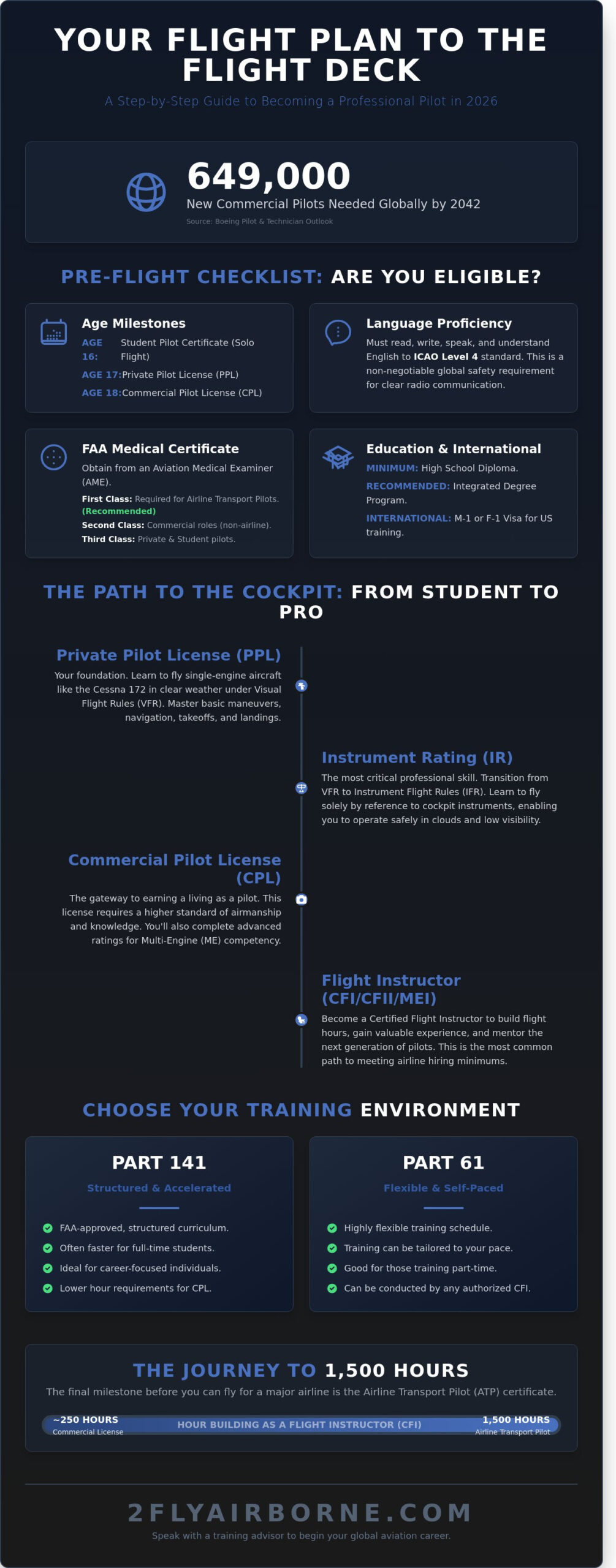
The FAA sets strict age milestones for every stage of your development. You can earn a student pilot certificate at age 16. This allows you to fly solo under the supervision of an instructor. By age 17, you’re eligible for a Private Pilot License (PPL). However, the professional journey truly begins at age 18. This is the minimum age required to hold a Commercial Pilot Certificate. Global aviation relies on a single language: English. You must demonstrate ICAO Level 4 English proficiency. This ensures you can communicate clearly over radio frequencies during high-stress situations. It’s a non-negotiable safety standard for every airline-ready professional.
The FAA Medical Certificate
Your health is your most valuable asset in the flight deck. You’ll need to visit an Aviation Medical Examiner (AME) to secure your certificate. There are three tiers to understand. A Third-Class certificate works for private pilots. Second-Class is for various commercial roles. The First-Class Medical is the gold standard for airline transport pilots. We recommend that professional-track students obtain a First-Class Medical before starting their training. It confirms you meet the vision, hearing, and neurological standards required for a long-term career. Common disqualifiers like certain cardiac conditions or color blindness are easier to identify early. You can find a local examiner through the FAA’s official designee locator database.
Education and International Prerequisites
A high school diploma is the minimum requirement for flight training, but the industry is evolving. Many top-tier carriers value candidates with a structured academic background. You can choose to pursue an integrated degree program to combine your flight hours with a university education. This dual approach often accelerates your path to the flight deck. For international cadets, the process includes securing an M-1 or F-1 visa. These documents allow you to train at elite US-based academies while building the skills needed for your home civil aviation authority. The 2025 Boeing Pilot and Technician Outlook projects a need for 650,000 new pilots over the next 20 years. Don’t leave your eligibility to chance. Speak with a 2Fly Airborne training advisor today to verify your prerequisites and start your journey toward a global aviation career.
The Pilot Certification Path: From Student to Commercial Captain
Building Your Foundation: PPL and Instrument Ratings
The Private Pilot License (PPL) is your foundation. During this phase, you’ll master basic maneuvers, takeoffs, and landings in a single-engine aircraft like the Cessna 172. A significant portion of your training focuses on cross-country flying, where you’ll learn to navigate between airports using dead reckoning and pilotage. You’ll operate primarily under Visual Flight Rules (VFR), meaning you rely on what you see outside the cockpit window to maintain control and avoid obstacles.
The Instrument Rating (IR) is the most critical safety skill for professional aviators. It marks your transition from VFR to Instrument Flight Rules (IFR). You’ll learn to fly solely by reference to the flight instruments, allowing you to operate in clouds and low-visibility conditions. This rating demands high mental discipline and precision. It’s the point where a student begins to think like a professional captain, managing complex navigation systems while maintaining situational awareness without a horizon.
Advanced Ratings and Multi-Engine Competency
The Commercial Pilot License (CPL) is the gateway to getting paid. To reach this milestone, the FAA typically requires a total of 250 hours of flight time. This stage isn’t just about logging hours; it’s about refining your mastery of the aircraft. You’ll perform advanced maneuvers like eights-on-pylons and steep spirals with a high degree of accuracy. Achieving a CPL proves you have the skills and judgment to be responsible for passengers and cargo in a professional environment. Understanding the complete commercial flying license requirements ensures you meet every FAA standard for professional certification. For a comprehensive chronological breakdown of every license and rating you’ll need, the step-by-step guide on how to become a commercial pilot provides the exact regulatory and educational milestones from beginner to airline-ready professional.
- Multi-Engine Rating: Most aspiring airline pilots progress to a twin-engine aircraft, such as the Piper Seminole. You’ll learn to manage the increased speed and complexity of two engines, focusing heavily on emergency procedures and asymmetric thrust.
- Time Building: After earning your CPL, you’ll continue to accumulate the flight hours necessary for airline minimums, often by working as a flight instructor.
If you’re ready to map out your specific timeline, Explore our FAA Airline Pilot Program to see how a structured environment accelerates your path to the flight deck. Our instructors provide the mentorship needed to move from your first solo to a professional career. To get personalized guidance on your training strategy, you should contact a 2Fly Airborne advisor today.
Selecting Your Training Environment: Part 61 vs. Part 141 Schools
Choosing the right environment is a pivotal step when you research how to become a pilot. The regulatory framework of your flight school dictates your daily schedule and your long-term career readiness. Most professional candidates choose between FAA Part 61 and Part 141 programs, each offering distinct advantages based on your specific goals. Understanding these differences is essential for anyone learning how to become a pilot in 2026.
Structured vs. Flexible Training
Part 141 schools follow a rigid, FAA-approved syllabus designed for career-track students. This path is disciplined. It’s methodical. It’s built for those who want to reach the flight deck as efficiently as possible. Part 61 training offers more flexibility. It’s often better for students who need to train around other full-time commitments. When you evaluate an academy, look beyond the regulations. Check the fleet for Garmin G1000 glass cockpits and advanced flight simulation devices. These tools ensure you aren’t just learning to fly, but learning to operate modern aircraft with precision. For a detailed overview of how modern pilot training in 2026 is structured across FAA and EASA standards, reviewing the full professional pathway helps you make an informed decision about your academy choice.
The Florida Advantage
Location impacts your training timeline more than almost any other factor. Florida provides over 300 days of VFR weather annually. You’ll avoid the long, unproductive winters that ground students in other regions. This consistency is why many choose an FAA airline pilot program in the Sunshine State. Training in this region also provides exposure to complex airspace. You’ll regularly interact with Air Traffic Control in high-traffic environments near Orlando and Miami, building the communication skills required for professional operations.
The "Global Pilot" concept takes this training further. By integrating FAA and EASA standards, you prepare for a career that isn’t limited by borders. This dual-standard approach is essential as the 2025 Boeing Pilot and Technician Outlook projects a global need for 650,000 new pilots over the next two decades. Success in these programs often depends on total immersion. On-campus housing plays a vital role here. It eliminates the stress of commuting and fosters a 24/7 aviation mindset. Academy data shows that students living on campus maintain higher engagement levels and complete their ratings faster than those living off-site.
A key part of this immersive environment is ensuring all facilities, from classrooms to simulators, are comfortable and conducive to learning. This often comes down to reliable climate control, a specialty of companies like BulletProof Air who understand the importance of a well-maintained environment for peak performance.
Your journey toward the flight deck requires a strategic choice of environment and a commitment to excellence. Speak with a 2Fly Airborne training advisor today to see which program fits your professional ambitions. You can also explore financing options to help launch your global aviation career.
Planning Your Journey: Timelines, Costs, and Financing
Mapping out a roadmap is the most critical phase when researching how to become a pilot. You’ll generally choose between an accelerated "Zero to Hero" track or a modular training path. Accelerated programs are designed for total immersion; they take a cadet from no flight time to a commercial certificate in roughly 10 to 12 months. Modular training offers a slower pace for those balancing other commitments, but it often extends the timeline to three years or more. Choosing the right speed depends on your career goals and your financial readiness to commit to full-time study.
Professional flight training involves several layers of investment. Beyond the aircraft rental and instructor fees, you must account for essential gear and regulatory costs. High-quality aviation headsets typically cost between $300 and $1,100, and a reliable laptop from a source like laptastic.com is essential for ground school. Most modern cockpits require an Electronic Flight Bag, which usually means an iPad equipped with a ForeFlight subscription, adding another $700 to your initial budget. Planning for these specifics early prevents financial surprises mid-training. It requires discipline and foresight.
Budgeting for Professional Training
Financial predictability is a major advantage of fixed-price training programs. Unlike hourly rates that fluctuate with fuel prices or maintenance delays, fixed-price models provide a clear total cost for your certification. Many students leverage Pilot Training Financing Options to manage this investment through specialized aviation loans or scholarships. You must also budget for "hidden" costs like FAA checkrides. These examiner fees currently range from $800 to $1,200 per test, and you’ll complete several throughout your journey to the flight deck. For a comprehensive breakdown of every expense you’ll encounter, review this detailed guide to flight school cost in 2026 so you can plan your budget with complete confidence.
The Global Pilot Outlook
While the initial cost is significant, the long-term return on investment is at an all-time high. The Boeing Pilot and Technician Outlook projects a need for 674,000 new commercial pilots through 2043. This massive demand has fundamentally changed the financial equation for anyone learning how to become a pilot. Starting salaries for regional First Officers in 2025 often exceed $90,000, and many airlines offer signing bonuses to attract elite talent. This demand ensures that airline-ready professionals can transition into high-paying roles quickly after graduation.
Ready to take the first step toward the flight deck? Contact a 2Fly Airborne training advisor to discuss your financing options and start your enrollment.
Beyond the License: Transitioning to a Professional Airline Career
Earning your commercial certificate is a major milestone, but the journey to the flight deck of a Boeing 737 or Airbus A320 requires more than just a license. To fly for a Part 121 airline in the United States, you must meet the 1,500-hour rule. This FAA mandate, established in 2013, requires pilots to accumulate substantial flight time before they qualify for an Airline Transport Pilot (ATP) certificate. Bridging the 1,250-hour gap between your initial training and the airlines is a critical phase of your professional development. It’s a time to refine your skills while gaining real-world experience in diverse weather conditions and busy airspace. Reviewing the complete 2026 career guide on how to become a commercial pilot gives you a precise checklist of the FAA and EASA standards you must satisfy before stepping into an airline cockpit.
Building Time as an Instructor
Most graduates choose to become a Certified Flight Instructor (CFI) to reach the 1,500-hour threshold. This role is the most common path because it allows you to earn a paycheck while building hours at a rapid pace. Instructors at busy flight schools often fly between 80 and 100 hours per month. Teaching others forces you to master flight maneuvers and complex FAA regulations with absolute precision. You’ll gain invaluable experience in decision-making and crew resource management from the right seat. To accelerate this process, many students enroll in the FAA First Officer Program, which provides a structured environment for building these essential hours while maintaining elite professional standards.
The Career Ladder
Regional airlines serve as the primary entry point into the jet environment. Companies like SkyWest, Envoy, or Republic Airways operate shorter routes for major partners, allowing you to build turbine time quickly. Many of these carriers offer flow-through agreements. These contracts provide a direct, guaranteed path to major airlines like United, Delta, or American without a second interview process. If your goal is to fly for a legacy carrier, understanding the specific hiring criteria and training pathways for becoming a United Airlines pilot gives you a strategic advantage when competing for these coveted positions. Preparing for this transition requires sharp technical skills and a high level of professionalism during simulator assessments. Recruiters look for candidates who demonstrate a safety-first mindset and the ability to work effectively in a multi-crew environment. Mastering the detailed commercial flying license requirements positions you as an elite candidate ready for airline operations.
Success in aviation also depends on the community you build. Join organizations like the Aircraft Owners and Pilots Association (AOPA) or the Women in Aviation International (WAI) to expand your professional network. These connections often lead to mentorship opportunities and internal referrals that can fast-track your career. Understanding how to become a pilot involves looking past the initial training at the long-term career trajectory. If you are focused on how to become a pilot with a major carrier, you must prioritize consistency and discipline from your very first solo flight.
The path from a student pilot to a senior captain is demanding but rewarding. If you’re ready to start your journey, contact a 2Fly Airborne training advisor today. Our team will help you map out a personalized timeline to reach the airlines and achieve your professional goals.
Take Command of Your Future on the Flight Deck
Mastering the steps of how to become a pilot requires more than just passion; it demands a structured approach to certification and a commitment to professional excellence. You’ve explored the critical differences between Part 61 and Part 141 training, the financial realities of flight school, and the rigorous path to the captain’s chair. Success in 2026 depends on choosing a partner that bridges the gap between a student license and a global airline career.
Since 1994, 2Fly Airborne has delivered elite flight training designed to create airline-ready professionals. Our Florida-based facilities provide over 300 flying days per year, ensuring you stay on schedule and build hours efficiently. With both FAA and EASA training pathways available, you can tailor your education to meet the standards of any major carrier worldwide. Don’t leave your ambitions to chance when you can train with an industry leader.
Speak with a 2FLY Training Advisor to start your journey today. The sky isn’t your limit; it’s your workplace. We’re ready to help you reach it.
Frequently Asked Questions
How much does it realistically cost to become a pilot in 2026?
Professional flight training costs typically range from $85,000 to $110,000 to reach airline-ready status in 2026. These figures include aircraft rental, instructor fees, and examiner costs for your private, instrument, and commercial ratings. While learning how to become a pilot requires a clear financial plan, many students utilize specialized aviation financing or merit-based scholarships to manage these expenses. For a complete picture of every expense involved, explore our guide to flight school cost for aspiring pilots in 2026, which covers tuition, living expenses, and financing options in full detail. Contact a 2Fly Airborne advisor for a detailed breakdown of current training rates and funding options.
Do I need a 4-year college degree to fly for a major airline?
You don’t need a 4-year degree to start your career at regional airlines or cargo operators. While major carriers like Delta or United historically preferred degrees, many shifted their requirements in 2023 to focus on flight experience and safety records. Pilots often pursue online degrees while working as first officers to build seniority early while completing their academic credentials. This strategy allows you to enter the workforce faster and start earning a professional salary sooner.
How long does flight school take for a full-time student?
Full-time cadets generally complete their professional training in 10 to 14 months. This timeline covers the progression from a Private Pilot Certificate to a Multi-Engine Commercial Pilot License. Weather conditions and student proficiency affect this schedule, so consistency is vital for maintaining your momentum. Our structured syllabus ensures you remain on track to become an airline-ready professional as efficiently as possible without compromising safety or depth of knowledge.
Can I become a pilot if I wear glasses or have color blindness?
You can fly professionally with glasses as long as your vision is correctable to 20/20 in each eye. Color blindness requires a more specific evaluation during your First-Class Medical exam. If you can pass a signal light gun test or an alternative color plate assessment, the FAA may issue a Statement of Demonstrated Ability. This document allows you to exercise full commercial pilot privileges. Reach out to our team to discuss how to prepare for your medical evaluation before you begin flying.
What is the difference between FAA and EASA pilot licenses?
FAA certifications are issued by the United States Federal Aviation Administration, while EASA licenses are governed by the European Union Aviation Safety Agency. Each authority has distinct requirements for theoretical knowledge exams and flight hour logging. 2Fly Airborne specializes in dual-certification pathways, allowing you to secure a global career by meeting the regulatory standards of both major jurisdictions. Choosing the right license depends on where you intend to live and work as a professional pilot.
Is there a maximum age limit to start flight training?
There’s no maximum age limit to begin flight training or earn your pilot licenses. However, FAA Part 121 regulations require commercial airline pilots to retire at age 65. If you start your journey at age 40 or 50, you still have two decades of potential employment in a high-demand industry. Many second-career pilots find success in corporate aviation or flight instruction where the age 65 rule doesn’t apply. Your passion and health are more important than the date on your birth certificate.
What happens if I fail my FAA medical exam?
If you fail an initial medical exam, the Aviation Medical Examiner often defers your application to the FAA for a more detailed review. This isn’t an automatic disqualification from the cockpit. You’ll likely need to provide additional documentation from specialists or undergo specific tests to prove your condition is manageable. Most medical issues can be resolved through a Special Issuance authorization. We recommend consulting with an aviation medical specialist if you have concerns about a specific health condition.
Can international students train to be pilots in the USA?
International students can train in the USA by obtaining an M-1 or F-1 student visa. You must also complete a TSA background check through the Alien Flight Student Program before starting your lessons. The United States remains the global hub for flight training due to its diverse weather patterns and vast airport infrastructure. Our advisors help international cadets navigate the visa process to ensure a smooth transition to our Florida training centers. Start your journey by contacting 2Fly Airborne for personalized guidance on international enrollment.
Article by
2FLY Airborne
2Fly Airborne is a professional flight training organization dedicated to developing the next generation of skilled, confident, and safety-focused pilots. With decades of combined aviation experience, our team of certified instructors provides structured, real-world training designed to prepare students for both checkrides and long-term success in the aviation industry.
Content Disclaimer
Some blog content is generated with the assistance of automated tools and may not always be fully accurate or up to date. Please verify all aviation-related information with official sources or a certified instructor. For additional guidance or clarification, we encourage you to contact one of our training advisors at 2Fly Airborne.