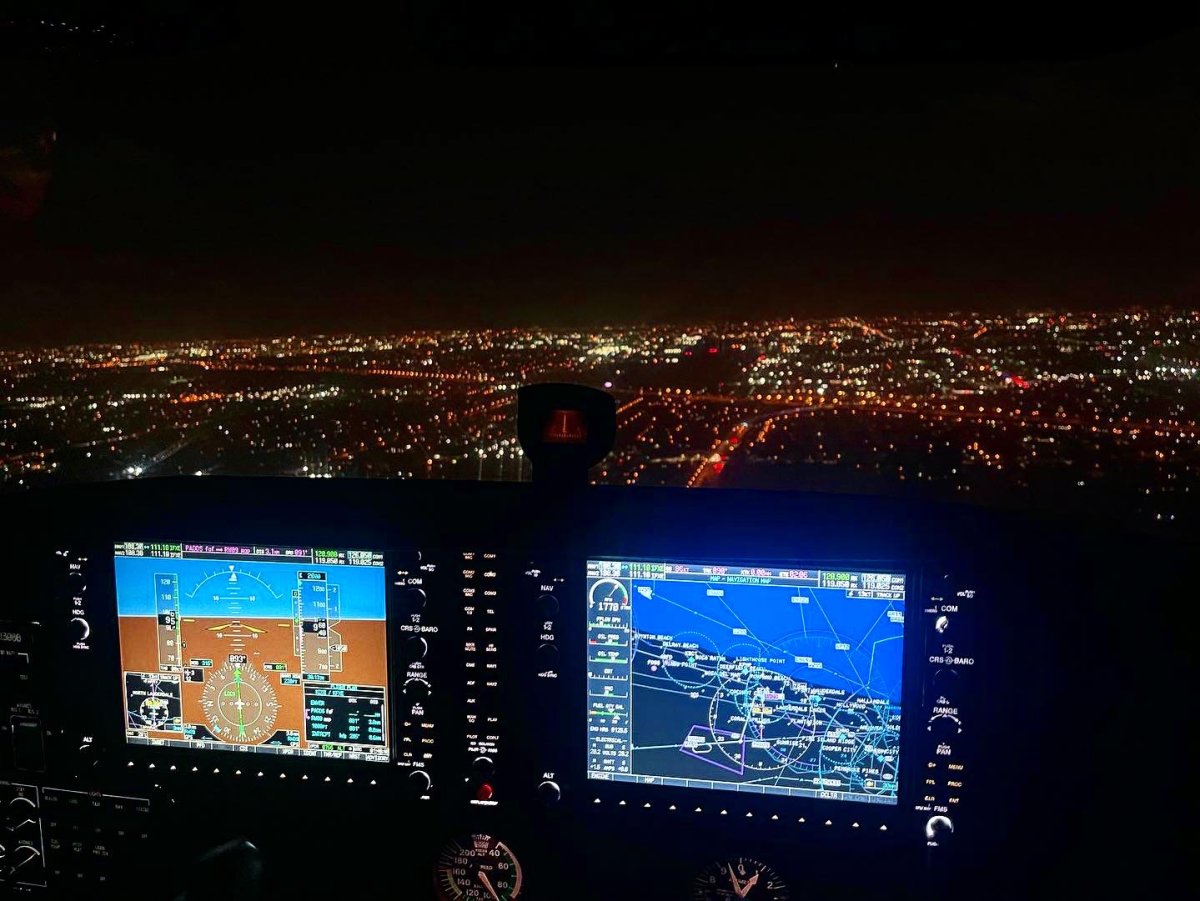
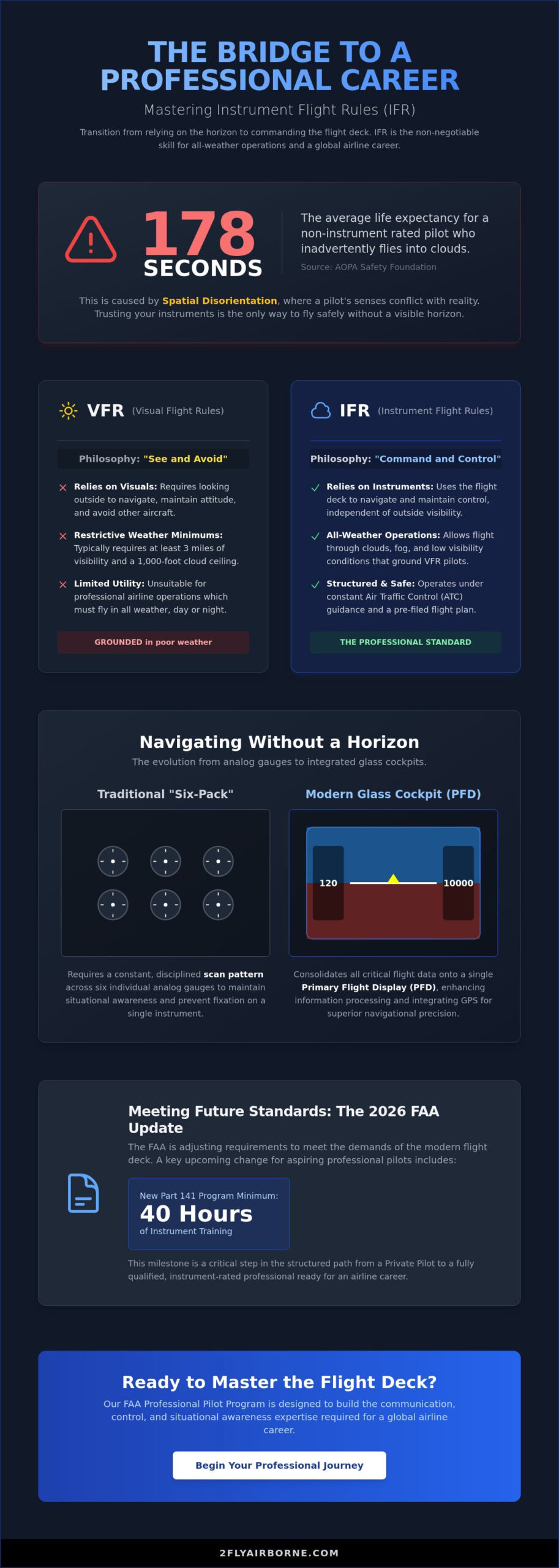
According to the AOPA Safety Foundation, a pilot without an instrument rating who flies into clouds has a life expectancy of just 178 seconds. This startling figure highlights why mastering ifr is the most critical transition you’ll make from a recreational flyer to a professional aviator. It’s the moment you stop relying on the horizon and start trusting the precision of your flight deck.
You likely feel the weight of technical requirements or the confusion of shifting regulations, such as the 2026 FAA hour adjustments. We understand that moving beyond visual navigation feels intimidating at first. This professional guide will help you master the core concepts of instrument flight and show you why this rating is the essential bridge to a global airline career.
We’ll explore the latest 2026 standards, including the new 40 hour minimum for Part 141 programs and the updated currency rules. You’ll gain a clear roadmap for your certification while learning how to handle the rigorous demands of the modern flight deck.
Key Takeaways
- Understand the core transition from visual navigation to the precise command and control environment of instrument flight.
- Master the fundamental skills of ifr to unlock the ability to fly safely in weather conditions that ground recreational pilots.
- Identify the 2026 FAA requirements and milestones necessary to transition from a private pilot to an instrument-rated professional.
- Discover how training in high-activity airspace builds the communication expertise required for a global airline career.
- Learn how to maintain total aircraft control and situational awareness without the need for a visible natural horizon.
What is IFR? Defining Instrument Flight Rules for the Modern Pilot
Think of the first time you flew through a cloud. For a visual pilot, that moment is a crisis; for an instrument pilot, it’s just another day at the office. In professional aviation, the ability to operate safely depends on the set of rules you follow. While most student pilots begin their journey under Visual Flight Rules (VFR), the professional standard is defined by Instrument Flight Rules. This framework allows you to fly through clouds, fog, and heavy rain where outside visual reference is insufficient to maintain control.
The shift to ifr represents a fundamental change in mindset from ‘see and avoid’ to ‘command and control’. Instead of looking out the window to avoid other aircraft or stay level, you rely on advanced technology and Air Traffic Control (ATC) to provide separation and guidance. Every flight begins with a specific flight plan. This acts as a contract between the pilot and the national airspace system to ensure a safe, predictable path through crowded skies. This level of technical mastery is a core component of our FAA Professional Pilot Program.
To better understand this concept, watch this helpful video:
The Core Philosophy of Instrument Flying
Mastery of the flight deck requires total trust in your instruments. For airlines, this capability is non-negotiable because it enables 24/7, all-weather operations. Modern aviation relies on electronic signals and satellite navigation to guide aircraft along invisible highways. By removing the need for a natural horizon, you can deliver passengers safely to their destinations regardless of the time of day or the cloud ceiling. It’s about precision. The horizon disappears, but your situational awareness remains absolute.
IFR vs. VFR: The Fundamental Differences
VFR pilots require at least 3 miles of visibility and a 1,000 foot ceiling to fly legally, but these conditions are too restrictive for a commercial career. Under ifr, those minimums drop significantly. This allows for takeoffs and landings in conditions that would ground a recreational flyer. Professional pilots almost exclusively operate under these rules because it places them under the constant watch of ATC. This structured environment provides a layer of safety and efficiency that visual flying simply cannot match. It’s the difference between flying for fun and flying for a living.
The Mechanics of Instrument Flying: Navigating Without a Horizon
Imagine flying into a thick cloud deck where the ground, sky, and horizon instantly vanish. Your inner ear might tell you the aircraft is banking left, even while you are flying perfectly straight. This sensory conflict is known as spatial disorientation. To fly safely in these conditions, you must learn to ignore your physical “seat of the pants” feelings and rely entirely on the flight deck instruments.
Traditional aircraft utilize a “six-pack” of analog gauges to provide situational awareness. This cluster includes the airspeed indicator, attitude indicator, altimeter, turn coordinator, heading indicator, and vertical speed indicator. Mastery of these tools requires a disciplined scan pattern. You must move your eyes constantly across the panel, ensuring no single instrument is ignored for more than a few seconds. This prevents “fixation,” a common error where a pilot focuses on one gauge while another critical flight parameter deviates.
Modern professional training has largely transitioned to digital Primary Flight Displays (PFD). These systems consolidate the six-pack into a single, high-resolution screen that enhances a pilot’s ability to process information. In 2026, 80% of student pilots plan to use advanced simulators to perfect these mechanics before ever entering actual clouds. Developing these technical skills is a core objective of our FAA Professional Pilot Program.
Modern Avionics and Glass Cockpit Systems
Today’s glass cockpits integrate GPS and Satellite-Based Augmentation Systems (SBAS) to provide incredible navigational precision. Features like moving maps and synthetic vision create a digital representation of the terrain outside, significantly reducing the mental workload during ifr operations. These systems allow you to see mountains, obstacles, and runways on your screen even when they are obscured by heavy fog. This technology ensures that modern pilots maintain a high level of safety during every phase of flight.
The Role of Air Traffic Control in IFR Operations
When flying under ifr, you operate under “positive control.” This means Air Traffic Control (ATC) is responsible for providing separation between you and other aircraft. The relationship is a constant dialogue. You receive a specific clearance that outlines your route, altitude, and transponder code. Following the FAA Instrument Flight Rules regulations ensures that you remain within a protected corridor of airspace. Controllers monitor your progress on radar, providing a safety net that is not available to pilots flying under visual rules alone.
VFR vs. IFR: Why Visual References Aren’t Enough for Careers
Airlines don’t stop operating just because the sun goes down or a layer of haze settles over the airport. While Visual Flight Rules (VFR) allow you to enjoy the scenery on a clear day, they’re far too restrictive for a professional career. VFR requires a minimum of three miles of visibility and a 1,000 foot ceiling. If the weather drops even slightly below these marks, a VFR pilot is legally grounded, making scheduled operations impossible.
Operating under ifr removes these limitations. It allows you to fly with significantly lower visibility and ceiling minimums, ensuring that the global transportation network remains on schedule. Training for this rating isn’t just about handling “bad weather” days. It’s a fundamental shift in your flying style that prioritizes extreme precision and disciplined procedures over general visual cues. You’ll learn to fly to a specific degree and a specific foot, a skill set that defines the elite aviator.
Understanding Instrument Meteorological Conditions (IMC)
Entering Instrument Meteorological Conditions (IMC) is a surreal experience. Inside a cloud layer, your world shrinks to the size of the flight deck. Without the horizon, your body’s internal sensors can quickly fail. This is why we referenced the “178 seconds” statistic earlier; it’s the average time a non-rated pilot survives after losing visual reference. Training under ifr provides the technical skills to manage these risks and the legal authority to enter controlled airspace when the sky turns gray. The Instrument Procedures Handbook serves as the definitive guide for navigating these complex environments safely.
The Professional Advantage of an Instrument Rating
An Instrument Rating (IR) is much more than a supplemental skill. It’s a mandatory prerequisite for obtaining a commercial pilot license. Airlines look for “airline-ready” professionals who can manage high-workload environments with composure. Proficiency in instrument flight is the primary indicator of this readiness. The 2025 Boeing Pilot and Technician Outlook projects a demand for 660,000 new pilots globally through 2044. Almost every one of those positions will require a pilot who is a master of the instrument environment. Safety statistics consistently show that IFR-rated pilots are better equipped to handle unexpected weather shifts, making them the preferred choice for commercial operators worldwide.
The Path to an Instrument Rating: Requirements and Milestones
After mastering the basics of visual flight, your next objective is the Instrument Rating (IR). It’s often considered the most challenging yet rewarding phase of early flight training. This certification is the bridge that turns a recreational flyer into a precise, career-ready aviator capable of handling the ifr environment with confidence.
To begin this phase, you must hold a private pilot license. Under the 2026 FAA adjustments, the minimum required hours depend on your training track. Part 141 academies now require 40 hours of instrument time, while Part 61 students must complete 50 hours. This data-driven shift reflects the FAA’s focus on structured proficiency over simple time-building.
A pivotal milestone in your training is the 250-nautical mile cross-country flight. This mission requires you to navigate along airways and perform three different types of instrument approaches at three separate airports. It’s a true test of your ability to manage a long-distance flight solely by reference to your instruments. Ready to start your journey? Explore the FAA Professional Pilot Program to see how we integrate these milestones into your career path.
Ground School and the IFR Knowledge Test
Ground training focuses on the technicalities of the national airspace system and advanced weather theory. You’ll master Enroute Low Altitude charts and learn to interpret complex Approach Plates, which are the blueprints for landing in low visibility. The FAA written knowledge test, which currently costs approximately $175, validates your understanding of these regulations. Success requires a deep dive into high-altitude physiology and the legalities of the modern flight deck.
Flight Training and Simulator Sessions
Initial flight sessions often utilize “foggles” or a view-limiting hood. These tools restrict your vision to the instrument panel, forcing you to ignore the world outside. You’ll also spend significant time in Advanced Aviation Training Devices (AATDs). These simulators are invaluable for practicing precision ILS approaches and non-precision RNAV or VOR procedures without the cost of a running engine. In 2026, 80% of student pilots plan to use these devices to sharpen their scan patterns before their final checkride.
The journey culminates in a practical exam with a Designated Pilot Examiner (DPE). This “checkride” consists of an oral examination and a flight test to prove your mastery of the aircraft in simulated instrument conditions. DPE fees in 2026 average around $1,000, though they can range from $600 to $1,300 depending on the location. Successfully passing this test marks your official entry into the world of professional aviation.
Advancing Your Career: IFR Training within a Professional Program
The transition from a visual pilot to an instrument-rated one is the most significant leap in your professional development. In our FAA Professional Pilot Program, the instrument phase is woven into the curriculum to ensure you build technical habits early. You aren’t just learning to fly by gauges. You’re learning to manage a complex system in high-activity airspace where precision is the only currency that matters.
Training in a busy environment prepares you for the fast-paced nature of commercial aviation. Our instructors provide the disciplined oversight needed to navigate the transition from single-engine trainers to advanced multi-engine platforms. This foundation is essential for your future commercial and multi-engine certifications. It ensures that when you reach the airline interview stage, your technical proficiency is already at a professional standard. Mastering ifr communications and situational awareness under the guidance of elite mentors is what sets a global pilot apart.
From Student to Airline-Ready Professional
The skills you develop during instrument training are immediately applied as you move into multi-engine aircraft like the Piper Seneca. Managing two engines while navigating an ifr approach requires a level of focus that only rigorous training can provide. The 2025 Boeing Pilot and Technician Outlook projects a demand for 660,000 new pilots globally through 2044. Airlines are looking for candidates who can demonstrate this high-level command from day one. Proficiency in instrument flight makes you a standout candidate in a competitive global market.
Next Steps: Starting Your IFR Journey
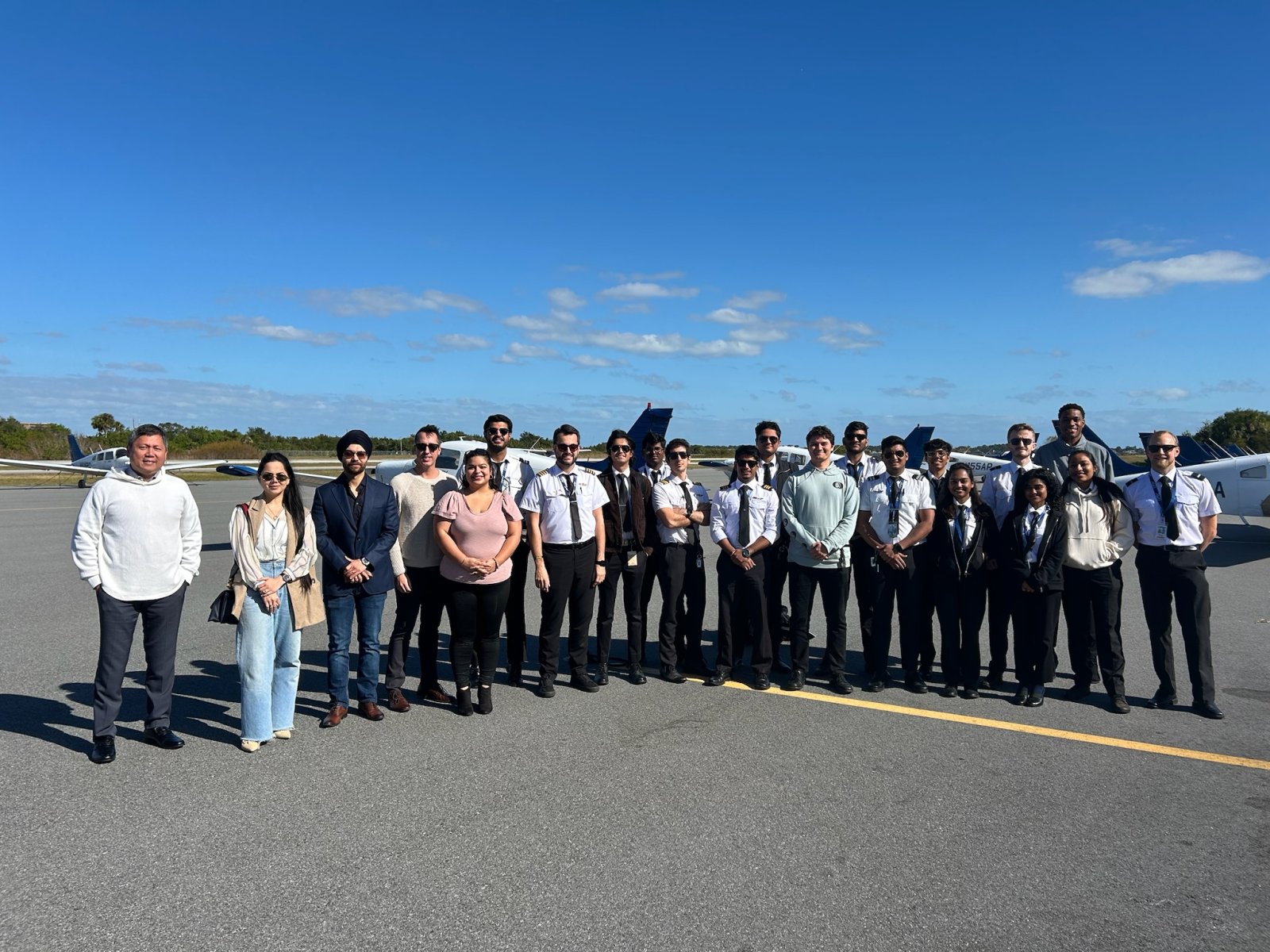
Don’t view the Instrument Rating as an isolated goal. It’s the definitive gateway to your career as a global pilot. We encourage you to look beyond the initial certificates and see the full roadmap to the flight deck. To help you reach these milestones, we offer various financing options designed for comprehensive training paths. You can also attend 2FLY Airborne events to meet our team and see our training environment firsthand.
In summary, mastering instrument flight rules is a matter of professional necessity and flight safety. It represents the transition from flying for fun to flying as a career-ready professional. By choosing a structured training environment, you ensure that your skills meet the highest industry standards. If you have any remaining questions about how to begin your instrument training, reach out to a 2FLY Airborne Training Advisor today.
Your Future on the Flight Deck Starts with Precision
Mastering the ifr environment is the definitive milestone that separates recreational flyers from professional aviators. You now understand how instrument proficiency allows for 24/7 global operations and why it’s the mandatory foundation for any airline career. This rating isn’t just about flying in clouds; it’s about developing the technical discipline required by the world’s leading carriers.
By choosing a training path that prioritizes high-activity airspace and state-of-the-art simulator access, you’re investing in your future as an airline-ready professional. Our proven FAA Professional Pilot Program is designed to meet global training standards while preparing you for the rigorous demands of modern aviation. You have the drive to reach the flight deck, and we provide the elite environment to help you succeed.
Ready to master the flight deck? Contact a 2FLY Airborne Training Advisor today to begin your journey. If you have any remaining questions about the training process or the 2026 FAA requirements, reach out to a 2FLY Airborne Training Advisor for expert guidance.
Frequently Asked Questions
Is an Instrument Rating (IFR) harder to get than a Private Pilot License?
Yes, most pilots find the instrument rating more mentally demanding than the initial private pilot certificate. It requires you to ignore your body’s physical sensations and rely entirely on the flight deck instruments. While the private pilot license focuses on basic stick and rudder skills, this rating demands extreme precision and the ability to multitask in high workload environments.
Can I fly IFR in any aircraft, or does it need special equipment?
No, you cannot fly ifr in any aircraft. The airplane must be specifically equipped and certified for instrument flight according to federal regulations. This includes having a two-way radio, a sensitive altimeter, and gyroscopic instruments like an attitude indicator. Many older training aircraft lack the necessary GPS or navigation systems required for modern instrument approaches.
How many hours of flight time are required for an FAA Instrument Rating?
As of May 2026, the FAA requires 40 hours of instrument time for Part 141 schools and 50 hours for Part 61 training. This is a data driven adjustment from previous standards to better reflect training proficiency. You must also complete a 250 nautical mile cross country flight as part of these requirements to gain real world experience.
What happens if my instruments fail while I am flying in IFR conditions?
If an instrument fails, you transition to “partial panel” flying using your remaining backup gauges. Pilots spend significant training time practicing these emergency scenarios in simulators to maintain composure. You would immediately notify Air Traffic Control of the failure. They will provide increased separation and guide you to the nearest airport with suitable weather for your remaining equipment.
Do I need an Instrument Rating to become a commercial pilot?
Yes, an instrument rating is a mandatory requirement for anyone seeking a career as a commercial airline pilot. While you can technically hold a commercial certificate without it, your operations would be severely limited to daylight hours and short distances. Airlines operate in all weather conditions, making this rating the essential bridge to professional employment and global pilot opportunities.
What is the difference between an IFR flight plan and a VFR flight plan?
An IFR flight plan is a legal contract that provides you with positive separation from other aircraft by Air Traffic Control. In contrast, a VFR flight plan is primarily used for search and rescue purposes and does not guarantee ATC separation. Under ifr, you must follow a specific route and altitude cleared by the controller to ensure safe passage through busy airspace.
Can I fly IFR through a thunderstorm?
No, you should never intentionally fly through a thunderstorm regardless of your rating or equipment. While instrument rules allow you to fly in clouds, thunderstorms contain severe turbulence, lightning, and icing that can damage an aircraft. Professional pilots use onboard radar and ATC weather updates to deviate around these cells by at least 20 miles to ensure safety.
How much does it typically cost to add an Instrument Rating to my license?
The median cost for an instrument rating in 2026 is approximately $11,500. Costs vary depending on the training track you choose. A Part 61 school might cost around $6,000, while a professional Part 141 academy can exceed $17,000. These figures typically include aircraft rental, instructor fees, and the $175 FAA written knowledge test fee.
Article by
2FLY Airborne
2Fly Airborne is a professional flight training organization dedicated to developing the next generation of skilled, confident, and safety-focused pilots. With decades of combined aviation experience, our team of certified instructors provides structured, real-world training designed to prepare students for both checkrides and long-term success in the aviation industry.
Content Disclaimer
Some blog content is generated with the assistance of automated tools and may not always be fully accurate or up to date. Please verify all aviation-related information with official sources or a certified instructor. For additional guidance or clarification, we encourage you to contact one of our training advisors at 2Fly Airborne.