

Imagine opening a letter from the FAA and seeing the word “denied” stamped across your medical application after years of training and significant financial investment. It feels as if your career has stalled before reaching cruising altitude. We understand that a medical setback is one of the most stressful experiences a pilot can face, but it doesn’t have to be the end of your journey.
You’ve worked hard for your ratings, and the thought of losing that momentum is daunting. Fortunately, a denial is often a procedural detour rather than a permanent grounding. This guide explains exactly how to appeal an FAA medical certificate denial by leveraging clinical evidence and legal precision to protect your professional future.
You’ll discover the critical differences between FAA reconsideration and an NTSB appeal, ensuring you meet every regulatory deadline. We provide a clear, step by step roadmap to help you regain your eligibility and get back into the cockpit where you belong. Let’s look at how you can turn this challenge into a successful return to flight.
Key Takeaways
- Learn how to distinguish between a deferral and a final denial to determine the most effective response strategy for your specific situation.
- Master the legal timelines and procedural steps regarding how to appeal an FAA medical certificate denial through the Federal Air Surgeon or the NTSB.
- Explore the Special Issuance pathway as a strategic alternative for pilots with disqualifying conditions to regain their professional flight status.
- Understand the importance of partnering with HIMS-trained medical experts to gather the high-level clinical evidence required for a successful case.
- Discover practical ways to maintain your knowledge and flight proficiency through ground school and simulation while your medical eligibility is under review.
Receiving a Denial: Immediate Steps and Decoding Your FAA Letter
Receiving a letter from the FAA regarding your medical status can feel like a sudden engine failure in IMC. Your first instinct might be to panic or rush into a new application. Stop. Take a breath. Understanding the specific language in that correspondence is the most critical step in learning how to appeal an FAA medical certificate denial.
To better understand this concept, watch this helpful video:
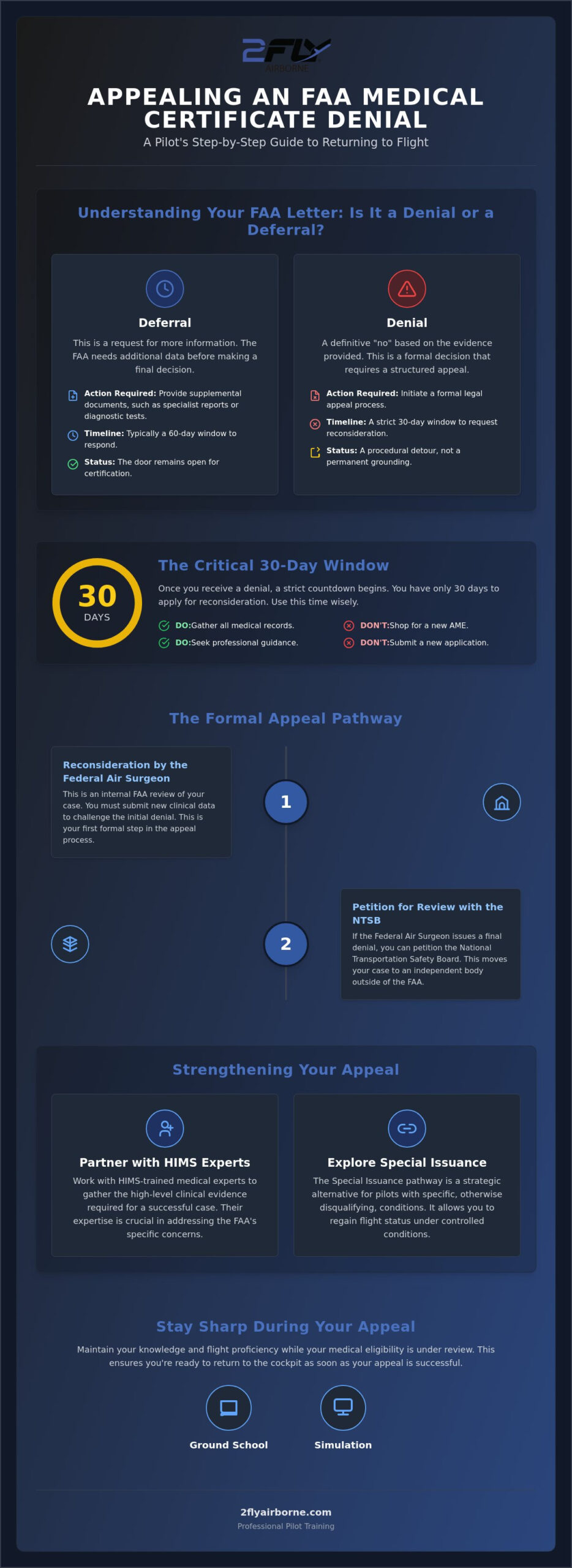
The source of the letter tells you exactly where your application stands in the regulatory hierarchy. A local Aviation Medical Examiner (AME) may defer your application if they find a potential issue, sending it to the Aerospace Medical Certification Division (AMCD) in Oklahoma City for further review. If the letter comes directly from Oklahoma City or the Federal Air Surgeon, you are likely facing a formal denial that requires a structured response. You must read the “Reasons for Denial” section with clinical objectivity. This section outlines the specific medical standards the FAA believes you have failed to meet.
Denial vs. Deferral: Why the Difference Matters
Many pilots mistake a deferral for a final rejection. A deferral is simply a request for more evidence, indicating the FAA needs more data before making a decision. This usually triggers a 60-day window for you to provide supplemental documentation, such as specialist reports or diagnostic tests. These requirements are rooted in rigorous Aviation medicine standards designed to ensure pilot safety. While a deferral keeps the door open, a formal denial is a definitive “no” based on current evidence. Overturning a denial requires a legal appeal process rather than just submitting extra paperwork.
The 30-Day Critical Window
Time is your most valuable asset once a denial is issued. The date stamped on your official FAA correspondence starts a strict countdown. Under 14 C.F.R. § 67.409, you generally have only 30 days from the date of a denial by the AMCD to apply in writing for reconsideration by the Federal Air Surgeon. Missing this deadline can lead to a permanent closure of your medical file. This makes it much harder to restart your professional career path later.
Use this time to gather your complete medical history immediately. Do not attempt to “shop” for a new AME or submit a fresh application without professional guidance. This common mistake can lead to accusations of falsification on your next MedXpress form. Instead, focus on clinical objectivity and begin building a case that addresses the FAA’s specific concerns head-on. If you are planning for future training costs once your medical is secured, you can research financing options to keep your professional goals in sight. Preparation now ensures you are ready to resume your FAA Professional Pilot Program as soon as your eligibility is restored.
Navigating the Formal Appeal Process: From the FAA to the NTSB
When the internal FAA review concludes with a final denial, your focus must shift from administrative requests to formal legal proceedings. This transition is a pivotal moment in your career. Understanding how to appeal an FAA medical certificate denial at this level requires a disciplined approach to the FAA’s official appeal process. The path moves from the Federal Air Surgeon to the National Transportation Safety Board (NTSB), providing multiple layers of due process for dedicated aviators.
The first formal step is requesting reconsideration from the Federal Air Surgeon. This is an internal FAA review where you can present new clinical data to overturn a previous decision. If the Federal Air Surgeon issues a final denial, you have the right to file a petition for review with the NTSB. This moves your case outside of the FAA’s direct control and into an independent legal arena. From there, your case progresses to a hearing before an Administrative Law Judge (ALJ), followed by a potential appeal to the full NTSB Board if the initial ruling is unfavorable.
The Role of the Administrative Law Judge
The ALJ hearing is a “de novo” review, which means the judge looks at your case from the beginning without being bound by the FAA’s previous findings. This is your opportunity to present “Gold Standard” evidence and expert medical testimony. The burden of proof typically rests on you to demonstrate your fitness for a certificate. However, if the FAA is seeking to revoke an existing certificate, the burden of proof may shift to them. Success at this stage often depends on the quality of your medical experts and their ability to translate complex clinical data into a compelling legal argument.
NTSB Timelines and Filing Requirements
Adhering to strict timelines is the most critical aspect of an NTSB appeal. You must file your petition for review within 60 days of the date on your final FAA denial letter. Missing this deadline by even a single day can result in an immediate dismissal of your case. After filing, you will need to submit a “Specification of Errors” that clearly outlines why the FAA’s decision was legally or medically flawed. Because these documents require precise legal formatting and aviation expertise, seeking specialized legal representation is essential to protect your professional trajectory.
While the process is rigorous, it remains a viable pathway for high achievers to reclaim their place in the industry. Staying informed about the legal landscape ensures you are ready to resume your FAA Professional Pilot Program once your medical eligibility is restored. With the right strategy and expert support, a denial becomes a temporary obstacle rather than a career ending event.
Strategic Alternatives: Reconsideration and Special Issuance Authorizations
A formal courtroom battle isn’t always the most efficient way to restore your flight status. For many aviators, the most direct path involves working within the FAA’s discretionary frameworks. Understanding how to appeal an FAA medical certificate denial includes knowing when to pivot from a legal challenge to a request for a Special Issuance (SI) authorization. This shift requires a deep understanding of federal regulations and a proactive approach to medical data management.
The Special Issuance (SI) Framework
An SI is a grant of discretionary medical certification. It allows pilots with otherwise disqualifying conditions, such as heart disease, diabetes requiring medication, or certain neurological histories, to exercise pilot privileges. The FAA issues these when you can prove that you can operate safely under specific conditions or limitations. You’ll typically need to submit periodic follow-up reports to maintain this status. These might include annual stress tests or quarterly blood work. This process ensures the FAA that your condition remains stable and that any risks to flight safety are mitigated.
Requesting Federal Air Surgeon Reconsideration
Before escalating to the NTSB, you should evaluate the informal appeal route. Learning how to appeal an FAA medical certificate denial through reconsideration is often the smartest first move for professional pilots. This pilot’s guide to a medical denial highlights how building a robust clinical case at this stage can save months of legal maneuvering. While wait times vary, a well-documented request often yields a response within 90 to 120 days. It’s a vital step for those who want to avoid the financial and emotional stress of a formal trial.
CACI: The Streamlined Certification Route
For certain chronic but manageable conditions, the FAA provides the Conditions AMEs Can Issue (CACI) framework. This is a streamlined certification route for issues like hypertension, glaucoma, or certain types of arthritis. If you meet the specific CACI criteria, your local AME can issue your certificate immediately during your office visit. This bypasses the lengthy review process in Oklahoma City entirely. Knowing if your condition fits a CACI worksheet is a critical advantage for any pilot facing certification hurdles.
The goal is always the same: returning to your FAA Professional Pilot Program and continuing your journey toward an international career. By choosing the right strategic alternative, you demonstrate the discipline and problem-solving skills required of an airline captain. Success in aviation is often about finding the most efficient and safe route to your destination.
Building Your Case: Clinical Evidence and Professional Consultation
Success in a legal hearing is only possible if your clinical foundation is unshakable. When you are determining how to appeal an FAA medical certificate denial, the quality of your evidence package is the primary factor that will sway a decision-maker in Oklahoma City. You need to move beyond general health checkups and secure specialized documentation that speaks the FAA’s specific regulatory language.
Choosing the Right Medical Consultant
Your family doctor is an expert in general health, but they likely don’t understand the FAA’s unique risk tolerances. You need a HIMS-trained AME or a specialized aviation medical consultant who understands the nuances of the 8500-8 form. These experts know exactly what diagnostic thresholds the Federal Air Surgeon requires for various conditions. Before hiring an advocate, ask about their specific experience with your medical condition and their track record with previous appeals.
Types of Required Clinical Documentation
The FAA requires “Gold Standard” evidence, which includes detailed specialist evaluations and diagnostic tests like stress EKGs or neuropsychological batteries. A simple note saying you are “fit for work” won’t suffice in this environment. You need a comprehensive status letter from your treating physician that addresses the FAA’s specific concerns with clinical precision. Ensure all diagnostic data is current, typically within 90 days of your submission, to avoid administrative delays.
A status letter must be more than a simple summary; it must be a roadmap of your recovery or management. It should detail your diagnosis, current treatment, and a prognosis that specifically highlights the absence of risk for sudden incapacitation. The FAA’s medical officers are looking for reasons to say “yes,” and a professional evidence package gives them the data they need to do so. This level of preparation is what separates a successful appeal from a permanent denial.
Your final evidence package should be a structured, professional document that leaves no room for ambiguity. Including a well-drafted personal statement can provide necessary context to your history, such as lifestyle improvements or successful treatment outcomes. This proactive approach shows the FAA that you are a disciplined professional committed to safety. Once you’ve secured your medical clearance, you can focus on the next step of your career in our FAA Professional Pilot Program.
Gathering this evidence is a rigorous process, but it’s the definitive gateway back to the cockpit. High-achievers understand that technical mastery extends beyond the flight deck into the regulatory requirements of the profession. By treating your appeal with the same precision as a pre-flight inspection, you protect your long-term vocational preparedness. Clear documentation is the most powerful tool you have to regain your medical eligibility.
Maintaining Your Career Momentum During the Appeal Process
While you work through the legal and clinical steps of how to appeal an FAA medical certificate denial, it’s easy to feel like your career has come to a standstill. This is a common misconception that can lead to “grounding burnout” if not managed correctly. Instead of viewing this period as a hiatus, treat it as an intensive phase of professional development. High-achievers understand that technical mastery is a continuous journey, regardless of their current medical status.
Maintain your mental edge by staying active in ground school and utilizing flight simulators to keep your instrument procedures and “stick-and-rudder” skills sharp. Utilizing advanced flight simulators allows you to practice emergency procedures and complex navigation without the need for a current medical certificate. This technical discipline ensures that your muscle memory remains intact for your return to the cockpit. By the time you receive your new certificate, your knowledge of regulations and procedures should be at its peak.
Financial planning is another productive way to use your time during the appeal process. You can research financing options for your future training phases, ensuring that you have the capital ready the moment your medical is reinstated. This proactive approach ensures that once you clear the regulatory hurdles, you can resume your flight hours without further delay. Engaging with the aviation community through seminars and local pilot groups will also keep your passion fueled while you navigate the administrative process.
The Long-Term Outlook for Pilots
It’s helpful to contextualize a medical delay within the scope of a 40 year aviation career. A few months spent on an appeal is a manageable fraction of your professional life. The 2025 Boeing Pilot and Technician Outlook projects a demand for 660,000 new pilots globally through 2044. This massive global requirement means the industry needs healthy, certified pilots now more than ever, and your place in the cockpit is waiting for you.
Next Steps with 2FLY Airborne
Our training advisors at 2FLY Airborne specialize in helping students navigate the complexities of the industry, including regulatory challenges. We provide the mentorship needed to keep your goals in sight while you focus on your health and certification. Once your medical eligibility is restored, we facilitate a seamless transition back into the FAA First Officer Program.
Reviewing the specific requirements of the FAA Professional Pilot Program now will help you hit the ground running. Stay focused on the process, maintain your clinical health, and keep your technical knowledge current. The road may have a few detours, but the destination remains the same: a world-class career in international aviation.
Securing Your Future in the Professional Cockpit
Navigating the complexities of FAA regulations requires the same discipline you apply to your flight training. While a medical setback is challenging, mastering how to appeal an FAA medical certificate denial ensures that your professional journey remains on track. Success depends on your ability to present precise clinical evidence and navigate formal legal pathways with confidence. It’s a procedural hurdle that many successful airline captains have cleared during their careers.
Your career is a long-term investment that deserves the best possible support. We provide professional mentorship from experienced instructors and expert guidance on FAA regulatory compliance to help you reach your goals. Our global aviation career pipeline is built to transition dedicated students into industry-prepared professionals. Your future is waiting.
If you have questions about your medical eligibility or training path, speak with a 2FLY Training Advisor today. Please reach out to a 2FLY Training Advisor with any remaining questions you may have. We’re ready to help you navigate the way back to the flight deck.
Frequently Asked Questions
How long does the FAA medical appeal process typically take?
The timeline for an appeal varies significantly based on the complexity of your medical history and the specific legal path you choose. Internal reconsideration by the Federal Air Surgeon typically takes between 90 and 120 days for a response. If your case progresses to the NTSB, the process can extend from several months to over a year as you coordinate with medical experts and wait for a scheduled hearing.
Can I still fly while my medical certificate appeal is pending?
You cannot exercise the privileges of your pilot certificate while your medical appeal is pending. Federal regulations require a valid medical certificate for most flight operations, and a denial or deferral effectively grounds you until a new certificate or Special Issuance is granted. Use this time to focus on your clinical recovery and maintain your knowledge through ground school or simulator sessions.
What are the most common reasons for an FAA medical denial?
Cardiovascular conditions, such as coronary artery disease, and neurological issues like seizure disorders are frequent causes of denial. The FAA also maintains strict standards regarding psychiatric conditions and the use of certain medications that could impair flight safety. Understanding how to appeal an FAA medical certificate denial often starts with identifying which of these specific standards the FAA believes you haven’t met.
Do I need a lawyer to appeal an FAA medical certificate denial?
While you aren’t legally required to have a lawyer for internal FAA reconsideration, professional legal counsel is highly recommended for NTSB proceedings. An aviation attorney understands the procedural rules of the court and knows how to effectively present expert medical testimony. Their expertise can be the deciding factor in successfully overturning a final denial and protecting your professional career.
What is the success rate for FAA medical certificate appeals?
Success rates are highly individual and depend more on the specific medical condition than on general statistics. Many pilots who receive an initial denial eventually regain their flight status through the Special Issuance pathway by proving their condition is stable and manageable. Working with a HIMS-trained AME significantly improves your chances of a favorable outcome by ensuring your evidence package is complete.
What happens if the NTSB denies my medical appeal?
If the full NTSB Board upholds the FAA’s denial, your next legal option is to seek review in the U.S. Court of Appeals. This is an advanced legal step that typically focuses on whether the NTSB followed proper legal procedures rather than re-evaluating the medical evidence itself. Most pilots find it more effective to focus on resolving the underlying medical issue and re-applying later.
Can I re-apply for a medical certificate after a final denial?
You can re-apply for a medical certificate if your medical condition changes or improves significantly. For example, if a denial was based on a temporary condition that has since been resolved, a new application with fresh clinical data may be successful. It’s essential to consult with an aviation medical expert before re-applying to ensure you’ve addressed all previous FAA concerns.
How much does it cost to appeal an FAA medical decision?
The FAA and NTSB do not charge official filing fees for requesting reconsideration or filing an appeal. However, you should be prepared for the costs associated with specialized medical evaluations, diagnostic testing, and professional legal representation. These investments are often necessary to build a “Gold Standard” evidence package that meets the rigorous demands of the Federal Air Surgeon.

Article by
2FLY Airborne
2Fly Airborne is a professional flight training organization dedicated to developing the next generation of skilled, confident, and safety-focused pilots. With decades of combined aviation experience, our team of certified instructors provides structured, real-world training designed to prepare students for both checkrides and long-term success in the aviation industry.
Content Disclaimer
Some blog content is generated with the assistance of automated tools and may not always be fully accurate or up to date. Please verify all aviation-related information with official sources or a certified instructor. For additional guidance or clarification, we encourage you to contact one of our training advisors at 2Fly Airborne.