
What if the flight school offering the lowest hourly rental rate is actually the most expensive choice for your professional career? It’s a common misconception that pilot training is a simple commodity where the lowest price wins. In reality, the choosing a flight school questions to ask must go beyond surface-level brochures to uncover hidden costs and structural inefficiencies. You need a training environment that acts as a definitive gateway to an international career, not a series of logistical bottlenecks.
You likely feel the pressure of navigating complex FAA versus EASA standards while worrying about instructor turnover delaying your progress. We understand that this is a high-stakes vocational audit where your time and capital are on the line. This guide provides a professional framework to master the vetting process, ensuring you evaluate safety protocols and career pipelines with precision. We’ve compiled 25 critical questions to help you identify red flags and select a training path with absolute confidence.
Key Takeaways
- Evaluate the aircraft-to-student ratio and fleet ownership to ensure your training schedule remains consistent and reliable.
- Scrutinize instructor tenure and continuity policies to prevent expensive delays in your professional certification timeline.
- Master your financial vetting by identifying the specific choosing a flight school questions to ask regarding hidden fees, fuel surcharges, and insurance deductibles.
- Align your training with global industry demands by investigating a school’s specific airline recruitment network and graduate placement success.
- Perform a final audit through a campus visit and direct student interviews to verify the training environment before you commit.
Vetting the Training Fleet and Safety Infrastructure
The aircraft you fly are more than just tools; they’re the foundation of your professional development. A school’s fleet composition and maintenance protocol directly dictate your ability to finish on schedule. High-achievers recognize that a shiny exterior matters less than the mechanical reliability and institutional stability supporting the airframe.
One of the most vital choosing a flight school questions to ask involves the student-to-aircraft ratio. An elite institution maintains a balance that ensures you aren’t fighting for time on the flight line. If a school enrolls too many students without expanding its fleet, your training timeline will inevitably slip as you wait for available cockpit hours.
To better understand how fleet and school choice impact your long-term path, watch this comparison of training environments:
Fleet ownership is another indicator of institutional stability. Schools that own their aircraft outright are less vulnerable to sudden repossessions or lease terminations that can halt student progress. When you investigate the FAA Professional Pilot Program, ask if the fleet is a permanent asset of the school.
Aircraft Availability and Scheduling Reliability
Ask specifically about fleet “up-time” percentages. If a school cannot provide data on how often their aircraft are available versus grounded for repairs, they likely aren’t tracking their own efficiency. Modern training centers use digital scheduling systems that allow you to manage your blocks remotely and view real-time aircraft status.
Reliability also depends on how a school handles “groundings.” Inquire if they have redundant aircraft available when a primary trainer goes into unscheduled maintenance. This redundancy is what separates a professional pipeline from a hobbyist flight club.
Maintenance Standards and Safety Culture
Verify if maintenance is performed in-house by full-time staff or outsourced to third parties. In-house teams often prioritize training fleet turnarounds, which is essential for maintaining momentum in the flight training process. Ask to see a summary of recent safety records and incident reports to gauge their transparency.
Determine if the school follows a progressive maintenance program or standard 100-hour inspections. Progressive programs, often found in high-volume Part 141 environments, allow for more frequent, smaller checks that keep aircraft in the air more consistently. A “safety-first” culture is a proactive environment where every stakeholder is empowered to halt operations whenever a risk is identified, regardless of the training schedule.
While technical details are paramount, remember the industry context of your journey. The 2025 Boeing Pilot and Technician Outlook projects a demand for 660,000 new pilots globally through 2044. Choosing a school with a robust infrastructure ensures you are ready to meet that demand. Note that individual timelines and regulatory requirements may vary based on your specific training location and student performance; for those who wish to experience flight before committing to a commercial path, you can learn more about Microlight Flight Training and Experience Flights to build foundational skills.
Evaluating Instructor Quality and Training Continuity
Imagine arriving for a critical cross-country flight only to find your instructor has been hired by a regional airline overnight. This scenario is a common reality for students who don’t vet instructor tenure properly during their search. Training continuity is the heartbeat of your progress, and a sudden change in mentorship can result in expensive delays and redundant lessons.
Your list of choosing a flight school questions to ask should prioritize how an institution mitigates “instructor turnover.” Ask if the school utilizes a standardized training philosophy that allows another instructor to step in seamlessly if your primary mentor moves on. You need to know if you’ll be assigned a dedicated instructor or if you’ll rotate through a pool, which can impact the depth of your personalized feedback.
Instructor Professionalism and Tenure
What percentage of the current teaching staff are graduates of the same program? Schools that hire their own top-tier graduates often maintain a higher level of syllabus consistency and institutional knowledge. Determine if instructors are full-time professionals or part-time contractors. Full-time commitment usually translates to better scheduling availability and more focused pre-flight briefings, ensuring you remain the priority.
Confirm the ratio of students to instructors before you commit. An overextended instructor cannot provide the technical mastery required for advanced certifications like the Instrument Rating or Commercial Pilot Certificate. High-achievers should look for an environment where the instructor’s success is directly tied to the student’s timely completion of the syllabus.
This emphasis on professional instruction is a standard that applies to any complex skill; for instance, students in the Westchester area seeking to master road safety before or alongside their flight training often turn to the White Plains Driving Center for specialized highway practice and expert driving lessons.
Structured Progress and Syllabus Integrity
A professional training environment relies on a structured syllabus, typically defined by Part 141 regulations. These programs involve rigorous “stage checks,” which are formal evaluations conducted by a chief or assistant chief instructor to verify your proficiency. This methodical oversight is a hallmark of FAA pilot training and certification standards and ensures you’re truly prepared for your final checkride.
Understand the difference between Part 61 and Part 141 training syllabi. Part 61 offers flexibility for those training around other commitments, while Part 141 provides a rigid, FAA-approved structure designed for rapid career progression. This structured approach is essential for meeting the massive global need for aviators. The 2025 Boeing Pilot and Technician Outlook projects a demand for 660,000 new pilots globally through 2044. If you fall behind your projected timeline, a professional school will have a clear remediation plan to get you back on track without compromising safety.
You can learn more about how a structured environment accelerates your career by reviewing the FAA Professional Pilot Program. Identifying the right mentor is the first step toward becoming an industry-prepared professional.
Navigating Flight School Costs and Financial Transparency
Do you know the true cost of reaching the flight deck? Many candidates select a school based on the lowest advertised hourly rate, only to find themselves facing thousands of dollars in unexpected surcharges later. This lack of transparency is a major barrier to vocational success and can stall your progress before you reach your first checkride.
One of the essential choosing a flight school questions to ask is whether the provided estimate includes all regulatory and administrative fees. You should verify if the quote covers fuel, insurance deductibles, and the fees for Designated Pilot Examiners (DPEs). Consulting AOPA’s guide to choosing a flight school can provide a professional baseline for what these standard operational costs typically look like across the industry.
Financial clarity also extends to your living environment. For out-of-state or international students, the availability of on-campus housing can significantly reduce the logistical burden of training. Ask for an itemized breakdown of housing costs and proximity to the flight line to ensure you aren’t trading a lower tuition for a massive commuting expense.
Fixed-Price vs. Hourly Training Models
Fixed-price models offer a professional framework for career-track pilots because they mitigate the risk of market fluctuations. In contrast, hourly or “pay-as-you-go” rates leave you vulnerable to rising fuel costs and maintenance surcharges. If your training takes longer than the FAA minimums, which is common for most students, an hourly model can quickly exceed your initial budget.
You can find a deeper analysis of these financial structures in our flight school cost guide. Always ask which specific items are excluded from an “all-in” price, such as ground school materials, digital chart subscriptions, or headset rentals. A school that provides a comprehensive, written list of exclusions is one that values your long-term success.
Financing and Tuition Reimbursement
Elite institutions often partner with specialized aviation lenders to provide tailored financing options for professional programs. These partnerships reflect the school’s credibility and the lender’s confidence in the graduate’s career prospects. The 2025 Boeing Pilot and Technician Outlook projects a demand for 660,000 new pilots globally through 2044, making pilot training a high-value investment for those who choose a structured path.
Check if there are opportunities for tuition reimbursement through airline partnerships. Many regional carriers now offer financial incentives to secure their future talent pipeline once you reach specific hiring milestones. Finally, always scrutinize the refund policy for early program departure. A clear, equitable policy protects your capital and demonstrates the institutional integrity you should expect from a world-class training provider.
Assessing Career Placement and Global Licensing Options
Does your flight school view you as a temporary customer or a future first officer? High-achievers understand that training is only the first phase of a lifelong professional journey. When vetting your options, the most critical choosing a flight school questions to ask are those that reveal the school’s ability to place you in a professional cockpit.
Career academies differ from hobbyist schools by maintaining active recruitment networks with regional and international airlines. Ask for specific data on graduate placement rates over the last 24 months to verify these claims. The 2025 Boeing Pilot and Technician Outlook projects a demand for 660,000 new pilots globally through 2044. This scale of demand requires a training partner with a proven pipeline to the flight deck.
International students must confirm that an academy is authorized to sponsor M-1 or F-1 student visas. Without this authorization, your training could be legally compromised or delayed. You should also inquire if the school provides career counseling or formal interview preparation to ensure you are industry-prepared upon graduation.
International Mobility: FAA and EASA Training
Training in the United States offers significant advantages, including consistent weather and a high density of airports. For those targeting careers in Europe, it’s vital to choose a school that offers EASA-compliant training alongside FAA certifications. You can explore the specific benefits of this dual approach in our EASA flight school USA guide. This allows you to leverage the efficiency of Florida training while meeting European regulatory standards.
The Pipeline to the Flight Deck
Ask which specific airlines have recently hired graduates from the program to gauge the school’s reputation in the industry. A school’s legitimacy is reflected in the success of its alumni. Our FAA Airline Pilot Program is designed as a direct bridge to professional employment. These structured pathways often include partnerships that streamline the transition from trainee to professional pilot.
Ready to start your journey? Explore our career-track training programs to see how we bridge the gap between the classroom and the cockpit.
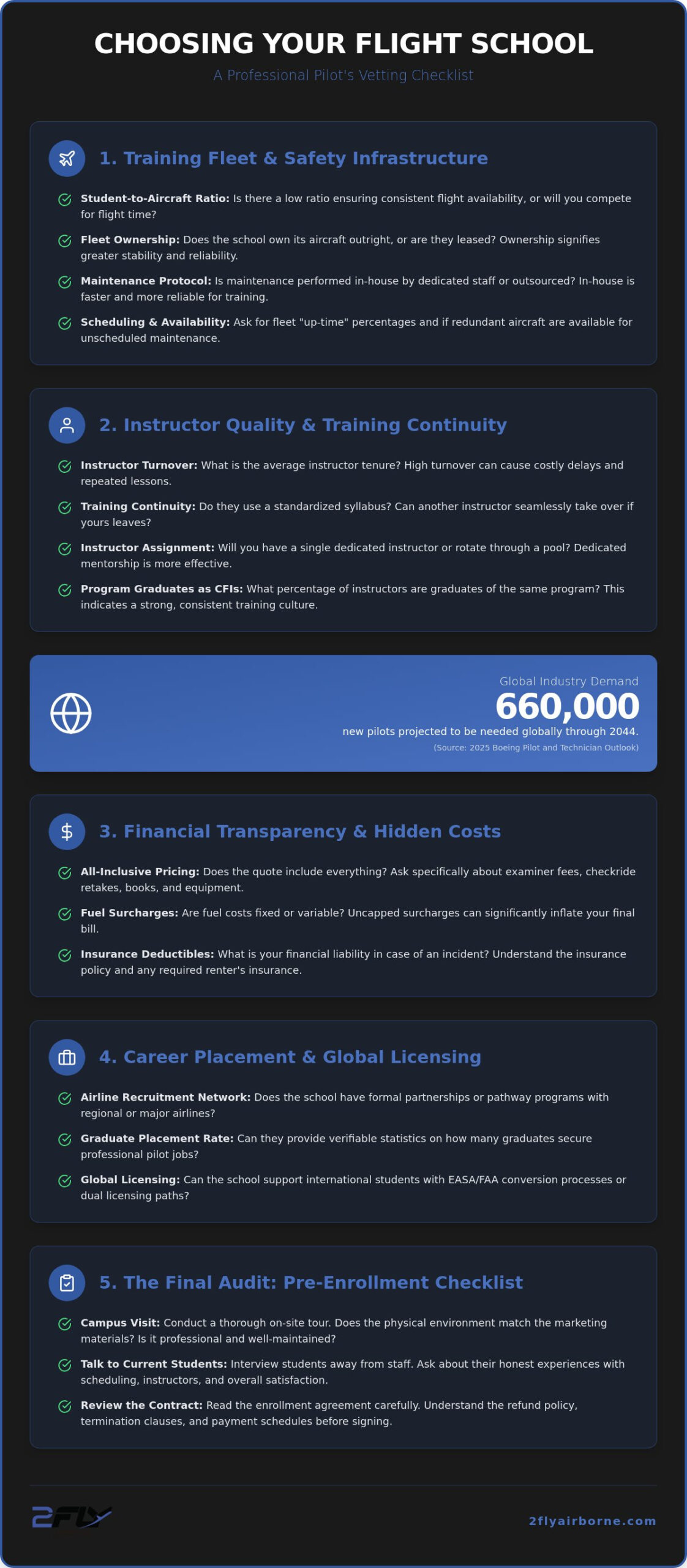
Finalizing Your Decision: The Pre-Enrollment Checklist
Have you ever made a major decision based solely on a digital brochure, only to find the reality didn’t match the pixels? For an investment as significant as pilot training, your final step must be a physical audit of the facilities. This stage is where you validate everything you’ve learned through your choosing a flight school questions to ask and ensure the environment matches your professional ambition.
Schedule a visit to the campus during a busy training block to observe the daily operational rhythm. Speak directly with current students away from the admissions office to get an unfiltered perspective on aircraft availability and instructor dedication. Audit a ground school session to evaluate if the instruction is engaging or merely a box-ticking exercise. You need to see the “up-time” of the fleet in person to confirm the school’s claims about scheduling reliability.
Review the enrollment contract with extreme care, specifically looking for “termination for convenience” clauses. These provisions allow you to exit the program and receive a fair refund of unused funds if your circumstances change. A transparent contract is the final mark of a school that respects its students as professional partners. Don’t hesitate to ask for clarification on any legal language that seems ambiguous before you sign.
The Campus Visit Strategy
Pay close attention to the condition of the aircraft and the cleanliness of the hangars. A disorganized hangar often signals a disorganized maintenance program, which can compromise both safety and your training schedule. Determine if the atmosphere is professional and goal-oriented; you want to train where the culture mirrors a commercial airline environment. Attending scheduled recruitment events is an excellent way to see how the school interacts with its industry partners and gauge the strength of their career pipeline.
Trusting Your Professional Instincts
At this final stage, remember that safety and structured progress must always outweigh “cheaper” alternatives. The 2025 Boeing Pilot and Technician Outlook projects a demand for 660,000 new pilots globally through 2044, and only the most disciplined, well-trained candidates will be ready to fill those seats. You aren’t just choosing a school; you’re choosing a mentor that will guide you from your first solo to your professional career. Trust your instincts if a school feels like it’s prioritizing enrollment numbers over student success.
In summary, choosing the right training environment requires a rigorous vetting process focused on safety, instructor quality, and financial transparency. By asking the right questions and performing a physical audit, you can select a path that leads directly to the flight deck. Prioritizing safe, structured training is the most reliable way to ensure you reach your career goals. If you’re ready to begin your journey, reach out to a 2FLY Training Advisor with any remaining questions.
Your Professional Pipeline Awaits
Selecting a training provider is a strategic audit of your future career. You’ve now learned how to evaluate fleet stability and why instructor continuity is vital for reaching the flight deck on schedule. By mastering the choosing a flight school questions to ask, you’ve moved past marketing brochures to the core of institutional reliability. This rigorous approach ensures that your time and capital are invested in an environment that prioritizes your vocational success and safety.
Since 1994, 2FLY Airborne has specialized in bridging the gap between student pilots and the global airline industry. Our expertise in FAA and EASA dual-standard training ensures you are prepared for international professional mobility from day one. We maintain an extensive global network of airline recruitment partners to support your transition into a professional cockpit. Every high-achiever deserves a mentor that values technical mastery and disciplined progression as much as they do.
Ready to take the first step toward your career? Speak with a 2FLY Airborne Training Advisor today to get your specific questions answered. The industry is ready for the next generation of prepared, professional aviators. Take command of your future today and reach out to a 2FLY Airborne Training Advisor with any remaining questions.
Frequently Asked Questions
Is it better to choose a Part 61 or Part 141 flight school for a career?
Part 141 schools are generally superior for those pursuing a professional career because they follow a rigid, FAA-approved syllabus. This structure is designed to produce industry-prepared professionals with higher consistency and often allows for lower flight hour requirements for certain certificates. While Part 61 offers flexibility for hobbyists, the structured environment of a Part 141 academy is the definitive gateway to an international airline career.
How many flight hours should I expect to fly per week?
In a professional, accelerated program, you should expect to fly between 10 and 15 hours per week. This high frequency is essential for maintaining muscle memory and progressing through complex maneuvers without the need for repetitive review sessions. Maintaining this steady rhythm is one of the most effective ways to minimize your total training duration and overall investment.
What happens if I fail a checkride during my training?
Failing a checkride is a temporary setback that requires specific remedial training in the areas where you didn’t meet the standards. Your examiner will issue a notice of disapproval, and you will work with your instructor to correct those deficiencies before re-testing. It is a standard part of the learning process for many, but maintaining a disciplined study habit can help you stay within the 75% of applicants who pass on their first attempt.
Do I need a college degree to become a commercial pilot in 2026?
A college degree is not a legal FAA requirement to become a commercial pilot or work for many regional airlines. However, many major carriers still view a four-year degree as a competitive advantage during the hiring process. The 2025 Boeing Pilot and Technician Outlook projects a demand for 660,000 new pilots globally through 2044, and while a degree helps, the industry’s primary focus remains on high-quality, structured flight experience.
Can I work a part-time job while attending an accelerated flight program?
Working during an accelerated program is generally discouraged because the training requires the same commitment as a full-time professional career. Your schedule must remain flexible to account for weather changes and maintenance blocks, which often conflicts with traditional employment. To reach the highest levels of the profession, you must treat your training as your primary focus to avoid expensive delays and mental fatigue.
What is the most common reason students drop out of flight school?
The most frequent reason for withdrawal is a lack of financial transparency leading to exhausted budgets before completion. This is why the choosing a flight school questions to ask must prioritize itemized cost breakdowns and hidden fee identification. Students who enter a program without a clear financial framework or a reliable aircraft-to-student ratio often lose the momentum necessary to finish their certifications.
How do I know if a flight school is officially FAA-approved?
You can verify an institution’s legitimacy by requesting their Air Agency Certificate or searching the FAA’s official database of certificated pilot schools. An approved Part 141 school must maintain rigorous standards for their facilities, personnel, and training course outlines. During your campus visit, ask to see their current certificate to ensure the program meets the strict regulatory demands of the industry.
What is the difference between an M-1 and F-1 student visa for pilots?
The M-1 visa is specifically for vocational or technical training, such as a focused pilot certificate program, while the F-1 visa is for students enrolled in full-time academic or degree-seeking programs. F-1 visas sometimes offer more extensive opportunities for practical training after graduation, but the M-1 is the standard for most international trainees in the USA. Always confirm that your chosen academy is authorized by the Department of Homeland Security to issue the necessary Form I-20.
Article by
2FLY Airborne
2Fly Airborne is a professional flight training organization dedicated to developing the next generation of skilled, confident, and safety-focused pilots. With decades of combined aviation experience, our team of certified instructors provides structured, real-world training designed to prepare students for both checkrides and long-term success in the aviation industry.
Content Disclaimer
Some blog content is generated with the assistance of automated tools and may not always be fully accurate or up to date. Please verify all aviation-related information with official sources or a certified instructor. For additional guidance or clarification, we encourage you to contact one of our training advisors at 2Fly Airborne.