

What if the training center that promises the fastest route to a cockpit is actually the one most likely to stall your professional journey? Choosing where to earn your wings is the most significant financial and career decision you’ll face. It’s natural to feel a sense of unease regarding hidden fees, aircraft safety, or high instructor turnover that could derail your timeline. You’re looking for a partner that treats you like a future captain, not just another number in a logbook. Understanding the specific red flags to look for in a flight school is essential to ensuring your path leads to a stable, international career.
This guide identifies the critical warning signs that separate elite academies from risky operations. You’ll learn how to spot a “pilot factory” that prioritizes volume over quality and how to evaluate the transparency of a school’s pricing structure. We’ll provide a clear checklist of what to avoid so you can select a professional-grade mentor with total confidence. From vetting maintenance logs to assessing instructor stability, here is how to safeguard your future in the skies. By the end of this article, you’ll have the tools to distinguish between a simple training facility and a true gateway to the global aviation industry.
Key Takeaways
- Identify why demanding large upfront payments is one of the most critical red flags to look for in a flight school and how to verify financial transparency.
- Learn how to conduct an operational integrity check to ensure the training fleet meets modern safety and avionics standards.
- Discover how to evaluate instructor stability to avoid training delays caused by high turnover and unmotivated staff.
- Distinguish between marketing hype and true career readiness by assessing a school’s commitment to international training standards and scheduling efficiency.
Financial Transparency: Why Upfront Payments Are a Major Red Flag
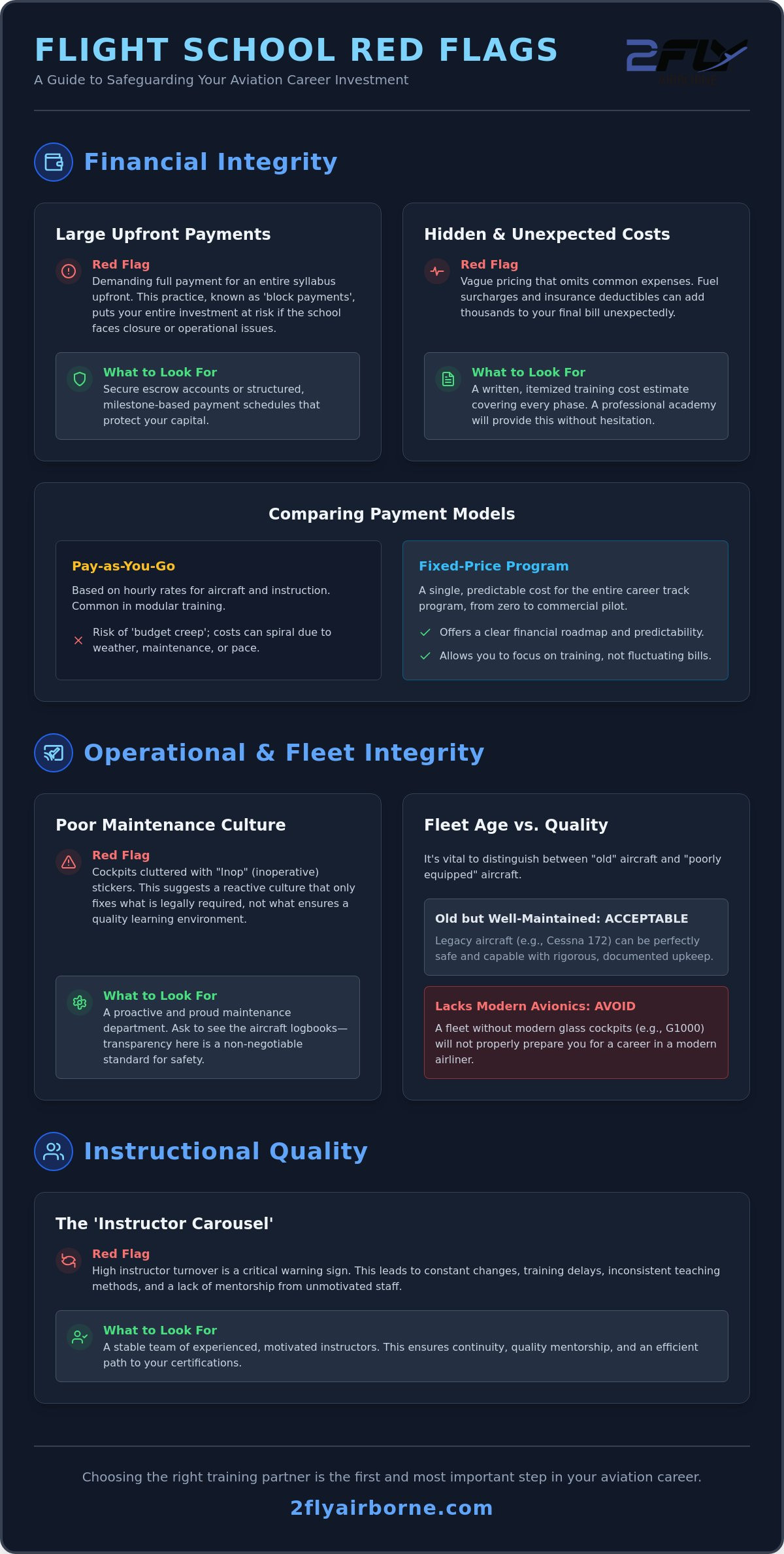
Investing in your aviation career is a significant commitment that requires absolute financial clarity. One of the most concerning red flags to look for in a flight school is a demand for large, unsecured upfront payments for an entire training syllabus. This practice, often referred to as ‘block payments’, places your capital at risk if the organization encounters operational hurdles or sudden closure. Legitimate academies protect your investment by utilizing escrow accounts or offering structured, milestone-based payment schedules.
To better understand how to protect your investment, watch this breakdown of common warning signs:
Beyond the initial deposit, look for hidden costs that can quietly inflate your total bill. Fuel surcharges and insurance deductibles are frequently omitted from marketing materials but can add thousands to your final spend. A professional academy will provide a written, itemized training cost estimate that covers every phase of the flight training process. Any hesitation to provide these details in writing is a clear signal that the school lacks the administrative integrity required for professional pilot development.
The ‘Pay-as-You-Go’ vs. Fixed-Price Debate
Traditional modular training often relies on hourly rates, which can lead to significant ‘budget creep’ as you progress through your ratings. If your training takes longer than the minimum FAA hours due to weather or personal pace, your costs will inevitably spiral. This is why many career-track students prefer a Fixed-Price Professional Pilot Program. These programs offer a clear financial roadmap from day one. Financial predictability is the hallmark of a professional school because it allows you to focus entirely on technical mastery rather than fluctuating bills.
Vague Refund Policies and Cancellation Clauses
Always scrutinize the fine print regarding how your funds are handled if you need to pause or exit the program. Warning signs include policies that penalize you for cancellations caused by weather or aircraft maintenance issues. These are factors beyond your control and should never result in a financial penalty for the student. Reputable schools also offer transparent financing options to help manage the cost of your professional certifications. Clear terms and fair exit clauses demonstrate that a school is confident in its ability to deliver a world-class training experience.
Operational Integrity: Fleet Maintenance and Safety Standards
Would you board a commercial flight if you knew the cockpit was covered in “Inop” stickers? In the aviation world, an “Inop” sticker indicates that a specific piece of equipment is inoperative. While some non-essential items can be deferred, a cockpit cluttered with these markers is one of the most visual red flags to look for in a flight school. It suggests a reactive maintenance culture that fixes only what is legally required to stay in the air, rather than what is necessary for a high-quality learning environment.
A professional academy should welcome your interest in their maintenance department. Ask to see the aircraft logbooks; these are the legal records of every inspection, repair, and service performed on the fleet. Secretive behavior regarding these logs should end your tour immediately. The Aircraft Owners and Pilots Association (AOPA) provides a detailed checklist of red flags when choosing a flight school, emphasizing that transparency in maintenance is a non-negotiable standard for student safety.
It is vital to distinguish between “old” aircraft and “poorly maintained” aircraft. Many training centers fly legacy Cessna or Piper models that are decades old but remain perfectly safe and capable due to rigorous upkeep. However, a fleet that looks pristine on the outside but lacks modern avionics, such as G1000 glass cockpits, may not prepare you for the technical demands of a modern airliner. You need a training environment that mirrors the technology you will operate in your professional career.
Evaluating the Maintenance Culture
Safety is a culture, not just a logbook entry. Watch for signs of a “push-it-through” mentality where instructors or management pressure students to fly aircraft with known, albeit minor, mechanical issues. A reputable school employs a dedicated, on-site maintenance team rather than outsourcing work to a third party that may have a backlog of several weeks. This internal oversight ensures that safety remains the primary driver of every launch decision.
Fleet Diversity and Availability
Relying on a “Single-Type” fleet presents a significant operational risk. If a specific model is grounded due to a fleet-wide airworthiness directive, your training comes to a complete halt. Professional academies mitigate this by investing in a diverse fleet of single-engine trainers and multi-engine aircraft like the Piper Seminole. They also utilize advanced flight simulators to keep training moving during poor weather. Elite programs like the FAA Professional Pilot Program prioritize a well-balanced fleet to ensure students stay on schedule. Check the student-to-aircraft ratio; if a school has more students than available seats, you will likely face a scheduling bottleneck that extends your training timeline and increases your costs.
Instructional Quality: The ‘Instructor Carousel’ Warning
Have you ever spent half a flight lesson repeating maneuvers you already mastered because your new instructor didn’t have your records? This frustrating scenario is the result of the “Instructor Carousel,” a term used to describe high staff turnover that forces students to switch teachers frequently. While it’s common for flight instructors to move to airlines after 12 to 18 months, a school that fails to manage this transition creates significant friction for your development. Constant instructor changes are among the most disruptive red flags to look for in a flight school because they kill your training momentum and lead to redundant flight hours.
A lack of continuity often stems from poor administrative oversight. When a school doesn’t prioritize student-instructor pairing, you become a cog in a machine rather than a protégé. Look for institutions that maintain a stable roster and have a clear plan for when an instructor eventually moves on to a major carrier. You can find more detailed checklists in AOPA’s guide to choosing a flight school, which highlights how instructional quality impacts your overall success.
Syllabus Structure and Progress Tracking
Training under FAA Part 61 offers flexibility, but it can often feel like an unstructured path for those with professional ambitions. Without a rigid framework, lessons may lack clear objectives or feel repetitive. For those pursuing a career, a formal FAA Part 141 syllabus is the gold standard. This structured approach ensures every hour in the air serves a specific purpose in your development. Any modern professional pilot school must utilize digital progress tracking. This technology allows any instructor to see exactly where you stand, preventing the “restart” phenomenon that wastes your time and money.
Instructor Mentorship vs. Hour Building
Some instructors are clearly “just building hours” to reach the 1,500-hour airline minimum. They may have little interest in your personal growth or the art of teaching. To avoid this, vet a potential instructor by asking about the following:
- Their students’ first-time checkride pass rate.
- How they track and communicate your strengths and weaknesses.
- Whether they follow a standardized briefing and de-briefing protocol.
Schools that offer their own CFI training courses to their graduates often have a more invested teaching staff. These instructors have been through the same program and understand the specific challenges you face. A mentor-based approach transforms the training experience from a series of tasks into a professional apprenticeship. When your instructor acts as a mentor, they prepare you for the cockpit of a jet, not just a checkride. This high level of engagement leads to faster certification and greater confidence.
The Career Pipeline: Marketing Hype vs. Airline Readiness
Will your training certificate actually open the door to a major airline, or is it just a piece of paper? Many schools use aggressive marketing to suggest a seamless transition to the cockpit, but the reality is often more complex. One of the primary red flags to look for in a flight school is a promise of “Guaranteed Jobs.” In the highly regulated world of aviation, no school can bypass the airline’s own rigorous interview and evaluation process. A reputable academy offers “Guaranteed Interviews” through established partnerships, but the final hiring decision always rests with the carrier.
The 2025 Boeing Pilot and Technician Outlook projects a demand for 660,000 new pilots globally through 2044. Meeting this massive demand requires more than just basic flight hours. Airlines now look for candidates who have been trained in a multi-crew environment with a focus on Crew Resource Management (CRM) and jet transition. If a school focuses solely on solo flight time and ignores these professional standards, they aren’t preparing you for a career; they’re just helping you pass a test. This lack of professional alignment is one of the most significant red flags to look for in a flight school.
Verifying Airline Partnerships
Don’t take a school’s word for it when they claim to have “strong airline ties.” Ask for specific data on where their graduates are flying today and look for a dedicated recruitment office on campus. It is a major warning sign if a school cannot name a single active airline partner or provide recent placement statistics. In today’s market, having an international perspective in your training is vital for long-term mobility. Schools that ignore international standards like EASA limit your potential to domestic markets, which can be a significant disadvantage during economic shifts.
The Value of a Degree Program
A degree program with airline pilot training provides a critical safety net that many “fast-track” schools ignore. While it’s tempting to rush toward a certificate, academic rigor is a significant green flag for recruiters at major carriers. It demonstrates a level of discipline and theoretical knowledge that goes beyond stick-and-rudder skills. Be wary of schools that actively discourage higher education. They often prioritize their own throughput over your long-term career stability.
If you want to ensure your training aligns with global hiring standards, consider the FAA Professional Pilot Program as your direct pipeline to the industry.
Operational Efficiency and Student Support Services
Have you ever cleared your schedule for a critical cross-country flight only to realize the aircraft was double-booked? This experience is more than a minor frustration; it’s a symptom of the “Scheduling Bottleneck.” This bottleneck is a primary reason many students fail to complete their training within their projected timeline or budget. When researching your options, one of the most significant red flags to look for in a flight school is a lack of transparency regarding fleet and instructor availability.
A dedicated student services department should be available to handle everything from TSA clearances to local administrative hurdles, allowing you to focus entirely on your flight training. If a school treats these complex regulatory requirements as an afterthought, they likely lack the infrastructure to support a high-level professional path. For students visiting training sites abroad, professional support often extends to ground logistics, such as using corralejotransfers.com for reliable airport connections, ensuring you don’t waste time on administrative friction.
The 2025 Boeing Pilot and Technician Outlook projects a demand for 660,000 new pilots globally through 2044. To meet this demand, you need a training environment that maximizes your efficiency in both the cockpit and the classroom.
Student-to-Aircraft and Student-to-Instructor Ratios
To determine if a school is over-enrolled, ask for their current student-to-aircraft and student-to-instructor ratios. A high ratio inevitably leads to “stale” skills, where you spend expensive flight time relearning maneuvers from previous weeks because you couldn’t get on the schedule. This inefficiency directly impacts your flight school investment. Flying three to five times per week is the definitive “sweet spot” for maintaining progress, ensuring that muscle memory and technical knowledge remain sharp throughout the syllabus.
The Role of On-Campus Housing
Living in a call-to-action residential aviation environment accelerates your learning through constant immersion. You’re surrounded by peers and mentors who share your professional goals, creating a natural networking hub that extends far beyond the hangar. A major red flag is a school that leaves you to find your own housing in an unfamiliar city without guidance. Professional on-campus housing isn’t just about convenience; it’s about building the social and professional foundation required for a successful career in a global industry. Schools that prioritize these support services demonstrate a commitment to your success that “pilot factories” simply cannot match.
Securing Your Future in Professional Aviation
Identifying the red flags to look for in a flight school is the first step toward a disciplined, high-level career. You now have the checklist to separate “pilot factories” from elite institutions that prioritize your individual growth. Focus on financial clarity, a robust safety culture, and stable mentorship to ensure your training remains on course. By vetting your training provider with these standards, you protect your investment and your future in the cockpit. If your interests extend into the burgeoning drone industry, you can discover Caswell Aviation Ltd for specialized training and technical support.
2FLY Airborne bridges the gap between training and employment through our Fixed-price Professional Pilot Program. We maintain rigorous FAA and EASA training standards while providing dedicated on-campus housing and full visa support for our international students. This structured environment is designed to transform ambitious candidates into industry-ready professionals. We invite you to experience a training pipeline built on transparency and technical mastery.
Ready to start your career with a school that prioritizes professional excellence? Speak with a 2FLY Training Advisor today to discuss your path forward. Please reach out to a 2FLY Training Advisor with any remaining questions. Your journey to the flight deck begins with a single, informed decision.
Frequently Asked Questions
Is it a red flag if a flight school requires full payment upfront?
Yes, demanding the entire program cost before training begins is one of the most critical red flags to look for in a flight school. This practice leaves your investment vulnerable if the organization faces financial instability or if you decide the program isn’t a good fit. Reputable academies offer pay-per-rating structures or use secure escrow accounts to protect your capital and ensure financial transparency.
How can I check a flight school’s safety and maintenance record?
You can verify a school’s commitment to safety by requesting to see recent aircraft maintenance logbooks and touring their on-site repair facilities. Look for a clean, organized hangar and a team of dedicated, full-time mechanics. A school that is hesitant to show you their maintenance records or lacks on-site staff is likely hiding operational deficiencies that could compromise your safety.
What is the difference between Part 61 and Part 141 flight schools?
Part 141 schools follow a rigid, FAA-approved syllabus designed for career-track students, while Part 61 schools offer a more flexible, less structured approach. For those aiming for a professional cockpit, the structure of Part 141 often leads to more efficient training and faster certification. It ensures that every hour you spend in the air meets specific, high-level commercial standards.
Should I avoid flight schools located at busy international airports?
Training at a busy airport is actually a significant benefit for aspiring professionals because it builds comfort with complex Air Traffic Control (ATC) environments. While it might involve slightly longer taxi times, the experience gained in high-traffic areas is invaluable for your future career. You’ll develop the radio proficiency and situational awareness required to operate in the world’s most demanding airspaces.
Is it normal for a student pilot to change instructors frequently?
While some instructor turnover is expected as pilots move to airlines, frequent changes are major red flags to look for in a flight school. This “instructor carousel” often results in repetitive lessons, lost momentum, and increased costs. A professional academy manages these transitions carefully to ensure you maintain a consistent mentor who understands your specific strengths and weaknesses.
What questions should I ask during a flight school tour to spot red flags?
During your tour, ask about the school’s checkride pass rate and whether they have a dedicated student services department. Inquire about the specific student-to-aircraft ratio and any additional costs, such as fuel surcharges, that aren’t listed in the brochure. These questions reveal the school’s operational transparency and their genuine focus on student success rather than just enrollment numbers.
Are ‘guaranteed job’ claims in flight school marketing legitimate?
Claims of a “guaranteed job” are almost always marketing hype and should be viewed with extreme skepticism. Airlines have their own independent, rigorous hiring processes that no flight school can bypass. Look for schools that offer legitimate pathway programs or guaranteed interviews with partner carriers rather than unrealistic employment promises that they cannot legally fulfill.
How important is a school’s student-to-aircraft ratio for my timeline?
Your training timeline depends heavily on the student-to-aircraft ratio, as a high ratio creates scheduling bottlenecks that delay your progress. If you can’t fly three to five times a week, your skills will likely become “stale” between lessons, forcing you to repeat maneuvers. This inefficiency extends your training duration and significantly increases your overall financial investment.
Article by
2FLY Airborne
2Fly Airborne is a professional flight training organization dedicated to developing the next generation of skilled, confident, and safety-focused pilots. With decades of combined aviation experience, our team of certified instructors provides structured, real-world training designed to prepare students for both checkrides and long-term success in the aviation industry.
Content Disclaimer
Some blog content is generated with the assistance of automated tools and may not always be fully accurate or up to date. Please verify all aviation-related information with official sources or a certified instructor. For additional guidance or clarification, we encourage you to contact one of our training advisors at 2Fly Airborne.