Why would a pilot holding an EASA license, arguably one of the most rigorous certifications in the world, feel like they are starting over when eyeing the American flight deck? It’s a common frustration for European aviators who see the vast opportunities in the U.S. market but feel stalled by a wall of paperwork. You’ve likely spent hours digging through outdated forums only to find conflicting information about the easa to faa conversion requirements for 2026.
We understand that the fear of redundant training and hidden costs can make the Atlantic feel wider than it actually is. You deserve a clear path that respects your existing expertise while ensuring you meet every FAA standard with precision. This expert-led breakdown will help you navigate the Bilateral Aviation Safety Agreement (BASA) process with absolute confidence.
We are providing a chronological checklist of the conversion steps, from the initial Verification of Authenticity through to your final FAA checkride. You will learn the vital distinction between simple license validation and a professional-grade conversion. By the end of this guide, you’ll have a definitive roadmap to transition your career to the United States and select a training partner that values your international mobility.
Key Takeaways
- Understand how the Bilateral Aviation Safety Agreement (BASA) streamlines the recognition of your European credentials by the FAA through established Technical Implementation Procedures.
- Identify the specific easa to faa conversion requirements including holding a valid Part-FCL license and meeting strict ICAO English proficiency standards.
- Learn to distinguish between a restricted validation and a full certificate conversion to ensure your FAA credentials support your long-term career goals and global employment.
- Master the chronological steps of the transition, starting with the FAA Verification of Authenticity and the critical requirement for a U.S. medical certificate.
- Discover the strategic advantage of holding dual certifications in a high-demand market that values international professional mobility and specialized ratings.
The BASA Framework: How the FAA and EASA Recognize Licenses
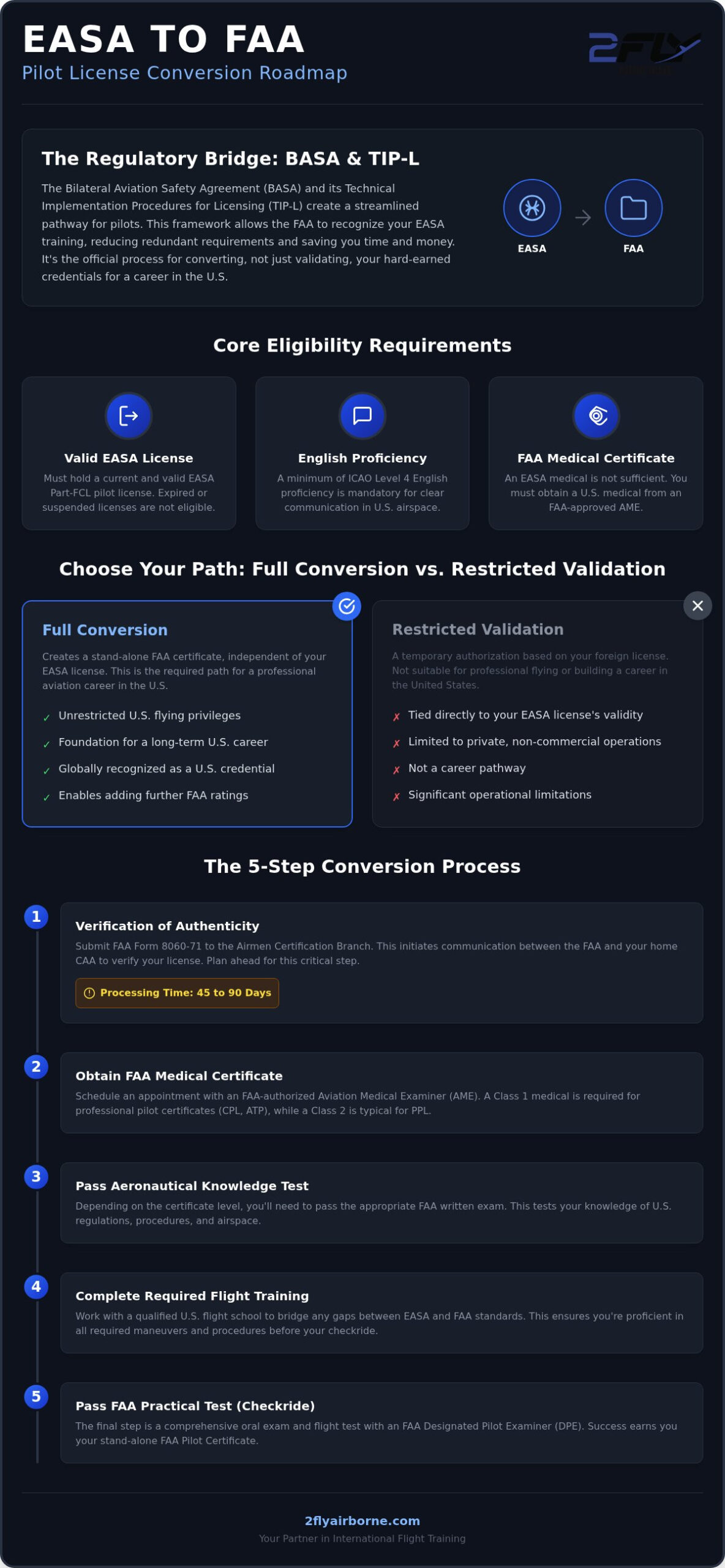
The transition from European skies to the American flight deck is made possible through a strategic partnership between the FAA and EASA. This partnership is formalized under the Bilateral Aviation Safety Agreement, commonly known as BASA. This agreement exists to simplify the recognition of safety standards and certifications between the two largest aviation jurisdictions in the world. Instead of forcing pilots to start from zero, BASA creates a foundation for mutual trust in pilot training and oversight.
Understanding the easa to faa conversion requirements begins with the Technical Implementation Procedures for Licensing (TIP-L). This document acts as the actual rulebook that dictates how the FAA and EASA recognize each other’s pilot licenses. Before this framework was established, pilots often faced extensive and redundant training requirements that wasted both time and capital. Today, the TIP-L ensures that your previous experience is credited, allowing for a more streamlined path to obtaining U.S. credentials.
The scope is broad. It covers several certification levels including the Private Pilot Certificate (PPL), Commercial Pilot Certificate (CPL), and Airline Transport Pilot (ATP) levels. Additionally, it provides specific procedures for converting an Instrument Rating (IR). Whether you are a recreational flyer or a career-focused professional, there is a defined regulatory bridge available to you.
The Role of the TIP-L Agreement
The TIP-L is the primary mechanism that allows a pilot to obtain a stand-alone FAA certificate rather than a mere validation. This distinction is vital in pilot licensing and certification standards. By adhering to these procedures, you can significantly reduce the number of flight hours required for retraining in the United States. It essentially guarantees that the FAA respects the high standards of your original European training, provided you meet the specific conversion criteria outlined in the 2026 guidelines. You don’t have to repeat the basics you’ve already mastered.
Why Conversion Matters for Your Career
Securing an FAA certificate isn’t just about gaining new skills; it’s about expanding your professional reach. It grants you access to the world’s largest general aviation and commercial sectors. Having dual certification makes you a versatile asset for international carriers that operate across different regulatory jurisdictions. For those enrolled in an FAA Professional Pilot Program, completing these easa to faa conversion requirements is the definitive step toward achieving international professional mobility. It positions you as a global aviator ready for the highest levels of the industry. Don’t let borders limit your potential.
Core Eligibility and Documentation Requirements
Before you step foot in a U.S. cockpit, your paperwork must be airtight. The FAA requires specific proof of your competency and health before they issue any American credentials. Meeting the easa to faa conversion requirements isn’t just about showing up; it’s about meticulous preparation months in advance.
Your foundation is a valid, current EASA Part-FCL pilot license. If your license has expired or is under suspension, the process stops immediately. You must also demonstrate English proficiency at a minimum of ICAO Level 4, as clear communication is the bedrock of safety in busy American airspace.
The FAA Medical Certificate
You can’t fly in the U.S. using only your EASA medical. You must obtain a medical certificate issued by an FAA-authorized Aviation Medical Examiner (AME). If you’re looking at a professional career, a Class 1 medical is mandatory, while a Class 2 is usually sufficient for private flying or hour building.
The Verification of Authenticity Process
This is often where pilots encounter the most significant delays. You must submit FAA Form 8060-71 to the Airmen Certification Branch to verify your foreign license. As of 2026, the current processing time for this verification is approximately 45 to 90 days. This timeline is governed by the Bilateral Aviation Safety Agreements (BASA) and requires coordination between the FAA and your home Civil Aviation Authority (CAA).
Your EASA license must remain valid throughout this entire verification period. If it expires while the FAA is talking to your CAA, the verification will fail. Once issued, your verification letter is valid for six months, giving you a specific window to complete your conversion in the States.
It’s important to understand that specific regulations and individual timelines vary based on your home country’s CAA and current FAA workloads. Speaking with a training advisor can help you synchronize your travel plans with these fluctuating regulatory wait times. This proactive approach ensures you arrive in Florida ready to train without administrative interruptions.
Comparing Full Conversion and Restricted Validation Paths
One of the most critical decisions you’ll make in your transition is choosing between a restricted validation and a full certificate conversion. While both paths result in the ability to fly N-registered aircraft, they serve very different career objectives. Understanding the nuance between these two options is essential for any pilot looking to maximize their international professional mobility.
Validation, governed by 14 CFR 61.75, creates a U.S. certificate that is legally “based on” your foreign license. It’s a paperwork-heavy process that bypasses the need for FAA written exams or practical tests at the private pilot level. While this is an efficient route for short-term leisure flying or hour building, it carries significant limitations for professional aviators who need a more permanent solution.
Full conversion results in a stand-alone FAA certificate that exists independently of your EASA status. This is the professional standard for pilots who want to secure employment with U.S. carriers or pursue advanced ratings. Navigating the easa to faa conversion requirements for a stand-alone certificate proves your technical mastery and commitment to the American regulatory environment. It transforms you from a visitor into a fully recognized professional within the U.S. system.
The 61.75 Restricted Certificate
This path is often chosen by pilots who only need to build hours in the Florida sun or fly for personal enjoyment. Because it is tethered to your EASA license, any change in your European status directly affects your ability to fly in the U.S. If your EASA medical or license expires, your 61.75 certificate becomes void instantly. Crucially, a restricted certificate cannot serve as the prerequisite for higher-level FAA commercial certificates. It’s a temporary bridge, not a permanent foundation for a career.
Stand-alone FAA Certification (TIP-L)
For those with global ambitions, a stand-alone certificate is the only logical choice. Under the TIP-L agreement, you must pass a specific FAA knowledge test and, for commercial or airline transport levels, complete a practical checkride with an FAA examiner. This ensures you are fully integrated into the U.S. aviation system and ready for the demands of a specialized career path. This path is ideal for pilots enrolled in the FAA First Officer Program. It provides the legal and professional autonomy required to work in the world’s most active aviation market without being dependent on your European paperwork.
The Step-by-Step FAA Conversion Process
Transforming your European credentials into an American certificate is a methodical journey that rewards precision. While the initial paperwork sets the stage, the active phase of your transition requires a structured approach to training and testing. Following a chronological path ensures you meet all easa to faa conversion requirements without unnecessary delays or missed regulatory deadlines.
- Verification of Authenticity: Submit Form 8060-71 to confirm your EASA license status with the FAA.
- FAA Medical Certification: Secure your Class 1 or 2 certificate from an authorized examiner.
- FAA Knowledge Test: Pass the written equivalency exam tailored for converting pilots.
- Flight Proficiency Training: Log the necessary hours to adapt your skills to U.S. standards.
- The Practical Test: Complete your oral exam and flight checkride with a Designated Pilot Examiner (DPE).
The Knowledge Test and Ground School
The FAA knowledge tests for conversion are specifically designed to bridge the gap between regulatory systems. These exams are typically shorter than initial FAA tests because they acknowledge your existing EASA theory. You will focus heavily on U.S. Airspace classifications, federal aviation regulations, and local ATC communication procedures. While self-study is an option, a structured ground school environment significantly increases your chances of a first-pass success. It helps you unlearn European habits that might not align with American procedures.
Flight Training and the Checkride
Once you arrive in the U.S., your flight training will focus on proficiency rather than basic maneuvers. You must adapt your EASA techniques to meet the specific Practical Test Standards (PTS) or Airman Certification Standards (ACS) used by the FAA. Before you can schedule your checkride, an FAA-certified instructor must endorse your logbook, certifying that you are prepared for the test. The checkride itself is a rigorous two-part event. It begins with a deep-dive oral examination followed by a flight portion where you demonstrate your mastery of the aircraft and U.S. operating rules.
Logistics: Visas and Housing
Moving across the Atlantic for training involves more than just flight bags and logbooks. International pilots must secure an M-1 visa to legally participate in vocational flight training in the United States. This process requires an I-20 form issued by a school capable of providing administrative support for SEVIS. Choosing a training center with on-campus housing can further simplify your transition, allowing you to focus entirely on your certification. The 2025 Boeing Pilot and Technician Outlook projects a demand for 660,000 new pilots globally through 2044, making this the ideal time to settle into your new training environment. You can start your professional transition today by coordinating your arrival with a dedicated training team.
Strategic Career Advantages of an FAA Certificate
What happens once the ink is dry on your new FAA certificate? For many European pilots, the transition is the catalyst for a global career that transcends local market limitations. Meeting the easa to faa conversion requirements transforms you into a versatile professional capable of operating in diverse regulatory environments. You become a high-value asset for international carriers that require pilots who can navigate the complexities of both EASA and FAA jurisdictions.
The United States provides a unique environment for professional growth that is difficult to replicate elsewhere. With its massive network of airports and varied weather patterns, Florida remains the premier destination for intensive hour building and acquiring specialized ratings. An FAA certificate is also recognized as the gold standard for high-stakes corporate aviation and international ferry pilot roles. It gives you the autonomy to move aircraft across borders with minimal regulatory friction.
The Global Demand for Skilled Aviators
The aviation industry is currently facing a transformative period of growth that requires a new generation of highly prepared professionals. The 2025 Boeing Pilot and Technician Outlook projects a demand for 660,000 new pilots globally through 2044. A stand-alone FAA certificate is the most versatile tool you can possess to meet this massive demand. Holding dual certification allows you to negotiate from a position of strength, effectively doubling your career opportunities and maximizing your lifetime salary potential.
Choosing the Right Training Partner
Your success depends on more than just your own drive; it requires an institution that understands the nuances of international professional mobility. You should prioritize an academy with a proven track record of helping European pilots navigate the regulatory bridge. Look for schools that offer flexible financing options for their professional programs to ensure your training remains on track. Consult with a training advisor early in your process to map out a specific timeline that aligns with your career goals. 2FLY Airborne bridges the gap between your European ambition and American opportunity, providing a direct pipeline to the professional flight deck.
Your Future in Global Aviation
Mastering the easa to faa conversion requirements is more than a regulatory hurdle; it’s a strategic investment in your professional autonomy. By navigating the BASA framework and choosing a stand-alone certificate, you position yourself at the forefront of the global industry. Success in the American market requires a dedicated approach to both paperwork and proficiency. Safe, structured training remains the most reliable path to a rewarding career on the flight deck.
At 2FLY Airborne, we specialize in bridging the gap for international aviators. Our team provides expert guidance on M-1 visa processing and offers on-campus housing to ensure your transition to Florida is seamless. With our fixed-price professional training modules, you can focus on technical mastery while we handle the administrative complexities. We invite you to speak with a 2FLY Training Advisor to start your conversion journey today.
If you have any remaining questions about your eligibility or the 2026 conversion timeline, please reach out to a 2FLY Training Advisor. Your journey toward an international career starts with a single, well-informed step.
Frequently Asked Questions
Can I convert my EASA PPL to an FAA PPL without a checkride?
Yes, under 14 CFR 61.75, you can obtain a restricted FAA Private Pilot Certificate based on your EASA license without a checkride. This process is purely administrative and relies on the verification of your foreign credentials by the FAA Airmen Certification Branch. However, remember that this certificate is tethered to your EASA license. It cannot be used as a basis for professional progression like a Commercial Pilot Certificate.
How long does the EASA to FAA verification process take in 2026?
The FAA’s current processing time for the Verification of Authenticity (Form 8060-71) is approximately 45 to 90 days. You must submit this application through the IACRA portal well before your planned travel to the United States. Once the FAA issues the verification letter, it remains valid for six months. This gives you a specific window to complete the process with a professional pilot school in Florida.
Do I need a new medical certificate for an FAA conversion?
Yes, you must obtain a U.S. medical certificate issued by an FAA-authorized Aviation Medical Examiner (AME) to exercise the privileges of an FAA certificate. While a 61.75 validation technically allows the use of a current foreign medical, professional career paths always require a standalone FAA medical. A Class 1 medical is necessary if you intend to pursue a commercial career or enroll in a professional pilot program to maximize your mobility.
Is there a specific written exam for EASA to FAA conversion?
Professional conversions under the TIP-L framework require passing a specific FAA knowledge test. These exams are generally shorter than initial FAA written tests because they focus on the differences in regulations and airspace. For a basic 61.75 validation at the PPL level, no written exam is required. However, you must still meet the easa to faa conversion requirements regarding English proficiency and have a valid verification letter from the FAA.
Can I work as a flight instructor in the US with a converted license?
No, you cannot work as a flight instructor using a converted license alone. To work as a CFI in the U.S., you must earn a standalone FAA Commercial Pilot Certificate and then pass the specific FAA flight instructor written and practical exams. Additionally, international pilots must have the appropriate work authorization or visa status to accept employment. Most students choose to complete these steps through a structured professional pilot program.
What is the difference between a 61.75 validation and a TIP-L conversion?
A 61.75 validation is a restricted certificate “based on” your foreign license, while a TIP-L conversion results in a standalone FAA certificate. The validation becomes void if your EASA license expires and has limited utility for career growth. In contrast, a TIP-L conversion requires a written test and often a checkride. It grants you full autonomy within the FAA system and is the preferred route for those seeking long-term professional employment.
Will my EASA multi-engine rating transfer automatically to my FAA certificate?
Ratings do not transfer automatically; they must be specifically requested during the verification and application process. Under the TIP-L agreement, certain ratings like the Multi-Engine Rating can be added to your FAA certificate provided you meet the experience requirements and pass any necessary exams. It is essential to ensure your home CAA verifies these specific ratings on your authenticity letter. This prevents the need for redundant training once you arrive in the U.S.
Can I use my FAA converted license to fly N-registered aircraft in Europe?
Yes, an FAA certificate allows you to operate N-registered aircraft globally, including within European airspace. This is a primary reason many pilots pursue the easa to faa conversion requirements for ferry flights or corporate roles. However, you must still comply with local airspace regulations and ensure you meet any specific EASA requirements for residents operating foreign-registered aircraft. Always verify local rules before conducting operations as a resident pilot in the EU.
Article by
2FLY Airborne
2Fly Airborne is a professional flight training organization dedicated to developing the next generation of skilled, confident, and safety-focused pilots. With decades of combined aviation experience, our team of certified instructors provides structured, real-world training designed to prepare students for both checkrides and long-term success in the aviation industry.
Content Disclaimer
Some blog content is generated with the assistance of automated tools and may not always be fully accurate or up to date. Please verify all aviation-related information with official sources or a certified instructor. For additional guidance or clarification, we encourage you to contact one of our training advisors at 2Fly Airborne.