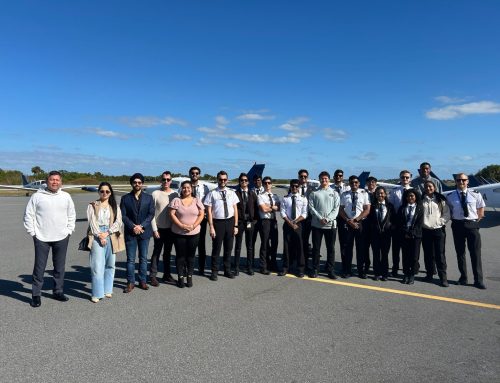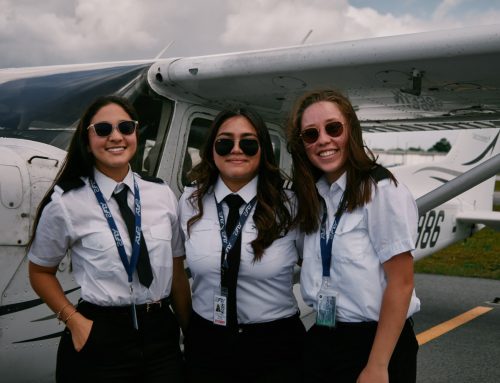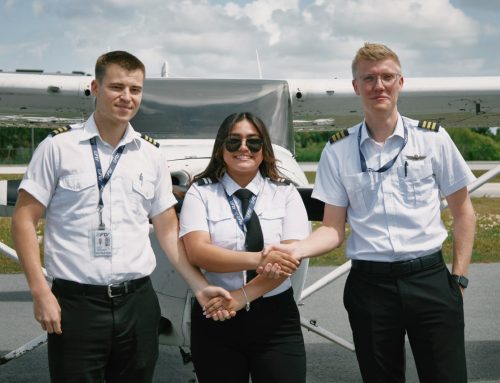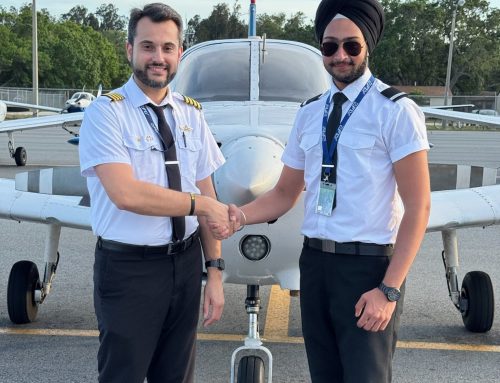
Could you really trade your current routine for a commercial cockpit in under twelve months? Many aspiring aviators assume that earning a professional license is a multi-year ordeal filled with scheduling bottlenecks and weather-related setbacks. While that might be true at a local flying club, accelerated flight training programs in Florida are designed to dismantle those barriers through total immersion.
It’s natural to feel a bit of anxiety about the high intensity of a professional-grade syllabus. You’re likely balancing the excitement of the industry with concerns about hidden delays or the complexity of FAA versus EASA requirements. We understand these pressures; they’re the same hurdles every high-achiever faces when they decide to commit to an elite career path.
This guide will show you how Florida’s unique aviation infrastructure provides a reliable, structured path to your first airline job. You’ll discover why a professional academy offers the stability and international perspective you need to transition from a trainee to an industry-prepared pilot. Let’s look at how a high-tempo environment turns your ambition into a tangible professional reality.
Key Takeaways
- Learn why Florida’s consistent flyable weather and sophisticated aviation infrastructure prevent the training delays commonly found in other regions.
- Discover how accelerated flight training programs in Florida utilize a structured, immersive environment to compress your career timeline without compromising FAA safety standards.
- Explore the step-by-step progression of the FAA Professional Pilot Program, from your foundational Private Pilot Certificate to the advanced Instrument Rating required for commercial operations.
- Gain clarity on the administrative and logistical requirements for international candidates, including M-1/F-1 visa sponsorship and the momentum-building benefits of on-campus housing.
- Understand the vital shift from recreational “pay-as-you-go” flying to an airline-style academy model designed for rapid professional advancement.
Defining Accelerated Training: Immersion Over Speed
In professional aviation, “accelerated” isn’t merely a reference to a calendar date. It signifies a fundamental shift from casual, hobbyist flying to a rigorous, career-focused immersion. While traditional schools often offer a modular approach where you fly when your schedule allows, accelerated flight training programs in Florida operate like a professional flight department. This structure mirrors the training cycles of major airlines, where pilots must master complex systems and procedures in high-tempo environments.
This high-frequency schedule is about more than just checking boxes. It’s about building deep-seated muscle memory and a professional mindset that a “pay-as-you-go” model simply cannot replicate. Consider these core benefits of the immersion model:
- Skill Retention: Daily repetition prevents the “two steps forward, one step back” cycle often seen in modular training.
- Operational Tempo: Learning to manage high-workload scenarios prepares you for the pace of airline-style training environments.
- Career Momentum: Moving through ratings in a single sequence keeps you focused on the end goal of professional employment.
The Philosophy of Professional Immersion
Entering an academy environment requires a mental transition from a student to a professional pilot candidate. You aren’t just learning to handle an aircraft; you’re developing “airmanship,” which is the consistent use of good judgment and well-honed skills in flight operations. Daily exposure to the cockpit builds situational awareness far faster than sporadic lessons. By training in Florida’s high-density airspace, you’re forced to interact with busy air traffic control and navigate complex traffic patterns from day one. This environment prepares you for the realities of international airline hubs, ensuring you’re ready for the cockpit well before your first interview.
Accelerated vs. Traditional Training Timelines
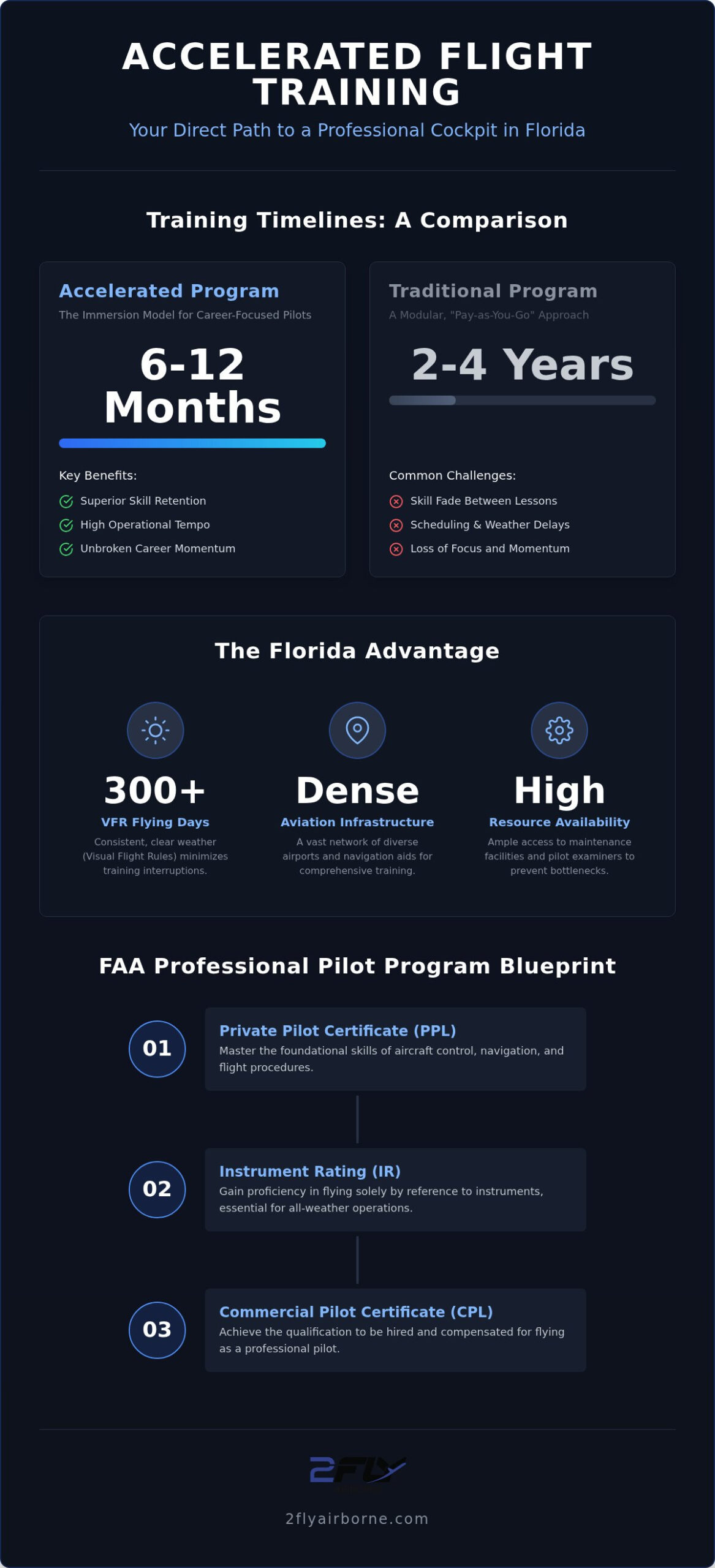
The difference between these two paths is stark. A traditional modular route can take anywhere from two to four years because of “skill fade,” which is the natural loss of proficiency that happens between infrequent lessons. In contrast, a structured FAA Professional Pilot Program allows candidates to complete their journey in six to twelve months. Flying five days a week ensures that muscle memory is reinforced daily, leading to superior skill retention. This consistency is the hallmark of modern pilot training, providing a direct pipeline to a commercial career. By choosing one of the premier accelerated flight training programs in Florida, you’re opting for a professional-grade education that values your time as much as your technical mastery.
The Florida Advantage: Why the Region Dominates Accelerated Aviation
Florida is often called the “Flight Training Capital of the World,” and for good reason. It isn’t just about the scenic views; it’s about a highly specialized ecosystem designed to keep pilots in the air. For those enrolled in accelerated flight training programs in Florida, the state provides a level of operational reliability that few other regions can match.
The primary driver is the climate. With over 300 days of VFR (Visual Flight Rules) weather annually, Florida allows for nearly uninterrupted training schedules. In aviation, VFR refers to weather conditions clear enough for pilots to fly by visual reference without relying solely on instruments. This consistency is vital for maintaining the momentum required in a high-tempo program.
Beyond the weather, Florida boasts one of the world’s most dense networks of airports and navigational aids. This infrastructure ensures that student pilots have access to diverse environments, including:
- Uncontrolled airfields for foundational maneuvers.
- Complex, multi-runway international airports for advanced communication.
- Over-water navigation routes to build confidence in diverse terrains.
This massive support system includes FAA-certified maintenance facilities and a high concentration of designated pilot examiners (DPEs). This availability reduces the common bottleneck of waiting weeks for a checkride, which is the final practical exam for a certificate. This efficiency is why many international candidates seek out an EASA flight school USA option located specifically in the Sunshine State.
Climate and Training Continuity
Consistent weather patterns do more than just facilitate flight hours; they eliminate the “rust factor.” This term describes the degradation of skills that occurs when a student is grounded for weeks due to seasonal snow or persistent storms. When you fly almost every day, you adhere more closely to the FAA’s pilot training standards, as your progress remains linear and predictable. Florida’s varied airspace also provides a superior classroom for learning complex communication and navigation.
A Community of Aspiring Aviators
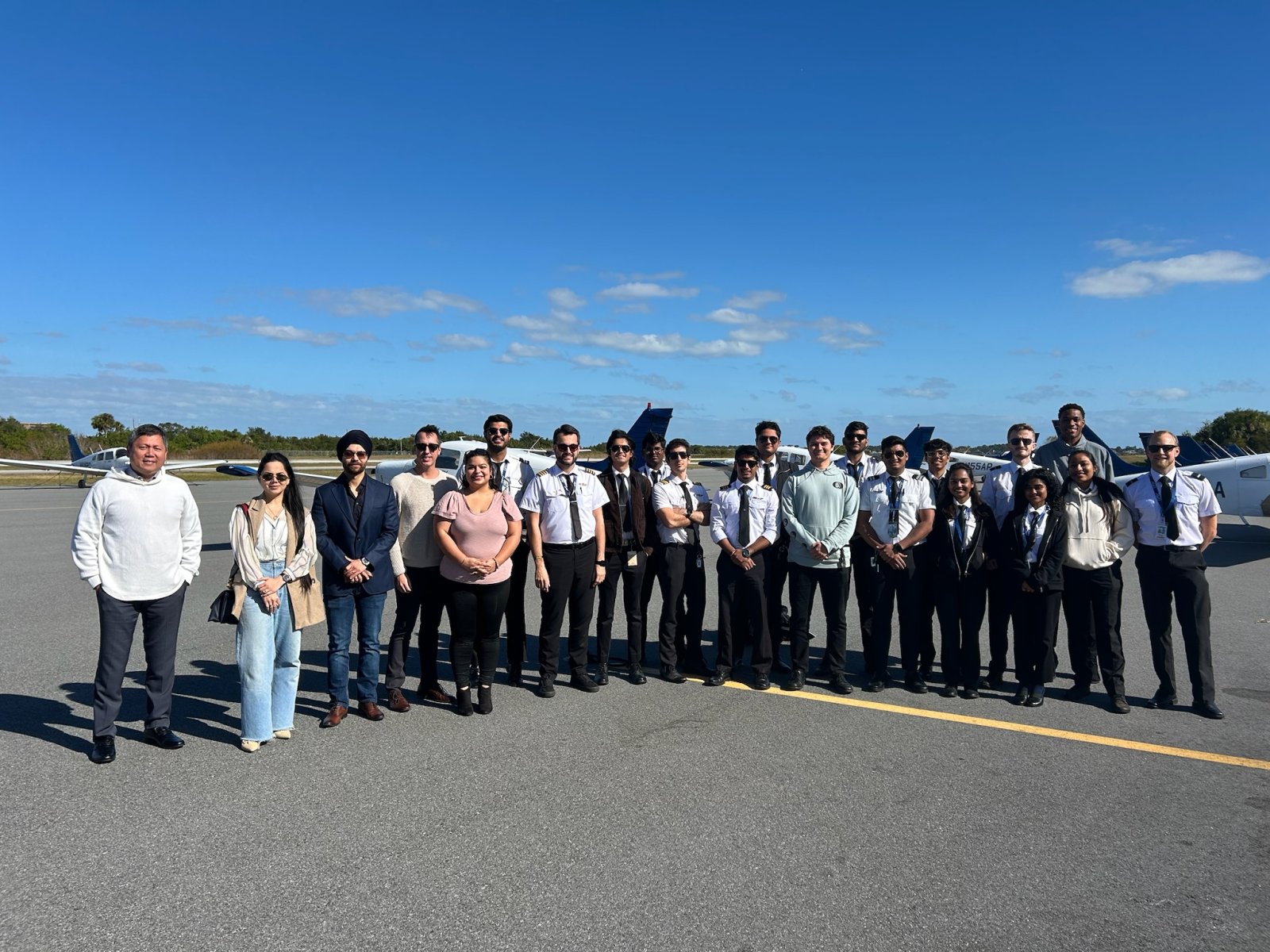
Training in a hub of this scale offers unparalleled networking opportunities. You’ll be surrounded by hundreds of other candidates who share your professional ambitions. Many academies enhance this experience by offering residential options that create a “living-learning” environment. Utilizing on-campus housing benefits allows you to stay fully immersed in your studies, keeping your focus entirely on the cockpit. If you’re ready to experience this environment firsthand, exploring a structured FAA Professional Pilot Program is the next logical step.
The FAA Professional Pilot Program: A Blueprint for Career Success
Transforming from a student to a professional pilot requires a structured, logical progression. It isn’t just about accumulating hours; it’s about mastering specific competencies that meet the highest industry standards. When you enroll in accelerated flight training programs in Florida, you follow a syllabus designed to build your skills in a clear, sequential order.
- Step 1: Private Pilot Certificate (PPL). This foundational stage introduces you to basic flight maneuvers, navigation, and federal aviation regulations. It’s where you develop the core “stick and rudder” skills necessary for every future rating.
- Step 2: Instrument Rating (IR). You’ll learn to fly solely by reference to instruments, which is a critical requirement for all-weather commercial operations. This phase builds the discipline needed for precise flight path management.
- Step 3: Commercial Pilot Certificate (CPL). This certificate elevates your proficiency to professional standards. You’ll master complex aircraft systems and refine your maneuvers to the exact tolerances required for commercial employment.
- Step 4: Multi-Engine Rating (ME). Since most commercial airliners utilize multiple engines, this rating is a non-negotiable step for career-minded pilots. It focuses on the aerodynamics and emergency procedures unique to multi-engine aircraft.
- Step 5: Certified Flight Instructor (CFI). Teaching others is one of the most effective ways to solidify your own knowledge. This role also provides a reliable path to build the flight hours necessary for airline recruitment.
The 2025 Boeing Pilot and Technician Outlook
The 2025 Boeing Pilot and Technician Outlook projects a demand for 660,000 new pilots globally through 2044. This massive requirement highlights why a high-tempo, professional pipeline is so vital for the industry. By choosing a comprehensive FAA Professional Pilot Program, you’re positioning yourself to meet this demand with the right credentials. The career outlook for pilots remains exceptionally strong for those who complete their training at a professional-grade academy.
Fixed-Price Tuition and Financial Transparency
One of the biggest hurdles in aviation is the uncertainty of “pay-as-you-go” models, where costs can spiral due to training delays. Professional academies often utilize a fixed-price model for their primary career programs, which provides a clear budget from day one. This transparency allows you to plan your investment without the fear of hidden fees for fuel surcharges or administrative costs. If you need assistance with the initial investment, there are several financing options available specifically for professional pilot candidates. This financial clarity ensures you can focus entirely on your training rather than worrying about fluctuating hourly rates.
Speed vs. Standards: Navigating the Intensity of Accelerated Learning
A common misconception in aviation is that “fast” equates to “cutting corners.” In reality, accelerated flight training programs in Florida maintain the same rigorous FAA safety standards as any traditional school. The difference lies in the density of the training, not a reduction in requirements. By compressing the timeline, you’re expected to arrive with a high level of discipline and a readiness to engage with complex material from day one.
Success in this environment depends heavily on pre-arrival preparation. Many candidates complete their ground school and written exams before they even step onto the tarmac. This proactive approach allows you to focus your mental energy on flying while utilizing state-of-the-art flight simulators to master procedures. Simulators provide a controlled environment where you can practice emergency scenarios and instrument approaches repeatedly until they become second nature.
Professional academies are experts at managing the high intensity of these schedules. They utilize sophisticated tracking systems to monitor student progress and fatigue, ensuring that safety is never compromised for the sake of the calendar. This methodical approach is why graduates from high-tempo programs often demonstrate higher checkride pass rates than those in unstructured environments.
The Role of the Expert Mentor
In a high-tempo program, your relationship with your instructor shifts from a simple teacher-student dynamic to a mentor-trainee partnership. Dedicated instructors are essential for managing the cognitive load and preventing student burnout. Training at a Part 141 flight school provides a “standardization” advantage, meaning every lesson follows a strictly FAA-approved syllabus. 2FLY Airborne reinforces this by ensuring instructors act as professional mentors who are deeply invested in your long-term career success.
Maintaining Training Quality Under Pressure
Quality assurance is built into the fabric of professional academies through regular “stage checks.” These are internal evaluations conducted by senior instructors to verify that you’ve reached the required proficiency before moving to the next phase. You’ll rely heavily on the Airplane Flying Handbook as your primary technical resource for mastering maneuvers. Airlines frequently prefer graduates from these structured environments because they’ve already proven they can perform under the pressure of a professional training schedule. If you’re ready to commit to this level of excellence, consider starting your journey with the FAA Professional Pilot Program today.
Preparing for Your Journey: Logistics and Professional Support
Starting your aviation career involves more than just mastering the flight controls; it requires navigating a complex administrative landscape. For international students, this means securing either an M-1 or F-1 student visa. The M-1 visa is generally designated for vocational flight training, while the F-1 is for those pursuing academic degrees alongside their flight hours. Academies that specialize in accelerated flight training programs in Florida provide dedicated support for SEVIS registration and visa sponsorship, ensuring your transition to the United States is as smooth as possible.
Once you arrive, the focus shifts to maintaining the momentum of your training. Living on campus eliminates the stress of daily commuting and allows you to remain fully immersed in the aviation environment. This logistical support is a cornerstone of professional academies, providing a stable foundation where you can focus entirely on your studies. You’ll have immediate access to study groups, flight simulators, and your mentors, creating a comprehensive learning ecosystem.
The final phase of your journey is the transition from trainee to industry professional. Elite academies maintain active recruitment offices and global networks to help graduates secure their first officer roles. While the 2025 Boeing Pilot and Technician Outlook projects a demand for 660,000 new pilots globally through 2044, having a direct pipeline to employers gives you a distinct competitive edge. Your training is a long-term investment in a career that spans continents.
International Mobility and Global Standards
Modern aviation is a global industry, and your training should reflect that reality. By training to both FAA and EASA standards, you gain the professional mobility to seek employment with airlines across different regions. This synergy is particularly valuable for students from Europe or Asia who want to leverage the efficiency of Florida’s training infrastructure. Some candidates choose to combine their flight hours with higher education through a degree program with airline pilot training, which can enhance their long-term prospects in airline management.
Your First Step: The Training Advisor Consultation
The path from zero experience to a commercial cockpit is a significant commitment. Before you begin, it’s essential to have a clear, customized roadmap based on your specific career goals. A discovery meeting with a professional training advisor serves as your initial career assessment. During this consultation, you’ll discuss your timeline, financial planning, and any prior experience you might bring to the program. This guidance ensures that you select the right syllabus and enter the academy with a realistic expectation of the demands ahead. Professional guidance is the bridge between your current ambition and your future professional reality.
Take Command of Your Aviation Career
Your journey to the commercial cockpit is a significant professional undertaking that requires more than just passion. By choosing accelerated flight training programs in Florida, you’re leveraging a world-class infrastructure designed for speed, safety, and reliability. You’ve seen how Florida’s consistent climate and the structured immersion of an academy environment provide a linear path from zero experience to airline-ready status.
Success in this high-tempo industry depends on selecting a training partner that offers more than just flight hours. Institutions that provide a fixed-price tuition guarantee, M-1 or F-1 visa sponsorship, and on-campus residential housing provide the stability necessary for technical mastery. These professional-grade resources ensure you can focus entirely on the rigorous demands of safe, structured training.
This emphasis on technical mastery and professional-grade resources is a standard found in other specialized fields as well; for example, you can discover A1 Crane Academy to learn about their intensive certification programs for mobile and service truck crane operators.
If you’re ready to transition from a trainee to a professional pilot, the first step is a simple conversation. We invite you to speak with a 2FLY Airborne Training Advisor today to start your journey and have any remaining questions answered. The airlines are waiting; it’s time to reach your destination.
Frequently Asked Questions
Is accelerated flight training harder than traditional training?
Accelerated training is more demanding than traditional routes because it requires total immersion. You’ll fly and study daily, which builds muscle memory much faster than sporadic lessons. This high-tempo environment mirrors the training cycles you’ll eventually face at a major airline. While the workload is intense, the structured support from expert mentors helps you maintain focus and meet FAA standards without unnecessary delays.
How long does it take to become a commercial pilot in an accelerated program?
Most candidates complete their journey from zero experience to a commercial pilot in six to twelve months. This timeline is possible because accelerated flight training programs in Florida take advantage of consistent weather and a high-density training infrastructure. In contrast, a modular “pay-as-you-go” approach can take several years. This rapid progression allows you to enter the job market sooner and start earning a professional salary.
Can international students enroll in accelerated programs in Florida?
International students are a core part of the aviation community in Florida. Professional academies are equipped to provide M-1 and F-1 visa sponsorship to help you navigate the legal requirements for training in the United States. From SEVIS registration to securing on-campus housing, these organizations provide the logistical support needed for a seamless transition. This global perspective ensures your training meets both FAA and international standards.
Are accelerated flight schools more expensive than modular training?
The total cost of training is often lower at an accelerated school because you finish much faster. By flying frequently, you avoid the “skill fade” that requires extra hours to relearn forgotten maneuvers. Fixed-price tuition models also provide financial transparency, protecting you from the fluctuating costs of fuel and hourly aircraft rentals. This efficiency ensures your budget is spent on actual progress rather than remedial lessons.
Will airlines hire pilots who trained in accelerated programs?
Airlines actively recruit graduates from structured, high-intensity academies. Completing a rigorous program demonstrates that you have the discipline and technical mastery required for a career in a commercial cockpit. It proves you can handle the high-tempo training environments used during airline type-ratings. The 2025 Boeing Pilot and Technician Outlook projects a demand for 660,000 new pilots globally through 2044. This demand makes being “airline-ready” a significant competitive advantage.
What are the prerequisites for the FAA Professional Pilot Program?
To enroll in a professional career track, you generally need to be at least 18 years old and hold a high school diploma. You’ll also need to obtain an FAA First Class Medical Certificate to ensure you meet the physical requirements for a commercial career. For international students, demonstrating English language proficiency is essential for communication with air traffic control. These foundational steps ensure you’re ready for the rigors of the cockpit.
What happens if I need more time to complete a specific rating?
Proficiency is the primary goal, so your progress is monitored through regular internal stage checks. If you need more time to master a specific maneuver or rating, your mentors will adjust your schedule to provide additional instruction. This ensures you’re fully prepared for the FAA checkride. While the schedule is fast-paced, safety and technical mastery are never sacrificed for the sake of the calendar.
Does the fixed-price tuition cover housing and visa fees?
Fixed-price tuition typically covers the flight hours, ground school, and simulator time required for your certificates. However, items like on-campus housing, FAA examiner fees, and visa processing costs are often handled as separate logistical expenses. It’s best to speak with a training advisor to get a full breakdown of your specific career path. This transparency helps you build a realistic budget for your entire professional journey in accelerated flight training programs in Florida.
Article by
2FLY Airborne
2Fly Airborne is a professional flight training organization dedicated to developing the next generation of skilled, confident, and safety-focused pilots. With decades of combined aviation experience, our team of certified instructors provides structured, real-world training designed to prepare students for both checkrides and long-term success in the aviation industry.
Content Disclaimer
Some blog content is generated with the assistance of automated tools and may not always be fully accurate or up to date. Please verify all aviation-related information with official sources or a certified instructor. For additional guidance or clarification, we encourage you to contact one of our training advisors at 2Fly Airborne.