

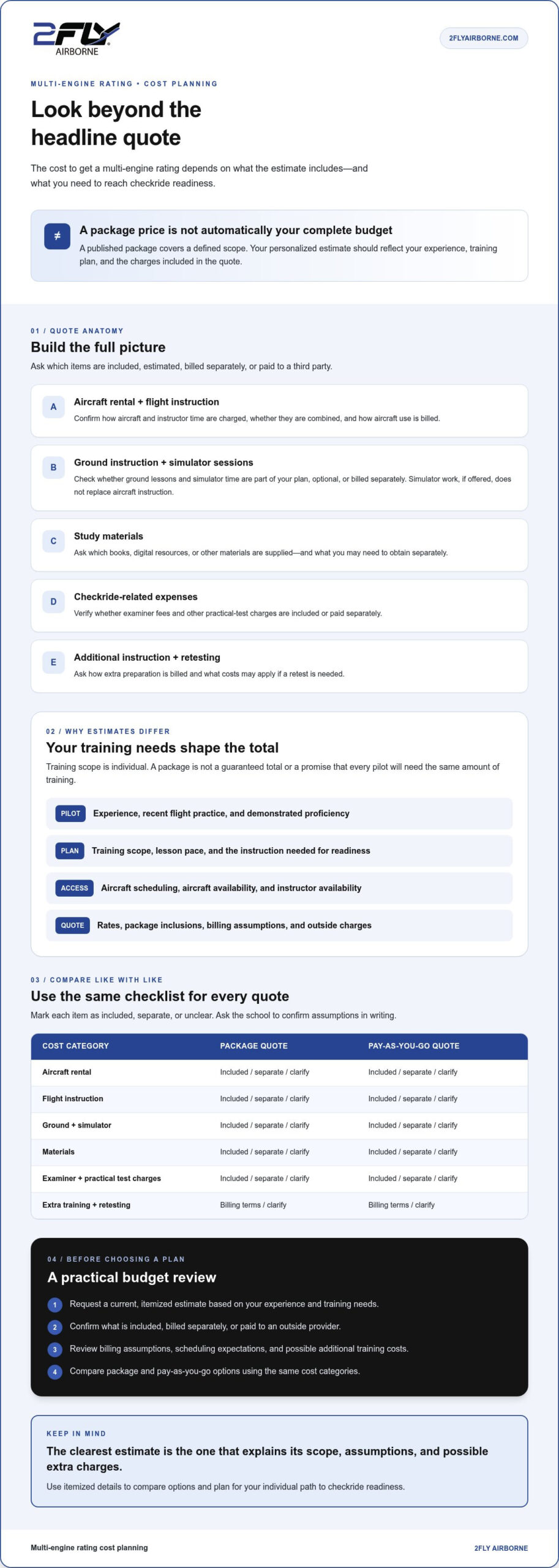
What if the first quote for your multi-engine rating doesn’t reflect what it’ll take to reach checkride readiness? If you’re researching the cost to get multi engine rating faa training, look beyond the headline figure. Aircraft time is only one part of the budget, and quotes may cover different combinations of instruction, study materials, and checkride-related expenses.
It’s reasonable to want a clear total before enrolling. Your final cost can change with your experience, proficiency, schedule, and aircraft availability. A lower initial quote may leave out expenses you’ll need to plan for, while an itemized estimate can make it easier to compare options.
This guide explains the main cost drivers and how to compare package and pay-as-you-go quotes on an equivalent basis. Use it to ask specific questions about aircraft rental, flight and ground instruction, materials, and examiner fees, then build a budget around your training needs.
Key Takeaways
- Estimate the complete path to checkride readiness, not just the initial quote.
- Compare the same categories across schools, including aircraft, instruction, simulator use, materials, and checkride-related expenses.
- When assessing the cost to get multi engine rating faa training, confirm which charges apply to your situation and which fall outside the school’s quote.
- Review billing assumptions, scheduling expectations, and the cost of possible extra training before choosing a package or pay-as-you-go plan.
- Ask for current, itemized details based on your experience and training needs before enrolling.
Cost to Get Multi Engine Rating FAA: What Affects Your Estimate?
The cost to get multi engine rating faa training includes the instruction and other applicable charges involved in becoming ready for the practical test. It is not necessarily the same as a headline package price. A published package describes a particular scope of training; a personalized estimate should reflect your experience, the school’s training plan, and what the quoted price covers.
Costs vary by student and school because aircraft and instructor rates, training inclusions, scheduling, and the proficiency a pilot demonstrates all affect the instruction needed to reach checkride readiness. A multi-engine rating falls within an aircraft class rating, a category of pilot qualification. When budgeting, compare the complete training plans rather than assuming every school’s package covers the same path.
Which charges can make up a multi-engine rating budget?
First, ask whether aircraft rental and instructor time are billed together or separately. Then check which learning and checkride-related expenses are included, estimated, or billed outside the training price. Ask the school to clarify any assumptions in writing.
- Aircraft and instruction: Confirm how aircraft rental and flight instructor time are charged, and whether the quote combines them.
- Ground and simulator training: Ask whether ground instruction and simulator sessions are part of the plan, and how additional sessions are billed.
- Materials and practical test: Verify whether study materials and checkride-related charges, such as the examiner’s fee, are included or paid separately.
- Extra training or retesting: Ask how additional instruction is handled if you need more preparation, and what costs may apply if a retest is needed.
These questions help separate the school’s training charges from expenses paid to a third party. Don’t assume an inclusion applies to every student or estimate. Ask the school to confirm which items apply to your training plan.
Why can two pilots receive different estimates?
Pilots begin with different experience, recent flight practice, and skill levels. These differences can affect how much instruction each person needs to demonstrate proficiency. Training scope is individual, so a published package shouldn’t be treated as a guaranteed total or a promise that every pilot will be ready after the same amount of training.
Practical factors matter, too. Aircraft scheduling, instructor availability, and the pace of your lessons can affect how training progresses and how you organize your budget. Ask for a current estimate based on your background, then confirm its assumptions and which charges could change as training advances. A transparent estimate gives you a stronger basis for comparing schools and planning for checkride readiness.
What Is Included in FAA Multi-Engine Rating Training?
A quote is useful only when you know what each line covers. Aircraft instruction develops practical skills in a multi-engine airplane, while ground preparation supports the knowledge and decision-making needed for training and the practical test. Some schools may also offer simulator sessions. Ask whether simulator use is part of your plan, optional, or billed separately.
The FAA requirements for a multi-engine rating provide regulatory context, but they don’t explain what a particular school includes in its quote. Training aircraft, lesson structure, and availability can differ. Confirm these details with the school rather than assuming a package uses a particular aircraft or includes every training component.
How do aircraft and instructor charges appear in a quote?
Ask how aircraft use is billed, such as by flight time or another stated unit, and whether instructor time is charged separately. Clarify whether instruction includes preflight planning, briefings, and postflight review, or whether those activities have separate billing assumptions. The answers can affect your total, even when two schools describe their training in similar terms.
Confirm which aircraft the school expects to use and whether access depends on scheduling or availability. This helps you understand the training plan without assuming a particular fleet type or that an aircraft will be available on your preferred schedule.
Are simulator time, materials, and checkride expenses included?
Simulator work, if offered, may support practice of procedures, but it does not take the place of aircraft instruction. Ask whether simulator sessions are planned for your training, optional, and included in the quoted amount. Check which books, digital resources, or other study materials are supplied and whether you’ll need to obtain anything separately.
Separate school-provided training from expenses charged by outside providers. Ask which checkride-related costs may apply, who sets or collects each charge, and how additional instruction or a retest would be billed. Applicability can vary, so request a written breakdown rather than treating every possible expense as automatic.
- Inclusions: List aircraft, instructor, ground, simulator, and study materials.
- Billing terms: Confirm the unit used for each charge and whether briefing time is included.
- Exclusions: Identify third-party, checkride-related, additional-training, or retest expenses.
- Changes: Ask how the estimate may change if your training needs or schedule differ.
Request the inclusions, exclusions, billing units, and additional-training terms in writing. An itemized estimate makes it easier to compare the cost to get multi engine rating faa training across schools and understand what your budget covers. If you’re considering the rating as part of a broader career plan, explore how it may fit your intended path and ask a 2FLY Training Advisor for current details about its Multi-Engine Rating.
How to Compare Multi-Engine Rating Quotes Without Missing Costs
Start a quote comparison by matching inclusions and exclusions, then checking the billing assumptions behind each line. Two estimates that look similar may cover different amounts of aircraft time, instructor support, or checkride-related expenses. Compare the scope before judging the total.
Use the same categories for every school. Mark each item as included, billed separately, or not specified, then ask for clarification where needed.
| Category | What to compare |
|---|---|
| Aircraft | Aircraft used, billing unit, and what happens if scheduling affects access. |
| Instructor | Whether instructor time is separate and which briefings or ground sessions are covered. |
| Simulator | Whether simulator use is planned, optional, included, or charged separately. |
| Materials | Which books, digital resources, or other study materials are provided. |
| Checkride-related items | Which expenses may apply, who sets or collects them, and whether they’re included. |
If you’re pursuing a rating as part of a broader Airline Transport Pilot certificate path, applicable training requirements may differ from those for a standalone add-on. Review the specific scope of 14 CFR § 61.156 with an appropriate training professional. Don’t assume it applies to every multi-engine rating quote.
Package or pay-as-you-go: which model fits your situation?
A package can make the planned training scope easier to see upfront. Hourly billing may suit a pilot whose training needs are less predictable. Neither model is automatically less expensive; the total depends on the package terms and the instruction you need.
Ask what happens if you don’t use all included training or need instruction beyond the package. For hourly quotes, confirm the rates and billing increments. Compare cancellation, rescheduling, and payment terms after each school confirms them.
What questions reveal a quote’s assumptions?
Ask what experience level and training plan the estimate assumes. Then clarify the rates, billing units, conditions that could add charges, and the school’s confirmed cancellation and scheduling policies.
- Which items are included, excluded, or estimated rather than fixed?
- What could change the estimate as training progresses?
- How are additional lessons and unused package components handled?
- Which terms apply to scheduling, cancellations, and payment?
These details give you a fair basis for comparing the cost to get multi engine rating faa training without mistaking a headline price for the full budget. Ask each school to explain its assumptions in writing. A 2FLY Training Advisor can provide current details about 2FLY’s Multi-Engine Rating and help you identify what to verify in an estimate.
How to Budget for the Rating and Manage Training Expenses
A practical budget should account for more than the expected lesson schedule. Your proficiency, access to the aircraft, instructor availability, and ability to maintain a consistent training cadence can all affect how your plan unfolds. Additional instruction supports the skills needed for safe, confident performance. It isn’t a failure or an expense to avoid at the cost of readiness.
How can you plan a realistic training budget?
Use this process to turn school estimates into a personal plan:
- Obtain itemized quotes. Request written estimates from the schools you’re considering, with each training component listed separately.
- Verify the assumptions. Confirm what’s included, excluded, billed separately, and how charges are calculated. Ask what experience and training needs the estimate assumes.
- Compare the terms. Review package or hourly billing, scheduling expectations, payment terms, and the school’s confirmed policies for cancellations or additional instruction.
- Plan a contingency. Ask what could cause your estimate to change and set aside a reserve based on the school’s guidance, not an assumed industry-wide percentage.
Next, map training against your work commitments, study time, aircraft access, and instructor availability. A schedule that leaves time to prepare and maintain continuity may be more useful than one built around an idealized timeline. Revisit your budget if your proficiency, availability, or training needs change, and confirm revised assumptions with the school.
Keep the goal in view: training should progress at a pace that supports proficiency and safety. Budgeting for possible additional instruction helps you make decisions based on readiness rather than pressure to finish within an arbitrary cost or schedule.
Can financing help with rating-related expenses?
Financing may be worth exploring, but availability, eligibility, terms, and the ratings covered depend on the provider. Before committing, review repayment obligations and ask the provider whether the specific multi-engine training you’re planning is eligible. Don’t assume a financing option applies to every rating or covers every item in a school estimate.
For broader planning, review 2FLY financing information, then confirm current details and applicability before making a decision. You can also ask a 2FLY Training Advisor questions about planning around your training needs and the Multi-Engine Rating.
Choosing a Multi-Engine Training Path and Getting a 2FLY Estimate
The right training path should fit your experience, goals, schedule, and learning needs. Consider those factors alongside quote transparency and instructional fit. For the cost to get multi engine rating faa training, a useful estimate reflects your background and clearly explains what it includes, rather than relying on a headline package price.
2FLY offers a Multi-Engine Rating, but current pricing, aircraft, training scope, and inclusions should be confirmed directly. Ask for a written estimate based on your situation and review its assumptions before making a commitment. No estimate can guarantee your final cost or the time you’ll need to reach checkride readiness.
What should you bring to a training-advisor conversation?
Be ready to discuss your training history. Have your certificates and ratings, logbook totals, and recent flight experience available, along with questions that will help you understand the proposed plan.
- Which aircraft and instructor charges are included, and how are they billed?
- Is simulator use planned, and are study materials included?
- Which checkride-related expenses may apply?
- How would additional training affect the estimate?
- What experience and scheduling assumptions does the estimate use?
Request current written terms, including confirmed inclusions and exclusions, before enrolling. A clear conversation helps you assess whether the training structure suits your needs and supports a safe, proficiency-focused path.
How does the rating fit a broader pilot career plan?
A multi-engine rating may be one step in a wider professional training progression. Its place in your plan depends on your existing qualifications and career goals. The rating alone doesn’t guarantee employment, airline eligibility, or a particular career outcome.
If you’re considering broader professional training, review 2FLY’s FAA Airline Pilot Program details and confirm how the available training options align with your plans. Choose based on a transparent estimate, a realistic schedule, and instruction that prioritizes proficiency over rushing to completion.
Key takeaway: Compare complete, current estimates and understand their assumptions before committing. Safe, structured training should guide both your budget and your decision. A 2FLY Training Advisor can answer questions about your experience, the Multi-Engine Rating, and the details to confirm in an estimate.
Plan Your Next Step With Confidence
The cost to get multi engine rating faa training depends on the full path to checkride readiness, not just a package headline. Compare itemized quotes using the same categories, confirm what’s included or billed separately, and ask which assumptions could change your estimate.
Build a budget around your experience, schedule, and training needs. Allow room for additional instruction when it supports proficiency and safe decision-making. A clear estimate and structured training plan help you make an informed choice without relying on a guaranteed cost or timeline.
2FLY Airborne offers a Multi-Engine Rating alongside broader training options, including Private, Instrument, Commercial, CFI, and MEI training. To discuss your goals and clarify current program details, speak with a 2FLY Training Advisor about your multi-engine training plan.
Approach the rating with a practical budget and a commitment to safe, thorough preparation. Each well-planned step moves you closer to your aviation goals.
Frequently Asked Questions
How much does it cost to get an FAA multi-engine rating?
There isn’t one fixed total for the cost to get multi engine rating faa training. Your estimate depends on the school’s rates and inclusions, the training aircraft, your experience, and the instruction you need to reach checkride readiness. Compare itemized estimates rather than headline prices. 2FLY Airborne offers a Multi-Engine Rating, but confirm its current standalone price and specific inclusions directly with a Training Advisor.
What is usually included in a multi-engine rating package?
A package may include aircraft instruction and instructor time, but the scope differs by school. Ground preparation, simulator sessions, study materials, and checkride-related expenses may be included, separate, or outside the package. Ask for a written breakdown identifying what’s covered, how each item is billed, and what could cost extra. Confirm whether additional instruction or a retest would involve further charges.
Is a package cheaper than paying by the hour for multi-engine training?
Not necessarily. A package may make the planned scope clearer, while hourly billing charges for the training you use under the school’s terms. The better fit depends on your proficiency, training needs, and the package’s rules for unused instruction or extra lessons. Compare the same items across both options, including aircraft, instructor, simulator, materials, and checkride-related expenses, before deciding which estimate suits your budget.
How many flight hours do I need for an FAA multi-engine rating?
For a multi-engine add-on rating, FAA rules don’t set a minimum number of flight hours, but you must meet applicable requirements and demonstrate proficiency. The hours needed can vary with your prior experience and progress. A school may also set its own training or aircraft-use conditions. Ask for a current estimate based on your background, and confirm applicable requirements with a qualified training professional.
Can I add a multi-engine rating to my existing pilot certificate?
Generally, a multi-engine class rating is added to an existing pilot certificate, subject to applicable eligibility and practical-test requirements. The training and evaluation path can depend on your certificate and the privileges you’re pursuing, so confirm the details for your situation before enrolling. A multi-engine rating may be part of a broader training plan, but it doesn’t by itself guarantee a career outcome.
What should I ask a flight school before enrolling in multi-engine training?
Request a written, itemized estimate and ask which aircraft and instructor charges are included, how time is billed, and whether ground instruction, simulator use, or materials are covered. Clarify checkride-related expenses, additional-training terms, scheduling assumptions, and cancellation or payment policies. Share your certificates, ratings, logbook totals, and recent experience so the school can explain the estimate’s assumptions. Contact a 2FLY Training Advisor with questions about its Multi-Engine Rating.
Article by
2FLY Airborne
2Fly Airborne is a professional flight training organization dedicated to developing the next generation of skilled, confident, and safety-focused pilots. With decades of combined aviation experience, our team of certified instructors provides structured, real-world training designed to prepare students for both checkrides and long-term success in the aviation industry.
Content Disclaimer
Some blog content is generated with the assistance of automated tools and may not always be fully accurate or up to date. Please verify all aviation-related information with official sources or a certified instructor. For additional guidance or clarification, we encourage you to contact one of our training advisors at 2Fly Airborne.