
How fast can you realistically master asymmetric thrust and complex twin-engine systems without compromising safety? For many pilots, pursuing an accelerated multi engine rating add on feels like drinking from a firehose, particularly when balancing tight timelines with demanding emergency procedures. You already understand standard aerodynamics, but managing single-engine service ceilings and critical engine failures requires absolute precision from day one.
The pressure to absorb vast technical knowledge while keeping pace with a compressed syllabus can be intimidating. High standards and tight flight schedules shouldn’t leave you second-guessing your readiness for the practical test. With deliberate preparation, focused instructor mentorship, and a structured syllabus, you can turn an intense training footprint into a definitive career milestone.
In this guide, you will master the essential prerequisites, flight syllabus milestones, and checkride maneuvers required to earn your multi-engine privileges efficiently. We walk you through every critical phase, from eligibility documentation and ground knowledge to the exact Airman Certification Standards tolerances you must demonstrate to pass on your first attempt.
Key Takeaways
- Master the physics of asymmetric thrust and critical engine factors to maintain positive control during simulated emergencies.
- Audit your pilot certificates, flight currency, and medical documentation beforehand to ensure smooth enrollment without administrative delays.
- Learn how a structured daily syllabus lets you complete an accelerated multi engine rating add on across focused, consecutive training days.
- Gain practical insight into aircraft systems, propeller feathering, and the exact FAA Airman Certification Standards required on checkride day.
- Discover how quality simulator prep, fleet reliability, and dedicated instructor mentorship lay the foundation for long-term commercial airline careers.
Understanding the Multi-Engine Rating Add-On: Core Aerodynamics and Purpose
An FAA multi-engine add-on expands your flight privileges by qualifying you to command aircraft with more than one engine. Because you already hold an active single-engine pilot certificate, the FAA does not require a separate written knowledge exam. Your syllabus concentrates entirely on aircraft systems, ground aerodynamics, and flight proficiency.
Stepping into a twin-engine cockpit is an essential bridge toward commercial operations. Major carriers and corporate flight departments require multi-engine command experience to ensure pilots can handle high-workload scenarios. Enrolling in an accelerated multi engine rating add on equips you with the asymmetric flight discipline required for these advanced flight decks.
To see how an intensive multi-engine course translates into practical checkride success, watch this walkthrough:
The Mechanics of Asymmetric Thrust and Zero Sideslip
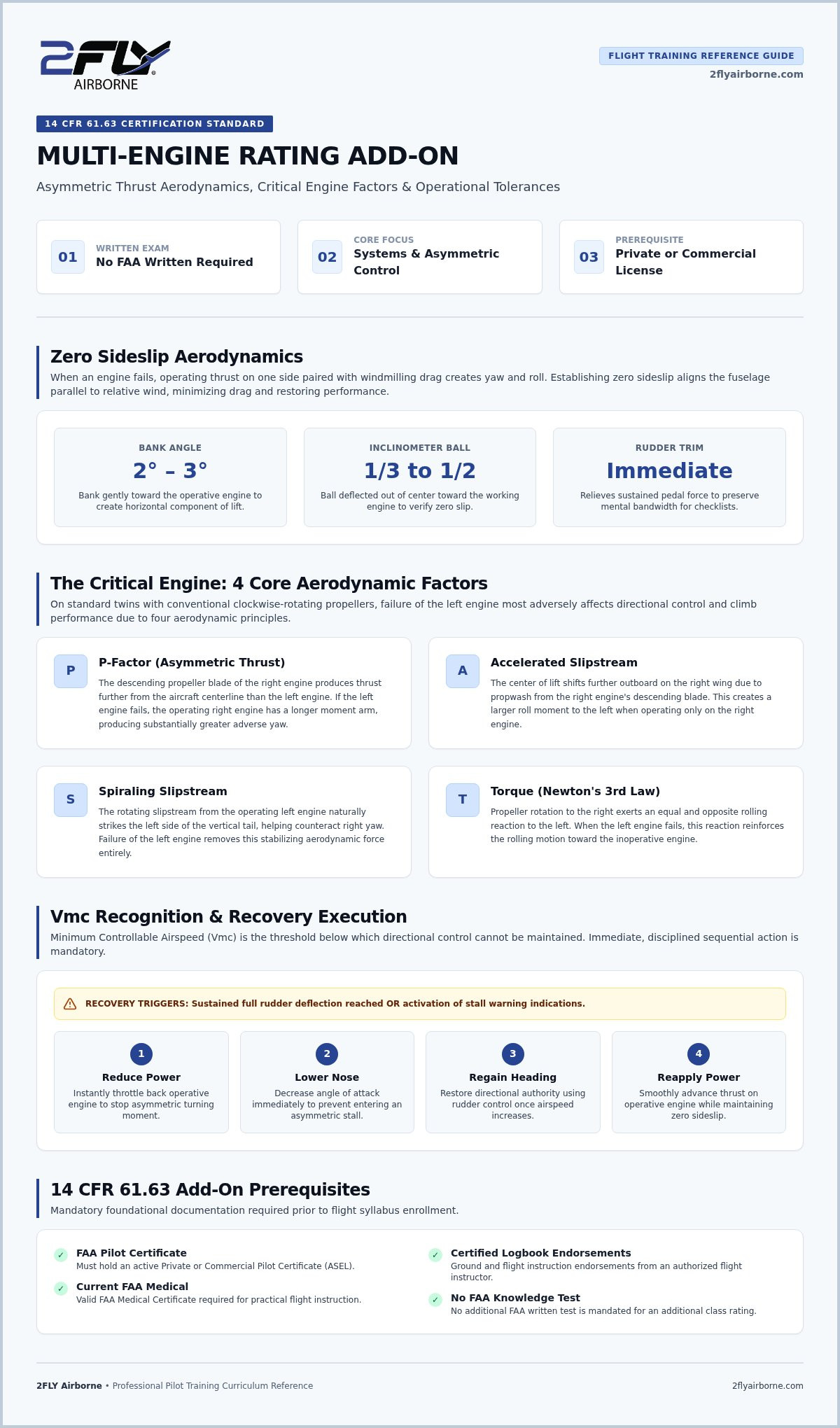
Twin-engine flight introduces dynamic forces you rarely manage in single-engine aircraft. When an engine fails, operating thrust on one side paired with windmilling drag on the other creates severe yawing and rolling moments toward the dead engine. Left uncorrected, this drag profile severely degrades climb performance and directional control.
Establishing a zero sideslip condition aligns the aircraft fuselage parallel with the relative wind to minimize drag. You achieve this by establishing a two-to-three-degree bank toward the operative engine and deflecting the inclinometer ball half to one-third out of center toward the working engine. Trimming the rudder immediately relieves heavy pedal loads, freeing your mental bandwidth for navigation and emergency checklists.
Understanding Vmc and the Critical Engine
Minimum controllable airspeed (Vmc) is the calibrated airspeed below which directional control cannot be sustained if the critical engine fails. The critical engine is the engine whose failure most adversely impacts aircraft control and climb capabilities. On standard aircraft where both propellers rotate clockwise, the left engine is critical due to four aerodynamic principles:
- P-Factor: The descending blade of the right engine produces a thrust vector farther from the aircraft centerline, creating a longer moment arm and greater yaw if the left engine fails.
- Accelerated Slipstream: Lift forms further outboard on the right wing, generating a heavier roll moment when operating on the right engine alone.
- Spiraling Slipstream: The left engine’s slipstream impacts the vertical fin to counter yaw, a beneficial force lost when the left engine ceases operating.
- Torque: The propeller rotation exerts an equal and opposite roll reaction to the left, accelerating roll when the left engine fails.
Recognizing the onset of Vmc is vital during slow flight and single-engine operations. If the rudder reaches its travel limit or stall warning horns activate, you must immediately reduce power on the operative engine, lower the nose to reduce angle of attack, and recover directional authority before reapplying thrust.
Accelerated Multi-Engine Prerequisites: What You Need Before Day One
Arriving prepared transforms an intensive flight course from an overwhelming trial into an efficient success. Before climbing into the cockpit for an accelerated multi engine rating add on, your administrative and aeronautical foundations must be in place. Under 14 CFR 61.63, an applicant seeking an additional aircraft class rating must hold at least a valid Private or Commercial Pilot Certificate and receive the required ground and flight training endorsements.
You must also hold an active FAA medical certificate aligned with your long-term aviation goals, alongside unexpired proof of citizenship such as a U.S. passport or birth certificate. Reviewing your specific multi-engine aircraft operating handbook, performance charts, and emergency checklists before your first day is vital. Committing critical memory items to memory beforehand frees your mental bandwidth for hands-on flying.
Private vs. Commercial Multi-Engine Add-On Standards
Your existing certificate level determines both the scope of your operating privileges and the standards of your checkride. If you add multi-engine privileges to a Private Pilot Certificate, you are restricted to private operations without compensation. Completing the add-on at the commercial level qualifies you for paid operations in multi-engine aircraft.
Commercial candidates must demonstrate tighter tolerances under the FAA Airman Certification Standards. You will maintain stricter altitude, heading, and airspeed margins throughout engine failure simulations and maneuvering. Earning commercial multi-engine privileges is a pivotal step for aviators advancing through the structured FAA Professional Pilot Program toward airline cockpits.
Instrument Rating Considerations for Multi-Engine Pilots
Instrument privileges do not automatically carry over to multi-engine aircraft without practical evaluation. If you already hold an instrument rating on your single-engine certificate, you must demonstrate instrument proficiency in the twin to fly multi-engine aircraft under IFR. Failing to include instrument tasks on the checkride results in a multi-engine certificate restricted to VFR only.
During the practical test, the examiner will evaluate your ability to navigate holding patterns and execute single-engine instrument approaches down to minimums. Entering an accelerated multi engine rating add on with a proficient instrument scan prevents task saturation during high-workload scenarios. Arriving with sharp basic instrument skills ensures you can focus entirely on twin-engine procedural workflows.
The Accelerated Training Timeline: Daily Flight and Ground Breakdown
Completing an accelerated multi engine rating add on requires total commitment. Most intensive programs structure their syllabus across three to five consecutive days of full-time training. Under 14 CFR Part 61, the FAA mandates no minimum flight hours for class add-ons, meaning your progression depends entirely on demonstrating proficiency. Most pilots require 10 to 15 hours of flight instruction, though advanced preparation can reduce this timeline.
Daily routines pair rigorous ground instruction with dual flight sorties. High-fidelity flight training devices play a vital role, giving you a controlled environment to practice emergency flows, feathered glides, and electrical failures before turning fuel into noise. Each morning begins with precise weight-and-balance computations, single-engine climb gradient calculations, and thorough preflight walkarounds.
Days One and Two: Ground Theory and Basic Airwork
The opening two days establish your baseline knowledge of complex twin-engine systems. Ground sessions break down fuel crossfeed systems, counter-rotating versus conventional propellers, constant-speed feathering governors, and split electrical buses. You will inspect landing gear hydraulic schematics and practice auxiliary gear extension protocols.
In the air, you adapt to faster approach speeds and greater control pressures. Training blocks introduce standard flight maneuvers tailored to a multi-engine airframe:
- Steep turns at 50 degrees of bank while managing twin power responses.
- Slow flight configured clean and with gear and flaps extended.
- Power-off and power-on stall recoveries with zero heading change.
- Traffic patterns, short-field departures, and stabilized single-engine landing approaches.
Days Three and Four: Emergency Maneuvers and Engine Failures
The midpoint of the course shifts focus directly to critical asymmetrical conditions. Your instructor introduces simulated engine failures at distinct flight phases. You will practice rejecting takeoffs before lift-off and securing failed powerplants during initial climb at safe altitudes.
Flight blocks emphasize intentional in-flight engine shutdowns, propeller feathering demonstrations, and air restart drills. You will master the memory flow: mixture, props, throttles full forward; flaps and gear up; identify dead foot; verify by retarding the throttle; and feather. Training then transitions to single-engine instrument approaches down to minimums, missed approach climbs, and single-engine go-arounds.
Day Five: Mock Checkrides and Stage Evaluations
The final phase tests your readiness across every practical parameter. You begin with a rigorous oral evaluation probing airworthiness requirements, performance charts, and Vmc factors. Your instructor verifies that your IACRA application and logbook endorsements are complete.
A comprehensive stage check mirrors the exact practical test profile. You will fly the maneuvers within practical test limits, execute emergency diversions, and complete partial-panel engine-out approaches. Once you demonstrate repeatable, confident mastery, your instructor issues the official endorsement for your FAA checkride.
Checkride Preparation: Mastering Engine-Out Maneuvers and ACS Standards
The practical test is the culmination of your accelerated multi engine rating add on. Administered by an FAA Designated Pilot Examiner (DPE), this combined evaluation tests your command authority, systems mastery, and emergency flight management. Success requires calm, disciplined procedural execution rather than rushed reactions when an engine fails.
Checkride day divides into an extensive ground oral examination followed by a flight assessment. You must demonstrate that safety and systematic risk management guide every decision you make in the cockpit. Preparation turns high-pressure scenarios into routine operating behaviors.
Oral Examination Focus Areas
The ground evaluation probes your deep understanding of aircraft systems and multi-engine aerodynamics. Examiners expect you to accurately trace fuel schematics, crossfeed valve operation, electrical bus distribution, and landing gear emergency free-fall mechanisms. A superficial answer will not suffice; you must explain how each system behaves when components fail.
You will also compute performance profiles using actual atmospheric conditions and gross weights. Be ready to calculate single-engine absolute and service ceilings alongside expected climb gradients. You must articulate how density altitude, center of gravity, and bank angle directly shift Vmc, illustrating why an improper bank away from the working engine rapidly degrades control authority.
In-Flight Practical Test Tolerances
Once airborne, you must fly within strict parameters defined by the FAA Airman Certification Standards (ACS). For commercial add-on candidates, the ACS demands consistent precision throughout normal maneuvers and sudden asymmetric emergencies:
- Maintain altitude within 100 feet and heading within 10 degrees during steep turns and basic airwork.
- Hold single-engine best rate of climb airspeed (Vyse) within +10/-5 knots following a simulated powerplant loss.
- Recognize impending Vmc decay immediately and initiate a prompt recovery before reaching full rudder deflection or stall onset.
- Fly a single-engine precision or non-precision instrument approach down to decision height, staying within one dot deflection on the localizer and glidepath.
Smooth memory item flows and steady hand-flying ensure you pass on your first attempt. If you want to prepare for this intensive practical test within an airline-standard training environment, enroll in the FAA First Officer Program to develop professional twin-engine competence.
Career Impact and Next Steps: Selecting the Right Professional Academy
Earning your multi-engine rating transforms your career trajectory, shifting your perspective from single-engine operations to complex multi-crew flight decks. Regional airlines, corporate flight departments, and cargo operators expect candidates who handle asymmetric thrust instinctively. Industry demand reinforces the career value of this qualification; The 2025 Boeing Pilot and Technician Outlook projects a demand for 660,000 new pilots globally through 2044.
Choosing the right flight academy determines whether your accelerated multi engine rating add on proceeds without interruption. Your training environment should reflect the operational discipline and safety culture of the airline industry.
Criteria for Choosing an Accelerated Flight School
A compressed syllabus leaves no margin for maintenance downtime. Prioritize academies operating an active fleet of identical twin aircraft rather than providers relying on a single twin-engine airframe. Having redundant aircraft on the flight line ensures that unexpected squawks won’t derail your training timeline.
You should also evaluate examiner scheduling and simulator integration. Premium flight academies maintain dedicated access to Designated Pilot Examiners, avoiding weeks of post-training testing delays. Reliable training providers maintain complete transparency regarding syllabus structures and syllabus pacing without making misleading guarantees about completion timelines.
Building Multi-Engine Time Toward Commercial Milestones
Passing your practical checkride is a major milestone, but your long-term focus must shift toward hour requirements. Under FAA regulations, qualifying for an Airline Transport Pilot (ATP) certificate requires at least 50 hours of multi-engine flight time. Completing your Multi-Engine Instructor (MEI) rating right after your add-on lets you build those multi-engine hours while training the next generation of aviators.
Instructing deepens your grasp of complex systems and sharpens your decision-making under asymmetric conditions. Aligning your accelerated multi engine rating add on with comprehensive commercial training pathways positions you for direct entry into airline cadet and first officer recruitment pipelines. Connecting with an experienced flight training advisor is the best way to evaluate prerequisites, confirm scheduling, and structure your next career phase.
Take Command of Your Professional Twin-Engine Career
Mastering asymmetric aerodynamics, staying ahead of critical engine procedures, and executing disciplined memory items are the hallmarks of an exceptional aviator. Completing an accelerated multi engine rating add on demands focused dedication, but structured training transforms complex emergency procedures into instinctive cockpit habits. Combining comprehensive ground briefings with modern twin-engine aircraft and advanced flight simulators ensures you meet strict FAA standards with complete confidence.
Your transition to high-performance cockpits begins with professional instructor mentorship and a proven flight training syllabus designed for aspiring commercial pilots. When you train with precision and purpose, the path toward regional carriers and corporate flight departments becomes clear. Speak with a 2FLY Airborne Training Advisor to verify your qualifications, plan your training schedule, and take the definitive next step in your aviation journey.
Frequently Asked Questions
How long does an accelerated multi-engine rating add-on take to complete?
An accelerated multi engine rating add on typically takes between three and five consecutive days of full-time training. Weather, pilot preparation, and examiner availability can influence the final timeline. Dedicating full days to alternating ground briefings with dual flight sessions ensures you retain complex systems knowledge and build muscle memory rapidly.
Do I need to take an FAA written knowledge test for a multi-engine add-on?
No separate FAA written exam is required if you already hold an active single-engine rating on your certificate. Because you have already demonstrated foundational aeronautical knowledge, your evaluation focuses entirely on multi-engine aerodynamics, aircraft systems, and operational procedures during an oral test and practical flight checkride with an examiner.
Can I add multi-engine privileges to both private and commercial certificates?
Yes, you can add multi-engine privileges to either a Private or Commercial Pilot Certificate. If added to a private certificate, your twin-engine operations remain restricted to private carriage without compensation. Adding the rating to a commercial certificate requires flying to tighter practical test tolerances, which qualifies you to operate multi-engine aircraft professionally for hire.
What happens if an engine fails during the multi-engine flight test?
During the practical test, the examiner simulates powerplant failures at various flight phases, such as the takeoff roll or cruise altitude. You must immediately maintain directional control using rudder, establish zero sideslip, configure the aircraft for optimal climb or glide performance, identify the failed engine, and execute published memory items and checklists accurately.
Is an instrument rating required before earning a multi-engine rating?
An instrument rating is not legally required as a prerequisite, but completing it first is highly advantageous. If you hold an instrument rating on your single-engine certificate and demonstrate single-engine instrument approaches during your checkride, your multi-engine privileges will include instrument flight. Without an instrument rating, your multi-engine privileges are restricted strictly to VFR conditions.
What makes multi-engine aircraft systems more complex than single-engine planes?
Multi-engine aircraft feature redundant, interconnected systems that require precise management during abnormal operations. You manage dual constant-speed propellers equipped with full-feathering governors, complex fuel distribution systems with crossfeed capabilities, and multi-bus electrical architectures. Landing gear systems often utilize hydraulic actuators backed by emergency gravity free-fall mechanisms, demanding thorough systems knowledge.
How many flight hours are typically needed for an accelerated add-on course?
Most candidates log between 10 and 15 flight hours to achieve practical test proficiency for an accelerated multi engine rating add on. The FAA sets no mandatory minimum flight hour requirement for class add-ons under 14 CFR Part 61. Pilots who thoroughly study aircraft operating limitations, checklists, and performance profiles in advance frequently complete the course closer to the lower end of that range.
Article by
2FLY Airborne
2Fly Airborne is a professional flight training organization dedicated to developing the next generation of skilled, confident, and safety-focused pilots. With decades of combined aviation experience, our team of certified instructors provides structured, real-world training designed to prepare students for both checkrides and long-term success in the aviation industry.
Content Disclaimer
Some blog content is generated with the assistance of automated tools and may not always be fully accurate or up to date. Please verify all aviation-related information with official sources or a certified instructor. For additional guidance or clarification, we encourage you to contact one of our training advisors at 2Fly Airborne.