

What if the examiner’s question isn’t testing whether you can recite a regulation, but whether you can use it to make a sound decision? That’s the challenge at the heart of the commercial pilot oral exam. If you’re unsure which subjects may come up, or worry about freezing when a scenario takes an unexpected turn, a commercial pilot oral exam preparation guide can help you focus on understanding, not memorization alone.
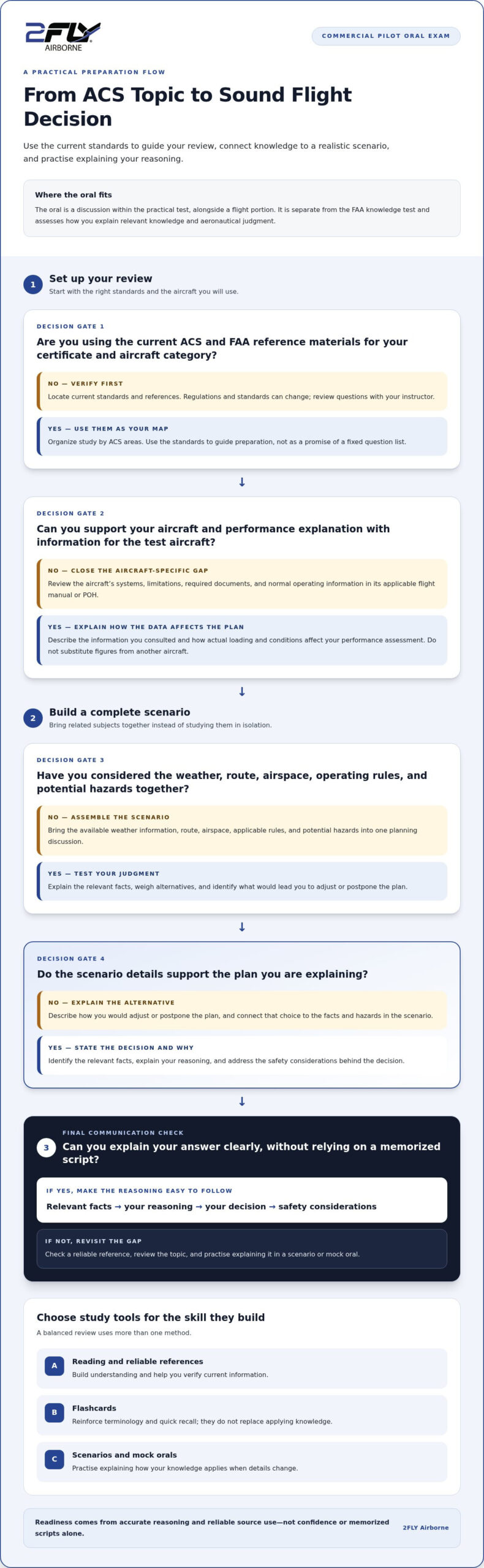
The oral exam is part of the practical test, and preparing for it means more than reviewing isolated facts. You need to explain how regulations, aircraft knowledge, performance planning, and risk management apply to real flight decisions. This guide shows how to use the ACS to organize a practical study routine, practise clear answers, and identify knowledge gaps before checkride day. A structured approach helps you build confidence while keeping sound judgment and safety at the center of your preparation.
Key Takeaways
- Use the current applicable FAA Airman Certification Standards to guide your review, rather than relying on a fixed list of expected questions.
- Connect regulations, aircraft systems, performance, weather, and flight planning to practical decisions you may need to explain.
- Use flashcards to reinforce terminology, then practise applying your knowledge to scenarios and mock oral questions.
- This commercial pilot oral exam preparation guide outlines a flexible study sequence, from identifying knowledge gaps to giving clear, consistent explanations.
- Readiness comes from accurate reasoning and reliable source use, not confidence or memorized scripts alone.
What the Commercial Pilot Oral Exam Assesses, and How It Fits the Checkride
You’ve studied the material and can recall a regulation, aircraft limitation, or planning principle. Then the examiner asks how it applies to a specific situation, and your explanation stalls. The commercial oral exam tests more than recall: it gives the examiner an opportunity to assess relevant knowledge and aeronautical judgment through your explanations and decisions.
Distinguish the FAA knowledge test from the oral portion of the practical test. The knowledge test is a separate written exam; the oral is a discussion within the practical test, which also includes a flight portion. These assessments are connected: what you explain about planning, aircraft operation, and judgment supports the decisions you demonstrate in flight.
For a practical look at checkride preparation, watch this video:
What happens during a commercial pilot oral exam?
The examiner leads a discussion, asking questions and following up on your answers. A conversation might connect a regulation to the aircraft you’ll fly, the weather for a planned trip, or whether conditions support a safe operation.
For example, reading performance information matters when you can explain how it affects a real planning decision. A strong response identifies relevant facts, describes your reasoning, and addresses safety considerations instead of relying on a memorized script. This commercial pilot oral exam preparation guide is educational, not official FAA guidance or a guaranteed set of questions.
What standards guide the commercial pilot practical test?
The FAA’s Airman Certification Standards (ACS) provide a framework for the knowledge and skills assessed during a practical test. They connect what an applicant needs to know with risk management and practical performance. The ACS followed the older Practical Test Standards (PTS); use current FAA materials, rather than a historical overview, to guide your preparation.
Before studying, locate the current standards that apply to your certificate and aircraft category, along with relevant FAA reference materials. Regulations and standards can change, so check for current versions and review questions with your instructor. The goal is not to predict every question. It is to build knowledge you can explain clearly and apply consistently on the ground and in the air.
Commercial Pilot Oral Exam Topics: Connect the ACS to Real Decisions
There isn’t a reliable universal list of oral-exam questions. Use the current FAA Airman Certification Standards (ACS) for your practical test to organize your review, then connect each knowledge area to decisions you might make in flight operations. For historical context on the development of the Commercial Pilot ACS, see AOPA’s coverage of the Commercial Pilot ACS.
Build your topic map around areas such as:
- Regulations: Identify the rules relevant to a proposed operation and explain how they affect your choices.
- Aircraft systems and limitations: Understand how the aircraft’s systems operate and what its approved information says about use.
- Performance: Use aircraft-specific data to assess how loading and conditions affect a plan.
- Weather and flight planning: Bring weather information, route, airspace, and operating rules together.
- Risk management: Recognize hazards, weigh alternatives, and account for your own limitations.
How should applicants study aircraft and performance knowledge?
Study the aircraft you’ll use for the test, not just general descriptions of similar models. Review its systems, limitations, required documents, and normal operating information in the applicable aircraft flight manual or pilot operating handbook (POH).
Then practise explaining a performance decision. Describe how you would use the aircraft’s information to evaluate a planned departure with the actual loading and conditions. State what data you consulted, which limitations matter, and how the results affect your plan. Don’t substitute figures remembered from another aircraft for information that applies to yours.
How do weather, regulations, and planning meet in scenarios?
Work through a complete planning scenario instead of studying each subject in isolation. Consider available weather information, route, airspace, applicable operating rules, and potential hazards. Explain your reasoning and alternatives, including what would lead you to adjust or postpone the plan.
Check current FAA materials when reviewing regulations and standards. Remembering an answer may help you recall a topic, but it isn’t a substitute for verifying current information and explaining how it applies to the situation.
Oral preparation connects knowledge, risk assessment, and sound decisions. That’s the central idea behind a commercial pilot oral exam preparation guide: learn the facts, apply them to realistic conditions, and communicate your reasoning clearly. For structured commercial pilot training that supports this preparation, explore 2FLY Airborne’s training programs.
Commercial Pilot Oral Exam Study Methods: Memorization, Scenarios, and Mock Orals
Different study tools build different skills. Reading helps you understand a topic and find reliable references. Flashcards strengthen quick recall. Scenarios and mock orals test whether you can explain how knowledge applies when details change. A balanced commercial pilot oral exam preparation guide uses each method for its purpose instead of treating one as a substitute for the others.
Recall practice helps you retrieve facts; scenario practice shows whether you can apply them to a decision. Both matter. Memorizing terminology can make an explanation more precise, but it won’t prepare you on its own to reason through an unfamiliar situation. Use the current applicable Commercial Pilot Airman Certification Standards (ACS) to organize your review, and check details against current, appropriate source material.
When are flashcards and question banks useful?
Use flashcards for concise material that benefits from repetition, such as definitions or aircraft limitations. Reading provides context, while question banks can prompt you to revisit a subject or test what you recall. Neither a card deck nor a question bank is a complete checkride script.
After answering a prompt, add a brief explanation: why does this information matter operationally? Don’t stop at recalling a limitation. Explain how it informs an aircraft-use decision, and verify aircraft-specific information against the applicable flight manual or pilot operating handbook. If you can’t explain the connection, mark the topic for review.
How can a mock oral reveal knowledge gaps?
Ask an instructor or study partner to lead a discussion, not just read questions for you to answer. Invite follow-ups that change a scenario’s details or ask you to explain your reasoning. Speaking aloud helps reveal where you know a fact but can’t yet apply or communicate it clearly.
During practice, be direct about uncertainty. Say what you know, identify what you would verify in an appropriate source, and explain how you would make a safe decision while checking. Guessing can hide a gap that deserves attention.
Keep a simple record of recurring trouble spots. Group them by topic, return to the relevant standards and source materials, then practise explaining the subject again in your own words. This makes each mock oral a focused learning session, not just a rehearsal. Preparation is more dependable when recall, verification, and practical reasoning work together.
How to Prepare for a Commercial Pilot Oral Exam: A Practical Study Sequence
Build your preparation around progress, not a fixed countdown. Your starting point, training commitments, instructor feedback, and familiarity with each topic all affect how much review you need. A commercial pilot oral exam preparation guide should help you work methodically while leaving room to revisit subjects that need more attention.
- Review the current applicable standards. Use them to map the knowledge areas you’re expected to understand, and check that your reference materials are current.
- Identify gaps. Mark topics you can’t explain clearly or apply to a practical situation. Prioritize those alongside areas your instructor has identified for review.
- Study in focused sessions. Choose a manageable topic for each session, then alternate reading and recall with scenario explanations and source checks.
- Practise and reassess. Use mock oral discussions to test your explanations, record recurring gaps, and return to the relevant material before trying again.
How should you build a focused study plan?
Set recurring review periods that fit your training commitments and adjust them as you make progress. After each session, keep a correction log with three entries: the topic, the source you checked, and a clearer explanation in your own words. This turns missed details into specific next steps instead of a vague sense that you need to study more.
Use instructor feedback to update your priorities. If you repeatedly struggle to explain a topic, revisit the applicable standard and source material, then practise explaining the concept aloud without relying on a script.
How can you practise answering scenario questions?
Listen to the full scenario before answering. Clarify relevant facts, identify applicable rules and aircraft limitations, and explain your decision process step by step. If you’re unsure about a detail, say what you would verify rather than guessing.
Ask a study partner or instructor to change one detail in a follow-up question. A route, condition, or operating constraint may shift the decision. Explain what changed, what information you’d check, and why your choice still makes sense. This tests whether your understanding extends beyond a rehearsed answer.
Readiness is more than confidence. Look for clear explanations, sound reasoning, consistent use of appropriate sources, and honest recognition of what you need to verify. Preparation timelines vary, so keep the focus on safe, structured learning. To connect exam preparation with commercial pilot training, explore 2FLY Airborne’s Commercial Pilot Certificate training.
Oral Exam Readiness and Structured Commercial Pilot Training
Readiness isn’t measured by how confidently you deliver a memorized answer. A stronger sign is being able to explain a concept in plain language, apply it to a realistic operating decision, and support your explanation with current, appropriate references. Use this commercial pilot oral exam preparation guide to assess how well your knowledge holds up when a question changes or requires you to recognize what you still need to verify.
What signs suggest your oral-exam preparation is on track?
You’re building readiness when you can:
- Explain core concepts clearly and connect them to practical decisions.
- Use current source material to check details instead of relying on unsupported certainty.
- Identify when a situation exceeds your knowledge and describe what you would review before deciding.
- Respond to follow-up questions with sound reasoning, not just a rehearsed answer.
Confidence can help you communicate, but it isn’t proof of understanding. If you can repeat a rule but can’t explain how it affects a decision, note the gap and return to the applicable standard and source material. Clear communication includes knowing when to pause, verify information, or seek clarification.
How does commercial pilot training support exam preparation?
The oral exam draws on knowledge developed throughout the Commercial Pilot Certificate pathway. Structured flight training can help connect regulations, aircraft knowledge, planning, and risk management with decisions pilots make in practice. It also supports progression across pilot certifications by building on prior learning, rather than treating each new stage as isolated facts to memorize.
2FLY Airborne’s FAA Professional Pilot Program is one pathway for developing professional pilot knowledge and skills. Preparation is individual, and no study method or training pathway can guarantee a particular checkride outcome. Keep using current materials, instructor feedback, and safe, structured practice as you prepare.
Key takeaways: Explain knowledge in your own words, apply it to operational decisions, verify information with appropriate sources, and recognize your limits. These habits support more than an oral exam; they are part of disciplined, safety-focused pilot training.
For questions about your training pathway or preparation, speak with a 2FLY Training Advisor.
Build Knowledge for the Checkride and Beyond
A strong commercial pilot oral exam preparation guide helps you prepare to do more than recall facts. Use current applicable standards to focus your study, connect regulations and aircraft knowledge to practical decisions, and practise explaining your reasoning through scenarios and mock orals.
Confidence matters, but it isn’t a substitute for sound understanding. Check details against appropriate sources, recognize when you need to verify information, and keep safety at the center of every decision. A structured study routine can help you strengthen gaps while building skills that matter beyond checkride day.
Founded in 1994, 2FLY Airborne offers Commercial Pilot Certificate training and an FAA Professional Pilot Program as part of a broader professional training pathway. Preparation needs vary, so keep your learning focused, current, and grounded in safe practice.
Have questions about your next step? Speak with a 2FLY Training Advisor and continue building toward your professional aviation goals.
Frequently Asked Questions
What is the commercial pilot oral exam?
The commercial pilot oral exam is the discussion portion of the practical test, where the examiner assesses your relevant aviation knowledge and aeronautical judgment. You may need to explain how regulations, aircraft information, weather, and planning apply to operational decisions. It’s different from the FAA knowledge test, which is a separate written exam. The oral discussion and flight portion are connected parts of the practical test.
What topics are covered in a commercial pilot oral exam?
Topics are guided by the current applicable FAA Airman Certification Standards (ACS), not a universal fixed question list. Areas may include regulations, aircraft systems and limitations, performance, weather, and flight planning. You should also be ready to explain how you identify hazards, assess risk, and choose a safe course of action. Organize your review around the standards that apply to your certificate and aircraft category.
How should I study for a commercial pilot oral exam?
Start with the current applicable standards and identify topics you find difficult to explain or apply. Use reading and flashcards to build understanding and recall, then practise explaining concepts aloud and working through scenarios. Check your answers against current, appropriate source material, including aircraft-specific documents where relevant. Mock oral discussions can help reveal gaps. Adapt your study routine to your progress and instructor feedback rather than relying on a rigid schedule.
Can I use question banks to prepare for the commercial pilot oral exam?
Yes, question banks can prompt review and help you practise recalling information, but they shouldn’t be treated as a complete exam script. Questions may not cover every relevant topic, and a rehearsed answer may not help when a scenario changes. After answering, explain why the information matters operationally and verify details against appropriate current references. Use question banks alongside standards review, scenario practice, and instructor feedback.
How long should I prepare for the commercial pilot oral exam?
There’s no set preparation period that fits every applicant. The time you need depends on your familiarity with the material, the knowledge gaps you identify, your training commitments, and feedback from your instructor. Review consistently, track topics that need more work, and practise explaining your reasoning under different scenarios. Focus on demonstrated understanding and safe decision-making rather than choosing a study timeline based on someone else’s experience.
What happens if I do not know an answer during the oral exam?
Don’t guess or present uncertainty as fact. Take a moment to organize your thinking, explain what you do know, and identify what information you would need to verify. Your answer should show sound judgment and respect for safe operating decisions. During preparation, practise using current references and recognizing knowledge limits. If a subject exposes a gap, record it and review the relevant standard and source material with your instructor.
Is the commercial pilot oral exam separate from the flight test?
The oral exam is distinct from the flight portion, but it isn’t a separate practical test. Both are components of the commercial pilot practical test, and the knowledge you explain on the ground relates to decisions you demonstrate in flight. The FAA knowledge test is separate from the practical test. Understanding these distinctions can help you plan for each assessment while preparing to apply knowledge consistently on the ground and in the aircraft.

Article by
2FLY Airborne
2Fly Airborne is a professional flight training organization dedicated to developing the next generation of skilled, confident, and safety-focused pilots. With decades of combined aviation experience, our team of certified instructors provides structured, real-world training designed to prepare students for both checkrides and long-term success in the aviation industry.
Content Disclaimer
Some blog content is generated with the assistance of automated tools and may not always be fully accurate or up to date. Please verify all aviation-related information with official sources or a certified instructor. For additional guidance or clarification, we encourage you to contact one of our training advisors at 2Fly Airborne.