

Could completing ATP-CTP still leave you short of the eligibility needed for a Restricted ATP? Yes. The faa restricted atp requirements and ATP-CTP serve different purposes. One pathway determines whether your flight experience and background qualify you for a Restricted ATP; the other is a required course before you can take the ATP knowledge test for an airplane multiengine rating.
It’s easy to mistake the two as parts of the same qualification. A degree program, military experience, flight hours, and existing certificates can all affect eligibility. ATP-CTP completion, by itself, doesn’t grant an ATP or satisfy the flight-time requirements.
This guide explains how Restricted ATP eligibility differs from ATP-CTP, outlines the main experience and education pathways, and covers the certificates and training steps involved. You’ll also learn how to evaluate training routes and cost components as you plan your next move. For aspiring professional pilots, understanding each step can make the route from current experience to airline first officer more manageable. 2FLY Airborne’s structured pilot training can form part of that longer certification and experience pathway.
Key Takeaways
- Use your flight hours, education records, and military background to identify which faa restricted atp requirements pathway may fit your circumstances.
- Keep ATP-CTP course completion separate from certificate eligibility. Each step serves a different purpose in the ATP process.
- Map your certificates, experience, training, and testing in sequence before planning your next step.
- Compare ATP-CTP options by course format, scheduling, included instruction, and travel and lodging costs that may affect your budget.
- Gather your logbooks and supporting records, then review current requirements before committing to a training plan.
Restricted ATP Requirements vs. ATP-CTP: What Each One Does
A pilot completes ATP-CTP, receives a course completion certificate, and assumes an ATP certificate is the next step. But the course alone doesn’t establish that the pilot meets the experience, education, or other eligibility requirements for an ATP or Restricted ATP. Those are separate parts of the process.
This distinction is central to understanding the faa restricted atp requirements. A Restricted ATP, often called an R-ATP, is a certificate issued through an eligible pathway with specific limitations. ATP-CTP is a training course required before an applicant takes the ATP multiengine airplane knowledge test. The two are related, but neither substitutes for the other.
| Point of comparison | Restricted ATP | ATP-CTP |
|---|---|---|
| Purpose | Provides an ATP certificate through an eligible pathway with restrictions on privileges. | Prepares applicants for the ATP multiengine airplane knowledge test. |
| Who needs it? | Pilots who qualify under an applicable restricted-eligibility pathway and seek those certificate privileges. | Applicants for an ATP certificate with an airplane multiengine rating, before taking the knowledge test. |
| Sequence | Eligibility depends on the applicant’s qualifications and applicable experience pathway. | Complete the course before taking the applicable knowledge test. |
| Completion does not grant | Eligibility based solely on course attendance or completion. | An ATP certificate, a passing knowledge-test result, or proof of R-ATP eligibility. |
What does a Restricted ATP certificate allow?
Under 14 CFR § 61.160, an R-ATP is an Airline Transport Pilot certificate issued to eligible applicants who qualify under specified provisions. It can allow a pilot to serve as a second in command, commonly called a first officer, in Part 121 airline operations. The restriction prevents the holder from serving as pilot in command in those operations until the applicable unrestricted ATP requirements are met.
Eligibility depends on the full picture: age, flight experience, education or military background where applicable, and other certificate requirements. A degree or a particular number of hours alone doesn’t automatically establish eligibility. Assess the faa restricted atp requirements against the pathway that applies and current regulations.
What is ATP-CTP, and when does it fit?
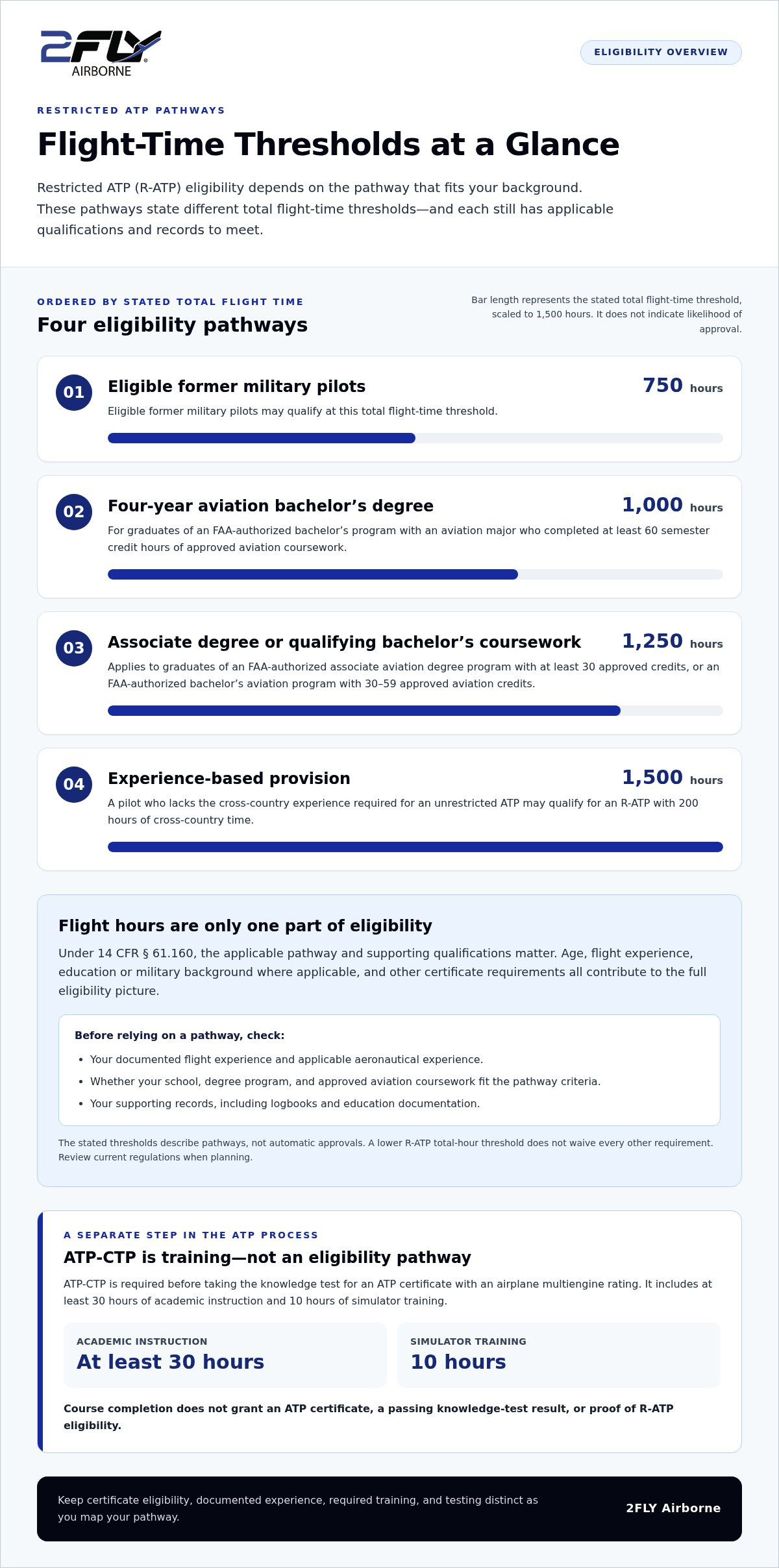
Under 14 CFR § 61.156, ATP-CTP is required before taking the knowledge test for an ATP certificate with an airplane multiengine rating. The course includes at least 30 hours of academic instruction and 10 hours of simulator training. Completion fulfills the course prerequisite, not the separate requirements for taking the test or receiving a certificate.
In plain language: ATP-CTP is training for the knowledge test; Restricted ATP is a certificate pathway based on eligibility.
After the course, the applicant must still meet the applicable eligibility standards, pass required testing, and complete the certification process. In 2FLY Airborne’s structured professional pilot training pathway, certificates and flight experience form part of a longer progression. Course completion by itself doesn’t confer R-ATP eligibility. Regulations can change, so review the current text of 14 CFR §§ 61.156 and 61.160 when planning your next step.
Which Restricted ATP Eligibility Pathway Fits Your Background?
Start with the experience you can document, not just the total shown in your logbook. Under 14 CFR § 61.160, Restricted ATP experience thresholds vary with qualifying military service, education, and aeronautical experience. The figures below describe pathways, not automatic approvals. The applicable requirements and supporting records matter.
- Military pilots: Eligible former military pilots may qualify with 750 hours of total flight time.
- Four-year aviation degree: Graduates of an FAA-authorized bachelor’s degree program with an aviation major may qualify at 1,000 hours if they completed at least 60 semester credit hours of approved aviation coursework.
- Associate degree or qualifying bachelor’s coursework: A graduate of an FAA-authorized associate’s aviation degree program with at least 30 approved credits, or a graduate of an FAA-authorized bachelor’s aviation program with 30 to 59 approved aviation credits, may qualify at 1,250 hours.
- Experience-based provision: A pilot with 1,500 hours who lacks the cross-country experience required for an unrestricted ATP may qualify for an R-ATP with 200 hours of cross-country time.
These provisions differ from the standard ATP experience pathway, which generally requires 1,500 hours total and includes additional aeronautical experience requirements. A lower R-ATP total-hour threshold doesn’t waive every other requirement. Applicants still need to meet applicable certificate, experience, testing, and eligibility provisions. The FAA’s ATP certification information is a useful reference alongside the current regulatory text.
How do education and flight hours affect eligibility?
A degree title alone doesn’t determine which threshold applies. Check that the school and program category meet the regulatory criteria, then compare your transcript with the required approved aviation credits. For example, a bachelor’s graduate with fewer than 60 qualifying credits may fall under a different experience threshold than a graduate who completed 60 or more.
Eligibility depends on both documented flight experience and the specific pathway that applies to your background. Keep transcripts, degree records, and logbooks together so you can assess them as a complete record.
How should military pilots assess their route?
Military flight experience may count under a separate R-ATP provision, but don’t assume every logged military hour qualifies in the same way. Review service and pilot documentation against the current requirements in § 61.160, including applicable definitions and conditions. The FAA’s ATP information also discusses reduced aeronautical experience for certain applicants.
For pilots planning the broader professional training sequence, 2FLY Airborne’s FAA Airline Pilot Program can be part of a structured pathway. A training plan doesn’t itself establish R-ATP eligibility, so assess your individual route using your records and the applicable rules.
How ATP-CTP, ATP Testing, and Certificate Eligibility Compare
Plan the ATP process around the certificate and rating you intend to pursue. First identify the applicable eligibility provisions, then sequence training and tests so each required step is completed in order. For an ATP with an airplane multiengine rating, the knowledge-test sequence includes ATP-CTP. Requirements may differ for other certificate or rating combinations.
Before setting a test date, review the relevant provisions in 14 CFR Part 61. Sections 61.153 and 61.155 address ATP eligibility and aeronautical knowledge, while §§ 61.156 and 61.157 cover ATP-CTP and practical-test requirements for the applicable route. A Restricted ATP applicant must also meet the specific eligibility provision that applies to their background.
What should pilots complete before ATP-CTP?
Begin by confirming that your certificate and experience records align with the ATP route you plan to follow. ATP applicants generally need a Commercial Pilot Certificate with an Instrument Rating, along with the applicable aeronautical experience and other eligibility qualifications. The experience review depends on whether you’re pursuing an unrestricted ATP or qualifying under a Restricted ATP provision.
Separate regulatory prerequisites from a training provider’s administrative enrollment process. A provider may request records to organize course participation, but those administrative steps don’t determine whether you satisfy the FAA’s eligibility rules. Check that your planned course corresponds to the certificate and rating you intend to test for, and keep the records needed to support your application.
What happens after the course?
For an ATP with an airplane multiengine rating, the next testing milestone is the applicable knowledge test. After satisfying the prerequisites for that test, the applicant must pass it before proceeding to the practical test. The practical test assesses whether the applicant meets the standards for the certificate and rating sought.
The milestones have different purposes:
| Milestone | What to track | What comes next |
|---|---|---|
| ATP-CTP record | Course completion documentation for the applicable multiengine ATP route. | Confirm test prerequisites, then prepare for the knowledge test. |
| Knowledge test | Test authorization and the result for the applicable ATP knowledge exam. | Continue to the practical-test stage after meeting its requirements. |
| Practical test | Evaluation for the certificate and rating requested. | Complete any remaining certification steps. |
| Certificate application | Eligibility records and required test documentation. | Certificate issuance depends on satisfying all applicable requirements. |
Use this sequence as a planning tool, not as an individual eligibility determination. Confirm current rules for your certificate, aircraft category, rating, and qualifications before scheduling tests or arranging training.
How to Compare ATP-CTP Course Options and Cost Factors
Compare ATP-CTP options by more than the course fee. A course may meet the required training standard, but its format, schedule, included instruction, and travel needs affect the overall commitment. Use the following steps to understand what you’re paying for and how the course fits your intended ATP pathway.
Which course details should you compare?
First check that the course is designed for the ATP certificate and rating you intend to pursue. Then compare its academic curriculum, instructor access, simulator components, schedule, and course-completion documentation. Make sure required instruction is clear and distinguishable from optional services or personal arrangements.
- Confirm regulatory fit. Make sure the course corresponds to the applicable ATP-CTP requirements for your planned certificate and rating. Your R-ATP pathway affects eligibility, but ATP-CTP doesn’t replace the requirements for that pathway.
- Review course scope. Check how academic instruction and simulator training are organized, which simulator components are included, and how instruction is delivered. Confirm what documentation you receive after successful completion.
- Compare format and scheduling. Consider whether the course schedule works with your preparation and travel plans. The format may affect when you need to be on site and how much time away from work or home is involved.
- Separate course inclusions from extras. Identify which instruction and training components are included in the course and which expenses, such as transportation or lodging, you’ll arrange separately.
How can you plan the wider training investment?
ATP-CTP is one expense within a longer certification and experience pathway. Build a separate budget for earlier certificates and ratings, flight-time building, ATP-CTP, travel and lodging, and later testing. The balance varies with a pilot’s qualifications and circumstances, so don’t treat the course fee as the full cost of reaching ATP certification.
Consider how each stage of training contributes to the overall budget rather than assessing expenses in isolation. Financing decisions should account for the sequence ahead, including training and experience requirements that remain after ATP-CTP. Explore pilot training financing options as you plan the investment.
Before enrolling, write down the questions that affect your decision: what the course includes, how its schedule fits your plans, and what travel arrangements you’ll need. A clear comparison helps you weigh options without confusing a course expense with the cost of the full professional pathway. For related structured pilot training, explore 2FLY Airborne’s FAA Airline Pilot Program. A 2FLY Training Advisor can also discuss how your existing certificates and flight time fit into your next training steps.
Plan Your FAA ATP Pathway with Structured Training and Advisor Support
A clear next step starts with a clear record. Before choosing a course sequence, organize your certificates, flight experience, and supporting documents, then compare them with current requirements for the ATP or Restricted ATP pathway you’re considering. The faa restricted atp requirements depend on individual qualifications, so a training discussion can help with planning but doesn’t guarantee eligibility or employment.
What information should you prepare for a pathway discussion?
Bring records that show where you are now and what you’re working toward. A complete picture makes it easier to map potential training stages and identify details that need closer review.
- Certificates and ratings: List your pilot certificates, instrument and multiengine ratings, and any instructor certificates.
- Flight experience: Gather logbooks and a current summary of total time and relevant categories of experience. Make sure the summary aligns with your underlying records.
- Education history: Bring transcripts and degree records if you plan to assess an education-based eligibility pathway.
- Military or professional flying records: If applicable, organize service records and documentation describing your flying experience and qualifications.
- Career goals: Be ready to discuss the role you’re working toward, your current qualifications, and the training steps you believe remain.
Use this material to frame a practical conversation, not to assume a particular outcome. An advisor can help relate your existing certificates and flight time to a structured training sequence. Eligibility determinations depend on the governing regulations and your documentation.
How can structured FAA training support the next step?
Professional pilot development is a progression. Foundational certificates and ratings, such as Private Pilot, Instrument, Commercial, and Multi-Engine, build toward later experience and certification milestones. 2FLY Airborne’s FAA Airline Pilot Program provides a structured training context for pilots planning professional aviation careers. It is one part of a longer pathway, not a substitute for meeting ATP or R-ATP eligibility requirements.
Before committing to a pathway or course sequence, review current FAA regulations and guidance relevant to your circumstances. Requirements and interpretations can change, and applicable provisions depend on factors such as your certificates, experience, and educational or military background. Keep copies of supporting documents and note any questions that need clarification.
With organized records and a realistic view of the steps ahead, you can make training decisions with greater confidence. Safe, structured aviation training supports steady progress, while individual qualifications determine which certification pathway may apply. For help discussing your current certificates, flight time, and professional training goals, reach out to a 2FLY Training Advisor with your questions.
Take the Next Step Toward Your ATP Goal
Turn your research into a plan that reflects your experience, career goals, and readiness for professional training. Keep your records organized and use current FAA rules as your reference when evaluating how the faa restricted atp requirements may apply to you. A thoughtful plan helps you focus on the right milestones without assuming that one course or qualification guarantees a particular outcome.
As you consider your options, look beyond the immediate certification step. A well-sequenced training path can support skill development, sound decision-making, and continued progress toward a professional aviation career. Individual routes differ, but preparation gives you a stronger foundation for each decision ahead.
For a conversation about your goals and possible training steps, speak with a 2FLY Training Advisor about your FAA pilot pathway. Take the next step with purpose, and keep building toward the career you’re working to achieve.
Frequently Asked Questions
Can I qualify for a Restricted ATP without completing an ATP-CTP course?
For an ATP certificate with an airplane multiengine rating, applicants must complete ATP-CTP before taking the applicable knowledge test. If you’re considering a different certificate or rating, identify that route first and review its current requirements. Don’t treat course attendance, a training provider’s enrollment decision, or a general pathway description as a personal eligibility determination.
Does ATP-CTP give you an ATP certificate?
No. A course completion record is one item in the certification process, not the certificate itself. Keep it with your test records and application materials, and check that the names and dates on your documents match your other pilot records. Missing or inconsistent paperwork can complicate preparation, so organize it before moving to the next certification step.
How many flight hours do you need for a Restricted ATP?
The applicable total depends on the provision you’re assessing and the experience documented in your logbook. Review how your entries are categorized, not just the grand total, and compare them with the current text of 14 CFR § 61.160. If your records include different types of flying, prepare a clear, supportable breakdown before evaluating your route.
Is an aviation degree required for a Restricted ATP?
An aviation degree isn’t a universal requirement for every ATP route. If you’re relying on education for a particular eligibility provision, retain official transcripts and degree documentation, and confirm that the program and coursework meet current criteria. A degree by itself doesn’t establish that all flight experience, certificate, and testing conditions have been met.
How much does an ATP-CTP course cost?
There isn’t one price that applies to every course option. Review a written breakdown that separates course instruction and simulator training from personal travel, lodging, and other arrangements. Then keep those figures separate from your broader flight-training budget, so a course quote doesn’t become a misleading estimate of the full certification pathway.
Can international pilots pursue FAA Restricted ATP eligibility?
An international background doesn’t decide eligibility by itself. Pilots with non-U.S. training should assemble their original certificates, logbooks, and supporting records, then determine how those documents apply under current FAA rules. Don’t assume a foreign certificate or an hour total automatically meets a U.S. requirement; the details depend on the applicable process and the records available.
What should I do if my flight hours or degree don’t fit a listed pathway?
Review your records for missing entries, unclear classifications, or incomplete education documents before choosing a next step. Note what you can document and which requirements need further review, then use current regulations to guide your planning. A training advisor can discuss how a structured training plan fits your goals, but cannot guarantee an eligibility outcome.
The key is to plan from accurate records, current requirements, and a realistic sequence of training and testing. A disciplined, safety-focused approach supports sound decisions as you work toward your professional aviation goals. Reach out to a 2FLY Training Advisor with your questions and discuss your next step.

Article by
2FLY Airborne
2Fly Airborne is a professional flight training organization dedicated to developing the next generation of skilled, confident, and safety-focused pilots. With decades of combined aviation experience, our team of certified instructors provides structured, real-world training designed to prepare students for both checkrides and long-term success in the aviation industry.
Content Disclaimer
Some blog content is generated with the assistance of automated tools and may not always be fully accurate or up to date. Please verify all aviation-related information with official sources or a certified instructor. For additional guidance or clarification, we encourage you to contact one of our training advisors at 2Fly Airborne.