
What if meeting FAA pilot eligibility requirements still isn’t enough to qualify for a regional airline job? That distinction is central to understanding regional airline pilot hiring minimum qualifications: federal rules set the certification baseline, while each airline establishes its own standards for applicants. It can be confusing when you’re comparing ATP or restricted ATP eligibility with an employer’s experience requirements.
This guide separates those benchmarks so you can plan your next steps. It explains how ATP and restricted ATP pathways relate to first-officer eligibility, which certificates, ratings, experience, and medical qualifications matter, and why an airline’s hiring criteria may go beyond regulatory minimums.
You’ll also see how pilot training can build qualifications progressively, from private and instrument training through commercial, multi-engine, and instructor certifications. FAA rules and airline recruiting standards can change, so use this overview as a planning framework and review current FAA requirements and airline job postings. Understanding the difference between eligibility and hiring criteria can help you make informed decisions about your path to the flight deck.
Key Takeaways
- Separate FAA certificate eligibility from an airline’s hiring standards before assessing your readiness.
- Review current ATP or restricted ATP requirements as a framework, since eligibility depends on your circumstances and applicable FAA rules.
- Compare required qualifications with preferred qualifications in each regional airline’s current job posting.
- Use a qualification gap analysis to identify which certificates, ratings, experience, or records need attention next.
- Map regional airline pilot hiring minimum qualifications to a structured training plan, allowing for individual progress and changing requirements.
Regional Airline Pilot Hiring Minimum Qualifications: What the Requirements Actually Mean
An applicant may hold a commercial pilot certificate, instrument rating, and multi-engine rating but still fall short of a regional airline’s hiring requirements. Certificates and ratings establish which privileges a pilot may exercise under applicable regulations; they don’t automatically meet an airline’s experience, documentation, or recruitment criteria. That’s why a single flight-hour figure is not enough to assess readiness.
FAA eligibility versus an airline’s hiring minimums
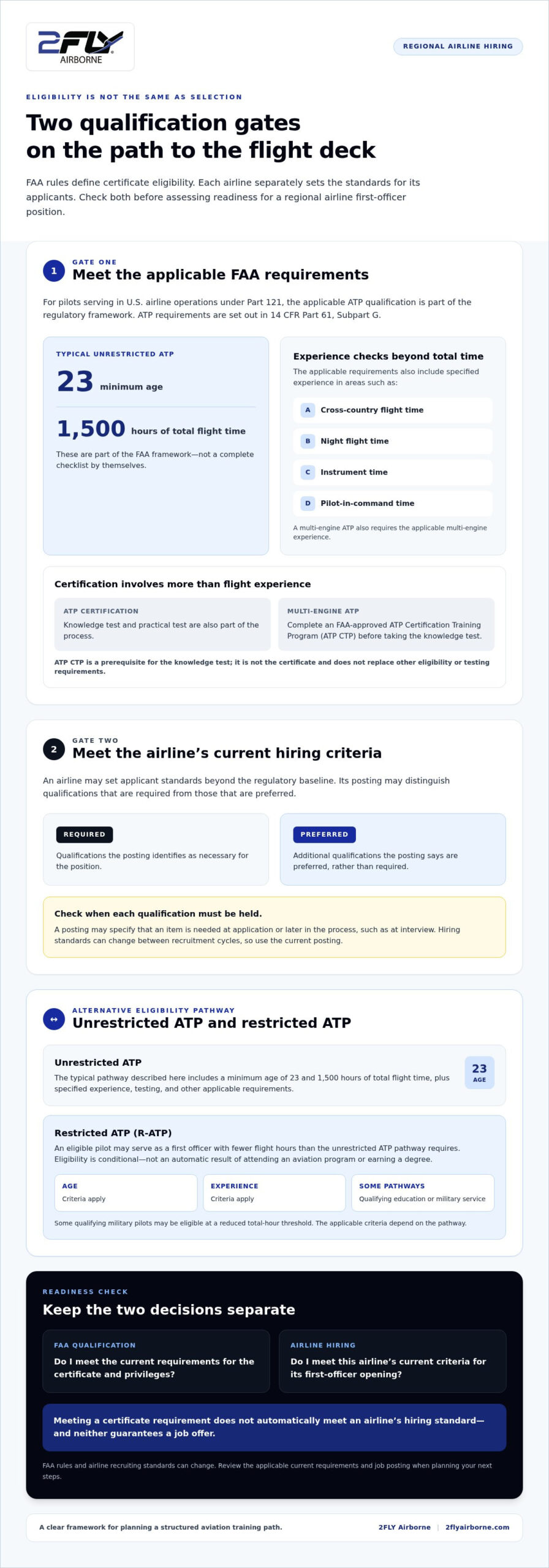
FAA eligibility means meeting regulatory requirements to hold or exercise the privileges of a certificate or rating. For airline operations under Part 121, pilots need the applicable Airline Transport Pilot (ATP) qualification. First officers may qualify with an ATP certificate carrying restricted privileges if they meet the relevant criteria. ATP certification requirements are set out in 14 CFR Part 61, Subpart G, while Part 121 includes requirements for pilots serving in airline operations.
Airline hiring minimums are separate, employer-set criteria. They can include experience, qualifications, or other conditions beyond the regulatory baseline. A job posting may also distinguish required qualifications from preferred ones. Since standards can change between recruitment cycles, use the current posting when assessing your application.
FAA rules establish the qualifications a pilot must meet to exercise certificate privileges; each airline sets its own criteria for selecting applicants.
This distinction is the starting point for assessing regional airline pilot hiring minimum qualifications. You may be eligible for a certificate without meeting a particular airline’s hiring standard. A posting may also specify that a qualification is needed later in the process, rather than on the date you apply. Read carefully for when each item must be met.
Which pilot role does a regional airline hire for?
Regional airlines typically recruit pilots for first-officer positions. A first officer serves alongside the captain, sharing flight-deck duties according to company procedures and applicable rules. The captain holds command responsibility for the flight. Meeting a first-officer hiring standard does not guarantee a future promotion to captain.
Airline hiring is different from flight instruction or hour building. A pilot may instruct to gain experience, but a flight-instructor role is not an airline first-officer position, and building hours does not itself result in an airline job offer.
Use precise terms when comparing your qualifications: an applicant is seeking a position; a first officer serves in an airline role; a captain is the pilot in command; and an airline transport pilot is a certificate level, not a job title. A structured FAA First Officer Program can help organize training toward an airline pathway, but training does not guarantee hiring or placement.
ATP and Restricted ATP Requirements: The Regulatory Qualification Framework
An Airline Transport Pilot (ATP) certificate is a key qualification for pilots serving in U.S. airline operations, but eligibility depends on more than a single flight-hour total. The FAA’s rules in 14 CFR Part 61, Subpart G set out requirements that vary according to factors such as an applicant’s age, flight experience, and qualification pathway. Those rules establish certificate eligibility, not an airline’s separate hiring decision.
ATP eligibility depends on your pathway and the current FAA requirements that apply to it. Consult the FAA Airline Transport Pilot (ATP) Requirements and applicable regulations when planning around specific requirements.
How the ATP certificate relates to regional airline applications
For a typical unrestricted ATP, the FAA framework includes a minimum age of 23 and 1,500 hours of total flight time, along with specified experience in areas such as cross-country, night, instrument, and pilot-in-command time. Applicants also need the required multi-engine experience for a multi-engine ATP. Meeting the total-hour threshold alone does not show that every experience requirement has been met.
ATP certification also involves knowledge and practical tests. For a multi-engine ATP, applicants must complete an FAA-approved ATP Certification Training Program (ATP CTP) before taking the knowledge test. The course is a prerequisite, not the certificate itself, and it does not replace other eligibility or testing requirements.
Keep two checks separate when planning an application: whether you meet FAA requirements for the certificate, and whether you meet the airline’s current criteria for the first-officer opening. You may satisfy one without satisfying the other. Note when the posting says each qualification must be held, such as at application or interview.
When a restricted ATP pathway may apply
A restricted ATP (R-ATP) can allow an eligible pilot to serve as a first officer with fewer flight hours than the unrestricted ATP pathway requires. It is conditional, not an automatic benefit of attending an aviation program or earning a degree. The FAA sets eligibility criteria that include age and experience requirements and, for certain pathways, qualifying education or military service.
- Some qualifying military pilots may be eligible at a reduced total-hour threshold.
- Graduates of certain FAA-approved aviation degree programs may qualify at reduced hour thresholds, depending on the program and applicable criteria.
These pathways have specific conditions. Confirm that your education or experience meets current FAA requirements before relying on an R-ATP hour threshold. Completing a degree or flight-training course alone does not establish eligibility. A structured FAA Professional Pilot Program can organize your training progression, while your individual R-ATP eligibility must be assessed against current rules.
Beyond the ATP: Ratings, Medical Qualification, and Airline-Specific Standards
An ATP pathway is only one part of an applicant’s qualifications. Commercial, instrument, and multi-engine qualifications establish different capabilities, while medical eligibility and an airline’s current posting add further conditions. Regional airline pilot hiring minimum qualifications can therefore vary by employer and recruitment cycle. Use the comparison below as a planning aid, not a complete hiring checklist.
Certificates and ratings applicants should understand
A commercial pilot certificate allows a pilot to exercise commercial pilot privileges under applicable rules. An instrument rating qualifies a pilot to operate under instrument flight rules when current and properly qualified. A multi-engine rating applies to flying multi-engine aircraft. Each qualification builds different skills; holding one does not automatically confer the privileges of another.
| Qualification | Regulatory relevance | Employer-specific variation |
|---|---|---|
| Commercial Pilot Certificate | Establishes commercial pilot privileges, subject to applicable rules and limitations. | An airline may require higher-level qualifications or experience beyond this certificate. |
| Instrument Rating | Provides instrument-flight privileges when the pilot meets applicable requirements. | Employers may specify instrument experience or other standards in a job posting. |
| Multi-Engine Rating | Applies to operation of multi-engine aircraft within the rating’s privileges. | An airline may set its own multi-engine experience criteria for a role. |
These credentials do not replace ATP or restricted ATP requirements that apply to an airline position. For additional context on the ATP qualification framework, see the AOPA ATP Certificate Overview. Compare each credential with the duties and qualifications in the specific first-officer posting.
Medical qualification and employer screening
An FAA medical certificate addresses regulatory medical eligibility to exercise relevant pilot privileges. The required class and its validity depend on the privileges being exercised and applicable rules. Don’t assume a medical certificate sufficient for one kind of flying meets the requirements for airline operations. Review current FAA medical guidance and the posting’s medical criteria.
Keep regulatory eligibility separate from an employer’s screening process. An airline may set application conditions in addition to FAA requirements, and hiring standards may change. Review the current posting for medical, certificate, and experience requirements, then make sure your records reflect your current qualifications. For structured preparation toward a first-officer pathway, explore 2FLY Airborne’s FAA First Officer Program.
How to Assess Your Readiness for Regional Airline Pilot Hiring
Assess readiness against a specific role instead of relying on a general idea of what regional airlines require. This process turns a job posting into a practical plan while keeping FAA eligibility separate from an employer’s selection criteria.
- Identify the target role. Focus on the position you intend to pursue, such as a regional airline first-officer role. Requirements may differ by position, airline, and recruitment cycle.
- Review the current posting. Separate qualifications marked required from those described as preferred. Note when each required item must be met, since the posting may specify a stage in the application process.
- Map your qualifications. Compare the posting with your certificates, ratings, flight experience, and other stated criteria. Assess ATP or restricted ATP eligibility only against current applicable FAA rules.
- Verify your records. Check that your certificates, ratings, flight records, and medical documentation, as applicable, are accurate and consistent with the qualifications you plan to claim.
- Plan the gaps. Identify which criteria you meet, which are in progress, and which need verification. Use that list to choose a realistic next step instead of assuming one milestone will satisfy every employer.
Assess readiness against both current FAA rules and the specific employer’s current posting. If a posting lists preferred experience alongside required qualifications, treat the preferred criteria as information about the employer’s expectations, not as an FAA requirement or a universal airline minimum.
Build a personal qualification gap analysis
Create a simple comparison for each airline you’re considering. Record the posting’s source and date, then mark each item as met, in progress, or requiring verification. Revisit the comparison when the posting or FAA regulations change.
| Published criterion | Your status | Evidence or next step |
|---|---|---|
| Certificate or rating listed as required | Met, in progress, or requiring verification | Check certificate and rating records |
| Experience or eligibility requirement | Met, in progress, or requiring verification | Compare flight records with the stated criterion |
| Preferred qualification | Met, in progress, or requiring verification | Decide whether it belongs in your development plan |
Plan training around the qualification gaps
Once you’ve identified a gap, connect it to a training or experience step. Pilot certifications can build progressively, from private and instrument training through commercial, multi-engine, and instructor qualifications. The appropriate sequence depends on your starting point and goals. Training supports qualification development; it does not guarantee an airline interview or job offer.
For a structured route focused on airline first-officer preparation, explore the FAA First Officer Program. If you have questions about aligning your training plan with your qualifications, reach out to a 2FLY Training Advisor.
Turning Hiring Requirements into a Structured FAA Training Plan
A hiring gap analysis is useful when it leads to specific, well-sequenced next steps. Start with the qualifications you hold, compare them with current FAA requirements and your target airline’s posting, then plan training around the gaps. The goal is to build capability and meet applicable standards, not to treat a course sequence as a guarantee of employment.
Choose training that builds toward your target qualifications
A pilot starting without certificates may progress through private pilot, instrument, commercial, and multi-engine training. Instructor qualifications can also form part of a professional development route, including a path to building experience through flight instruction. The appropriate sequence depends on your existing qualifications, experience, and intended pathway.
Use your gap analysis to decide what comes next. For example, a pilot who already holds a commercial certificate may need to focus on a remaining rating or experience requirement, while someone earlier in training may need to plan several certificates in sequence. Confirm each step against current FAA rules, especially when ATP or restricted ATP eligibility is part of your goal.
- Private Pilot Certificate: establishes an early foundation in piloting skills.
- Instrument Rating: develops qualifications for instrument-flight privileges.
- Commercial Pilot Certificate: advances the pilot’s certification toward commercial privileges.
- Multi-Engine Rating: adds qualifications for multi-engine aircraft.
- Instructor ratings: may support a route that includes flight instruction and experience building.
This is a planning framework, not a universal checklist. Training routes and individual progress vary, and the right steps depend on your starting point and target qualifications. Explore the 2FLY FAA First Officer Program as a structured training option related to this career goal. No training program can guarantee airline hiring or placement.
Take the next step with an informed plan
Bring your current certificates, ratings, experience records, and target role into a discussion with a training advisor. This can help you clarify which qualifications you hold, what remains to be completed or verified, and how structured FAA training may fit your goals.
FAA eligibility establishes the regulatory baseline; each airline sets its own hiring criteria, which can change. Build your plan around current requirements, accurate records, and safe, structured training. For questions about your experience and training options, speak with a 2FLY Training Advisor.
Take Your Next Step Toward the Flight Deck
Aviation careers develop through continual learning, sound judgment, and a commitment to refining your skills. Treat regional airline pilot hiring minimum qualifications as one waypoint, not the full measure of the professional pilot you’re working to become. The habits you build now can shape how you approach future opportunities.
As you consider what comes next, reflect on the kind of pilot you want to be and the standards you’ll bring to your work. Thoughtful questions can help turn ambition into a clear direction.
Ready to talk through your goals? Speak with a 2FLY Training Advisor and take your next step with a structured plan.
Frequently Asked Questions
Do regional airlines require an ATP certificate before hiring a first officer?
Not in every case or at every application stage; follow the timing stated in the specific airline’s posting. Note whether the qualification is needed to submit an application, begin employment, or meet a later condition. This helps you distinguish an application-stage requirement from a general rule.
Can you become a regional airline pilot with a restricted ATP?
Yes, an eligible applicant may pursue a regional airline first-officer position with a restricted ATP, subject to the airline’s current criteria. If your qualification relies on an education or military pathway, keep the supporting records organized with your application materials. Review the applicable FAA requirements and the employer’s posting before describing your status on an application.
How many flight hours do regional airline pilots need?
There is no single total that applies to every regional airline applicant. Reconcile your logbook totals before applying, and make sure your summaries agree with the underlying entries. Pay attention to how the posting defines experience rather than relying on a figure from another airline’s advertisement. Flight hours are one part of an application, not proof by themselves that you meet every criterion.
Is a commercial pilot certificate enough to apply to a regional airline?
Not necessarily. A commercial certificate may be one part of an applicant’s qualifications, but the airline’s posting determines what else it expects for the position. Compare each listed qualification with your certificates and ratings, then ensure your application describes them accurately. If a required item is still in progress, don’t present it as completed. Meeting stated requirements allows you to apply, but does not determine the employer’s selection decision.
Do regional airlines require a first-class medical certificate?
There isn’t one answer that applies to every role and employer. Check the medical language in the current posting and compare it with your certificate’s class, issue date, and any limitations. Keep track of when your medical documentation may need attention, and use current FAA materials for questions about its regulatory status. An employer may also have a separate screening process, distinct from FAA medical documentation.
Does completing flight school guarantee a regional airline pilot job?
No. Completing flight training represents progress in your professional development, not a hiring decision. As you move from training to applications, keep records orderly, practice explaining your experience clearly, and continue building sound decision-making habits. Employers make selection decisions according to their current processes. Safe flying and continued learning remain essential throughout your career.
What should I check before applying for a regional airline pilot job?
Start with the posting’s publication or update date, then note any application deadlines and the stage by which each qualification is required. Compare the criteria with your documents, and save a copy of the posting so you can track changes before applying. Regional airline pilot hiring minimum qualifications may differ by employer. For help planning your next training step, reach out to a 2FLY Training Advisor.
Article by
2FLY Airborne
2Fly Airborne is a professional flight training organization dedicated to developing the next generation of skilled, confident, and safety-focused pilots. With decades of combined aviation experience, our team of certified instructors provides structured, real-world training designed to prepare students for both checkrides and long-term success in the aviation industry.
Content Disclaimer
Some blog content is generated with the assistance of automated tools and may not always be fully accurate or up to date. Please verify all aviation-related information with official sources or a certified instructor. For additional guidance or clarification, we encourage you to contact one of our training advisors at 2Fly Airborne.