
You’ve planned a destination flight, but the route can do more than take you somewhere. With a clear training goal, cross-country flight time building packages can turn planned trips into purposeful experience while keeping your career path in view.
Choosing an option involves more than comparing hourly rates. Aircraft access, package-hour rules, route flexibility, and your certification goals all shape the decision. This guide explains how time building works, what affects package costs, how scheduling and cross-country routes fit together, and why accurate records matter. Use these details to plan your next step in flight training with safe, structured progress in mind.
Key Takeaways
- Track cross-country time separately and plan routes around the requirements for your target certificate or rating.
- Compare package pricing by how flight hours are charged and shared, not just by the advertised hourly rate.
- Build a realistic schedule around your availability, route planning, and the experience you need to log.
- Use structured training to connect time building with your next pilot certification and broader career goals.
Cross-country flight experience
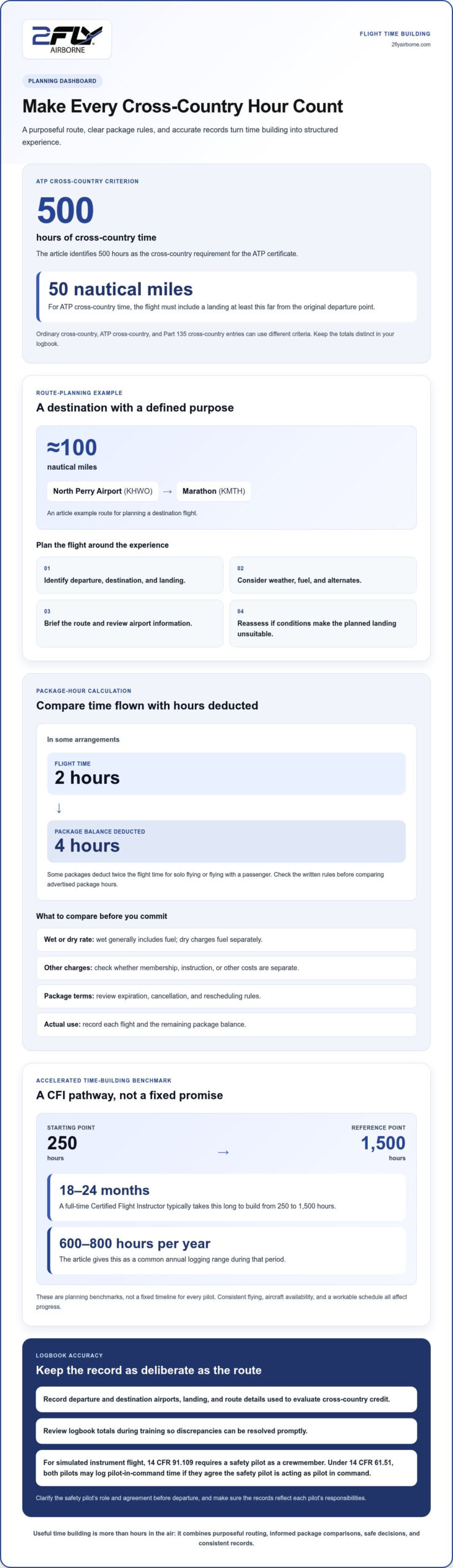
Cross-country time building is most useful when each route has a defined training purpose. For ATP cross-country time, the flight must include a landing at least 50 nautical miles from the original departure point. The Federal Aviation Administration also sets a 500-hour cross-country requirement for the ATP certificate.
For this ATP criterion, plan a destination and landing beyond the required distance, then record the flight clearly. Ordinary cross-country, ATP cross-country, and Part 135 cross-country entries can use different criteria, so keep their logbook totals distinct.
To plan a route, identify the departure airport, destination, and landing before departure. Then consider weather, fuel, alternates, and the experience you want from that flight. A North Perry Airport (KHWO) to Marathon (KMTH) route is approximately 100 nautical miles, offering a specific destination example for route planning.
Flight schools verify and log cross-country time by reviewing the route, airports, landings, and pilot roles against the intended training requirement. Keep your own records consistent and review your logbook totals during training so discrepancies can be resolved promptly.
- Record departure and destination airports for each flight.
- Note the landing and route details used to evaluate cross-country credit.
- Separate ordinary, ATP, and Part 135 totals where their criteria differ.
- Review totals during training rather than waiting until checkride preparation.
How do FAA rules address cross-country flights, landings, and pilot-in-command logging? ATP cross-country time requires a landing at least 50 nautical miles from the original departure point, while pilot-in-command logging depends on the flight’s circumstances and applicable criteria. During simulated instrument flight, 14 CFR 91.109 requires a safety pilot as a crewmember.
Under 14 CFR 61.51, both pilots may log pilot-in-command time during simulated instrument flight if they agree the safety pilot is acting as pilot in command. The safety pilot’s role and the agreement should be clear before departure, with flight records reflecting the pilots’ responsibilities.
What safety, weather, insurance, and cancellation risks should pilots consider? Assess weather and route alternatives before departure, understand aircraft insurance terms, and review the school’s cancellation policy when scheduling a longer flight. A weather change may require a different destination or delay, so build decision points into the route plan.
Before a destination flight, brief the route, review airport information, and identify an alternate plan. If conditions make the planned landing unsuitable, reassess rather than pressing on just to complete the route. Useful cross-country experience includes sound decisions, accurate records, and safe planning, not just time in the air.
Hourly pricing and total costs
An hourly rate is only one part of the cost of building flight time. Compare what each billed hour includes, how package hours are deducted, and whether the aircraft arrangement fits your certificate or rating goals. Cross country flight time building packages can use different billing rules, even when their advertised flight-hour totals look similar.
Compare flying club rates carefully
Flying clubs may quote wet or dry aircraft rates. A wet rate generally includes fuel, while a dry rate charges fuel separately from the aircraft. Confirm what each rate includes before comparing costs.
Ask how aircraft time is recorded, what happens when a flight changes, and whether membership charges apply. Flight schools may structure aircraft access and instruction differently from clubs, so compare the full arrangement rather than the hourly figure alone. Include any instruction you need instead of focusing only on aircraft access.
Understand package-hour calculations
Prepaid packages can make spending easier to plan, but the hour-use rules matter. Some arrangements allow solo flying or flying with a passenger while deducting twice the flight time from the package. Read the calculation carefully before treating the remaining package balance as equivalent to time in the air.
Compare the advertised flight-hour allowance with the package’s deduction method. If a two-hour flight uses four package hours, it provides less usable flight time than a package that deducts one hour per hour flown. That difference affects how many trips fit your remaining balance. Cross country flight time building packages are easier to assess when you compare actual flight time with package-hour deductions.
Ask for the pricing structure in writing. The price depends on the case and is given after a quote request; relevant factors include aircraft type, fuel treatment, package size, flight duration, and whether instruction or other charges apply.
Build a realistic total-cost estimate
Start with the flight hours you plan to purchase, then apply the package’s billing method to your expected flights. Account separately for items listed in the agreement, such as membership or instruction, rather than assuming the aircraft rate covers them.
- Compare the same aircraft category and fuel-inclusion terms.
- Check whether solo flights and passenger flights use package hours differently.
- Review expiration, cancellation, and rescheduling terms before prepaying.
- Keep a record of each flight and remaining package balance.
Cross-country routing affects planned flight duration, so estimate costs using routes that match your training objective. A local flight and a destination flight may have the same hourly rate but different totals. Compare each option by its billing method, flexibility, and relevance to your training plan, not just its headline rate.
Accelerated time-building timeline
An accelerated schedule depends on consistent flying, available aircraft, and a workable plan for using each flight hour. A full-time Certified Flight Instructor typically takes 18 to 24 months to build from 250 to 1,500 hours, while commonly logging 600 to 800 hours per year during that period. These are planning benchmarks, not a fixed timeline for every pilot.
Compare instructing with paired flying
Flight instructing builds experience through teaching and flying with students. The pace depends on lesson demand, aircraft access, weather, and scheduling. Full-time Certified Flight Instructors commonly log 600 to 800 hours per year while building from 250 to 1,500 hours, so the route requires sustained work and consistent flight opportunities.
Paired time-building arrangements use a different structure. Pilots are paired to build 30 to 50 pilot-in-command hours, and time-builders using the package typically fly together for 8 to 10 hours per night. Before planning around those figures, understand how each pilot’s role and logged time are recorded.
Map the hours before setting dates
Start with your current logbook total and the target you’re working toward. Then identify how much time remains, what type of experience you need, and which schedule fits your aviation commitments. A pilot with 250 hours aiming for 1,500 has a substantial time-building phase ahead, even with regular flying.
Build a weekly plan around aircraft access, partner availability, airport operations, and recovery time. Include alternate flying days so one cancellation does not derail the schedule. A condensed calendar can maintain momentum, but only when aircraft and partners are consistently available.
Make the timeline usable
Use a repeating review cycle to keep the plan grounded in actual logbook progress:
- Set a weekly flying target that matches your schedule and available aircraft.
- Record completed hours and confirm how each flight was logged.
- Compare the updated total with your certificate or career milestone.
- Adjust upcoming flights when access, weather, or training needs change.
For pilots building through instructing, the additional 550 hours before applying to a regional airline can take up to 2 years or more. That makes it useful to plan around realistic monthly availability rather than assuming every week will produce the same flight hours.
An accelerated timeline requires coordination, not simply longer days at the airport. Compare instruction with paired flying by considering the experience each offers, the hours you can consistently log, and how the schedule fits your next aviation goal.
One CFI in the discussion reports that instructors at their flight school fly 80-120 hours per month. Treat that as an individual report, not a guarantee of what another school or instructor can sustain. For an instructing plan, compare the reported monthly pace with your own lesson demand, aircraft access, and calendar, then check actual logbook totals regularly. If those conditions differ, adjust the schedule rather than assuming the same pace will hold throughout the time-building period.
Cross-country routing in time-building packages
A useful package makes route planning part of the time-building strategy. Consider whether destinations, landings, and logbook goals align with the experience you need for your pilot certificate and career.
Packages can differ in aircraft access, route flexibility, and instructor support. The aircraft, destinations, and instructor involvement depend on the program structure, so compare these elements alongside the hourly terms.
U.S. flight schools offer time-building opportunities from their training airports, with routes shaped by local geography and airport access. In Florida, North Perry Airport (KHWO) provides a routing reference for flights to Stuart, Orlando Executive, Tampa, Gainesville, and Jacksonville.
Choose routes for useful experience
A destination route can combine navigation practice with a landing and exposure to different airport environments. From North Perry, Stuart (KSUA) is approximately 80 nautical miles away, while Orlando Executive (KORL) is approximately 165 nautical miles away. These destinations offer different flight lengths for planning a route around available time and training priorities.
Longer routes can add planning complexity. Gainesville (KGNV) is approximately 275 nautical miles from North Perry, and Jacksonville (KJAX) is approximately 325 nautical miles away. Pilots should account for weather, fuel planning, alternates, and airport conditions before selecting a longer leg.
A route should serve the logbook goal, not just maximize distance. ATP cross-country time has specific criteria, and Part 135 cross-country time uses different criteria. Keep those categories distinct when planning and recording flights.
Coordinate the route with the package
Before booking, compare the planned route with the package’s aircraft access, hourly billing, and scheduling process. For example, consider whether a flight to Stuart or Tampa fits your intended flight length and destination experience.
- Choose a departure airport and destination that support the training objective.
- Review route distance, likely flight duration, weather, and landing options.
- Confirm how the flight will be recorded and which pilot roles apply.
- Keep a backup destination in the plan if conditions change.
Instructor support can add structure when a route introduces unfamiliar navigation or airport procedures. A pilot working toward a 250-hour milestone may prioritize varied destinations, while another pilot may focus on a specific cross-country logbook category.
A strong route plan balances useful experience with sound decision-making. Compare destinations, aircraft arrangements, and instructor involvement before committing package hours, then record a clear purpose for each flight.
What cross-country flight hours are required for an instrument rating and commercial pilot certificate?
Instrument and commercial certificates use different hour requirements, so separate the totals in your logbook. In the United States, an instrument rating requires 50 hours of pilot-in-command cross-country time, including at least 10 hours in an airplane, according to the Federal Aviation Administration.
Plan cross-country time for an instrument rating
Pilot-in-command time means you’re responsible for the flight’s operation. The 50-hour cross-country total is not interchangeable with instrument time, which tracks flying by reference to instruments in actual or simulated conditions.
An instrument rating also requires at least 40 hours of actual or simulated instrument time. Of that instrument experience, at least 15 hours must be instrument training. Track these categories separately so a flight’s cross-country credit doesn’t get confused with its instrument credit.
Before an instrument checkride, review your logbook for pilot-in-command cross-country time, airplane cross-country time, and instrument experience. One flight can count toward more than one category when it meets the relevant criteria, but the entries should show what you did and how the time was logged.
Understand commercial certificate hour minimums
For a U.S. commercial single-engine land certificate, the stated flight-hour minimum is 250 hours under Part 61 or 190 hours under Part 141. These are different training pathways, so identify which program applies before estimating the remaining time.
Commercial training also includes specific cross-country experience. The described flights include a 2-hour daytime flight and a 2-hour nighttime flight, totaling 4 hours. Keep those flights identifiable in your records instead of assuming every cross-country hour automatically satisfies a commercial training task.
Before earning a Commercial Pilot Certificate, a student pilot cannot carry passengers or cargo for compensation or hire. The certificate changes the privileges available, while the required training and experience must still be completed and recorded appropriately.
Use this logbook review process to spot gaps early:
- Separate total flight time, pilot-in-command time, and cross-country time.
- Track airplane cross-country time separately for the instrument requirement.
- Record instrument time and instrument training as distinct categories.
- Identify the applicable commercial pathway, Part 61 or Part 141.
- Compare completed flights against each certificate requirement before checkride planning.
Clear records help connect time building with the next pilot certificate or rating. For a broader view of how professional training progresses, explore the FAA airline pilot program and map your next steps around the experience you still need.
After a Private Pilot Certificate and Instrument Rating, pilots typically need roughly 130 to 150 more flight hours before a commercial checkride. A pilot in the discussion said they needed 19 more cross-country hours.
2FLY Airborne: FAA Professional Pilot Program
2FLY Airborne offers the FAA Professional Pilot Program for pilots planning structured progress toward professional aviation. It also offers the Private Pilot Certificate (PPL), Instrument Rating (IR), and Commercial Pilot Certificate (CPL).
Consider these training options when planning your next step after reviewing cross-country requirements, logbook experience, and certificate goals. A clear sequence connects flight training with the skills and qualifications for a professional pathway, while keeping each stage focused on its own requirements.
Explore the program details and consider how the available certifications align with your current experience and future plans. For questions about your training path, contact 2FLY Airborne or visit 2flyairborne.com.
Turn your flight-hour plan into a training pathway
Your next step is to connect the hours you want to build with the pilot certifications that advance your career. Compare cross country flight time building packages against your current experience, preferred training sequence, and the flying skills you want to develop.
2FLY Airborne’s FAA Professional Pilot Program, Private Pilot Certificate (PPL), and Instrument Rating (IR) can help structure that progression. A training advisor can discuss how these options relate to your goals and where focused hour building fits into your plan.
Keep safety and accurate logbook records central as you move from one stage of training to the next. A deliberate plan gives each flight a purpose and helps you build professional skills alongside experience.
Contact 2FLY Airborne about training options and speak with a 2FLY Training Advisor about your questions. Take the next step with focus, preparation, and ambition.
Frequently Asked Questions
What is pilot time building?
Pilot time building is the planned accumulation of logged flight experience toward later certification or career goals. Each flight can develop practical skills and add to your record of experience. For example, a pilot progressing from a Private Pilot Certificate can plan flights that support the next training stage while keeping the logbook organized.
How much does pilot time building cost?
The total depends on the aircraft arrangement, billing method, and any separately charged instruction or membership. Compare expected flight time with the package’s hour-deduction rules, then review fuel treatment and cancellation terms. A written breakdown clarifies what the quoted amount covers and how it fits your planned flying.
What counts as cross-country flight time for FAA pilot certification?
Cross-country credit depends on the certificate or rating requirement being pursued. For ATP cross-country time, the flight must include a landing at least 50 nautical miles from the original departure point. Keep route and landing details in your logbook, and distinguish the applicable category when tracking progress toward a checkride.
How do flight time building packages compare with renting an aircraft or joining a flying club?
A package groups flight hours under specific usage terms. Aircraft rental and flying clubs may bill differently, and clubs may include membership terms. Compare access, billing, fuel treatment, instruction, and scheduling flexibility against your flying pattern. A pilot flying intermittently may prefer a different arrangement from someone following a regular schedule.
Choose a plan that supports purposeful flying, careful records, and safe decision-making. Structured training helps connect experience with your next aviation goal. Reach out to a 2FLY Training Advisor with questions about your pilot training path.
Which U.S. flight schools offer cross-country time building packages, and where?
2FLY Airborne is named in connection with an FAA Professional Pilot Program and a Bulk XC Hours package. North Perry Airport is used as a route-planning starting point.
Article by
2FLY Airborne
2Fly Airborne is a professional flight training organization dedicated to developing the next generation of skilled, confident, and safety-focused pilots. With decades of combined aviation experience, our team of certified instructors provides structured, real-world training designed to prepare students for both checkrides and long-term success in the aviation industry.
Content Disclaimer
Some blog content is generated with the assistance of automated tools and may not always be fully accurate or up to date. Please verify all aviation-related information with official sources or a certified instructor. For additional guidance or clarification, we encourage you to contact one of our training advisors at 2Fly Airborne.