
The lowest hourly rate isn’t always the lowest total cost. For cheap multi-engine hour building in the USA, compare the aircraft rate, what it includes, how flight time is logged, and any additional charges. The right option depends on whether you need training, a proficiency checkout, or time building.
These are different goals. Training develops skills for a rating, a checkout assesses readiness to fly a particular aircraft, and time building focuses on accumulating flight experience. Treating them as equivalent can make an estimate appear cheaper than the flying you actually need.
This guide explains how the options differ, what affects total cost, and what to ask for in a written estimate. Compare aircraft time, instruction, checkout requirements, and stated charges on a like-for-like basis, then choose a structured path that supports your professional goals.
Key Takeaways
- Separate multi-engine training, a proficiency checkout, and time building before comparing options; each serves a different purpose.
- Compare total operating costs, not just the hourly rate, and identify which services and charges are included.
- Ask for a written estimate that clearly breaks down aircraft time, instruction, checkout requirements, and any additional fees.
- Confirm how flight time will be logged and whether the planned flying supports your experience goals.
- Match your multi-engine experience plan to the roles you’re pursuing, since job requirements vary across employers.
Calculating the total cost of usable experience
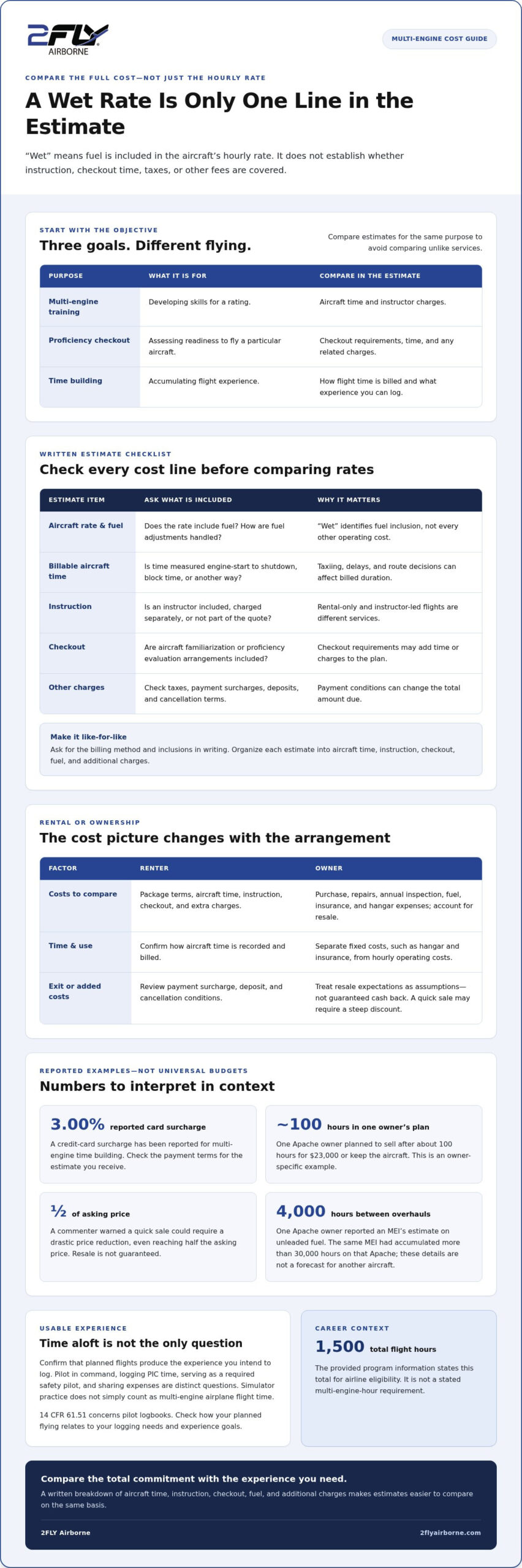
A low hourly figure can hide the cost of making each flight count toward your goals. Compare the full outlay with the experience you can log and use.
That example shows why acquisition cost alone can mislead. These figures describe one aircraft and owner’s experience, not a universal operating budget.
To explore how flight experience fits a pilot career, watch this video:
For a renter, compare the package’s complete terms with your intended flying. “Wet” means fuel is included in the hourly rate, but it doesn’t establish which other charges are covered. A 3.00% credit-card surcharge has also been reported for multi-engine time building.
Ownership shifts the calculation. Add purchase, repairs, annual inspection, fuel, insurance, and hangar expenses, then account for resale. One Apache owner planned to sell after about 100 hours for $23,000 or keep the aircraft. A commenter warned that a quick sale could require a drastic price reduction, even reaching half the asking price.
- Separate fixed costs, such as hangar and insurance, from hourly operating costs.
- Distinguish airplane time from ground instruction or simulator practice.
- Confirm that planned flights produce the experience you intend to log.
- Compare the entire commitment, including payment surcharges and resale assumptions.
Logbook value matters as much as time aloft. 14 CFR 61.51 concerns pilot logbooks, while acting as pilot in command, logging PIC time, serving as a required safety pilot, and sharing expenses are distinct questions. Simulator practice doesn’t simply count as multi-engine airplane flight time.
Aircraft condition also affects ownership economics. One Apache owner reported an MEI’s estimate of 4,000 hours between overhauls on unleaded fuel; the same MEI had accumulated more than 30,000 hours on that Apache. Those owner-specific details aren’t a forecast for another aircraft.
Finally, compare usable experience with your career target. The provided program information states that airline eligibility requires 1,500 total flight hours. That figure is total flight time, not a stated multi-engine-hour requirement. A cheap multi-engine hour-building plan in the USA should therefore fit your broader hours, logging needs, and professional objective.
A short ownership window makes the exit plan part of the cost calculation, not an afterthought. A commenter said that buying an aircraft for a month of time-building and selling it quickly may require a drastic price reduction and can result in a sale at 1/2 the asking price. Treat an expected resale figure as an assumption rather than guaranteed cash back. Before committing, consider whether you could keep the aircraft longer if a quick sale would mean accepting a steep discount. This helps compare the cost of usable experience against the financial risk of relying on a fast resale.
Hourly wet rate and included services
A wet rate usually includes fuel in the aircraft’s hourly rental charge. A wet rate may not include instruction, checkout time, taxes, or other fees. Treat each quoted rate as one part of the comparison, not the complete cost of flying.
For example, two Seminole quotes may show the same hourly rate but cover different services. One may include fuel only, while another may also specify instructor support or checkout arrangements. Compare the written inclusions rather than assuming “wet” covers every operating cost.
Use this checklist to see what each aircraft rate covers:
- Fuel: Confirm whether the stated rate includes it and how fuel adjustments are handled.
- Aircraft time: Check how the flight duration is recorded and billed.
- Instruction: Separate instructor charges from aircraft rental when listed separately.
- Checkout: Identify whether aircraft familiarization or proficiency evaluation is included.
- Other charges: Look for payment surcharges, taxes, deposits, or cancellation terms.
Next, compare how each school calculates billable time. A quote may define it as engine-start-to-shutdown time, block time, or another measure. The wording matters because taxiing, delays, and route decisions can affect billed duration. Ask for the billing method in writing and use the same basis across estimates.
Instructor support also changes what an hourly figure represents. Rental-only and instructor-led flights are different services. If your goal is multi-engine proficiency, clarify whether the listed rate covers instruction, aircraft rental, or both. An MEI, or Multi-Engine Instructor, can provide instruction focused on multi-engine flying.
Look beyond the headline rate when comparing aircraft. Aircraft type, operating procedures, fuel arrangements, and scheduling can affect the practical value of each option. A familiar aircraft may take less time to adapt to, while a different cockpit layout may require familiarization. Include these factors without assuming they have a fixed cost.
Review payment terms separately. A credit-card surcharge, deposit, or cancellation charge can change the amount due, even when the hourly rate seems straightforward. Note the payment method and any stated conditions beside each estimate to compare like with like.
For a clear decision, organize each estimate into aircraft time, instruction, checkout, fuel, and additional charges. Then compare the total against the experience and training you need. Pilots mapping multi-engine development into a broader career path can explore structured airline pilot training as part of that planning.
Requesting a written estimate
Request a written estimate based on your specific flying objective. State whether you need multi-engine training, a proficiency checkout, or time building. These activities have different purposes, so the quote should identify the planned service rather than group everything under a vague “twin time” label.
Describe your experience and aircraft needs clearly. Include your current multi-engine qualifications, recent flying, preferred aircraft, and logging goal. A pilot seeking solo time building, for example, needs a different plan from someone seeking instructor-led proficiency work.
Ask the school to itemize the estimate so you can compare each part:
- Aircraft type and hourly billing method.
- Fuel inclusion and any fuel-related adjustments.
- Instructor time, if instruction is part of the plan.
- Checkout or aircraft familiarization requirements.
- Deposits, payment surcharges, cancellation terms, and other charges.
- How flights and pilot roles will be documented.
Ask how the estimate separates aircraft rental from instruction. A training flight may include both, while time building may focus on aircraft use. The estimate should identify the planned activities and explain how each charge applies, rather than presenting one unexplained total.
Clarify how time will be logged before accepting a proposed plan. Acting as pilot in command, logging PIC time, and serving as a required safety pilot are separate matters. Ask the school to describe the planned flight arrangement and documentation, then compare them with your experience objective.
Request the assumptions behind any projected total, such as the planned aircraft, expected flight duration, instructional needs, and payment method. If the plan changes after a checkout or flight review, ask how the estimate will be updated. This makes the scope easier to understand.
Use the same written questions for each estimate. A consistent request reveals whether one quote includes instruction while another covers aircraft time only. Compare equivalent services, not just the first hourly figure. Record each school’s stated inclusions, exclusions, and terms.
Before committing, review the estimate line by line. Confirm that the activity, aircraft, billing basis, instructor role, and additional charges match your intended flying. A clearly defined written plan gives you a practical basis for comparing options and organizing safe, structured multi-engine experience.
Which US flight schools offer multi-engine hour-building packages?
US flight schools may offer multi-engine flying as instruction, aircraft rental, or packaged time building. These options aren’t interchangeable. A rating course develops skills toward a qualification, while time building is intended to accumulate experience after pilots meet the school’s participation requirements.
Start by identifying the flying you need. If you still need instruction, look for structured training with an instructor. If you’re seeking experience, you may need an hour-building arrangement and a checkout before flying the aircraft independently. Package descriptions should make this distinction clear.
Availability and package structure vary. Some arrangements are organized around scheduled flights; others are designed for concentrated flying over a shorter period. The original inquiry behind this topic sought around 100 multi-engine hours in less than a month, preferably as pilot in command. That goal illustrates why aircraft access, scheduling, and the meaning of logged time matter as much as the package label.
Compare options by their operating model, not just by the word “package.” Look for clear details on:
- Whether the arrangement is instruction, rental, or time building.
- Which aircraft the package uses and how flying is scheduled.
- What checkout or preparation precedes the planned flights.
- Whether the intended pilot role aligns with your experience objective.
- How the school records and documents each flight.
Pay particular attention to pilot-in-command time. A flight may have a designated pilot in command, but whether you can log time depends on the circumstances and applicable rules. Don’t assume the package name proves every hour serves the same logbook purpose.
Safety and readiness should shape the plan. Multi-engine aircraft demand attention to handling, directional control, and performance if an engine fails. A time-building schedule should allow for the checkout and preparation needed to operate the aircraft competently, rather than treating every available slot as an automatic flight.
For international pilots, location and training structure also affect practical fit. A school may offer both pilot training and hour building, but these are separate stages. Match the program to your current qualifications, intended aircraft, and career plan before comparing package formats.
In short, look for a US flight-school arrangement that matches your purpose: instruction, checkout, or experience building. Comparing these categories helps you identify which package supports your next step, without confusing accumulated flight time with training toward a multi-engine qualification.
For a concrete comparison, Multi Engine Time Building says its time-building flights provide pilot-in-command time, with the customer as the only person flying and logging the multi-engine time. Check that this setup matches your experience goal, and clarify how the flights and logged time will be documented before committing. The page identifies 91.109 as an official rule concerning simulated instrument flight, so pilots comparing arrangements can note whether simulated instrument flying is part of the plan.
Keep rating courses distinct from hour-building packages when weighing advertised totals. The advertised accelerated multi-engine rating course is 15 hours long, comprising 10 hours in the aircraft and 5 hours of ground school. That course description is a useful reminder to confirm what a package’s hours include, rather than assuming all advertised time is independent flying. Ask how the proposed schedule, aircraft access, and pilot role fit your objective before choosing an arrangement.
How many multi-engine hours are typically needed for airline or charter pilot jobs?
There isn’t one multi-engine-hour target for every airline or charter position. Employer requirements depend on the role, aircraft, and experience sought. At least twenty five hours of twin-engine flight time is a practical benchmark for commuter-airline applications.
That benchmark isn’t a universal hiring rule, and reaching it doesn’t guarantee an interview or job. Airlines assess an applicant’s broader qualifications, while charter operators may set requirements suited to their operations and aircraft.
Separate multi-engine time from total flight time: they measure different experience. A pilot may have substantial overall experience but comparatively little time in a twin-engine aircraft. Conversely, building twin-engine time alone doesn’t replace the broader experience required for a professional flying career.
Use employer requirements to shape your plan:
- Review the specific airline or charter role you’re targeting.
- Record the stated multi-engine experience separately from total flight time.
- Check whether the posting asks for particular aircraft or operational experience.
- Compare your logbook with each requirement before choosing additional flying.
Quality matters alongside quantity. A record that clearly identifies the aircraft, pilot role, and flight purpose helps employers understand your experience. PIC means pilot in command, the person responsible for the flight. Confirm that each planned flight supports the kind of time you intend to document.
For example, a pilot pursuing a commuter-airline role can use the twenty five-hour benchmark as a planning reference, then assess the employer’s full criteria. A charter applicant should review the operator’s stated requirements instead. Neither case means one target fits every application.
Multi-engine training and time building also serve different career stages. Training develops skills and may prepare a pilot for a rating. Time building accumulates experience once the pilot is ready for the planned flying. Employers may value both qualifications and relevant experience, not hours alone.
Keep your plan focused. First, identify the job category and review its stated experience criteria. Next, compare them with your current logbook. Then decide whether you need instruction, a proficiency checkout, or additional multi-engine flying. This sequence helps prevent building hours without a clear connection to your goal.
Use the twenty five-hour figure as a commuter-airline planning reference, not a promise of employment or a rule for charter jobs. Employer standards differ, and requirements can change. Targeted, well-documented experience gives you a clearer basis for planning your next step in aviation.
2FLY Airborne: FAA Professional Pilot Program
2FLY Airborne’s FAA Professional Pilot Program connects pilot training stages for readers planning a commercial aviation career. It may be a useful next step when you’re comparing multi-engine experience with the broader certifications your career plan requires.
The program’s training options include the Private Pilot Certificate (PPL), Instrument Rating (IR), and Commercial Pilot Certificate (CPL). Each covers a different stage of pilot development, from foundational flight skills through commercial qualification. Consider how these stages fit your experience when planning what to pursue next.
For a discussion of your training goals and program questions, reach out to a 2FLY Training Advisor.
Build Your Next Step With Purpose
Choose your next step by weighing the value of the flying against your career direction. A cheap multi-engine hour-building plan in the USA should support a clear training objective, not simply add time. Keep safety and structured preparation central to your plan.
As you move forward, build experience deliberately and develop the judgment professional flying demands. A disciplined plan can connect today’s training decisions with your longer-term aviation goals.
Contact 2FLY Airborne to reach a 2FLY Training Advisor with your questions. Keep moving toward your aviation ambitions with purpose and care.
Article by
2FLY Airborne
2Fly Airborne is a professional flight training organization dedicated to developing the next generation of skilled, confident, and safety-focused pilots. With decades of combined aviation experience, our team of certified instructors provides structured, real-world training designed to prepare students for both checkrides and long-term success in the aviation industry.
Content Disclaimer
Some blog content is generated with the assistance of automated tools and may not always be fully accurate or up to date. Please verify all aviation-related information with official sources or a certified instructor. For additional guidance or clarification, we encourage you to contact one of our training advisors at 2Fly Airborne.