Planning a professional flying career starts with understanding the FAA commercial pilot eligibility requirements. The checklist can seem complex, but breaking it into clear milestones makes your next steps easier to plan.
This guide explains what a commercial pilot certificate permits, how eligibility is assessed, and what to expect from training and testing. Use it to understand the milestones and plan your aviation training with focus.
Key Takeaways
- Separate total flight time from pilot-in-command experience so you can see how each contributes to commercial eligibility.
- Understand how solo or supervised pilot-in-command flights build the required cross-country and night experience.
- Prepare for both parts of the evaluation: the aeronautical knowledge test and the practical checkride.
- Learn what commercial privileges allow and how an instrument rating can affect certain passenger-for-hire limitations.
- Map the certification stages that can take you from private pilot training toward commercial aviation.
Solo flight or supervised pilot-in-command time
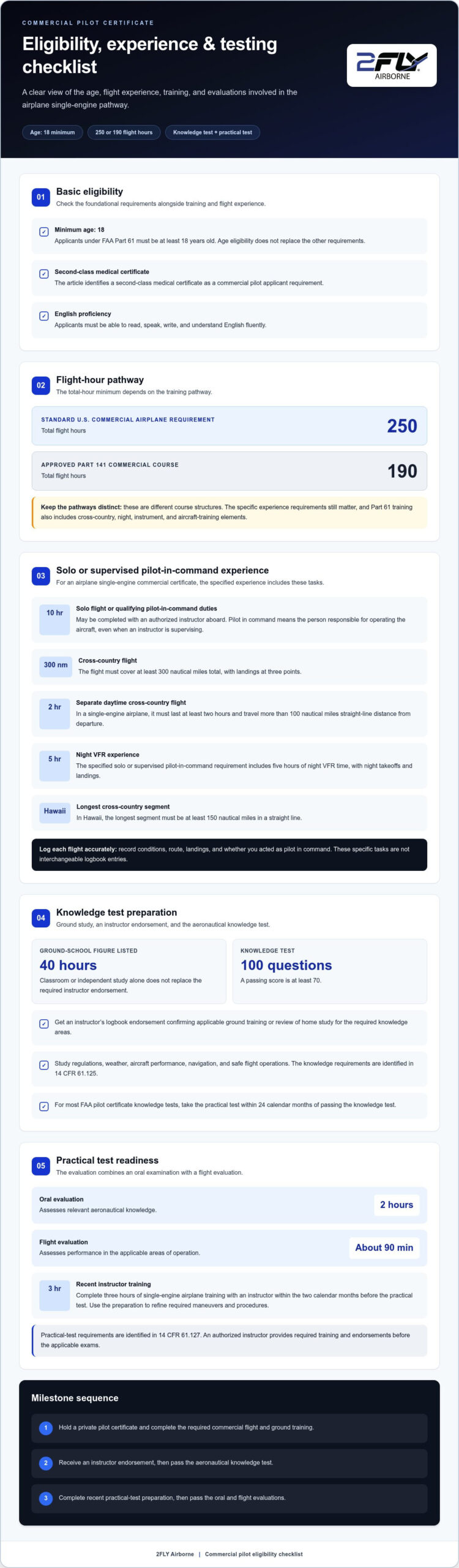
Commercial flight training requires more than reaching a total-hour minimum. For an airplane single-engine commercial pilot certificate, applicants need 10 hours of solo flight or qualifying pilot-in-command duties with an authorized instructor aboard. Pilot in command means the person responsible for operating the aircraft, even when an instructor is supervising.
That experience includes specific cross-country and night tasks. The cross-country flight must cover at least 300 nautical miles total, with landings at three points. A separate daytime cross-country flight must last at least two hours in a single-engine airplane and travel more than 100 nautical miles straight-line distance from departure.
- The specified solo or supervised pilot-in-command requirement includes five hours of night VFR time.
- The night-flight portion also involves takeoffs and landings.
- In Hawaii, the longest cross-country segment must be at least 150 nautical miles in a straight line.
These experience requirements are specific tasks, not interchangeable logbook entries. Record each flight accurately, including its conditions, route, landings, and whether you acted as pilot in command. A private pilot can plan cross-country practice with an instructor, then build qualifying experience through an allowed solo or supervised route. Detailed records help show that each requirement is met.
The total-hour minimum depends on the training pathway. The standard U.S. commercial airplane requirement is 250 total flight hours, while an approved Part 141 commercial course can qualify a student at 190 total hours. These figures describe different pathways; the course structure and the specific experience requirements still matter. Part 61 training also includes cross-country, night, instrument, and aircraft-training elements.
Flight proficiency is assessed separately from logbook totals. Before the practical test, applicants need three hours of instructor training in a single-engine airplane within the two calendar months before the test. This preparation lets you refine required maneuvers and procedures, while the examiner evaluates your performance against applicable standards.
An FAA commercial pilot applicant needs a second-class medical certificate. Commercial pilot training costs in the United States depend on factors such as prior flight hours, aircraft use, and training pathway; providers give a price after a quote request.
Knowledge test and practical checkride
After earning a private pilot certificate, the next stages are commercial flight training, the required knowledge test, and the practical test. An authorized instructor provides the necessary training and endorsements before you take the applicable exams. The FAA commercial pilot knowledge requirements appear in 14 CFR 61.125, and practical-test requirements appear in 14 CFR 61.127.
Ground study prepares you to apply aviation knowledge, not simply recall terms. Commercial pilot training includes ground instruction on subjects such as regulations, weather, aircraft performance, navigation, and safe flight operations. The listed ground-school figure is 40 hours, but completing classroom or independent study alone does not replace the required instructor endorsement.
Before taking the aeronautical knowledge test, you need an instructor’s logbook endorsement. It confirms that you’ve completed applicable ground training or reviewed home study for the required knowledge areas. The test covers subjects relevant to your aircraft category and class, including federal aviation regulations on commercial pilot privileges, limitations, and flight operations.
For the FAA Commercial Pilot Airplane knowledge test, expect 100 questions. A passing score is at least 70. Review missed concepts carefully: understanding why an answer is correct helps you apply the same knowledge during the oral examination and in flight. For most FAA pilot certificate knowledge tests, you must take the practical test within 24 calendar months of passing the knowledge test.
The practical test combines an oral evaluation with a flight evaluation. The examiner assesses your understanding of relevant aeronautical knowledge and your ability to perform the applicable areas of operation. The oral portion is stated as two hours, while the flight portion is about 90 minutes. Treat each as an evaluation of sound judgment, preparation, and consistent technique.
For the airplane practical test, applicants must complete three hours of single-engine airplane training with an instructor within the two calendar months before the test. This focused preparation covers practical-test areas and helps identify skills to refine. Your instructor also confirms the applicable requirements and endorsements before the exam.
- Hold a private pilot certificate and complete the required commercial flight and ground training.
- Receive an instructor endorsement, then pass the aeronautical knowledge test.
- Complete recent practical-test preparation, then pass the oral and flight evaluations.
For structured training from private pilot through commercial certification, explore the FAA Professional Pilot Program and its progression through the required training stages.
Minimum age
The minimum age is a firm eligibility threshold, separate from flight experience and test performance. According to the Federal Aviation Administration, an applicant for a commercial pilot certificate under 14 CFR Part 61 must be at least 18 years old. Meeting that age requirement makes an applicant eligible to pursue the certificate, but age alone does not satisfy the other training, experience, knowledge, and practical-test requirements.
That distinction matters when planning flight training. Someone younger than 18 can consider the sequence of pilot certifications and prepare for later commercial training, but the commercial certificate age minimum remains 18. A training plan should account for the applicant’s age alongside their private pilot certificate, logged experience, endorsements, and readiness for the required tests.
English proficiency is another eligibility requirement. Commercial pilot applicants must be able to read, speak, write, and understand English fluently. These skills support clear communication in training and aviation operations, from understanding written material to communicating accurately with others. International candidates should develop aviation English alongside flight skills, rather than leave language practice until test preparation.
Age also helps clarify the difference between a commercial certificate and airline eligibility. A commercial certificate permits certain flying for compensation or hire, while airline operations have additional qualifications. A pilot serving as a first officer in U.S. Part 121 airline operations must be at least 21 years old and hold an ATP certificate or an ATP certificate with restricted privileges. The commercial certificate is therefore a professional milestone, not automatic qualification for every airline role.
Other qualifications remain distinct from the age threshold. For an airplane single-engine commercial certificate, the Federal Aviation Administration requires 100 hours of pilot-in-command flight time, including 50 hours in airplanes. Applicants also need the relevant training and testing; turning 18 does not replace any flight-hour or proficiency requirement.
Use age as one planning checkpoint. First, identify the certificate and aircraft category you’re pursuing. Then map the required experience, English proficiency, medical qualification, and tests against your training progress. A private pilot working toward a commercial certificate can use this plan to identify remaining milestones. International students can include English practice in their training routine.
A college degree is not mandatory for commercial pilot training, although airline hiring requirements can differ. Focus first on meeting the age threshold, completing the applicable commercial training, and demonstrating the required knowledge and flight proficiency. The FAA commercial pilot eligibility requirements combine these separate qualifications, and no single item replaces the others.
Powered-aircraft and airplane hours
Flight-hour totals measure different kinds of experience, so read each requirement separately. According to the Federal Aviation Administration, a U.S. commercial pilot certificate requires 250 total flight hours. For an airplane single-engine rating, the experience requirements also specify pilot-in-command time, meaning time when you’re responsible for operating the aircraft.
According to the Federal Aviation Administration, applicants seeking an airplane single-engine commercial pilot certificate must have 100 hours of pilot-in-command flight time. That total includes 50 hours in airplanes, according to the Federal Aviation Administration. The figures describe overlapping experience, not separate totals to add together: airplane PIC time can count toward the broader PIC requirement.
Powered-aircraft time is another useful distinction. Commercial airplane experience includes 100 hours in powered aircraft, including 50 hours in airplanes. An airplane is powered, but powered-aircraft experience may involve other eligible aircraft. The aircraft category and class sought affect which experience applies, so logbook entries should identify the aircraft and the role performed on each flight.
Applicants must also complete 10 hours in a turbine-powered, complex, or technically advanced airplane, or a combination of those aircraft. A complex airplane has advanced systems that require specific pilot operation; a technically advanced airplane uses specified electronic displays and navigation equipment. Turbine aircraft use turbine engines rather than the piston engines common in basic training airplanes. These hours develop experience with aircraft systems and operating procedures beyond basic airplane handling.
Choose training aircraft based on the certificate and rating you’re pursuing, then consider how they fit your longer-term aviation goals. An airplane single-engine rating, for example, applies to a different aircraft class than a multi-engine rating. To fly a multi-engine airplane, you need the appropriate rating. Set training priorities around your intended operation, not simply the number of hours in a particular aircraft.
An aircraft type rating is distinct from a category or class rating. It applies to a specific aircraft type where required. In U.S. Part 121 airline operations, a first officer must hold an appropriate aircraft type rating. That airline qualification is separate from earning a commercial pilot certificate; the commercial certificate alone does not supply every qualification needed for airline service.
Organize your logbook by total time, pilot-in-command time, aircraft category, and relevant aircraft experience. This makes it easier to compare your records with each requirement and see what remains. Because FAA commercial pilot eligibility requirements depend on the certificate and rating sought, distinguish airplane experience from broader powered-aircraft experience as you plan.
What Is the Commercial Pilot License?
In the United States, the formal credential is a commercial pilot certificate, although “commercial pilot license” is commonly used. The certificate allows its holder to act as pilot in command of an aircraft flown for compensation or hire. This is a professional step beyond a private pilot certificate, but it does not authorize every type of flight or operation.
Commercial privileges depend on the certificate’s aircraft category, class, and applicable limitations. A certificate for airplane single-engine operations does not automatically qualify its holder to fly a multi-engine airplane. The pilot needs the appropriate rating for that aircraft class, so consider your intended aircraft and operation when planning your career path.
Instrument qualifications can affect passenger-for-hire privileges. An airplane commercial pilot certificate without an instrument rating in the same category and class carries a limitation against passenger-for-hire cross-country flights over 50 nautical miles or flights at night. A commercial airplane pilot without the matching instrument rating also can’t carry passengers for hire at night. These restrictions concern carrying passengers for hire, not the general meaning of commercial certification.
For example, a commercial pilot with an airplane single-engine certificate but no matching instrument rating must account for those limitations before accepting a passenger-for-hire flight. The certificate’s privilege to act as pilot in command for compensation or hire doesn’t erase its restrictions. Adding the relevant instrument qualification can remove the stated limitation after the applicant meets the requirements of § 61.65 for that category and class.
A student pilot certificate serves a different stage of the pathway. It supports training toward later certificates, while commercial privileges come with a commercial pilot certificate. A private pilot certificate is another distinct milestone, with different privileges. Knowing which certificate you hold helps clarify the flying it authorizes.
Airline work also requires qualifications beyond a commercial certificate. For air carriers, the FAA’s minimum certification requirements include a commercial certificate with an instrument rating. A pilot serving as a first officer in U.S. Part 121 operations must hold an ATP certificate or an ATP certificate with restricted privileges. Each airline sets its own minimum experience requirements, so commercial certification is not a guarantee of airline employment.
Think of the commercial certificate as a professional credential with defined privileges, not a universal authorization. Match the certificate and ratings to the aircraft and operation, then account for passenger, night, and instrument limitations. If you’re preparing for commercial flying, explore structured commercial pilot training that connects certification stages with your aviation career goals.
2FLY Airborne: FAA Professional Pilot Program
2FLY Airborne offers an FAA Professional Pilot Program for aspiring commercial pilots. It connects key certification stages, including the Private Pilot Certificate (PPL), Instrument Rating (IR), and Commercial Pilot Certificate (CPL). This pathway can help you organize your training around the qualifications and flight experience discussed in this guide.
Consider the program if you’re planning to begin flight training or progress from private pilot training toward commercial certification. Knowing the FAA requirements gives you a practical foundation for discussing your goals and training sequence with an advisor. Contact 2FLY Airborne to discuss your pilot training plans and next steps.
Make Your Next Training Decision Count
A commercial pilot career takes more than a certificate. Eligibility, documented flight experience, test preparation, and appropriate ratings all shape your next steps. Use the requirements in this guide to set priorities and build a training plan around them.
Structured, safety-focused flight training helps turn those priorities into consistent skills and sound decisions. Keep your long-term goals in view as you progress through each stage, and revisit your plan as your experience develops.
Speak with a 2FLY Training Advisor about your goals and training pathway. Contact 2FLY Airborne about pilot training to start the conversation. Every professional journey begins with a thoughtful next step.
Frequently Asked Questions
Can You Get a Commercial Certificate Without an Instrument Rating?
Yes. You can earn a commercial airplane certificate without an instrument rating, but passenger-for-hire privileges are limited. Before accepting a flight, consider the certificate’s category and class, whether passengers are being carried for hire, and whether the operation involves night or cross-country flying. For pilots planning commercial work, adding the matching instrument rating is an important step toward broader privileges.
What is the first step to becoming a pilot?
Choose the aircraft category that matches your goal, then begin training toward its pilot certificates. For aspiring airplane pilots, the private pilot certificate is the first milestone on the commercial pathway. Early lessons introduce aircraft control, flight planning, and aviation decision-making. A structured training plan shows how these foundational skills develop into the experience and qualifications needed for professional flying.
What are the FAA minimum age requirements for a commercial pilot certificate?
The Federal Aviation Administration sets the minimum age for a commercial pilot certificate under 14 CFR Part 61 at 18 years. Use that threshold as a planning point, not as a reason to delay learning about the career. An applicant can use earlier preparation to build aviation knowledge and understand the certification sequence. Airline eligibility has separate criteria, so the commercial certificate alone doesn’t settle every career requirement.
How many flight hours are required for an FAA commercial pilot certificate under Part 61?
The Federal Aviation Administration requires 250 total flight hours for a U.S. commercial pilot certificate. Keep your logbook organized so you can distinguish total time from pilot-in-command time and aircraft-specific experience. For example, record each flight’s aircraft and role clearly, then compare those entries with the rating you’re pursuing. This makes it easier to identify gaps before scheduling a practical test.
How do Part 61 and Part 141 commercial pilot training requirements differ?
Part 61 and Part 141 are different training pathways, and an approved Part 141 commercial course can qualify a student at 190 total flight hours. That minimum applies to the approved course pathway, not automatically to any school or training plan. Compare the course’s structure with your learning needs and certification goals, and make sure you understand how the required experience fits within its curriculum.
What FAA knowledge and practical tests must commercial pilot applicants pass?
Applicants must pass the applicable aeronautical knowledge and practical tests for the certificate and aircraft sought. For the airplane knowledge test, prepare for regulations, aircraft performance, weather, navigation, and commercial operations. An instructor endorsement is also required. Plan the written exam and checkride as connected milestones, allowing time to address weak areas before demonstrating your knowledge and flying skills to an examiner.
What flight experience requirements apply to commercial pilot applicants, including cross-country and night flying?
Experience requirements include specified cross-country and night flying, as well as broader flight-time requirements for the certificate and rating. Keep separate logbook records for route, distance, landings, time of day, and pilot-in-command duties. Clear details help show which flights meet particular requirements. A cross-country entry should document its route and landings rather than rely on a general note that the flight was cross-country.
What English language proficiency and citizenship or TSA requirements apply to commercial pilot training?
Commercial applicants must be able to read, speak, write, and understand English fluently. Citizenship, visa status, and any applicable security-screening steps are separate from that language qualification. For international students, 2FLY Airborne is an M-1 visa-approved flight school, not an F-1-approved school. Consider the visa pathway and required administrative steps as part of training preparation, alongside aviation English and flight-school enrollment.
Article by
2FLY Airborne
2Fly Airborne is a professional flight training organization dedicated to developing the next generation of skilled, confident, and safety-focused pilots. With decades of combined aviation experience, our team of certified instructors provides structured, real-world training designed to prepare students for both checkrides and long-term success in the aviation industry.
Content Disclaimer
Some blog content is generated with the assistance of automated tools and may not always be fully accurate or up to date. Please verify all aviation-related information with official sources or a certified instructor. For additional guidance or clarification, we encourage you to contact one of our training advisors at 2Fly Airborne.