

A cfii instrument instructor course syllabus is best read as a training roadmap, not a universal FAA checklist. A syllabus PDF can be hard to interpret on its own, especially if it doesn’t show how ground preparation, teaching practice, and flight lessons connect.
That distinction matters because schools and publishers can organize training differently. Instead of assuming one syllabus sets a required sequence for every provider, look for a clear link between instrument topics and the knowledge and teaching skills you’ll use in the aircraft.
This guide explains what a CFII syllabus is for, what it commonly covers, and how ground lessons and flight training can work together. It also offers practical questions to ask before choosing a training path, including how lesson plans support flight practice and how the provider checks that course details are current. With that context, you can evaluate a syllabus more confidently and prepare for structured instruction.
Key Takeaways
- A cfii instrument instructor course syllabus organizes instrument knowledge into teachable lessons linked to flight practice.
- Check how the course connects ground preparation, lesson planning, preflight briefings, flight practice, and debriefing.
- Compare training plans by sequence, instructor feedback, learning resources, progress tracking, and how updates are handled.
- Prepare for each lesson by reviewing its objectives, planning how to teach the topic, practicing, and noting follow-up work.
- 2FLY Airborne offers CFII training. Contact the academy to clarify its current training pathway and course details.
Purpose of a CFII Instrument Instructor Course Syllabus
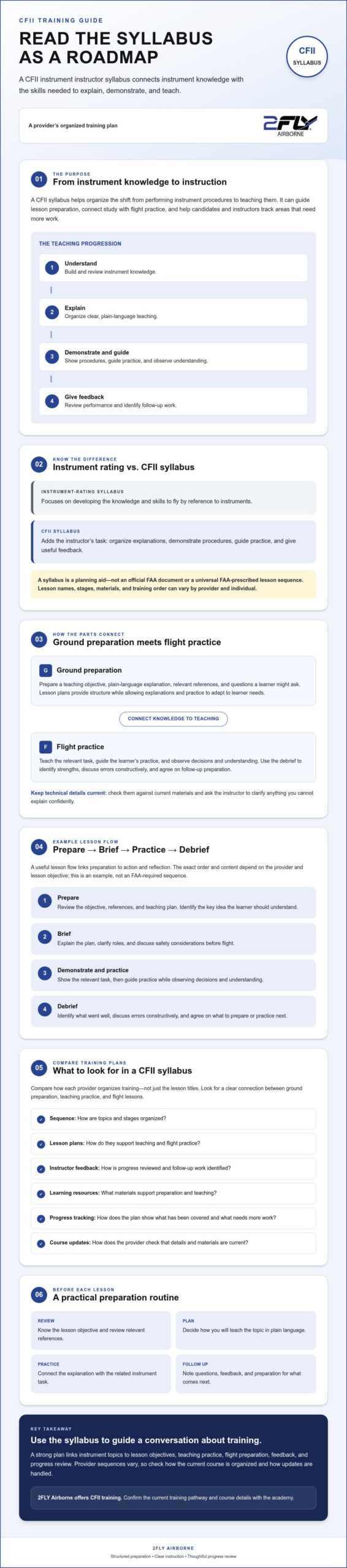
How do you turn instrument knowledge into a clear lesson a student can understand and apply in the aircraft? A cfii instrument instructor course syllabus helps organize the shift from performing instrument procedures to explaining, demonstrating, and teaching them.
A syllabus is a sequenced training plan that links ground preparation, lesson delivery, and flight practice. It’s a planning aid, not an official FAA document or proof that every provider follows the same course sequence.
For a practical look at the instructor checkride experience, watch this overview:
How a CFII syllabus differs from an instrument-rating syllabus
An instrument-rating syllabus focuses on developing the knowledge and skills to fly by reference to instruments. A CFII syllabus adds the instructor’s task: organizing explanations, demonstrating procedures, guiding practice, and giving useful feedback. You need to learn not only how to perform a procedure, but also how to explain its purpose and recognize where a student needs support.
In brief: a CFII syllabus is a provider’s organized plan for developing instrument-instruction skills, not a universal FAA-prescribed lesson sequence. Lesson names, stages, and materials can vary. For broader context on the instructor role and ratings, see Flight Instructor roles and ratings.
Who uses a CFII syllabus and when
Candidates use a syllabus to prepare for lessons, connect study topics with flight practice, and track which areas need more work. Instructors use it to plan training, review progress, and adapt preparation to a candidate’s needs. Experience and training order can differ, so use the document to guide discussion rather than assume every task will happen in the same order.
If you’re reviewing instrument fundamentals, use your instrument-rating study materials alongside the CFII plan. For each topic, ask how the lesson will develop your ability to teach it, not just perform the procedure.
How CFII syllabus stages connect ground lessons and flight training
A syllabus may divide CFII training into stages or modules, but those labels aren’t universal. Review the provider’s current plan to see what each stage covers and how ground preparation supports teaching in the aircraft.
Ground study builds the explanation; flight practice gives you a chance to teach, observe, and refine it. The two reinforce each other, helping turn instrument knowledge into clear, practical, safety-focused instruction.
Ground lessons and instrument teaching preparation
Before a lesson, prepare a teaching objective, a plain-language explanation, relevant references, and questions a learner might ask. For example, for a lesson on an instrument approach, plan how to explain the procedure’s purpose and help a student understand its parts. Check technical details against current materials, and ask your instructor to clarify anything you can’t explain confidently.
Written lesson plans can help make teaching consistent without making every lesson identical. They give you a structure to follow while leaving room to adjust explanations and practice to the learner’s needs. For applicable instructor qualifications and limitations, consult the current FAA flight instructor qualifications in the Electronic Code of Federal Regulations, and confirm regulatory details against current sources.
Preflight, flight practice, and debriefing
A useful lesson flow links preparation to action and reflection. The exact order and content depend on the training provider and lesson objective, so treat this as an example, not an FAA-required sequence:
- Prepare: Review the objective, references, and teaching plan. Identify the key idea the learner should understand.
- Brief: Explain the plan, clarify roles, and discuss safety considerations before flight.
- Demonstrate and practice: Show the relevant task, then guide the learner’s practice while observing their decisions and understanding.
- Debrief: Identify what went well, discuss errors constructively, and agree on what to prepare or practice next.
Feedback is most useful when it gives the learner a specific next step. Rather than saying only that a task needs work, describe what you observed, ask the learner to explain their reasoning, and identify what to focus on next. Keep safe decision-making part of the learning process throughout the lesson.
Use the cfii instrument instructor course syllabus to check how the provider connects preparation, briefing, flight activity, and feedback. Ask how instructors adjust the sequence to individual progress and how they decide when a topic needs more practice.
How to evaluate a CFII syllabus before choosing a training course
A syllabus is useful when you can see how it guides training and how your progress will be reviewed. Compare the provider’s actual process, not just the number of stages or the appearance of a PDF. The cfii instrument instructor course syllabus should help you understand how preparation, teaching practice, and feedback fit together.
Use these questions to compare programs. The answers should describe the provider’s approach, not suggest that every course follows one required sequence.
| What to compare | Questions to ask |
|---|---|
| Learning sequence | How are ground preparation, lesson planning, briefings, flight practice, and debriefing connected? |
| Instructor feedback | How will I present teaching lessons, receive feedback, and identify areas for more practice? |
| Learning resources | Which materials and references are provided, and which should I obtain or verify myself? |
| Progress tracking | How does the instructor document progress and decide what to revisit? |
Questions to ask about lesson plans and progress checks
Ask how you’ll prepare and present a lesson, and whether feedback covers both content accuracy and how clearly you teach. Find out how the instructor identifies knowledge or teaching gaps, and what additional practice may involve. For broader context on instructor training, you can also compare the CFII pathway with a published CFI course guide.
Confirm the materials list before training begins. A lesson plan may point to references without including them, and an older document may not reflect current requirements. Ask which materials you’re expected to have and which references the instructor recommends.
How to check requirements and syllabus currency
Ask for the syllabus revision date and how the provider handles updates. Clarify which syllabus version the course uses and what approval framework applies, if relevant. A provider’s chosen sequence is not itself proof of current FAA eligibility, testing, or endorsement requirements.
Check applicable requirements against current FAA materials rather than relying on a dated PDF or commercial course description. The FAA’s Airman Certification Standards page provides access to certification standards. Confirm which current standard or other FAA reference applies to your specific training and practical test.
If you’re comparing instructor-training options, a published CFI course guide can provide context, but assess each CFII plan on its own details. To clarify 2FLY Airborne’s current CFII training pathway, contact the academy and ask about its syllabus, resources, and progress-review process.
How to prepare for CFII training and get more from each lesson
A syllabus becomes more useful when you treat each lesson as a cycle of preparation, teaching, practice, and reflection. The goal isn’t simply to finish modules. It’s to build the judgment and communication skills to explain instrument concepts clearly and support safe learning.
A repeatable study routine for syllabus modules
Before each session, review the lesson objectives and the materials your instructor identified. Prepare a concise explanation of the topic, then note any points you can’t yet explain confidently. Ask yourself what purpose a procedure serves, how you’d describe it to a learner, and what question could reveal a misunderstanding.
Use this routine to carry preparation through the lesson and into your next study session:
- Review: Read the objectives and the references your instructor recommends.
- Prepare: Outline a clear explanation and identify questions to resolve.
- Brief: Confirm the lesson’s focus and expectations with your instructor before practice.
- Practice: Teach or apply the topic, staying open to correction and guidance.
- Debrief: Record specific feedback, strengths to build on, and areas to revisit.
- Follow up: Review unresolved points before the next lesson and ask for clarification when needed.
Keep notes practical. Instead of writing “review approaches,” record the specific concept or explanation that needs work. If you’re unsure about an eligibility, test, endorsement, or other requirement, ask your instructor and verify it using current FAA materials. Don’t guess based on a syllabus or an online post.
Common syllabus-use mistakes to avoid
Checking off a module shows that you covered its content, but it doesn’t prove by itself that you’re ready to teach it. Readiness also involves explaining the topic accurately, responding to learner questions, and applying instructor feedback. Your instructor can help identify what needs more practice.
Avoid memorizing procedures without understanding their purpose. A flight instructor needs to make the reasoning understandable, not just repeat steps. A written lesson plan can support that work, but it should help you teach rather than become a script that stops you responding to the learner.
Online materials can help you prepare, but they don’t replace instructor direction or current requirements. Use the cfii instrument instructor course syllabus as a working guide, and adapt your study plan to your progress. For questions about preparing for CFII training or 2FLY Airborne’s current pathway, contact the academy.
How 2FLY Airborne can help you explore a CFII training pathway
2FLY Airborne lists Certified Flight Instructor Instrument (CFII) training among its FAA pilot-training offerings. This confirms that CFII training is part of the academy’s offerings, but it doesn’t establish a particular syllabus, course sequence, duration, or current availability. Confirm those details directly before making plans.
A conversation with the academy can help you understand how your existing certificates and experience relate to the next step. It can also clarify current training details, without relying on an old syllabus PDF or assuming another provider’s lesson plan applies.
What to confirm with a 2FLY Training Advisor
Ask whether CFII training is currently available and how the pathway is organized. Request details about the current training documents and learning materials, and clarify how preparation and progress are reviewed.
Discuss your background so the academy can address questions relevant to your situation. For example, you might ask:
- What current entry requirements should I verify for my circumstances?
- Which syllabus version or training documents are currently used?
- What materials should I prepare or obtain?
- How is training scheduling discussed, and what factors may affect my progress?
- How do my existing instructor experience, certificates, and flight background fit into the pathway?
Confirm regulatory details, including eligibility and testing information, against current FAA materials. Requirements and individual training timelines can change or vary, so a discussion with the academy can clarify its current process but doesn’t replace checking the applicable rules.
Continue planning your professional pilot pathway
CFII training may be one step in a broader aviation training plan. If you’re comparing how instructor training fits alongside other pilot certifications, explore 2FLY Airborne’s FAA airline pilot program for additional program context. Use that information as a starting point, then ask how a CFII goal relates to your experience and objectives.
Keep the essentials in view: use the syllabus as a training aid, confirm current course details, and verify requirements before acting on them. Safe, structured preparation supports sound instrument instruction and professional development. For questions about CFII availability, the current training pathway, or your next step, contact 2FLY Airborne.
Take the Next Step Toward CFII Training
A cfii instrument instructor course syllabus is a roadmap for developing teaching skills alongside instrument knowledge, not a universal sequence. Use it to understand how preparation, lesson delivery, flight practice, and feedback connect. Then ask how the provider tracks progress and keeps training information current.
Before choosing a pathway, confirm the course structure and materials with the training provider, and check applicable eligibility and testing details against current FAA sources. A clear plan supports focused preparation, while individual experience and progress can shape the training process.
2FLY Airborne lists Certified Flight Instructor Instrument training among its offerings and provides FAA pilot training and instructor certifications. To explore how CFII training may fit your goals, contact the academy and ask about its current pathway.
For help clarifying current CFII training details and your next steps, contact 2FLY Airborne with your questions.
Frequently Asked Questions
What does a CFII instrument instructor course syllabus include?
A CFII syllabus commonly outlines ground preparation, lesson-planning practice, flight instruction, and progress review. It may connect instrument topics with opportunities to explain, demonstrate, and teach them, but the exact content and sequence depend on the provider. Use the cfii instrument instructor course syllabus to understand how the course is organized, then confirm which learning materials, teaching activities, and progress checks are included with the training provider.
Is there one FAA-required CFII syllabus?
No single lesson-by-lesson syllabus applies universally to every CFII training provider. A school or publisher may organize training into its own stages, while applicable certification requirements and testing standards must be checked against current FAA materials. A syllabus can help structure preparation, but don’t treat its sequence as official FAA guidance. Ask the provider which version it uses and verify current requirements independently.
How is a CFII syllabus different from an instrument rating syllabus?
An instrument-rating syllabus focuses on developing a pilot’s ability to fly using instrument references and procedures. A CFII syllabus also develops the ability to teach that material. Candidates practice organizing explanations, demonstrating tasks, guiding learner practice, and using feedback. The plans may cover related instrument concepts, but their learning objectives differ: one develops pilot skills, while the other emphasizes instructional skills.
Can I use a free CFII syllabus PDF to prepare for training?
Yes, a free PDF can help you preview topics and see how one provider organizes training. Check who published it, when it was revised, and whether its content matches the course you’re considering. Don’t assume it reflects current requirements or another school’s sequence. Treat it as a study aid, then ask your instructor which references to use and confirm regulatory details with current FAA materials.
How do ground lessons and flight lessons fit into CFII training?
Ground preparation helps you understand a topic and plan how to teach it. Flight lessons let you apply that plan through briefing, demonstration, learner practice, and debriefing. The sequence can vary by provider and lesson objective. After practice, instructor feedback can help you identify what to strengthen before moving on. Ask how your course connects ground study with flight instruction and reviews your progress.
How do I know whether a CFII syllabus is current?
Check the document’s revision date and ask the provider whether it remains in use and how updates are handled. Confirm which course version and training framework apply, then verify current eligibility, testing, and endorsement information using FAA materials. A recent-looking PDF or online description alone doesn’t establish that requirements are current. If details conflict, ask the training provider and check the relevant FAA source before relying on them.
What should I ask a flight school before starting CFII training?
Ask whether CFII training is currently available, how it’s organized, and what materials you’ll need. Find out how instructors review lesson plans, provide feedback, and identify areas for more practice. Discuss how your existing certificates and experience relate to the pathway, and clarify scheduling and current documentation. Verify applicable requirements with current FAA materials. Contact 2FLY Airborne to ask about the academy’s current CFII pathway.
Article by
2FLY Airborne
2Fly Airborne is a professional flight training organization dedicated to developing the next generation of skilled, confident, and safety-focused pilots. With decades of combined aviation experience, our team of certified instructors provides structured, real-world training designed to prepare students for both checkrides and long-term success in the aviation industry.
Content Disclaimer
Some blog content is generated with the assistance of automated tools and may not always be fully accurate or up to date. Please verify all aviation-related information with official sources or a certified instructor. For additional guidance or clarification, we encourage you to contact one of our training advisors at 2Fly Airborne.