
What if the prestigious four-year degree you’re eyeing is actually the primary obstacle standing between you and a major airline cockpit? It’s natural to feel torn when choosing between an accelerated flight school vs university aviation program, particularly when the current hiring environment rewards those who reach their seniority number first. You’re likely weighing the traditional college experience against the urgency of a career that values time above almost everything else.
You don’t want to spend years in a classroom while your peers are already building hours toward their ATP certificate. The fear of missing the peak of the hiring cycle is a valid concern for any high-achiever. This guide will provide the professional clarity you need to decide which route aligns with your ambition to become an industry-prepared professional.
We’ll deliver a direct comparison of training structures, analyze the true cost-benefit ratio of early career earnings, and map out the most efficient trajectory to a global aviation career. Prepare to see the flight training landscape through the lens of a professional pilot who values technical mastery and long-term rewards.
Key Takeaways
- Master the seniority race by comparing the 12 month timeline of an immersive program against the traditional 48 month university track.
- Evaluate the critical trade-offs between an accelerated flight school vs university aviation program to determine which path secures your airline seniority number fastest.
- Discover why most major airlines have shifted to degree preferred status in 2026, allowing you to prioritize flight proficiency and immediate entry.
- Analyze the financial impact of fixed-price training versus per-credit university tuition to maximize your return on investment.
- Use our strategic checklists to identify if you’re better suited for a high-intensity professional program or a traditional collegiate environment.
Understanding the Structural Differences: Accelerated Training vs. Collegiate Aviation
Understanding the structural differences between an accelerated flight school vs university aviation program is the first step in mapping your career. An accelerated school operates as a dedicated training center where the singular focus is on moving through certifications. It’s an immersive, vocational approach designed to prepare you for the airline flight deck in months rather than years.
University programs take a broader approach by integrating flight training into a four-year Bachelor of Science degree. These institutions follow a strict Part 141 regulatory framework, which is highly structured and approved by the FAA for specific training sequences.
Accelerated schools may utilize Part 61 or Part 141, but they often favor the flexibility of Part 61 to help students progress as fast as their skills allow. For a comprehensive overview of flight training and how these regulations differ, it’s helpful to look at the foundational requirements for each license. Part 61 allows for a more personalized pace, which is why it’s the backbone of many fast-track programs.
Visualizing the day-to-day reality of these paths can help you identify which environment matches your learning style. Watch this detailed comparison to better understand the core differences between these two training architectures:
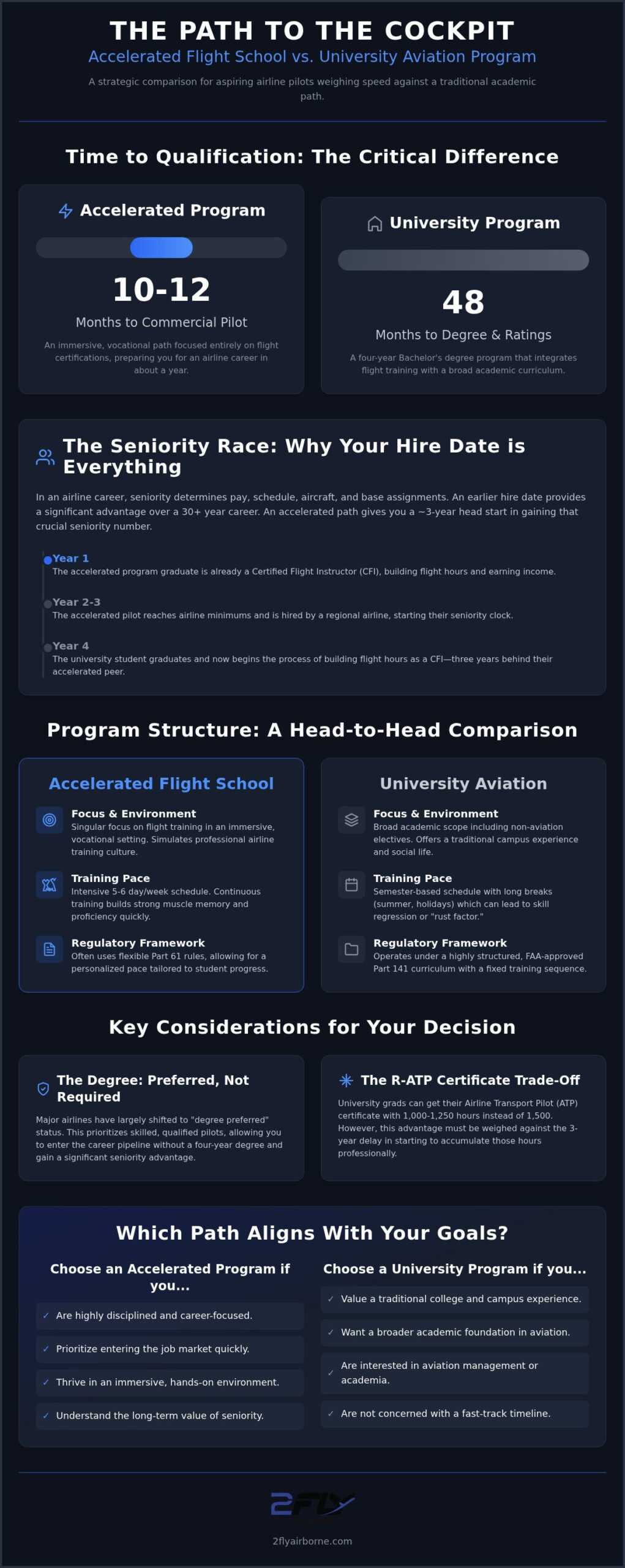
The “Zero to Hero” model at an accelerated school is a direct pipeline. You start with no experience and finish with your Commercial Pilot Certificate and Flight Instructor ratings in a continuous, uninterrupted flow. A university syllabus is interrupted by summer breaks, midterms, and non-aviation electives. These gaps can sometimes lead to a “rust factor” in your flying skills, requiring extra review hours that can add to your total training time.
The Immersive Nature of Accelerated Programs
Success in a high-speed environment requires a five to six day a week commitment. This constant immersion builds superior muscle memory because you’re applying what you learned yesterday to your flight today. You aren’t just a student; you’re a professional in training. The FAA Professional Pilot Program exemplifies this structure, providing a clear, goal-oriented path that mirrors the intensive training rhythm you will eventually encounter at a major airline.
The Academic Scope of University Aviation
University life offers a traditional campus experience and networking opportunities that extend beyond the hangar. You’ll complete core classes in subjects like aviation law, aerodynamics, and meteorology alongside standard university electives.
The primary technical advantage here is the Restricted ATP (R-ATP) certificate. This allows graduates from approved programs to apply for airline jobs with 1,000 or 1,250 flight hours instead of the standard 1,500 hours. You must weigh this reduction against the four years spent in school before you can begin building those professional hours.
The Seniority Race: Why Training Speed is the Critical Variable in 2026
Imagine standing in a line where every person who joins after you will earn less, work harder, and have fewer choices for the rest of their career. This is the reality of the airline seniority system. Your hire date is the most critical metric of your professional life, determining your rank on the master seniority list from day one.
When choosing between an accelerated flight school vs university aviation program, the primary factor isn’t just the curriculum; it’s the calendar. An accelerated program can move you from zero experience to a Commercial Pilot Certificate in roughly 10 to 12 months. In contrast, a university program typically requires 48 months to confer a degree alongside your ratings. While you wait for graduation, thousands of other pilots are securing their place on the seniority list ahead of you.
The 2025 Boeing Pilot and Technician Outlook projects a demand for 660,000 new pilots globally through 2044. This massive requirement creates a window of opportunity that rewards those who can enter the workforce quickly. Every month spent in a classroom instead of building hours toward official FAA pilot requirements is a month of lost seniority that can never be recovered.
Seniority and Quality of Life
Seniority isn’t just a number; it is your quality of life. It dictates whether you spend holidays with your family or in a hotel room across the country. Higher seniority allows you to choose your preferred base, bid for better schedules, and transition to wide-body aircraft sooner. Entering the industry during a hiring surge positions you to move into the Captain’s seat at a major airline years earlier than those who delayed their training.
Opportunity Cost of the Four-Year Degree
Opportunity cost in the context of pilot seniority is the total value of the wages, benefits, and career progression lost by choosing a longer training path over a faster one. If you spend three additional years in school, you aren’t just losing three years of starting pay. You’re losing three years of top-tier Captain’s pay at the end of your career, which can exceed $400,000 annually in 2026. Timing the market is essential to maximizing your lifetime earnings. If you’re ready to start your journey, exploring an FAA Professional Pilot Program can help you secure that seniority number much sooner.
The Degree Requirement Reality: Evaluating Career Stability vs. Immediate Entry
A common misconception often stalls the careers of aspiring pilots before they even leave the ground. You don’t need to believe the myth that the FAA mandates a four-year university degree for all commercial airline positions. In reality, it’s a fact that no such federal law exists, and many successful captains have built elite careers without ever stepping foot in a traditional university classroom.
The 2026 hiring landscape reflects a significant shift toward proficiency and experience. While major carriers historically held a hard line on degrees, most have transitioned to a “degree preferred” status to widen their talent pool. This change makes the choice between an accelerated flight school vs university aviation program more about career timing than basic eligibility.
The 2025 Boeing Pilot and Technician Outlook projects a demand for 660,000 new pilots globally through 2044. This massive requirement has forced airlines to prioritize flight hours and technical skill over traditional academic credentials. Proficiency in the cockpit is the ultimate currency in today’s aviation market.
Major vs. Regional Airline Requirements
Regional airlines are currently the primary engine for pilot hiring, and they rarely require a degree for entry-level First Officer roles. They value candidates who can transition from training to the flight deck with minimal friction. For those who still desire a collegiate background for long-term career stability, the degree program with airline pilot training offers a path to secure both credentials without sacrificing speed.
A degree can provide a competitive edge during rare economic downturns when hiring slows. However, many pilots now choose to finish their degrees online while working as regional pilots. It’s a strategy that allows them to build seniority and earn a professional salary simultaneously.
The Value of Focused Professional Training
Airlines are increasingly looking for the discipline and high-stress management skills developed in immersive environments. The intensity of a professional program demonstrates a candidate’s ability to handle the rigorous training cycles found at major airlines. You’ll find that technical mastery often speaks louder than a diploma in a specialized field.
Recruiters often prioritize a clean checkride record and strong instructor recommendations over a high GPA in non-aviation subjects. Success in your initial certifications is the clearest indicator of your future performance in a jet transition course. Modern bridge programs and airline partnerships have largely replaced the degree as the primary filter for new talent. These pathways focus on your technical readiness and professional maturity rather than your academic history.
Financial Breakdown: Comparing Tuition, Time-Opportunity Costs, and ROI
Financial planning for your flight deck career shouldn’t feel like navigating through a storm without an altimeter. You need to look past the top-line tuition numbers to understand the true cost of your journey to the airlines. Comparing an accelerated flight school vs university aviation program reveals a significant difference in how your capital is deployed and when you begin to see a return on that investment.
Professional programs typically operate on a fixed-price model, which provides a level of financial predictability that universities often struggle to match. In a collegiate setting, you’ll likely encounter per-credit tuition increases, lab fees for every flight hour, and the high cost of non-aviation electives that don’t directly contribute to your pilot skills. These hidden costs can inflate your total investment far beyond the initial estimates provided in a campus brochure. Choosing a path with a flat-fee structure allows you to lock in your costs and avoid the volatility of fuel surcharges or annual tuition hikes.
Securing the necessary capital is a major step, and there are robust options for pilot training financing available for both paths. However, the efficiency of how you use those funds will dictate your long-term debt-to-income ratio. It’s vital to choose a training architecture that prioritizes your transition into a paying cockpit as quickly as possible.
Tuition vs. Total Investment
A 12 month immersive program requires you to cover only one year of housing and personal living expenses. A four year degree quadruples that timeline, forcing you to fund 48 months of room and board before you can even begin your professional career. Fixed-price tuition acts as a financial hedge, ensuring that market volatility doesn’t derail your training progress mid-syllabus. When you factor in the availability of on-campus housing for immersive training, the professional path often represents a much leaner total investment.
Return on Investment (ROI) Timelines
The most critical financial metric is your time to first paycheck. Graduates of professional programs often start earning as a Certified Flight Instructor (CFI) within a year of starting their first lesson. This allows you to build the 1,500 hours required for the airlines while being paid to fly, rather than paying for every hour in a classroom. The 2025 Boeing Pilot and Technician Outlook projects a demand for 660,000 new pilots globally through 2044. This sustained demand ensures that those who finish quickly can transition to high-paying regional roles while university students are still completing their junior year. If you’re ready to evaluate your financial options, review our financing pathways to see how you can reach the flight deck sooner.
Strategic Decision Making: Choosing the Right Flight Training Architecture
How do you define your success five years from today? Your answer determines whether you should pursue an accelerated flight school vs university aviation program. The best architecture is the one that aligns with your specific professional timeline and personal learning style.
Choosing the right path requires an honest assessment of your drive and your ultimate career destination. If your priority is to reach an airline seniority number as fast as possible, you likely fit the profile of an Accelerated Candidate. These individuals are often career changers or high-achievers who thrive in a high-intensity, immersive environment.
- You’re ready for a full-time, six-day-a-week commitment to your craft.
- You value speed to market and early entry into the seniority race.
- You prefer vocational, hands-on training over traditional classroom electives.
Conversely, a Collegiate Candidate might value the broader social and networking aspects of a university campus. This path is often preferred by those targeting military aviation or those who want a backup degree before entering the industry. It’s a slower pace that allows for a traditional four-year transition into professional life.
Before committing to any program, you must see the operation in person. Attending aviation events and visiting training facilities allows you to gauge the culture and professionalism of the organization. A first-hand look at the fleet and maintenance hangars tells you more than any marketing material ever could.
Questions to Ask Before You Enroll
- What is the current instructor-to-student ratio to ensure I get consistent flight time?
- How many aircraft are available for my specific training block to avoid scheduling delays?
- What is the school’s historical placement rate at regional airlines for graduates?
The 2FLY Airborne Advantage
The FAA First Officer Program is designed to bridge the gap between initial certification and professional employment. By training in a high-traffic, professional environment, you develop the situational awareness and technical discipline required for jet operations. The 2025 Boeing Pilot and Technician Outlook projects a demand for 660,000 new pilots globally through 2044, and our structure ensures you’re ready to meet that demand.
Focus on quality of instruction and rigorous safety standards above all else. Your training is the foundation of a 40 year career, and cutting corners on safety is never an option. Choose a partner that treats your development with the seriousness a professional aviation career demands. Safe, structured training remains the most important factor in your long-term success.
Deciding between fast-track training and a university degree depends on your personal goals and the urgency of your career timeline. While universities offer a broad academic foundation, accelerated programs provide the fastest route to airline seniority and long-term earnings. If you have remaining questions about which path is right for you, reach out to a 2FLY Training Advisor to discuss your specific career goals.
Take Command of Your Aviation Future
Choosing between an accelerated flight school vs university aviation program is a strategic decision that shapes your entire professional life. The evidence is clear that the fast-track path prioritizes the seniority number that dictates your future earnings and quality of life. By focusing on a direct, career-focused syllabus, you can enter the workforce during this historic hiring window without the delays of a traditional four-year degree.
Success in this industry requires technical mastery and a reliable partner to guide your journey. Our professional instructor network and fixed-price tuition options provide the transparency and elite mentorship you need to become an industry-prepared professional. Safe, structured training remains the most critical foundation for your long-term advancement and international mobility.
Ready to fast-track your career? Speak with a 2FLY Training Advisor today. Our team is here to help you navigate the requirements and launch your international career with confidence. Please reach out to a 2FLY Training Advisor with any remaining questions about your specific pilot path.
Frequently Asked Questions
Is an accelerated flight school harder than a university program?
Accelerated training is more intensive but not necessarily harder in technical terms. It requires a full-time commitment of five to six days a week, focusing exclusively on flight proficiency and technical mastery. University programs spread this training over four years, which can feel less pressurized but requires you to balance academic coursework with flight labs.
Can I get financial aid for an accelerated flight school in 2026?
You can access various private financing options for an accelerated flight school vs university aviation program in 2026. While federal student loans are typically reserved for degree-granting institutions, specialized lenders provide competitive loans for professional pilot programs. These financial products are designed for the high return on investment of a pilot career, often featuring deferred payments until you reach a paying cockpit.
Do major airlines like Delta or United prefer university graduates?
Major airlines like Delta and United have shifted to a degree preferred rather than a degree required hiring policy in 2026. Recruitment teams now prioritize proficiency, flight hours, and a clean checkride record over traditional academic credentials. Securing an early seniority number through a fast-track program is often viewed as a tactical advantage for reaching the Captain’s seat sooner.
What happens if I start an accelerated program and decide I want a degree later?
Starting an accelerated program does not prevent you from earning a degree later in your career. Many pilots choose to finish their bachelor’s degree online while working as a First Officer at a regional airline. This strategy allows you to build seniority and earn a professional salary while simultaneously completing your academic requirements for future promotions.
How much faster can I reach 1,500 hours in an accelerated program?
You can reach the 1,500 hour requirement significantly faster through an accelerated path because you begin building hours as a paid instructor within 10 to 12 months. University students often don’t start their full-time hour-building phase until after graduation in their fourth year. This head start allows you to reach a major airline cockpit while collegiate peers are still completing their senior year coursework.
Are university aviation programs safer than private flight schools?
Safety is a result of organizational culture and maintenance standards rather than the type of institution. Both university programs and professional flight schools must adhere to rigorous FAA regulations and safety oversight. The 2025 Boeing Pilot and Technician Outlook projects a demand for 660,000 new pilots globally through 2044, and every reputable school prioritizes safety to ensure their graduates are industry-prepared for this global demand.
Can international students attend accelerated flight schools in the US?
International students can attend accelerated flight schools in the United States using M-1 or F-1 vocational visas. These programs are highly valued globally because they provide FAA certifications that are recognized as an international gold standard. Many elite schools offer integrated housing and support to help international candidates transition smoothly into the professional training environment.
Article by
2FLY Airborne
2Fly Airborne is a professional flight training organization dedicated to developing the next generation of skilled, confident, and safety-focused pilots. With decades of combined aviation experience, our team of certified instructors provides structured, real-world training designed to prepare students for both checkrides and long-term success in the aviation industry.
Content Disclaimer
Some blog content is generated with the assistance of automated tools and may not always be fully accurate or up to date. Please verify all aviation-related information with official sources or a certified instructor. For additional guidance or clarification, we encourage you to contact one of our training advisors at 2Fly Airborne.