What if the secret to reaching the captain’s seat months ahead of your peers isn’t found in a textbook, but in the specific coordinates of your training base? You likely already know that Florida is famous for its sunshine, but as an aspiring professional, you’re more concerned with how those 350 flyable days per year impact your checkride timeline and training budget. Understanding the professional benefits of flight training in Florida is the first step toward transforming your ambition into a career.
It’s natural to feel some anxiety about the complexity of FAA versus EASA standards or the total time it takes to earn your wings. We’ve designed this 2026 guide to provide clarity on how the Sunshine State serves as a definitive gateway to an international career. You’ll discover why Florida remains the premier global destination for pilot education and how it can accelerate your journey to a professional flight deck.
We’ll examine the geographic advantages that allow for consistent progress and the high density of complex airspace that builds elite level skills. From navigating busy international hubs to understanding the direct career pipelines available, this overview ensures you’re grounded in the practical realities of your training journey. You’ll gain the confidence to choose a path that offers both technical mastery and long term professional mobility.
Key Takeaways
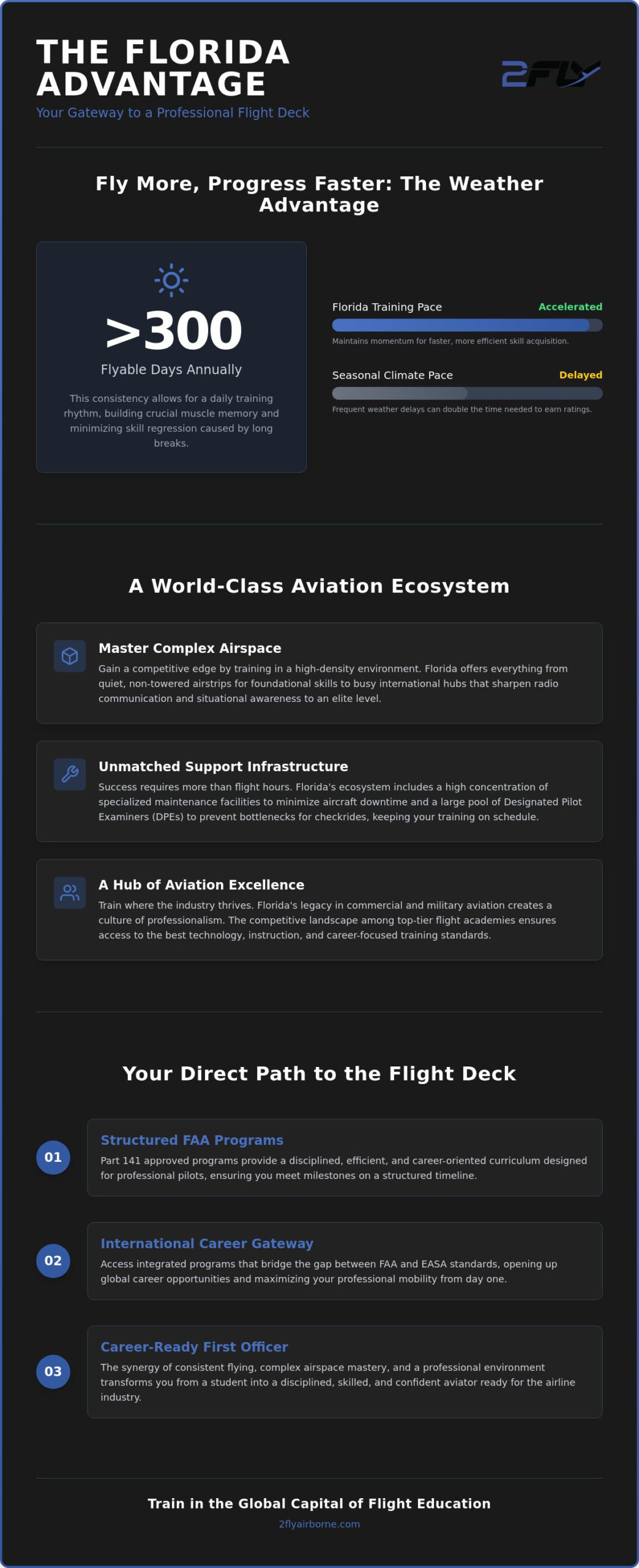
- Leverage over 300 days of annual flyable weather to maintain training continuity and build muscle memory faster than in seasonal climates.
- Gain a competitive edge by mastering complex airspace and busy international traffic, which sharpens radio communication and situational awareness skills.
- Discover how the professional benefits of flight training in Florida include access to integrated programs that bridge the gap between FAA and international EASA standards.
- Evaluate the structural advantages of Part 141 environments and total immersion through on-campus housing to stay focused on your career milestones.
The Strategic Advantage of Florida for Aspiring Pilots
One of the primary benefits of flight training in Florida is the ability to move beyond a recreational mindset and embrace a truly vocational environment. The professional standards here are shaped by a massive concentration of talent and infrastructure. To better understand the logic behind selecting this region for your career, watch this helpful video:
A Legacy of Aviation Excellence
The state’s prominence in the sky isn’t accidental. Decades of investment have shaped a landscape where aviation is a primary economic driver. You’ll find a rich history of training both commercial and military aviators here, creating a culture of excellence that permeates every flight school. For a broader look at the state’s aerospace impact, you can explore the history of Aviation in Florida. This legacy ensures that the training you receive meets the high expectations of global airlines.
Infrastructure Built for Student Success
Success in a professional program requires more than just a plane and an instructor. Florida provides a superior density of airports, ranging from quiet non-towered strips to complex, high-traffic international hubs. This variety allows students in the FAA Professional Pilot Program to build diverse skills in a single afternoon. This “Zero to Hero” capability is supported by a robust network of services:
- Access to specialized maintenance facilities that minimize aircraft downtime.
- A high concentration of Designated Pilot Examiners (DPEs) to keep checkride schedules on track.
- Proximity to major aerospace manufacturers and service hubs that foster a professional atmosphere.
The sheer volume of flight academies in the area creates a healthy, competitive environment. This ensures that training standards remain world-class as schools strive to offer the best technology and instruction. By training in this concentrated hub, you’ll realize the full benefits of flight training in Florida through a vocational environment that prizes efficiency and professional discipline.
Optimal Flight Conditions and Maximum Training Continuity
Imagine waking up for a scheduled flight lesson only to find a low ceiling of grey clouds for the third week in a row. For students in many parts of the world, this is a standard winter reality that stalls progress and drains motivation. In Florida, the reality is over 300 days of flyable weather annually. This consistency isn’t just about convenience; it’s the foundation of professional skill development.
One of the most significant benefits of flight training in Florida is the ability to maintain a daily training rhythm. Rapid repetition builds muscle memory. When you fly consistently, your hands and feet learn the controls instinctively. Gaps in training lead to regression, where the first portion of a lesson is spent remembering what you learned weeks ago. Florida eliminates this wasted time.
The Impact of Year-Round Sunshine on Your Timeline
Speed is a professional asset in the aviation industry. Students in seasonal climates often take twice as long to reach their Private Pilot Certificate (PPL) or Instrument Rating (IR). By maintaining a steady schedule, you keep your momentum high. This allows you to move through the FAA Professional Pilot Program with the focus required for first-attempt checkride success.
Continuity also impacts your psychological readiness. When you’re in the cockpit every day, the environment becomes a second home rather than a foreign space. This familiarity reduces anxiety during critical phases of training. You’ll find that your progression from solo flights to complex cross-country navigation feels like a natural evolution rather than a series of disconnected hurdles.
Cost-Efficiency Through Accelerated Learning
Time is money in aviation, and every hour spent re-learning maneuvers after a weather delay is an hour added to your total investment. Training in a stable climate minimizes these redundant costs. Beyond the immediate savings, finishing your training months earlier means you enter the workforce sooner. Considering Florida’s aviation economic impact, it’s clear the state prioritizes a robust environment for pilots to thrive.
A faster timeline leads to earlier entry into the professional job market, allowing you to begin earning a senior officer’s salary sooner. If you’re looking for a structured path that maximizes these climate advantages, you might consider speaking with an advisor about the FAA First Officer Program. This focused approach ensures that every flyable day is used to advance your career goals.
Navigating Diverse Airspace and Complex Infrastructure
Many students assume that the quietest flight path is the easiest path to a license. While a rural airfield might feel less intimidating initially, it doesn’t prepare you for the high-intensity environment of a commercial flight deck. One of the most critical benefits of flight training in Florida is the immediate exposure to complex, high-density airspace. You’ll learn to operate alongside corporate jets, international airliners, and hundreds of other training aircraft from your very first hours.
This isn’t just about learning to fly the plane; it’s about learning to manage the environment. The Florida Department of Transportation Aviation Office oversees a massive network of over 100 public-use airports. This infrastructure creates a training ground that mirrors the complexity of global airline routes. By the time you reach your checkride, navigating busy sectors will feel like a routine task rather than a stressful event.
Training in this environment forces you to develop “head-on-a-swivel” habits that become second nature. You aren’t just flying in a vacuum; you’re part of a living, breathing aviation system. This constant engagement with varied traffic types builds a foundation of professionalism that sets you apart during airline interviews. It’s a strategic investment in your future situational awareness.
Mastering Radio Proficiency and ATC Interaction
Radio confidence is often the biggest hurdle for new pilots. In Florida, you’re forced to overcome this quickly. You’ll interact with Air Traffic Control (ATC) in diverse settings, from small towered airports to some of the busiest approach control sectors in the country. This frequent interaction builds a level of professional communication that simply can’t be replicated in quieter regions.
You’ll hear a variety of international accents and professional terminology every day. This exposure is vital for anyone aiming for an international career. It prepares you to listen, process, and respond with the precision required of a commercial first officer. Students in the FAA Professional Pilot Program benefit from this immersion, turning radio work into a subconscious skill before they even reach their commercial checkride.
Situational Awareness in High-Density Environments
Situational awareness is the ability to understand everything happening around your aircraft at once. In Florida’s crowded skies, you’ll learn to “see and avoid” with expert precision. You’ll navigate complex VFR corridors and transition routes that require strict adherence to altitudes and headings. These challenges aren’t obstacles; they’re the building blocks of a superior pilot.
Airlines specifically value pilots who have trained in these high-activity sectors. They know that a Florida-trained pilot is already comfortable with traffic density and complex instructions. You’ll enter your first airline job with a higher baseline of confidence and technical mastery. This real-world preparation ensures that your transition from a trainee to an industry-prepared professional is seamless and efficient.
Selecting the Right Flight Academy for Your Career Goals
Identifying Florida as your training destination is only the first half of the equation. To truly capitalize on the benefits of flight training in Florida, you must select an institution that aligns with the rigorous standards of global airlines. The right academy acts as a bridge, moving you from a student mindset into a professional vocational environment where technical mastery is the daily expectation.
Prospective pilots often face a choice between Part 61 and Part 141 training environments. While Part 61 offers flexibility for hobbyists, career-track students almost always favor the structured, FAA-approved syllabus of a Part 141 school. This structured approach ensures every hour in the cockpit is tied to a specific learning objective, leading to a more predictable graduation date and higher checkride pass rates.
Part 141 vs. Part 61: Which Path is Faster?
Efficiency is the hallmark of a professional program. Under Part 141 regulations, flight schools must adhere to a strict curriculum that has been vetted by the FAA for its educational effectiveness. This rigor is why airlines often prefer candidates from these environments; they know the pilot has survived a disciplined, high-standard training regime.
The 2025 Boeing Pilot and Technician Outlook projects a demand for 660,000 new pilots globally through 2044. Meeting this massive demand requires an accelerated path that doesn’t compromise on safety or skill. Choosing a structured program allows you to reach the flight deck with the confidence of an industry-prepared professional.
The Role of On-Campus Housing and Community
Total immersion is a powerful tool for rapid learning. Living in integrated on-campus housing allows you to engage in “hangar talk” with peers, reinforcing lessons long after the propellers have stopped turning. This community atmosphere is especially vital for international students who are navigating a new country while simultaneously mastering the skies.
A world-class academy also provides comprehensive administrative aid, including M-1 and F-1 visa sponsorship. This level of support ensures you can focus entirely on your certifications rather than logistical hurdles. If you are ready to begin this journey, you can explore the FAA Professional Pilot Program to see how an integrated approach accelerates your career.
Finally, assess the quality of the training fleet and simulators. Modern “glass cockpit” avionics are now the industry standard, and training on this technology from day one is essential. When combined with dual FAA and EASA standards, you gain the international professional mobility required to fly for airlines anywhere in the world.
Launching Your International Career with 2FLY Airborne
How do you turn a logbook full of hours into a lifelong profession? At 2FLY Airborne, we recognize that your training is a strategic investment in your future. We position ourselves as your expert mentor, guiding you through the rigorous demands of the industry to ensure you’re prepared for the highest levels of the profession. Our focus remains on the end result: your professional career.
The benefits of flight training in Florida extend far beyond the cockpit. By training in a world-class hub, you gain the technical mastery and international reach required to fly for global carriers. Our FAA Professional Pilot Program is designed to be a direct pipeline, moving you seamlessly from a trainee to an industry-prepared professional ready for the flight deck.
A Direct Pipeline to the Flight Deck
Financial transparency is a cornerstone of our vocational preparedness strategy. Our fixed-price tuition model allows you to plan your career path with certainty and peace of mind. You won’t have to worry about the anxiety of rising costs as you progress through your ratings, allowing you to focus entirely on technical mastery.
Once you earn your Commercial Pilot Certificate, the journey continues through our hour-building support. Many of our students transition into roles as a Certified Flight Instructor (CFI), gaining the experience needed for airline placement while being paid to fly. The 2025 Boeing Pilot and Technician Outlook projects a demand for 660,000 new pilots globally through 2044.
Global Mobility and Multi-License Support
Professional mobility is essential in a globalized economy. We offer unique EASA training options within our Florida-based environment, allowing you to meet international regulatory standards without leaving the state. This dual-standard capability ensures you aren’t limited to a single region when looking for employment, making you a highly versatile candidate for international airlines.
We provide administrative excellence in visa sponsorship for international candidates, handling the complexities of M-1 and F-1 requirements. Our team is dedicated to supporting your transition to the US and ensuring your focus remains on your training milestones. Ready to begin your journey? Speak with a 2FLY Training Advisor today to discuss your career roadmap and take the first step toward the flight deck.
Take Command of Your Aviation Future
Choosing the right training environment is the most critical decision of your professional life. The benefits of flight training in Florida go beyond the sunshine; they include the technical mastery gained from navigating complex airspace and the efficiency of year-round flying. By prioritizing a structured, Part 141 environment, you ensure that your journey from student to first officer is both methodical and rapid. This geographic advantage, combined with rigorous professional standards, provides the stability you need to reach your career milestones.
Since 1994, we’ve served as a definitive gateway for high-achievers aiming for the highest levels of the profession. With dedicated visa sponsorship support and comprehensive on-campus housing, we provide the total immersion required for vocational success. You aren’t just earning a license; you’re building an international career with a mentor that understands the global market. We invite you to step into the cockpit with confidence and join a legacy of aviation excellence.
Contact a 2FLY Training Advisor to plan your professional pilot career. If you have any remaining questions about our programs or the transition to Florida, please reach out to a 2FLY Training Advisor.
Frequently Asked Questions
Is Florida the best state for flight training in 2026?
Florida remains the premier destination for aviators due to its 300 to 350 flyable days per year and world class aviation infrastructure. The high density of airports and specialized maintenance services ensures training continuity that few other regions can match. These benefits of flight training in Florida allow students to reach their professional milestones with greater predictability and efficiency than in seasonal climates.
How much does flight school cost in Florida for a commercial pilot license?
Total investment depends on your chosen training path, previous experience, and how quickly you progress through your certifications. Professional programs often include ground school, flight hours in single and multi engine aircraft, and simulator sessions. It’s best to consult with a training advisor to discuss a fixed price tuition model that covers your specific journey to the flight deck without hidden fees.
Can international students attend flight school in Florida?
Yes, international students are welcome and frequently choose Florida for its high training standards and global reputation. Schools like 2FLY Airborne provide dedicated M-1 and F-1 visa sponsorship support to help you navigate the administrative requirements. This allows you to focus on your technical mastery while we handle the logistical details of your transition to the US, including recommendations for local travel—you can learn more about PDA Limo for luxury car services in Orlando.
How long does it take to complete a professional pilot program in Florida?
Most full time students can complete a comprehensive professional program in approximately 12 to 18 months. This timeline is significantly accelerated by Florida’s consistent weather, which minimizes cancellations and prevents skill regression. Your individual progress will depend on your personal dedication, flight frequency, and the specific requirements of your chosen certification path.
Why is Florida airspace considered better for pilot training?
Florida’s airspace offers a unique blend of quiet practice areas and some of the world’s busiest international hubs. This exposure builds superior situational awareness and radio communication skills from your first hours in the cockpit. Training in such a diverse environment ensures you’re prepared for the complex realities of modern commercial airline operations from day one.
What is the difference between FAA and EASA training in Florida?
FAA certifications are the standard for pilots flying US registered aircraft, while EASA standards are required for those aiming to fly for European airlines. Florida is one of the few locations globally where you can pursue both standards within a single training environment. This dual certification capability provides the international professional mobility needed for a truly global career.
Are there financing options available for flight training in Florida?
Yes, many professional flight academies partner with specialized finance companies to offer loans tailored to student pilots. These options help manage the initial investment of your education while you focus on reaching the requirements for airline placement. You should check with your school’s admissions team to explore the specific financial aid packages available for your program.
What are the housing options for student pilots in Florida?
Most career oriented academies offer integrated on campus housing to foster a total immersion learning environment. Living with fellow student pilots encourages professional collaboration and reduces the logistical stress of commuting to the flight line. This residential approach is particularly beneficial for international candidates who value a supportive community during their training journey.

Article by
2FLY Airborne
2Fly Airborne is a professional flight training organization dedicated to developing the next generation of skilled, confident, and safety-focused pilots. With decades of combined aviation experience, our team of certified instructors provides structured, real-world training designed to prepare students for both checkrides and long-term success in the aviation industry.
Content Disclaimer
Some blog content is generated with the assistance of automated tools and may not always be fully accurate or up to date. Please verify all aviation-related information with official sources or a certified instructor. For additional guidance or clarification, we encourage you to contact one of our training advisors at 2Fly Airborne.