
Fixating solely on keeping your needles centered is the fastest way to unravel an instrument checkride. While flying precise numbers matters, examiners care far more about how you manage cockpit workload, mitigate risk, and make sound decisions under simulated instrument conditions. If you feel overwhelmed by dense regulatory language, an organized instrument rating airman certification standards checklist transforms that intimidating official publication into a clear, methodical flight plan.
You don’t need to second-guess what an examiner expects during your approach plate briefing or whether your altitude deviations stay within passing limits. This comprehensive guide gives you the tools to master every Area of Operation, conquer oral weather theory, and execute instrument procedures with complete confidence. Ahead, we provide a structured, task-by-task roadmap covering every flight tolerance you must demonstrate to earn your rating.
Key Takeaways
- Understand how modern FAA testing evaluates real-time risk management and decision-making alongside mechanical stick-and-rudder proficiency.
- Use an actionable instrument rating airman certification standards checklist to verify required aircraft inspections, logbook endorsements, and preflight regulations before test day.
- Master exact checkride flight tolerances for altitude, heading, and airspeed across precision, non-precision, and partial-panel approaches.
- Develop decisive emergency habits for alternator failures, avionics anomalies, and lost communications in simulated instrument conditions.
- Discover how structured flight training environments and advanced flight simulators accelerate instrument scan mastery and build professional pilot habits.
Demystifying the Instrument Rating Airman Certification Standards (ACS) Framework
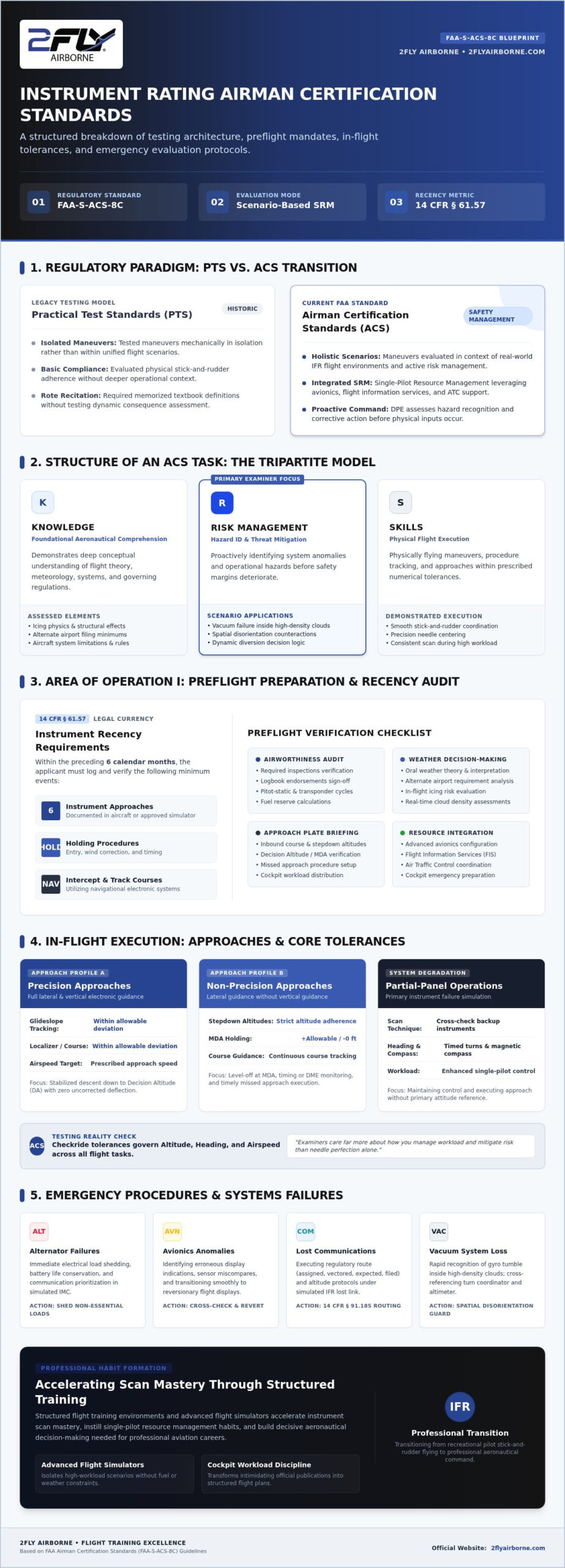
The FAA Airman Certification Standards document serves as the comprehensive testing blueprint for your instrument practical test. Unlike historical testing models that treated maneuvers in isolation, the current standard (FAA-S-ACS-8C) functions as a complete safety management system. It benchmarks how effectively you evaluate real-world operating environments while operating under Instrument Flight Rules (IFR).
Within the broader framework of Pilot certification in the United States, earning an instrument rating marks a major transition from recreational flying to professional aeronautical decision-making. Designated Pilot Examiners (DPEs) do not simply grade whether your instruments remain within allowable limits. They evaluate how you anticipate risks, identify system anomalies, and brief instrument approach procedures before physical control inputs occur. Using a structured instrument rating airman certification standards checklist ensures you study these elements in tandem rather than treating risk management as an afterthought.
To better understand how examiners apply these testing elements during an evaluation, watch this helpful breakdown:
Structure of an ACS Task: Knowledge, Risk, and Skills
Every Area of Operation divides into specific tasks built upon a unified three-part evaluation framework. This tripartite architecture grades three distinct components:
- Knowledge (K): Demonstrating foundational aeronautical comprehension, such as icing physics or alternate airport minimums.
- Risk Management (R): Identifying hazards, assessing potential consequences, and applying mitigation strategies before safety margins degrade.
- Skills (S): Physically flying maneuvers and instrument approaches within prescribed numerical tolerances.
Examiners utilize coded risk management elements to craft probing oral questions and in-flight scenarios. For instance, rather than asking you to recite a textbook definition of spatial disorientation, an examiner might present a scenario involving vacuum failure inside high-density clouds. Your ability to recognize that hazard and articulate corrective actions demonstrates true mastery.
Transitioning from Practical Test Standards (PTS) to ACS
The transition from legacy Practical Test Standards (PTS) eliminated rote, isolated maneuvers in favor of holistic scenario evaluation. Under PTS, applicants frequently flew maneuvers mechanically, showing basic compliance without understanding how subtle changes in environment affect flight safety.
Modern standards require integrated Single-Pilot Resource Management (SRM). You must leverage available avionics, flight information services, and air traffic control support to solve dynamic inflight dilemmas. Aligning your pre-checkride preparation with an instrument rating airman certification standards checklist ensures you cultivate proactive command habits that satisfy examiners and serve your future commercial aviation career.
Instrument Rating ACS Ground Knowledge and Preflight Preparation Checklist
Ground evaluation sets the tone for your practical test. Examiners often form lasting impressions before you ever turn a propeller, probing your understanding of regulatory airworthiness and weather decision-making. Utilizing a precise instrument rating airman certification standards checklist ensures no critical logbook endorsement, inspection cycle, or fuel reserve calculation slips through the cracks.
Area of Operation I: Preflight Preparation Essentials
Before discussing weather charts, an examiner audits your personal qualifications and aircraft documents. Under 14 CFR 61.57, confirm your instrument recency requirements, including six instrument approaches, holding procedures, and intercepting or tracking courses within the preceding six calendar months. In the Official FAA Instrument Rating ACS, these regulatory baselines form the foundation of flight safety.
Ensure your checkride preparation covers all mandatory equipment inspections and regulatory flight planning minimums:
- Aircraft Inspections: Confirm annual, 100-hour (if applicable), altimeter and pitot-static system (24 calendar months), transponder (24 calendar months), and VOR operational checks (30 days).
- Required IFR Instruments: Verify functionality under 14 CFR 91.205 for visual and instrument conditions, including gyroscopic pitch, bank, and direction indicators.
- Flight Planning and Alternates: Plan adequate fuel to reach your destination, divert to an alternate airport, and fly for an additional 45 minutes at normal cruising speed. Review the 1-2-3 rule to determine if an alternate is required, and verify non-standard alternate minimums on approach plates.
Area of Operation II: Preflight Procedures and Cockpit Management
Cockpit management bridges ground knowledge and aircraft command. Prior to engine start, systematically inspect avionics, pitot-heat systems, and deicing equipment. Verify navigation database cycles across all GPS receivers. Flying on an expired database violates instrument operational rules and creates an immediate checkride obstacle.
Conduct a thorough taxi briefing using airport surface diagrams to identify runway crossings, surface movement limits, and designated hot spots. Aviators enrolled in a structured FAA airline pilot program execute these disciplined workflows on every leg, developing standardized habits that turn checkride expectations into routine operational procedures.
In-Flight Maneuvers and Instrument Flight Tolerances Checklist
Precision hand-flying defines the flight portion of your practical test. Maintaining an exact instrument rating airman certification standards checklist keeps target parameters clear when air traffic communications or turbulence threaten your instrument scan. As highlighted in the AOPA Guide to the ACS, knowing allowable deviations helps you make prompt micro-corrections before a minor drift becomes a disqualifying trend.
Air Traffic Clearances, Holding, and Basic Instrument Flight
During basic attitude maneuvers, unusual attitude recoveries, and tracking, examiners expect prompt control application and disciplined scanning. Flight tolerances demand that you maintain altitude within ±100 feet, heading within ±10 degrees, and airspeed within ±10 knots. You must also copy ATC clearances accurately, give standard readbacks, and establish appropriate holding entries while compensating for wind drift.
Instrument Approach Procedures and Tracking Tolerances
Instrument approach tasks evaluate your descent planning, lateral alignment, and situational awareness down to authorized decision points. Precision approaches mandate tracking localizer and glidepath indications within a three-quarter scale deflection. Non-precision approaches require continuous awareness of step-down fixes and absolute altitude discipline at your Minimum Descent Altitude (MDA).
| Approach Element | Precision Approach | Non-Precision Approach |
|---|---|---|
| Course Tracking | Within ¾ scale deflection | Within ¾ scale deflection (or ±5° for RMI/NDB) |
| Altitude Limits | Maintain glidepath to DA/DH | MDA: +100 / -0 feet to MAP |
| Airspeed Limits | ±10 knots of target | ±10 knots of target |
| Missed Approach | Initiate immediately at DA/DH | Initiate immediately at MAP or if visual cues fail |
Circling Approaches and Landings from Instrument Approaches
Circling maneuvers test low-altitude positioning and visual judgment under degraded weather minimums. You must maintain circling altitude within +100/-0 feet and remain within the authorized circling radius for your aircraft approach category. Once in position for a normal descent, transition visually to execute a smooth landing within the runway touchdown zone.
Emergency Procedures, Systems Failures, and Checkride Day Checklist
High-pressure scenarios reveal true airmanship. Handling partial panel flight and critical systems failures separates a safe instrument pilot from an applicant merely flying by rote. A thorough instrument rating airman certification standards checklist prepares you to manage unexpected cockpit emergencies and administrative requirements with equal precision.
Area of Operation VI: Emergency Operations and Malfunctions
Examiners simulate system anomalies to test your scan discipline under stress. When a primary flight display freezes or vacuum-driven gyros fail, quickly identify the failure using secondary instruments. Trust your turn coordinator, altimeter, and backup attitude indicator over misleading visual cues.
Under partial panel conditions, you must fly a non-precision approach to landing minimums while controlling airspeed and heading. Managing alternator failures, pitot-tube icing, or lost communications demands immediate troubleshooting and clear diversion strategies. Always prioritize aircraft control over checklist speed.
Practical Test Day Administrative and Document Checklist
Administrative oversights cancel practical tests before the oral exam begins. Organize your test binder using this essential checklist:
- Personal Identification: Valid government-issued photo ID, pilot certificate, and current FAA medical certificate.
- Exam Documentation: Official FAA knowledge test report and signed FAA Form 8710-1 or IACRA application.
- Logbook Records: Certified instructor endorsements verifying practical test eligibility, flight proficiency, and written exam deficiency reviews.
- Flight Planning Data: Detailed navigation log, current weather briefings, NOTAM printouts, and weight and balance calculations.
Common Instrument Checkride Pitfalls and Mitigation Tactics
Most practical test disqualifications stem from workload saturation rather than poor hand-flying skills. When an examiner introduces diversion scenarios or rapid ATC re-routes, maintain your scan while adjusting avionics. Never let head-down data entry pull your attention away from pitch and bank control.
Brief your approach plates before reaching the initial approach fix, noting step-down altitudes and missed approach instructions. Verbalize your risk assessments out loud during unexpected events. Communicating your operational logic proves that you command the aircraft with the strategic discipline developed in the FAA first officer program.
Mastering the Instrument ACS Through Structured Professional Flight Training
Achieving genuine instrument proficiency requires more than solo memorization; it demands an environment that enforces strict operational discipline. While decentralized Part 61 training offers scheduling flexibility, structured Part 141 flight training accelerates competency through FAA-approved syllabi, formal stage checks, and integrated ground schools. Following a methodical curriculum ensures that every line item on your instrument rating airman certification standards checklist is mastered well before test day.
Why Structured Part 141 Training Maximizes Checkride Readiness
Standardized pilot schools eliminate training guesswork. Formal stage checks mirror official practical test events, identifying knowledge gaps and technique flaws before you meet an examiner. This cohesive structure prevents training plateau delays and eliminates unnecessary flight hours. Trainees develop professional airline crew habits early, mastering standardized callouts, disciplined checklist usage, and proactive threat management.
Leveraging Advanced Simulators to Master ACS Tolerances
Modern flight training devices and advanced simulators let pilots practice high-risk emergency procedures safely. Inside a simulator, you can repeatedly rehearse vacuum failures, severe turbulence, and zero-visibility missed approaches until reactions become second nature. Mastering avionics programming and approach briefings in simulated environments builds sharp scan patterns, allowing you to fly the actual aircraft with calm precision.
Advancing from Instrument Pilot to Commercial Flight Professional
Earning an instrument rating serves as the foundational milestone for commercial aviation aspirations. It validates the technical precision needed to pursue a commercial pilot license, multi-engine rating, or flight instructor certificate. Global demand for skilled aviators continues to expand; The 2025 Boeing Pilot and Technician Outlook projects a demand for 660,000 new pilots globally through 2044. Enrolling in a comprehensive pathway like the FAA airline pilot program turns checkride readiness into an enduring professional flying career.
Elevate Your Airmanship and Command the Instrument Flight Deck
Earning an instrument rating transforms you from a fair-weather flyer into a disciplined, career-ready pilot capable of commanding complex airspace. True checkride readiness demands more than memorizing numbers; it requires active single-pilot resource management, rigorous approach discipline, and proactive threat mitigation. Working through a dedicated instrument rating airman certification standards checklist ensures every ground regulation, emergency workflow, and flight tolerance becomes second nature before you meet an examiner.
Professional aviators build confidence through structured curricula, modern flight simulation, and expert mentorship aligned with global airline standards. Safe habits formed during instrument training establish the foundation for commercial certificates, multi-engine ratings, and career flight operations. Reach out to speak with a 2FLY Airborne Training Advisor today to discuss your aviation goals and take your next step toward the commercial flight deck.
Frequently Asked Questions
What are the exact flight tolerances for an instrument rating checkride?
Flight tolerances require maintaining altitude within ±100 feet, heading within ±10 degrees, and airspeed within ±10 knots during basic attitude maneuvers. On precision approaches, keep localizer and glideslope indications within a three-quarter scale deflection down to decision altitude. On non-precision approaches, descend to the Minimum Descent Altitude within +100/-0 feet. Tracking these metrics on an instrument rating airman certification standards checklist keeps your target parameters sharp.
Can an examiner fail you for one momentary deviation outside ACS tolerances?
No, a momentary deviation does not trigger an automatic failure if you promptly recognize and correct it. Designated Pilot Examiners assess whether you maintain overall command and situational awareness when excursions occur. If turbulence pushes you 120 feet off altitude, verbalize the trend immediately and apply smooth corrective pitch. Failing to notice the deviation or allowing it to continue uncorrected constitutes an unsatisfactory performance.
What happens if you fail an Area of Operation on your instrument practical test?
Failing a specific task results in a Notice of Disapproval, but you receive credit for every Area of Operation passed successfully. Your instructor must provide retraining on the deficient knowledge or flight areas and log a new endorsement. You then schedule a retest with an examiner, typically needing to re-demonstrate only the unsatisfactory items within 60 days. Staying organized prevents repeat errors during your practical re-evaluation.
How many flight hours do you need to take the FAA instrument practical test?
Under Part 61 rules, applicants must log at least 50 hours of cross-country flight time as pilot-in-command and 40 hours of actual or simulated instrument time. In an approved Part 141 flight training program, requirements drop to 35 hours of specialized instrument training without the 50-hour cross-country prerequisite. Training timelines and total flight hours naturally vary based on individual learning pace and schedule consistency.
Is an oral exam failure common on the instrument rating practical test?
Oral exam disapprovals happen frequently when applicants rely on surface memorization rather than deep scenario analysis. Examiners evaluate how you interpret real-world weather briefings, select legal alternates, and brief complex approach procedures. Reviewing an instrument rating airman certification standards checklist before your checkride ensures you understand the underlying risk management behind each regulatory mandate, transforming theoretical facts into actionable cockpit decisions.
Can you use an autopilot during the FAA instrument rating practical test?
Yes, if your aircraft is equipped with an operable autopilot system, the ACS requires demonstrating its proper use. You will typically fly one instrument approach utilizing autopilot modes and flight director guidance to demonstrate system integration. However, you must also prove hand-flying proficiency and demonstrate how to disconnect the system immediately during malfunctions or unusual attitude recoveries.
What is the difference between PTS and ACS for instrument pilots?
The older Practical Test Standards (PTS) evaluated mechanical flying skills and aeronautical knowledge as isolated events. The modern Airman Certification Standards (ACS) framework integrates knowledge, flight proficiency, and active risk management into every evaluated task. This modern system evaluates how you identify threats, make sound aeronautical decisions, and manage cockpit workload, rather than grading pure stick-and-rudder maneuvers in a vacuum.
Article by
2FLY Airborne
2Fly Airborne is a professional flight training organization dedicated to developing the next generation of skilled, confident, and safety-focused pilots. With decades of combined aviation experience, our team of certified instructors provides structured, real-world training designed to prepare students for both checkrides and long-term success in the aviation industry.
Content Disclaimer
Some blog content is generated with the assistance of automated tools and may not always be fully accurate or up to date. Please verify all aviation-related information with official sources or a certified instructor. For additional guidance or clarification, we encourage you to contact one of our training advisors at 2Fly Airborne.