Picture reviewing your flight logbook and wondering whether each entry moves you closer to a commercial certificate. Under Part 61, an airplane single-engine applicant needs 250 hours of flight time as a pilot, according to the Federal Aviation Administration. The total is only one part of the experience picture.
Applicants must also meet separate requirements for pilot-in-command experience, cross-country flying, and training. Track each category clearly in your records.
This guide explains how the requirements fit together, including solo-flight and instructor-supervised options. It will help you understand the experience involved and organize your progress toward a commercial pilot certificate.
Key Takeaways
- Under Part 61, airplane commercial applicants need 250 hours of flight time as a pilot, according to the Federal Aviation Administration.
- Separate the total-hour target from pilot-in-command, cross-country, and training requirements to understand what your logbook needs to show.
- Learn how solo flight and instructor-supervised pilot-in-command duties can meet the applicable experience requirement.
- See how cross-country flights are defined and which route details matter for the commercial certificate.
- Understand how instrument training fits into the broader experience requirements and supports commercial-level flying skills.
What Are the Eligibility Requirements?
For an airplane commercial pilot certificate under Part 61, applicants need flight experience across several categories. Total flight time, pilot-in-command experience, and required training each have separate thresholds.
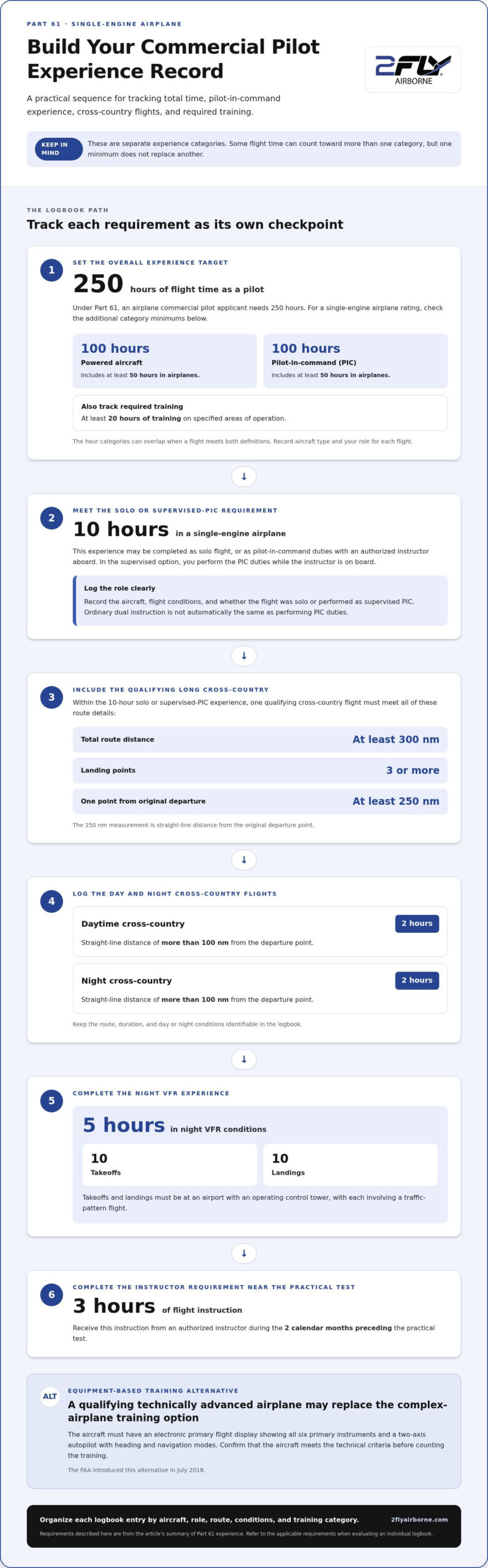
Under U.S. FAR Part 61, an applicant for an airplane commercial pilot certificate must have 250 hours of flight time, according to the Federal Aviation Administration. For a single-engine airplane rating, applicants also need at least 100 hours in powered aircraft, including at least 50 hours in airplanes, according to the Federal Aviation Administration.
The pilot-in-command requirement is a separate measure. Single-engine applicants must log at least 100 hours of pilot-in-command flight time, including at least 50 hours in airplanes, according to the Federal Aviation Administration. They must also complete at least 20 hours of training on specified areas of operation, according to the Federal Aviation Administration.
Single- and Multiengine Flight Time
These requirements distinguish experience in a single-engine airplane from experience in a multiengine airplane. For a single-engine rating, the 250-hour total includes minimums for powered-aircraft time, airplane time, and pilot-in-command time. Multiengine applicants generally need 250 hours as a pilot under Part 61, but the experience must match the rating sought. Track each aircraft category and class separately so your logbook clearly supports the application.
Powered-Aircraft Flight Time and Experience
Powered-aircraft time is a broad category, while airplane time is a narrower part of that experience. The single-engine requirements call for 100 hours in powered aircraft, with 50 hours in airplanes; the pilot-in-command minimum separately specifies 100 hours, including 50 hours in airplanes. These totals overlap when a flight meets both definitions, but one threshold doesn’t erase another. Review each flight entry for aircraft type and pilot role.
Credit for Prior Flight Experience
Military, foreign, and civilian flight experience may contribute when its records document the relevant aircraft, duties, and experience categories. It doesn’t automatically replace each certificate requirement. Applicants with military experience may qualify through the provisions of § 61.73, while other prior experience must be assessed against the certificate and rating requirements. Preserve detailed logbooks and training records so previous flight time can be matched to the applicable categories.
Technically Advanced Airplane Equipment
A technically advanced airplane can satisfy the specified equipment-based training alternative in place of a complex airplane. In July 2018, the FAA introduced a rule allowing commercial pilot applicants to complete the required complex-airplane training in a technically advanced airplane instead.
A qualifying aircraft has an electronic primary flight display showing all six primary instruments and a two-axis autopilot with heading and navigation modes. These systems let pilots train with modern cockpit displays and automation. Before counting training toward the applicable experience requirement, confirm that the aircraft meets the technical criteria.
Solo flight or supervised pilot-in-command duties
For a U.S. single-engine airplane commercial certificate, this experience may be logged as solo flight or as pilot-in-command duties with an authorized instructor aboard. The distinction matters: both routes can contribute, but each flight and duty must meet the applicable requirements.
Solo or supervised pilot-in-command flight time
Applicants must complete 10 hours of solo flight in a single-engine airplane or perform pilot-in-command duties in one with an instructor aboard. Pilot in command means the person responsible for the flight, even when an authorized instructor is also on board. The instructor-supervised option lets a student demonstrate responsibility while receiving instruction. Record the aircraft, flight conditions, and role accurately so the logbook shows how each flight qualifies.
The 10-hour requirement includes specific experience, not simply any collection of solo trips. One qualifying cross-country flight must cover at least 300 nautical miles total, include landings at a minimum of three points, and reach a point at least 250 nautical miles straight-line from the original departure point. Plan the route around those measurements, then ensure the completed flight and landings are logged.
Flight training with an authorized instructor
Supervised pilot-in-command time differs from ordinary dual instruction. The applicant performs the pilot-in-command duties while an authorized instructor is aboard; the instructor does not replace the applicant’s role for this requirement. Keep the training record clear about which flights used this option. Separately, applicants must receive 3 hours of flight instruction from an authorized instructor during the 2 calendar months preceding the practical test.
Daytime and nighttime cross-country flights
Single-engine applicants must complete a daytime cross-country flight lasting 2 hours and covering a straight-line distance of more than 100 nautical miles from departure. A separate nighttime cross-country flight must also last 2 hours and cover more than 100 nautical miles straight-line from departure. These flights develop route planning and navigation in different conditions. Keep each flight’s route, duration, and conditions identifiable in the logbook.
Night-flight requirements and limitations
The solo or supervised experience also includes 5 hours in night VFR conditions, with 10 takeoffs and 10 landings at an airport with an operating control tower. Each takeoff and landing involves a traffic-pattern flight. A traffic pattern is the standard circuit aircraft fly around an airport before landing. The 10 solo night VFR landings at a towered airport are a specific checklist item, so distinguish those entries in your records.
Night VFR means flying at night under visual flight rules, rather than in instrument conditions. Plan night flights to cover the required takeoffs, landings, and cross-country experience, and log each element separately. Clear records show how your training addresses the certificate requirements.
What Aeronautical Experience is Required?
Pilot-in-command experience is time spent acting as the responsible pilot, not simply total flight time. Instrument training also has a defined role in the commercial certificate requirements.
Pilot-in-Command Experience
Pilot-in-command experience is flight time logged while performing the duties of the pilot responsible for the flight. For a single-engine airplane commercial certificate, the requirement includes 100 hours as pilot in command, with 50 hours in airplanes, according to the Federal Aviation Administration. It matters because total flight time alone doesn’t demonstrate experience in this role. Applicants should distinguish PIC entries from other training flights in their records.
Check each logbook entry for aircraft type and the capacity in which you flew. A flight may count toward multiple experience categories if it meets each category’s conditions. However, meeting a total-hour threshold does not automatically satisfy a separate PIC, aircraft, or training requirement.
Organize records by rating goal. For example, an applicant pursuing an airplane single-engine certificate should be able to distinguish airplane PIC time from PIC time in other powered aircraft. Clear entries make it easier to track progress and identify gaps before applying for the practical test.
PIC experience is also connected to cross-country time. The required cross-country component has its own total and airplane minimums, so record route details as well as your pilot role. This helps show which flights count toward PIC experience and which meet a separate cross-country requirement.
Instrument Training and Flight Experience
Instrument training develops control using cockpit instruments when outside visual references are limited. Applicants must complete 10 hours of instrument training using a view-limiting device, including at least 5 hours in a single-engine airplane, according to the Federal Aviation Administration. The device limits the pilot’s outside view during training so attention remains on the instruments.
These hours are a specific training requirement, not a substitute for the overall flight-time or PIC requirements. Track the training method and aircraft for each entry. This helps distinguish instrument instruction completed with a view-limiting device from other flight experience.
Instrument practice also develops precise aircraft control and attention to cockpit information. During a training flight, a student might use the device while an instructor monitors the aircraft and provides instruction. Record the aircraft and training activity accurately so each hour can be matched to the required category.
Review instrument entries alongside the rest of your certificate records. Confirm that the required training hours include the single-engine airplane portion, while keeping PIC and cross-country totals separate. This organized approach shows how each flight contributes toward the rating without treating all logged hours as interchangeable.
Cross-country experience
Track cross-country time separately from total flight time and pilot-in-command experience. For a commercial airplane applicant, it has specific distance, route, and aircraft requirements.
How cross-country time is counted
For the U.S. Commercial Pilot Certificate, a cross-country flight includes a landing at an airport more than 50 nautical miles straight-line from the original departure point. The straight-line measurement matters, even if the route flown bends around weather or airspace. For example, a flight covering a longer route may not qualify if its destination airport falls within that 50-nautical-mile distance. Log the departure, destination, and landing.
Pilot-in-command cross-country experience
U.S. commercial airplane single-engine applicants must have at least 50 hours of pilot-in-command cross-country flight time, including at least 10 hours in airplanes, according to the Federal Aviation Administration. This is a distinct total within the broader flight-time record. A cross-country flight counts toward it only when the applicant’s logbook reflects pilot-in-command time and the flight meets the cross-country definition.
Clearly identify the aircraft type and your pilot role in every entry. A flight in a powered aircraft may count toward broad flight-time totals, but the airplane portion must be identifiable. Review the logbook by category, class, and flight purpose to distinguish airplane cross-country time from other experience when preparing for the certificate.
Daytime and nighttime cross-country flights
The single-engine airplane requirements include a daytime cross-country flight lasting 2 hours and covering more than 100 nautical miles straight-line from departure. A separate nighttime cross-country flight must also last 2 hours and cover more than 100 nautical miles straight-line. These are distinct flights, so record each flight’s conditions, duration, and route separately.
Night cross-country experience complements required night training, but the categories are not interchangeable. The flight’s distance and duration must meet the cross-country criteria, while night takeoffs and landings satisfy separate experience elements. Record both when applicable. Clear entries show how a flight contributes to each requirement.
Long solo cross-country flight
The required solo cross-country flight covers at least 300 nautical miles total and includes landings at a minimum of three points. It must also reach a point at least 250 nautical miles straight-line from the original departure point. These measurements describe separate parts of the route: total distance, landing locations, and the farthest qualifying point.
Plan the route so each element is clear in the flight record. Identify the departure airport, landing points, and the point that meets the straight-line distance requirement. This long flight is one part of the commercial experience requirements, not a substitute for separate daytime, nighttime, or pilot-in-command cross-country totals.
Part 61 commercial pilot aeronautical experience
Part 61 sets flight-time and training thresholds for airplane commercial pilot applicants. The commercial pilot aeronautical experience requirements under this route cover several distinct logbook categories, not just one overall hour total.
Applicants must complete 10 hours of instrument training using a view-limiting device, including at least 5 hours in a single-engine airplane, according to the Federal Aviation Administration. Part 61 also requires 3 hours of flight instruction from an authorized instructor during the 2 calendar months preceding the practical test.
How Part 61 and Part 141 differ
Part 61 specifies experience and training requirements, while an approved Part 141 program follows an established course. A commercial certificate through an approved Part 141 program can require a minimum of 190 hours of experience, compared with the Part 61 airplane route’s 250-hour total. These routes have different structures, so compare the requirements for the program you’re following.
Training-device credit also varies by route. Under Part 61, time in a Redbird Advanced Aviation Training Device may count for up to 50 hours toward a commercial pilot certificate. Under Part 141, time in a Redbird AATD may count for up to 20% of the total commercial pilot training time requirements. Those allowances apply to different pathways and aren’t interchangeable.
For a useful progress review, compare the commercial pilot aeronautical experience requirements with your training route and logbook categories. A lower minimum total under Part 141 doesn’t mean every logged hour automatically applies. Part 61 applicants must likewise track the required experience and instruction separately, rather than relying on a single cumulative figure.
Logbooks, endorsements, and training records
Keep logbook entries clear about the date, aircraft, flight duration, conditions, and pilot role. For cross-country flights, record the route and landings; for instrument instruction, identify the device used and the single-engine airplane portion. These details show how individual flights apply to the commercial pilot aeronautical experience requirements.
Keep instructor records with the logbook, including documentation of practical-test preparation. Endorsements record instructor sign-offs connected with training and test preparation. The current revision of Advisory Circular 61-65 provides a reference for endorsement wording, while consistent logbook and training records make your experience easier to review.
Before applying for the practical test, compare your records with the certificate and rating requirements. Check that every required category is identifiable and supported by relevant entries. This review can help you address gaps through further structured training, rather than discovering unclear documentation while preparing your application.
2FLY Airborne: FAA Professional Pilot Program
2FLY Airborne offers an FAA Professional Pilot Program for students pursuing a commercial aviation career. The training pathway includes the Private Pilot Certificate (PPL), Instrument Rating (IR), and Commercial Pilot Certificate (CPL), helping you understand how these certifications fit your goal.
Consider a structured program when you’re ready to turn experience requirements into a training plan. Comparing your current certificates and logged flight experience with the next stage can clarify where to begin and which skills to build. The Commercial Pilot Certificate is a key step for pilots pursuing professional flying opportunities.
For information about the FAA Professional Pilot Program and its training pathway, contact 2FLY Airborne or visit the 2FLY Airborne website.
Turn Your Training Goals Into a Clear Next Step
The next stage involves more than accumulating flight time. Treat each flight as part of a professional record: log consistently, focus on sound decision-making, and connect your training objectives to the flying you want to pursue.
Understanding the commercial pilot aeronautical experience requirements helps you discuss your progress with purpose and plan your development around the certificate you’re pursuing. Structured training can turn ambitious goals into practical milestones, with safe, disciplined flying at the center.
If you’re ready to consider your next step, contact 2FLY Airborne about pilot training and discuss the path that fits your goals. Keep building your skills with focus. Your professional journey starts with the decisions you make in training.
Frequently Asked Questions
What Are the Steps to Become a Commercial Pilot?
Start by confirming that you meet the certificate prerequisites, then choose a training route and plan for its requirements. Complete the required knowledge preparation, flight instruction, and experience, keeping your logbook and endorsements current. Before applying for the practical test, review your records against the rating you seek. This sequence helps you identify missing training or documentation before it delays your next stage.
What aeronautical experience is required for a commercial pilot certificate under FAA Part 61?
Part 61 experience covers several distinct areas, including total flight time, pilot-in-command duties, cross-country flying, and specified instruction. The practical task is to show how your logged experience meets each category, rather than relying on a single total. Sort entries by aircraft, flight purpose, and pilot role. That review can reveal whether experience in one category has been mistaken for another.
How many total flight hours are required for an FAA commercial pilot certificate?
The total depends on the certificate path: Part 61 has a defined airplane-flight minimum, while an approved Part 141 course follows its approved curriculum. Identify your training basis before assessing your progress, since the totals aren’t interchangeable. For a useful review, compare your logbook with that program’s requirements and distinguish aircraft experience from any eligible training-device credit.
What flight time must be logged as pilot in command for a commercial pilot certificate?
Applicants need pilot-in-command experience, with the applicable amount and aircraft categories determined by the certificate and rating sought. For each entry, identify who acted as pilot in command and which aircraft was flown. Label cross-country flights separately, too. This makes it easier to identify experience that qualifies for multiple categories without assuming every logged flight counts toward every requirement.
What cross-country flight requirements apply to commercial pilot applicants?
Cross-country experience includes both a broader logged-time component and specifically defined qualifying flights. A practical logbook review should capture departure and destination airports, route, landings, flight conditions, and pilot role. Check that the route meets the applicable distance definition rather than relying only on total distance flown. This helps distinguish a qualifying cross-country flight from a longer local or training flight.
What night-flying experience is required for a commercial pilot certificate?
Night experience includes specified operations in night visual conditions, plus separate night cross-country experience for the single-engine airplane route. Keep records detailed enough to distinguish traffic-pattern operations from cross-country flying. For each relevant entry, note the conditions and flight purpose. Separating these details in your logbook shows how night experience fits the certificate requirements without treating all night hours as equivalent.
What solo flight or acting-as-PIC requirements apply to commercial pilot aeronautical experience?
Applicants can meet the applicable experience requirements through solo flying or by performing pilot-in-command duties with an authorized instructor aboard. Records should identify which option applied to each flight and document the applicant’s role. For flights intended to satisfy a specific route or landing requirement, preserve the itinerary and airport details. Clear entries demonstrate the nature of the experience, not just its duration.
Article by
2FLY Airborne
2Fly Airborne is a professional flight training organization dedicated to developing the next generation of skilled, confident, and safety-focused pilots. With decades of combined aviation experience, our team of certified instructors provides structured, real-world training designed to prepare students for both checkrides and long-term success in the aviation industry.
Content Disclaimer
Some blog content is generated with the assistance of automated tools and may not always be fully accurate or up to date. Please verify all aviation-related information with official sources or a certified instructor. For additional guidance or clarification, we encourage you to contact one of our training advisors at 2Fly Airborne.