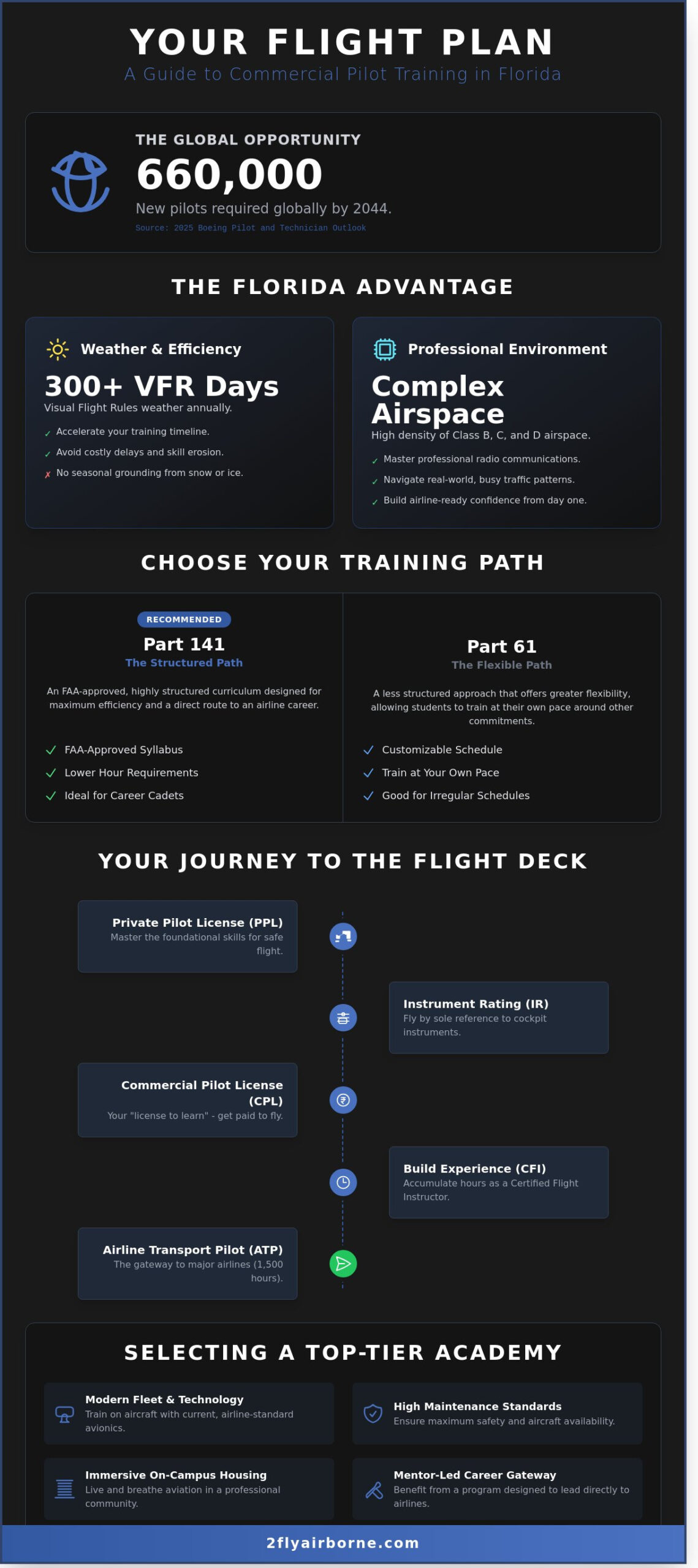
The 2025 Boeing Pilot and Technician Outlook projects a global requirement for 660,000 new qualified pilots through 2044. You understand the potential for a lucrative career, yet the logistical hurdles can feel daunting. It’s common to feel stuck between Part 61 and Part 141 options or worried about the total investment required to reach 1,500 hours. You need more than a flight school; you need a professional gateway to the airlines.
This 2026 guide gives you the edge. You’ll discover how to select the highest quality commercial pilot training florida provides to ensure you graduate as an airline-ready professional. We will break down the progression from student to commercial pilot and show you how a structured environment leads directly to recruitment. To get personalized advice on your specific goals, speak with a training advisor at 2FLY Airborne and begin your journey toward the flight deck today.
Key Takeaways
- Leverage Florida’s year-round flying weather to maintain an accelerated training timeline and reach your career goals faster.
- Master the FAA prerequisites for your Commercial Pilot License to capitalize on the projected industry demand for 660,000 new pilots by 2044.
- Evaluate the structural differences between Part 141 and Part 61 training to choose the most efficient path toward becoming an airline-ready professional.
- Learn how to vet a flight academy based on fleet technology, maintenance standards, and the immersive advantages of on-campus housing.
- Discover how a mentor-led commercial pilot training florida program serves as your definitive gateway to a global aviation career.
The Strategic Advantage of Commercial Pilot Training in Florida
Florida is the global epicenter for aviation education. Choosing the right location for commercial pilot training florida determines how quickly you’ll reach the flight deck. The state’s infrastructure supports a massive volume of flight operations, providing a training ground that mirrors the reality of professional airline schedules. According to the 2025 Boeing Pilot and Technician Outlook, the industry requires 660,000 new pilots by 2044. Florida’s high-capacity training environment is specifically designed to meet this urgent global demand.
To see how a professional environment shapes your future, watch this overview of Florida training:
Weather and Efficiency: Maximizing Flight Hours
Success in flight training depends on consistency. Florida boasts over 300 days of Visual Flight Rules (VFR) weather annually, which significantly reduces the risk of training delays. In northern regions, students often face seasonal grounding due to snow, ice, or persistent low cloud ceilings. These delays don’t just stall progress; they lead to skill erosion and increased costs. When you pursue FAA pilot certification, you need a climate that allows for daily flight operations. This consistency is why commercial pilot training florida is favored by international airlines seeking to cadet their future crews. “In professional aviation, time is the most valuable currency; Florida weather ensures your training stays on schedule.”
Airspace Complexity: Training in a Professional Environment
Florida features one of the highest densities of airports in the world. Training here exposes you to a sophisticated mix of Class B, C, and D airspace. You’ll operate in the same skies as major international hubs like Orlando and Miami, forcing you to master complex radio communications and traffic patterns early in your syllabus. This immersion builds “airline-ready” confidence long before you reach a regional carrier. You aren’t just learning to fly a small aircraft; you’re learning to navigate a professional ecosystem. This exposure is a core component of the FAA Airline Pilot Program, which prepares students for the transition to multi-crew transport operations.
- Accelerated Progression: Fly more often and finish your ratings faster.
- Professional Communication: Gain experience talking to busy Air Traffic Control centers.
- Global Reputation: Graduate from a region recognized by airlines worldwide for high-caliber training.
The path to the flight deck requires a strategic choice of location. Contact 2FLY Airborne today or speak with a training advisor to receive personalized guidance for your career.
Understanding Commercial Pilot License (CPL) Requirements
The Commercial Pilot License (CPL) is your official entry into the professional aviation industry. It represents the legal threshold where you transition from a student paying for flight time to a professional earning a paycheck in the cockpit. If you’re looking for commercial pilot training florida, you’ll find that this license is the pivot point for your career. While your Private Pilot License (PPL) and Instrument Rating (IR) provide the foundational skills for safe flight, the CPL refines your precision and mastery to a commercial standard. According to the 2025 Boeing Pilot and Technician Outlook, the industry needs 660,000 new qualified pilots through 2044. Securing your CPL is the critical first step to meeting that global demand.
You must be at least 18 years old to apply for the certificate. You’re also required to read, speak, and understand English fluently, as this is the universal language of aviation. Most cadets view the CPL as a “license to learn” because it provides the legal right to work while you accumulate the hours required for an Airline Transport Pilot (ATP) certificate. It’s a stepping stone that allows you to build professional experience, often as a flight instructor or banner tower, while moving toward the flight deck of a major carrier.
The FAA Commercial Rating Checklist
Meeting the Commercial Pilot License (CPL) requirements involves reaching specific flight time milestones. Under FAA Part 61 regulations, you generally need 250 total flight hours. Many students pursuing commercial pilot training florida choose Part 141 programs instead. These structured environments often allow for certification in as few as 190 hours due to the rigorous oversight and syllabus approval by the FAA.
- Medical Certification: You’ll need at least a Second-Class Medical Certificate to exercise commercial privileges and get paid.
- Aeronautical Knowledge: You must pass a comprehensive written exam covering high-altitude operations, complex systems, and federal regulations.
- The Checkride: This is the final practical test with an FAA examiner. You’ll demonstrate advanced maneuvers and professional-grade decision-making.
Single-Engine (CSEL) vs. Multi-Engine (CMEL) Pathways
Your career goals dictate whether you start with a Commercial Single-Engine Land (CSEL) or a Commercial Multi-Engine Land (CMEL) rating. A CSEL allows you to fly single-engine aircraft for hire, but major airlines require experience in aircraft with two or more engines. For this reason, most career-track students choose to add a multi-engine rating immediately to become airline-ready. You can explore why you need a multi-engine rating for airlines to see how this fits into a professional timeline.
Training in Florida provides the advantage of consistent flying weather. This helps you move through these complex ratings without seasonal delays. If you’re ready to map out your path, speak with a training advisor to discuss which pathway fits your long-term goals.
Choosing Your Path: Part 141 vs. Part 61 Training
Selecting the right regulatory framework is the first critical decision you’ll face when starting your journey. In the United States, the FAA provides two primary training paths: Part 61 and Part 141. While both lead to the same certificates, the structure and oversight differ significantly. Part 61 is often viewed as a flexible, pay-as-you-go option suitable for hobbyists or those with irregular schedules. It allows for a less rigid curriculum, but this lack of structure can lead to inconsistent progress for career-minded students.
For those pursuing a professional career as a commercial pilot, Part 141 is the industry standard. These schools must use FAA-approved training outlines and undergo regular audits to ensure they meet strict performance benchmarks. Optimizing your commercial pilot training florida experience requires choosing a school that prioritizes this level of accountability. It’s a common misconception that Part 61 is always cheaper. In reality, the lack of a formal syllabus often results in “wasted” flight hours where students repeat maneuvers due to gaps in training. Part 141 programs provide a clear, efficient roadmap that maximizes every dollar spent on fuel and instructor time.
The Integrated Career Program Advantage
The “Professional Pilot Program” model is designed as a streamlined pipeline to the flight deck. By following a structured syllabus, you eliminate the redundancy found in casual training environments. This integrated approach ensures that every hour in the cockpit builds directly toward your next rating. Programs like the FAA Airline Pilot Program focus on creating airline-ready professionals from day one. You’ll join a cohort of like-minded cadets, fostering a competitive and supportive environment that mirrors the professional culture of a major carrier.
The urgency for this structured approach is backed by industry data. According to the 2025 Boeing Pilot and Technician Outlook, there is a projected demand for 660,000 new qualified pilots through 2044. Meeting this demand requires efficient training that doesn’t sacrifice safety or technical proficiency. A structured program ensures you graduate with the discipline and precision that airline recruiters demand.
International Synergy: FAA and EASA Options
Florida serves as a unique global hub where students can access dual FAA and EASA training paths. This is a massive advantage for cadets who want to maximize their employability across the US, Europe, and Asia. Holding dual certifications allows you to transition between different regulatory environments without the need for extensive license conversions later in your career. When you choose commercial pilot training florida schools that offer this international synergy, you’re not just training for a job; you’re preparing for a global career. This perspective is vital as airlines continue to expand their international routes. Speaking with a training advisor can help you determine which certification path aligns best with your long-term goals.
Key Criteria for Selecting a Florida Flight Academy
The 2025 Boeing Pilot and Technician Outlook highlights a massive global requirement for 660,000 new pilots through 2044. To meet this demand, you must choose a school that prioritizes modern standards over outdated methods. Identifying the right environment for your commercial pilot training florida is the difference between a stalled start and a rapid career ascent. You need an academy that functions as a professional launchpad rather than just a rental fleet. Before making your final decision, reviewing a comprehensive flight academy in USA selection checklist can help you evaluate every critical factor with confidence. For a broader perspective on evaluating institutions at the collegiate level, our guide on choosing the right aviator college for professional pilot training provides a detailed framework for assessing financial stability, certification pathways, and long-term career outcomes.
Fleet and Technology Standards
A flight school is only as good as the tools it provides. Modern airlines operate with advanced automation; therefore, your training should begin on a “glass cockpit” platform. Systems like the Garmin G1000 are no longer optional. They’re essential for preparing you for the transition to a jet. You should verify that the academy uses specific, high-performance airframes for multi-engine training, such as the Piper Seminole. This aircraft is widely recognized for its reliability and its role in helping students master complex maneuvers. Additionally, look for schools that integrate high-fidelity flight simulators into their syllabus. These devices allow you to build procedural muscle memory without the costs or weather constraints of actual flight time.
Mastering the complex software in modern cockpits is essential. For pilots looking to build an even stronger foundation in general software proficiency, which can be a valuable career asset, you can check out f2f.gr. Furthermore, as aviation becomes more interconnected, the importance of networking and cybersecurity cannot be overstated; Insoft Services provides the expert training and consultancy required to secure the digital infrastructure of global industries.
The Support Ecosystem: Housing and Financing
Success in commercial pilot training florida requires total focus. Total immersion is the fastest way to earn your wings. Residential accommodation on or near the flight line acts as a force multiplier for your progress. It allows you to live and breathe aviation alongside fellow cadets. This is particularly vital for international students who are navigating a new country while managing a rigorous study schedule. If you’re coming from abroad, ensure the school provides M-1 or F-1 visa sponsorship to streamline your legal entry into the United States.
Financial transparency is another non-negotiable factor. The best academies provide clear, upfront tuition models that help you plan your investment without fear of hidden fees. You can find detailed guidance on managing these costs by exploring pilot training financing options. Beyond the money, evaluate the school’s human resources. A low instructor-to-student ratio ensures you receive personalized attention and consistent scheduling. You don’t want your progress stalled because there aren’t enough instructors to go around. High maintenance standards are also critical. A well-maintained fleet ensures that when you’re scheduled to fly, the aircraft is ready and safe.
Your Journey to the Flight Deck with 2FLY Airborne
Choosing the right partner for your commercial pilot training florida is the most critical decision of your early career. 2FLY Airborne acts as more than a flight school; we function as a mentor-led academy dedicated to your long-term success. The aviation industry is currently facing an unprecedented period of growth. According to the 2025 Boeing Pilot and Technician Outlook, there is a global demand for 660,000 new qualified pilots through 2044. We’ve designed our programs to ensure our cadets are at the front of the line for these opportunities.
The FAA Airline Pilot Program stands as our definitive path for aspiring professionals. This curriculum isn’t about just logging time. It’s a structured, intensive journey that takes you from zero experience to a fully certified commercial pilot. You’ll train in an environment that mirrors the operational standards of major carriers, ensuring you’re “airline-ready” from day one. Many of our graduates choose to stay with us as Certified Flight Instructors (CFI). This role allows you to build the flight hours necessary for airline hiring while refining your own skills through teaching others.
The 2FLY Professional Pilot Path
Your progression begins with the Private Pilot License (PPL), where you master the fundamentals of flight. From there, you’ll move through Instrument Ratings and your Commercial Pilot License (CPL). What sets 2FLY apart from local competitors is our “Global Pilot” concept. We don’t just focus on local regulations; we train you to operate in any airspace in the world. “At 2FLY, we don’t just train you to pass a checkride; we prepare you for the rigours of a global airline career.” This international perspective gives our cadets a distinct advantage in a competitive job market.
This global outlook is increasingly relevant as airlines support specialized services, such as assisting non-emergency patients with international travel on commercial routes. To explore how RN MEDflights operates these professional medical assistance services, click here.
Our training syllabus is rigorous and goal-oriented. We’ve eliminated the guesswork by providing a clear timeline and professional milestones. You’ll benefit from:
- High-performance aircraft and advanced simulators.
- Mentorship from instructors with deep industry experience.
- A training environment focused on crew resource management.
- Direct pathways to building the 1,500 hours required for many airline positions.
Next Steps: Becoming a Cadet
The transition from dreamer to pilot starts with a single, professional step. We encourage all prospective students to attend a 2FLY Event or Seminar. These sessions provide an opportunity to meet our flight team, tour our facilities, and see our fleet in action. It’s the best way to experience the high-energy, professional atmosphere that defines our academy.
Your first interaction with us won’t be a simple application process. Instead, we begin with a professional consultation. We want to understand your career goals, your timeline, and your aspirations. This personalized approach ensures that you’re entering a program that aligns with your future. Don’t wait for the industry to move without you. The flight deck is within reach, and we’re here to guide you every step of the way. Contact a 2FLY Training Advisor Today to map out your personalized path to the airlines.
Take Command of Your Future on the Flight Deck
The aviation industry is entering a period of unprecedented growth. The 2025 Boeing Pilot and Technician Outlook projects a global demand for 660,000 new qualified pilots through 2044. Securing your place in this competitive workforce requires a training environment that mirrors elite airline standards. Choosing commercial pilot training florida at 2FLY Airborne provides you with this professional immersion. Our cadets benefit from our rigorous Red Dot standard fleet maintenance and the convenience of on-campus residential housing. These resources ensure you remain focused on your progression from a student to an airline-ready professional.
Your journey toward a global career depends on the quality of your foundation. We combine technical precision with a disciplined training syllabus to prepare you for the high-stakes demands of the flight deck. It’s time to align your ambition with a proven pathway to the cockpit. Don’t wait to begin your ascent while the industry is actively seeking its next generation of leaders.
Speak with a 2FLY Training Advisor to start your career. The sky isn’t the limit; it’s your future office. We’re ready to help you reach it.
Frequently Asked Questions
How long does commercial pilot training in Florida typically take?
Commercial pilot training in Florida typically takes between 7 and 10 months for students starting with zero experience. This accelerated timeline is possible because Florida provides over 230 days of flyable weather each year. Your specific duration will vary based on your personal aptitude and how often you fly. Contact a 2FLY Airborne training advisor to build a timeline that helps you reach the flight deck faster.
What is the difference between a Commercial Pilot License and an Airline Transport Pilot (ATP) certificate?
A Commercial Pilot License (CPL) allows you to earn a living as a pilot, while an Airline Transport Pilot (ATP) certificate is required to lead a crew for a scheduled airline. You can achieve a CPL with 250 flight hours, but a standard ATP requires 1,500 total hours. This progression is a core part of becoming an airline-ready professional. It’s the essential path for anyone targeting a major carrier.
Can international students attend flight school in Florida?
International students can attend flight school in Florida by securing an M-1 or F-1 student visa. Our academy specializes in the Global Pilot concept, training cadets from every continent to meet rigorous FAA standards. This international atmosphere prepares you for the diversity of a global aviation career. Contact 2FLY Airborne today to learn how we assist with the paperwork and transition for our international cadets who seek commercial pilot training in Florida.
Is it better to train under FAA Part 61 or Part 141 for a career?
Training under FAA Part 141 is often the superior choice for those seeking a professional career because it utilizes a structured, FAA-approved syllabus. This disciplined environment is ideal for preparing for the 2025 Boeing Pilot and Technician Outlook, which predicts a global need for 660,000 new pilots by 2044. Part 141 schools provide the methodical training required to become an elite, career-ready pilot in a shorter timeframe. To ensure you’re applying the right criteria when comparing institutions, consult our detailed guide on choosing the best flight academy in USA for your 2026 pilot training.
What are the medical requirements for becoming a commercial pilot?
You must obtain an FAA First-Class Medical Certificate if you plan to fly for a major airline. This medical exam ensures you meet the physical standards for vision, hearing, and overall health required for safety. Most commercial pilot training in Florida requires at least a Second-Class certificate to operate legally for hire. We suggest passing this exam early to confirm your eligibility for a professional career.
Beyond medical fitness, a commitment to safety is paramount in the cockpit. For those looking to enhance their emergency response capabilities, JPF First Aid provides professional training that aligns with the high standards expected in the aviation industry.
How much does it cost to become a commercial pilot in 2026?
The investment required to become a commercial pilot in 2026 depends on current fuel costs and the specific training path you select. While we don’t provide definitive price guarantees, the 2025 Boeing Pilot and Technician Outlook highlights a massive demand for 660,000 new pilots through 2044, suggesting a strong return on investment. For the most accurate and up-to-date pricing information, speak with a 2FLY Airborne advisor for a personalized training quote.
Can I get a degree while completing my flight training in Florida?
You can certainly earn a degree while completing your flight training through our various university partnerships. Many cadets choose to pursue a Bachelor’s degree in Aviation Science to make their profiles more attractive to major airlines. This approach combines technical mastery with academic achievement, ensuring you’re fully prepared for a global career. Contact our team to learn how you can balance your studies with your time in the cockpit.
Article by
2FLY Airborne
2Fly Airborne is a professional flight training organization dedicated to developing the next generation of skilled, confident, and safety-focused pilots. With decades of combined aviation experience, our team of certified instructors provides structured, real-world training designed to prepare students for both checkrides and long-term success in the aviation industry.
Content Disclaimer
Some blog content is generated with the assistance of automated tools and may not always be fully accurate or up to date. Please verify all aviation-related information with official sources or a certified instructor. For additional guidance or clarification, we encourage you to contact one of our training advisors at 2Fly Airborne.