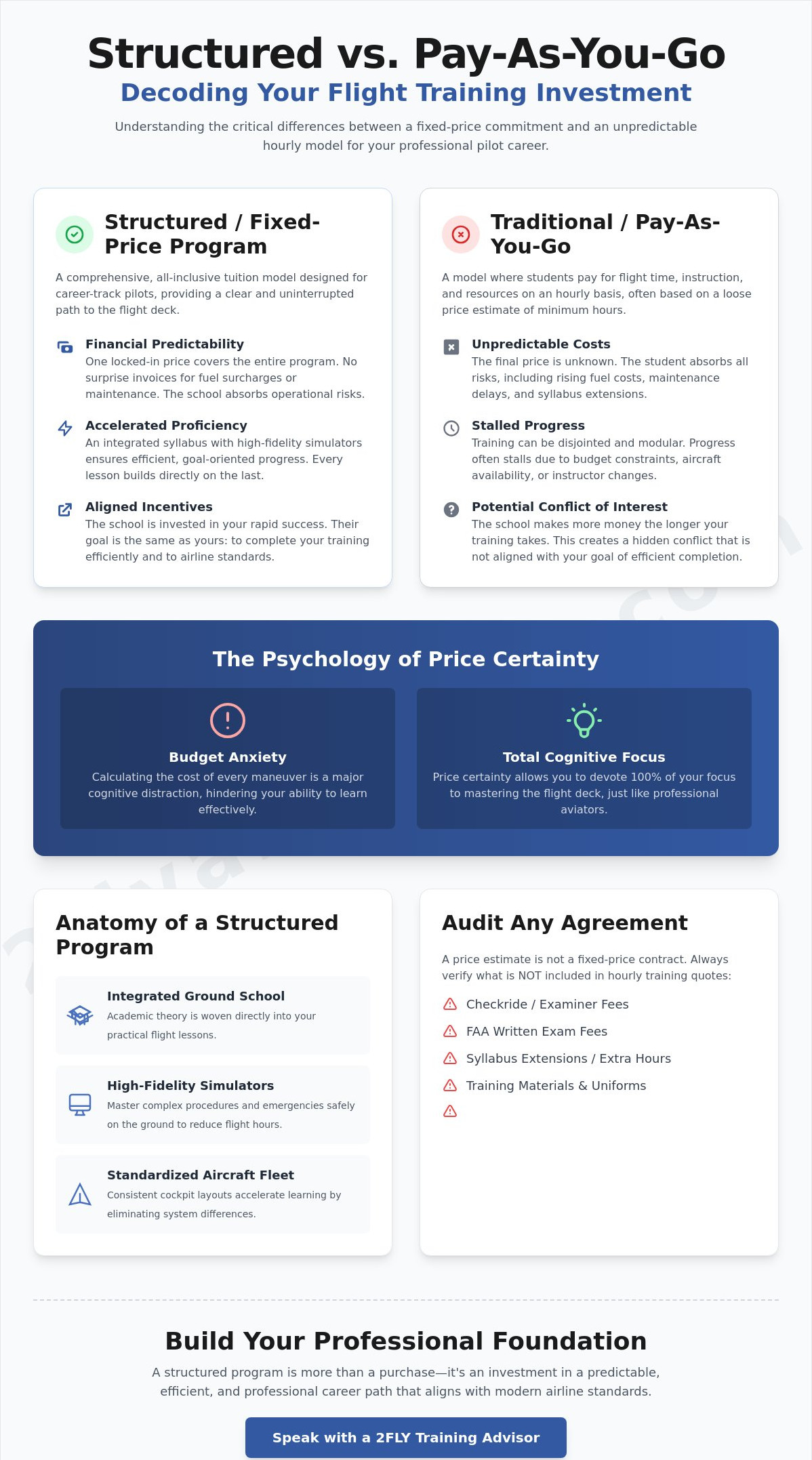
The traditional pay-as-you-go flight training model is often the most expensive and unpredictable way to become a professional pilot. Many students start their journey with high hopes only to find their progress stalled by hidden costs or syllabus extensions. Transitioning to structured pilot training programs allows you to focus on mastering the flight deck instead of worrying if your next lesson will push you into debt.
It’s understandable to feel anxious about the gap between FAA minimum hours and the actual proficiency required for a career in the skies. You deserve a clear, uninterrupted path that treats your training like the professional career it is. These programs provide the financial predictability and technical discipline necessary to transition seamlessly from a trainee to an industry-prepared professional.
This article reveals how fixed-price models eliminate financial uncertainty and align your instruction with elite airline standards. We’ll examine the benefits of a goal-oriented syllabus and how it provides a definitive gateway to your international aviation career.
Key Takeaways
- Learn the critical difference between a vague price estimate and a fixed tuition agreement to protect your investment.
- Understand how structured pilot training programs integrate high-fidelity simulators to accelerate proficiency and reduce overall training costs.
- Identify the hidden conflict of interest in hourly models and why a fixed-price commitment ensures your flight school is invested in your rapid success.
- Discover how to audit training contracts to identify common exclusions like checkride fees and FAA written exam preparation.
- See how an integrated syllabus creates a direct, professional pipeline that aligns your training with modern airline standards.
What is Fixed Price Pilot Training and Why Does It Matter?
Imagine starting your engine for a cross-country flight without wondering if a sudden rise in fuel surcharges will ground your ambitions next month. Fixed-price training is a comprehensive tuition model designed for career-track pilots who want to lock in their investment from the start. It replaces the traditional “pay-as-you-go” uncertainty with a clear, all-inclusive financial commitment that covers your journey to the flight deck.
There’s a massive difference between a simple price estimate and a professional fixed tuition agreement. An estimate is often just a best-case scenario based on minimum hours, while a fixed agreement is a binding contract that secures your path through pilot certification in the U.S. without surprise invoices for maintenance or overhead. This model shifts the financial risk away from the student, allowing you to focus entirely on your performance.
To better understand how these programs operate in a real-world setting, watch this helpful video:
Traditional flight schools often struggle with price creep. When fuel prices spike or an aircraft requires unscheduled maintenance, those costs are frequently passed directly to the student in hourly models. Within structured pilot training programs, the academy absorbs these operational risks. This creates a true partnership where both the student and the school are incentivized to reach proficiency efficiently and safely.
The Psychology of Price Certainty
Removing financial stress isn’t just about your bank account; it’s about your brain. When you aren’t calculating the cost of every orbit or stall recovery, you can devote your full cognitive focus to mastering complex flight maneuvers. Professional aviators prioritize these predictable environments because budget anxiety is a known distraction that can actually hinder your ability to achieve technical proficiency. Clarity in your training costs leads to clarity in the cockpit.
Fixed Price vs. Guaranteed Training
It’s vital to understand that “fixed price” covers the specific requirements of a professional syllabus rather than an infinite hour guarantee. These agreements bundle ground school, high-fidelity simulator sessions, and the necessary flight hours into a single, transparent package. This transparency ensures you know exactly what’s included from day one. It allows you to follow the FAA Professional Pilot Program requirements without the distraction of secondary financial negotiations or unexpected fees.
The Anatomy of a Structured Professional Pilot Program
A professional flight deck isn’t built on isolated lessons; it’s constructed through a deliberate sequence of skills that mirror airline operations. Successful aviators often credit their rapid progression to structured pilot training programs that eliminate the “restart” period often found in modular training. This building-block approach ensures that every hour spent in the air or in a simulator contributes directly to your final commercial checkride.
High-fidelity simulators play a vital role in this progression. These devices allow you to master complex procedures and emergency scenarios in a controlled environment before ever leaving the ground. By using simulation to handle the heavy lifting of procedural learning, academies can reduce the total hours needed in the actual aircraft. This efficiency directly lowers the total investment required while increasing your technical proficiency.
Standardization is the backbone of safety in the commercial aviation industry. Professional academies replicate this environment by maintaining a uniform fleet of aircraft. When every cockpit layout and avionics suite is identical, you spend less time adjusting to new switches and more time perfecting your maneuvers. This consistency is a primary reason why students in an FAA Professional Pilot Program often reach their goals faster than those at smaller, decentralized schools.
The Three Pillars of Professional Certification
Phase 1 begins with mastering the fundamentals through the Private Pilot Certificate. You’ll learn the essential physics of flight and basic navigation required by the FAA requirements for pilots. This stage sets the standard for your entire career, focusing on safety and stick-and-rudder skills.
Phase 2 moves into technical flight with the Instrument Rating. This is where you learn to fly solely by reference to instruments, a critical skill for airline operations in varying weather conditions. It’s a demanding phase that transitions your mindset from a recreational flyer to a technical professional.
Phase 3 concludes with achieving professional standards through the Commercial Pilot Certificate. Here, the focus shifts to precision, advanced maneuvers, and the legal responsibilities of flying for compensation. You’ll refine your skills to meet the rigorous demands of the commercial aviation industry.
Efficiency Through Standardization
Having a dedicated flight instructor following a set curriculum prevents the “re-learning” that happens when students bounce between different teachers. Structured programs use sophisticated resource management systems to ensure aircraft are available when you need them. This eliminates the scheduling delays that often plague smaller operations. Because the path is clearly mapped out, you can focus on your training timeline without worrying about logistical bottlenecks.
Fixed Price vs. Hourly Training: Decoding the Real Investment
Many students are drawn to the seemingly lower entry point of hourly aircraft rentals. However, this “pay-as-you-go” approach often conceals a fundamental conflict of interest. In an hourly model, the flight school technically generates more revenue the longer you take to learn, which can lead to “training stretch” where extra lessons are added without clear necessity.
Choosing structured pilot training programs removes this friction by aligning the academy’s goals with your own. When the tuition is fixed, the school is financially incentivized to provide the highest quality instruction and modern resources to ensure you reach proficiency on schedule. This partnership ensures that every flight hour is optimized for your advancement toward the professional flight deck.
Hidden Costs in Pay-As-You-Go Models
Hourly quotes rarely tell the whole story. You might see a competitive rate for the aircraft but realize later that instructor fees and fuel surcharges are billed separately. For a deeper look at these variables, review our guide on Flight School Costs to avoid common financial pitfalls. Pre-flight and post-flight briefings are also frequently omitted from hourly quotes, adding hundreds of dollars to your monthly expenses.
Fuel surcharges are particularly volatile and can fluctuate significantly during your training period. In a structured program, these market shifts are absorbed by the school, protecting your budget from external economic factors. You won’t find yourself grounded because of a sudden spike in aviation gasoline prices in the middle of your syllabus.
Incentive Alignment and Student Progress
Professional academies focus on efficiency because their reputation and business model depend on successful graduations. This high level of accountability makes it easier for students to secure flight school financing, as lenders prefer the predictability of a fixed-cost pathway. It provides a stable foundation for your transition into a high-earning profession without the anxiety of a floating budget.
The 2025 Boeing Pilot and Technician Outlook projects a demand for 660,000 new pilots globally through 2044. Entering the workforce even six months earlier by avoiding training delays can result in a significant boost to your lifetime earnings. When you evaluate the pilot career outlook, the real investment isn’t just the tuition; it’s the time saved getting to your first airline officer position.
How to Audit a Structured Pilot Training Agreement
Signing a training contract is one of the most significant steps in your professional journey. You must ensure the agreement you sign is a comprehensive roadmap rather than a vague list of estimates. Many academies use “all-inclusive” language, yet students often discover later that thousands of dollars in mandatory fees were left out of the initial quote. A thorough audit of your agreement ensures your focus remains on the flight deck rather than on unexpected invoices.
Professional career-track students should prioritize schools that maintain FAA Part 141 certification. This designation indicates that the school follows a highly regulated, FAA-approved syllabus designed for efficiency and high-level proficiency. Within structured pilot training programs, this certification serves as a badge of quality that airlines recognize. It ensures your training meets the rigorous standards required for a smooth transition into a commercial cockpit.
As you evaluate your training options, consider the long-term scale of the industry you’re entering. The 2025 Boeing Pilot and Technician Outlook projects a demand for 660,000 new pilots globally through 2044. This massive global need means you need a training partner capable of delivering a professional-grade education that holds weight across international borders. Finding a school that offers transparent, fixed-price agreements is the first step in meeting that demand.
The Essential Inclusion Checklist
Your audit should start with a clear list of what the tuition actually covers. Verify if the price includes the full path from your Private Pilot Certificate through to your Commercial Multi-Engine Instrument rating. Some contracts omit “soft costs” like digital charts, flight bags, or headsets, which can add up quickly. You should also confirm the school’s policy on additional proficiency hours. If weather or a scheduling conflict delays a checkride, you need to know if the cost of “refresher” flights is included in your package.
Evaluating Financing and Value
Lenders typically prefer fixed-price professional programs because the risk of default is lower when costs are predictable. When you apply for flight school financing, having a structured agreement makes the approval process more straightforward. For international students, the value of a program often extends beyond the flight hours. Look for agreements that include administrative support for visas and on-campus housing, as these factors significantly reduce the stress of relocating for your training.
View the full details of our FAA Professional Pilot Program to see how we structure our agreements for your professional success.
Building Your Professional Foundation with 2FLY Airborne
Choosing a training partner is the most critical decision you’ll make before ever stepping into a cockpit. Structured pilot training programs at 2FLY Airborne are designed to bridge the gap between a passionate student and a career-ready professional. We don’t just teach you to fly; we prepare you to meet the rigorous demands of the global aviation industry through a methodical and disciplined approach.
Our commitment to transparency ensures that your focus remains on your performance rather than your balance sheet. By viewing your education as a direct pipeline to employment, we align our resources with your long-term success. This professional perspective is what distinguishes an elite academy from a standard flight school, providing you with a stable environment to reach the highest levels of your profession.
The 2FLY Airborne Advantage in Structured Training
Technical mastery requires more than just time in the air. We utilize high-fidelity simulator training to expose you to complex scenarios that prepare you for real-world airline operations. This simulation, combined with our standardized fleet, ensures that your training remains on schedule and within your budget. When every aircraft in the fleet features a consistent cockpit layout, you maintain momentum and avoid the delays associated with switching between different avionics suites.
International professional mobility is a core pillar of our philosophy. We understand that the modern pilot needs to be prepared for a career that spans across borders. For a deeper look at the steps required to launch your career, review our guide on How to Become a Pilot. Our programs are designed to give you the technical foundation and the professional discipline that international carriers demand from their first officers.
Your Next Steps Toward the Flight Deck
The path to your commercial wings requires three essential elements: financial predictability, technical proficiency, and adherence to professional standards. Fixed-price, structured training provides the most reliable route to achieving these goals. By removing the uncertainty of hourly billing, you can commit fully to the rigorous syllabus required for airline readiness. Safe, structured training isn’t just a requirement; it’s the foundation of a successful career in the skies.
Your future in aviation starts with a single, professional step. We invite you to explore how our FAA Professional Pilot Program can turn your ambition into a reality. If you have any remaining questions about our fixed-price programs or your training timeline, please reach out to a 2FLY Airborne Training Advisor today.
Take Command of Your Aviation Career
Navigating the path to the flight deck requires more than just passion; it demands a strategic investment in your professional education. By choosing structured pilot training programs, you eliminate the financial volatility of hourly models and replace it with a clear, goal-oriented syllabus. This approach ensures your progress is measured by technical proficiency and airline standards rather than a fluctuating budget.
Success in modern aviation depends on a foundation of technical mastery and operational reliability. Our Fixed-Price Professional Pilot Program provides the predictability you need, supported by a modern fleet and high-fidelity simulators that mirror the environments of major carriers. Graduates also benefit from a global recruitment network designed to help you transition from a trainee to an industry-prepared professional. Your journey deserves the stability of a world-class training environment that views your education as a direct pipeline to employment.
It’s time to move beyond the uncertainty of traditional instruction and embrace a methodical path to your commercial wings. We invite you to Speak with a 2FLY Training Advisor about our Fixed-Price Programs to begin your journey. Please consider reaching out to a 2FLY Training Advisor with any remaining questions as you take the next step toward your future in the skies.
Frequently Asked Questions
Is fixed price pilot training really a single flat fee?
A fixed-price agreement covers the specific syllabus items listed in your contract, such as flight hours, ground school, and simulator time. It provides a high level of financial predictability compared to hourly models. You should always review the fine print for external costs like examiner fees or personal equipment that might sit outside the core tuition.
What happens if I need more flight hours than the program includes?
Most structured pilot training programs are designed to bring students to proficiency within the allotted syllabus hours. If you require additional time to master a specific maneuver, extra hours are typically billed at a pre-negotiated rate. It is important to discuss how these “overage” hours are handled with your training advisor before you enroll.
Does fixed-price training include the cost of FAA checkrides?
In most cases, the fees for FAA checkrides are paid directly to a Designated Pilot Examiner and are not included in the school’s tuition. These are external administrative costs that vary by region and examiner. You should budget for these practical tests separately to ensure your training remains on schedule.
Can I use financial aid or flight school loans for fixed-price programs?
Yes, many specialized lenders prefer these models because the total investment is clearly defined from day one. This predictability reduces the risk for financial institutions and often simplifies the approval process for student loans. Having a fixed-price contract allows you to secure the exact funding needed for your professional journey.
Why is fixed-price training better for commercial career paths?
This model ensures that the school is invested in your rapid and safe progression toward the airlines. The 2025 Boeing Pilot and Technician Outlook projects a demand for 660,000 new pilots globally through 2044. Structured pilot training programs provide the most efficient route to meeting this demand by focusing on proficiency rather than accumulating billable hours.
What are the main exclusions I should look for in a contract?
Common exclusions include FAA medical examiner fees, written knowledge test center fees, and personal flight gear like headsets. You should also verify if the agreement covers digital chart subscriptions or the cost of a pilot uniform. Understanding these minor out-of-pocket expenses early helps you maintain a realistic training budget.
How does fixed-price training compare to Part 61 vs Part 141 schools?
Fixed-price structures are most frequently found in Part 141 schools, which operate under a more rigid, FAA-approved curriculum. Part 61 schools offer more flexibility in their training pace but often lack the cost certainty and standardized progression required for an airline career pipeline. Choosing a structured path ensures your education meets the high standards of commercial aviation.
Is housing typically included in professional pilot program tuition?
Housing is usually treated as an optional add-on rather than a standard inclusion in the base tuition. Some programs specifically designed for international students may bundle accommodation to streamline the relocation process. It’s best to ask for a comprehensive breakdown of what is included in your specific professional package.
Article by
2FLY Airborne
2Fly Airborne is a professional flight training organization dedicated to developing the next generation of skilled, confident, and safety-focused pilots. With decades of combined aviation experience, our team of certified instructors provides structured, real-world training designed to prepare students for both checkrides and long-term success in the aviation industry.
Content Disclaimer
Some blog content is generated with the assistance of automated tools and may not always be fully accurate or up to date. Please verify all aviation-related information with official sources or a certified instructor. For additional guidance or clarification, we encourage you to contact one of our training advisors at 2Fly Airborne.