Most international students view a visa as a simple entry permit, but for an aspiring pilot, the right paperwork is actually your most valuable career asset. If you’re searching for an f1 visa flight school usa, you already know that training in the United States offers some of the world’s best instruction and aircraft access. The real challenge is ensuring you aren’t forced to return home the moment you earn your commercial certificate.

This guide explains why the F-1 visa is the premier gateway for international students to train, work, and launch a global aviation career. We provide a clear roadmap for managing the 2026 regulatory landscape while securing the legal right to work in the American aviation industry. It’s about moving beyond the classroom and into a professional flight deck with confidence.

You’ll discover how to leverage Optional Practical Training to reach the 1,500-hour milestone and earn globally recognized certifications. From understanding the new 30-day application windows to mastering the path from trainee to first officer, we offer the expert insight needed to reach the highest levels of the profession. This is your first step toward a stable and world-class career in the skies.

Key Takeaways

  • Understand why selecting an f1 visa flight school usa is the most strategic choice for long-term career mobility and work authorization in the American aviation market.
  • Learn the critical differences between F-1 and M-1 visas to ensure you don’t accidentally limit your training duration or post-completion employment opportunities.
  • Master the step-by-step application process for 2026, including mandatory government fees and the new fixed four-year admission period for international students.
  • Discover how to leverage Optional Practical Training (OPT) to legally build the 1,500 flight hours required for a globally recognized airline career.
  • Explore how a structured FAA Professional Pilot Program creates a direct pipeline from initial training to becoming an industry-prepared professional ready for global recruitment.

The Strategic Advantage of the F-1 Visa for International Pilots

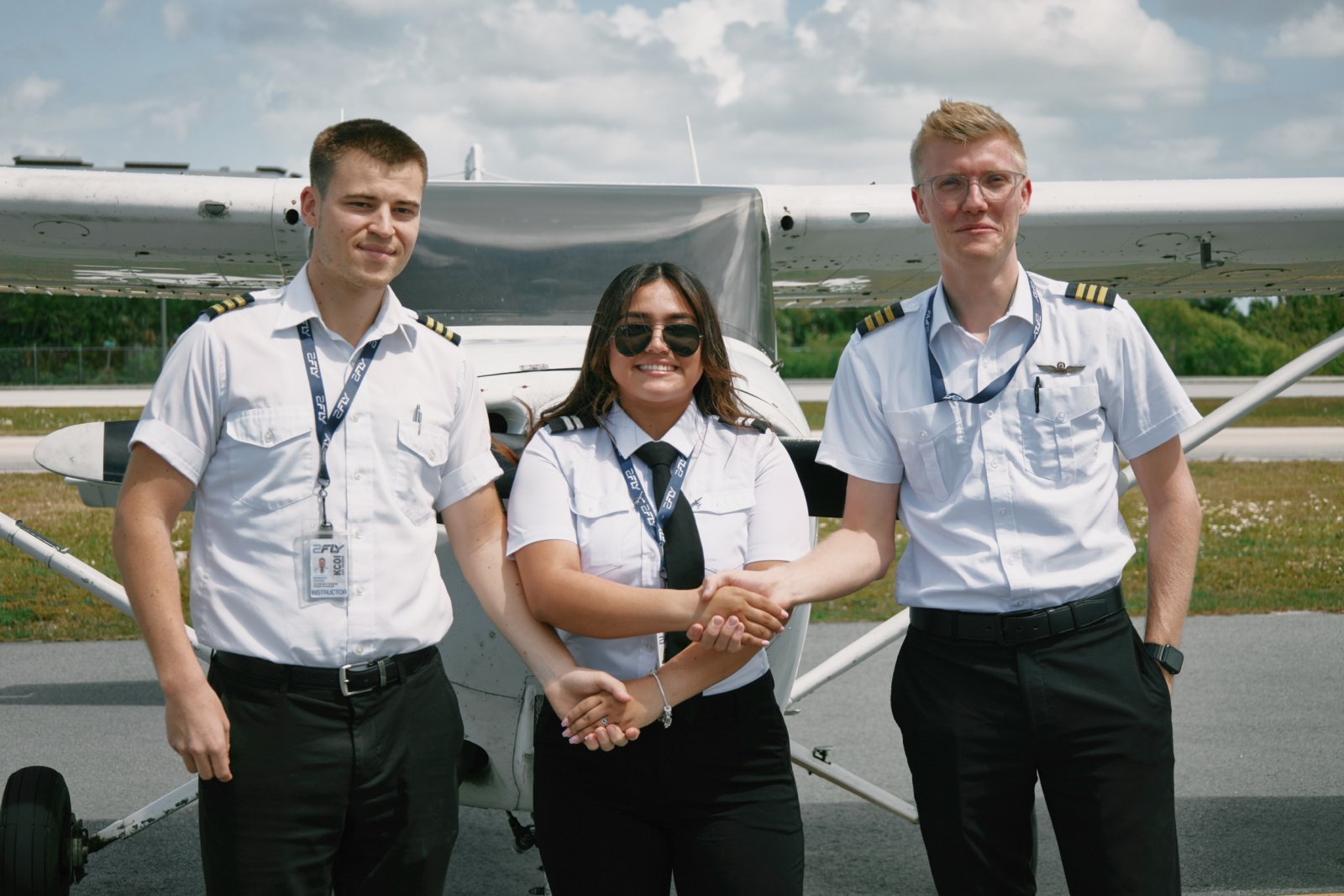
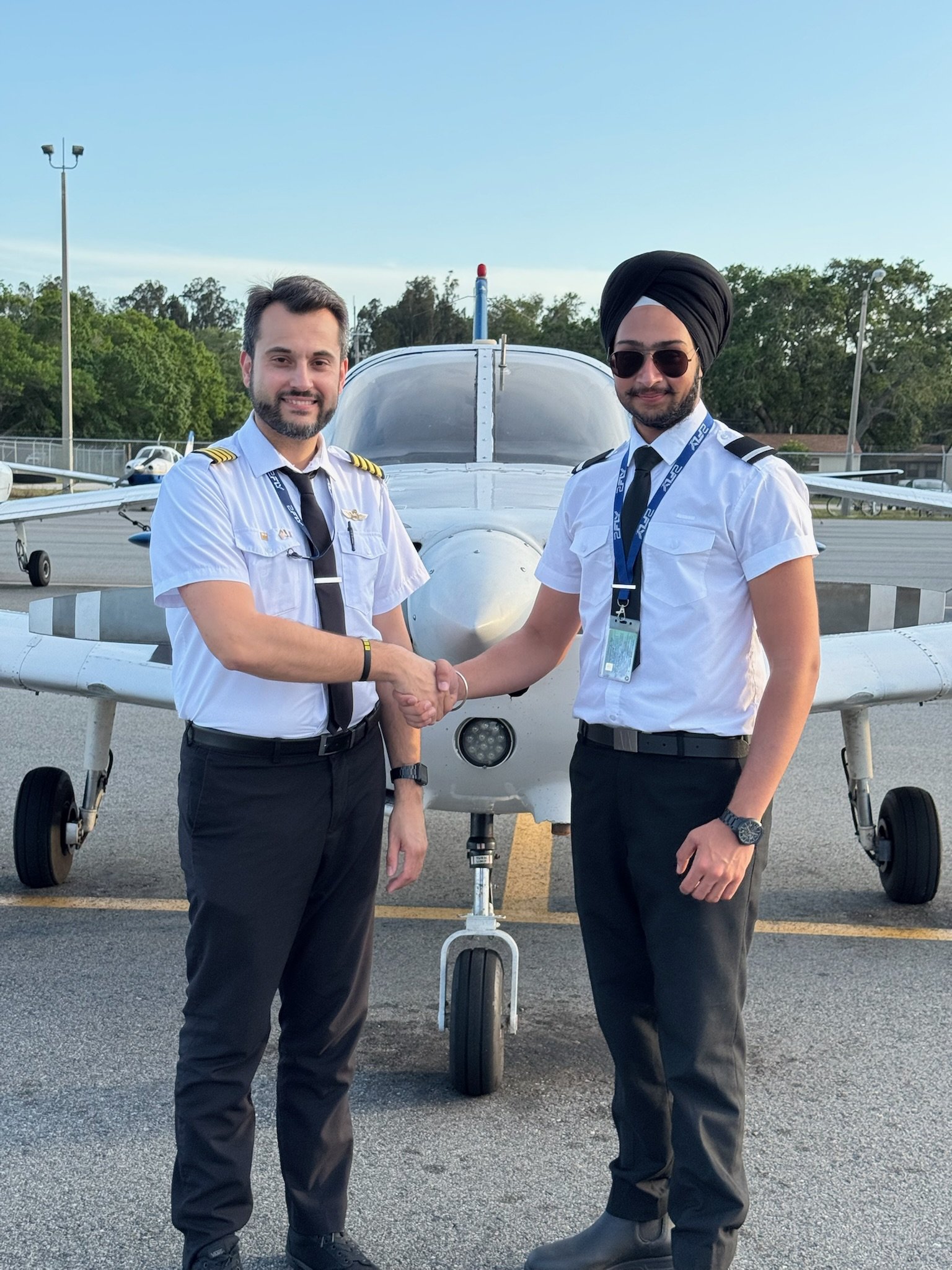
Imagine stepping onto the sun-drenched tarmac of a premier US training facility. You aren’t just there for a few weeks of flying; you’re there to build a lifelong career. Selecting an f1 visa flight school usa is a strategic decision that secures your professional journey from day one. While many programs offer basic flight training, the F-1 framework is specifically designed for long-term immersion in the American aviation ecosystem. It represents the gold standard for high-achievers who view their education as a vocational investment rather than a temporary hobby. Top-tier academies prioritize this accreditation because it allows them to support your growth from a novice student to an industry-ready professional.

To better understand the daily reality of this training path, watch this helpful video:

Beyond the Classroom: A Gateway to Professionalism

The transition from a trainee to a professional pilot is a demanding process that requires more than just cockpit time. The F-1 visa facilitates a structured immersion that prepares you for the rigorous standards of global airlines. Training within the United States provides unique exposure to complex airspace and diverse weather patterns. This experience ensures that your FAA certifications are recognized and respected by recruitment officers worldwide. We focus on the concept of international professional mobility, ensuring your training serves as a direct pipeline to a career. By the time you complete your FAA Professional Pilot Program, you’ll possess the technical mastery and professional polish required by the world’s leading carriers.

Why Accreditation Matters for Your Visa Status

Not every flight school has the authority to issue the documentation required for your career. To host international candidates, an institution must be certified by the Student and Exchange Visitor Program (SEVP). This status indicates that the school has met stringent federal requirements regarding its facilities, instructors, and curriculum. When you seek an F-1 student visa, you’re choosing a path that prioritizes academic and professional stability. It’s a commitment to a higher standard of training that shorter vocational visas simply cannot match. The 2026 updates to the program, including the transition to a fixed four-year admission period, underscore the need for a structured and well-managed training timeline. Keep in mind that federal regulations and individual application timelines vary; you should always speak with a training advisor to ensure your specific path aligns with current US government requirements.

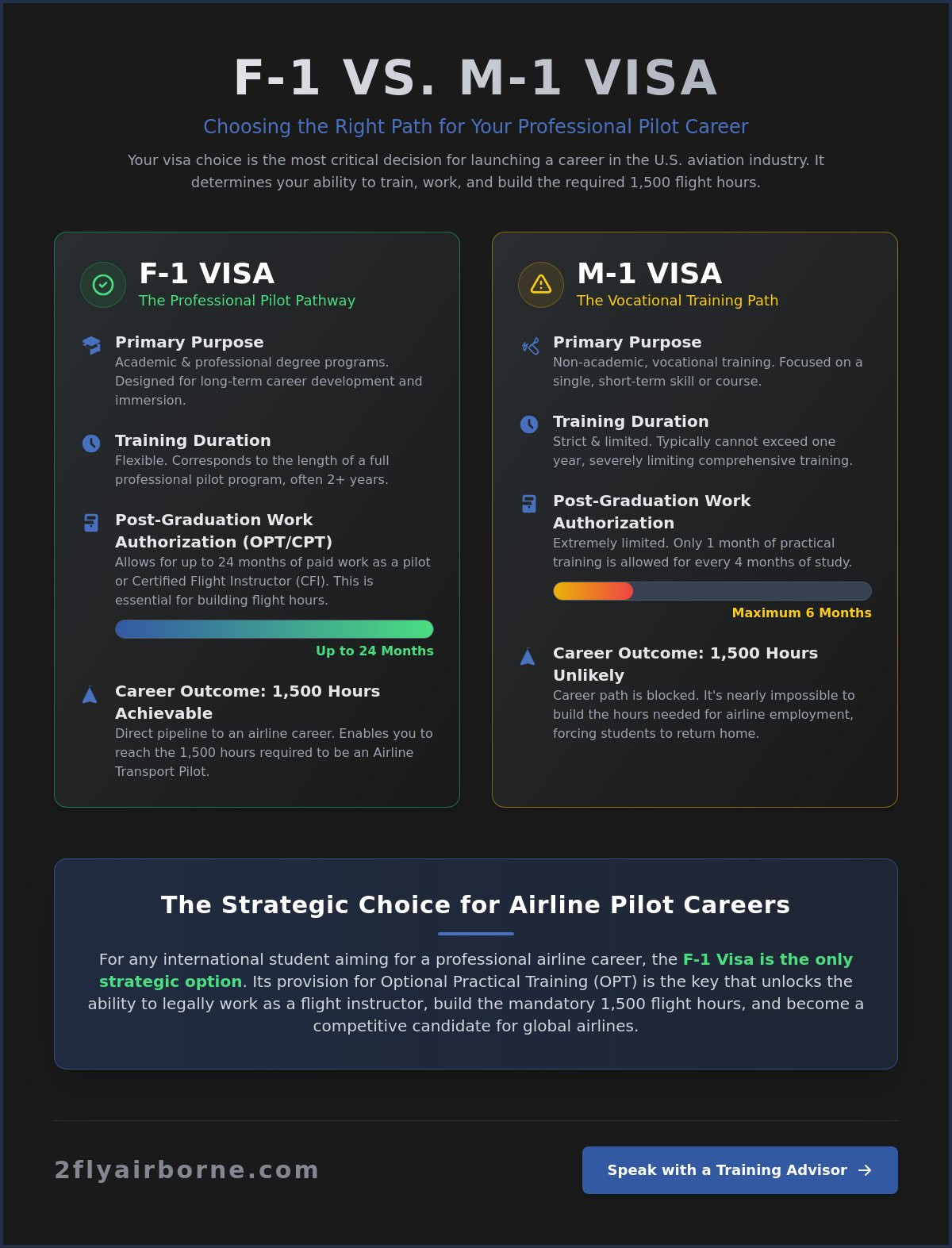
F-1 vs. M-1 Visa: Choosing the Right Path for Your Career Goals

Choosing between visa types is more than a technicality; it’s a strategic decision that defines your future earning potential. If you select the wrong category, you might find yourself forced to leave the U.S. just as you’re becoming most valuable to global airlines. While an f1 visa flight school usa offers a comprehensive career pipeline, other categories often fall short of professional requirements. You must align your visa choice with the specific milestones of a commercial pilot’s journey.

The primary difference lies in the ultimate objective of your stay. The M-1 visa is designed for vocational training, while the F-1 is for academic and professional immersion. This distinction impacts how long you can stay and whether you can legally work in the aviation industry after graduation. Understanding the U.S. student visa application process is the first step in securing a path that supports your long-term ambitions.

The Vocational M-1 Path: Short-Term Focus

The M-1 visa is strictly vocational and usually limits your stay to the specific duration of your flight course. It’s often better suited for recreational pilots or those seeking modular training to bring back to their home country. However, for career-minded individuals, the M-1 presents a significant hurdle: it doesn’t allow for the extended “Practical Training” periods that are essential for building hours. 2FLY Airborne supports international students in navigating these complex choices to ensure their training doesn’t hit a dead end. If your goal is a seat in a commercial flight deck, the M-1 might end your journey prematurely.

The Professional F-1 Path: Long-Term Mobility

In contrast, the F-1 path is built for high-achievers who demand long-term mobility. It requires a higher level of academic rigor but offers rewards that the M-1 cannot match. By enrolling in an FAA Airline Pilot Program, you gain access to extended stay benefits that keep you in the cockpit for years, not just months. This category allows for legal work authorization, enabling you to transition from a student to a professional instructor. This transition is vital for reaching the flight hour requirements of major airlines. Speaking with a training advisor can help you map out a timeline that maximizes your legal stay in the U.S.

  • F-1 Visa: Allows for Optional Practical Training (OPT) to build professional hours.
  • M-1 Visa: Strictly limits stay to the training period with no meaningful work authorization.
  • Career Impact: F-1 students can often stay for up to four years under the 2026 regulations to complete training and gain experience.

F-1 Visa Flight School USA: The 2026 International Pilot Career Guide

The F-1 Visa Application Process for Flight Training

Navigating the federal requirements for a student visa can feel as complex as your first solo cross-country flight. It’s a journey that demands a methodical approach and an unwavering attention to detail. Success depends on more than just filling out forms; it requires a deep understanding of how to present your career trajectory to U.S. authorities. By choosing an f1 visa flight school usa with a dedicated admissions team, you ensure that every administrative hurdle is cleared before you even step into a cockpit. Accuracy in your documentation isn’t just a preference; it’s a requirement to avoid the delays or denials that can stall a promising career.

Step 1: Admission and the I-20 Form

Your journey officially begins when an accredited flight school issues your Form I-20, the Certificate of Eligibility. This document confirms you’ve been accepted into a full-time program and that the school is SEVP-certified to host international students. To receive this, you must provide comprehensive financial evidence demonstrating your ability to cover flight school costs and living expenses. Once your I-20 is in hand, you’ll need to pay the $350 SEVIS I-901 fee. This fee supports the Student and Exchange Visitor Program, the system that maintains your legal status throughout your stay in the United States.

Step 2: The Embassy Interview and TSA Clearance

The visa interview at a U.S. embassy or consulate is a pivotal moment where you must clearly articulate your professional intent. Consular officers look for high-achievers who are focused on their training goals and have strong ties to their home country. Frame your move to the United States as a strategic step toward a global aviation career. You’ll also need to pay the mandatory $185 DS-160 application fee before your interview can be finalized. Preparation is key; you should be ready to discuss how your FAA certifications will translate to employment opportunities in your home region or internationally.

Parallel to the visa process, you must obtain security clearance from the Transportation Security Administration (TSA). This federal background check is mandatory for all foreign nationals seeking flight training in the U.S. and must be initiated before you can begin actual flight instruction. The process involves submitting fingerprints and a detailed history for review. As of 2026, most F-1 students are admitted for a maximum initial period of four years, or the length of their program, whichever is shorter. This fixed admission period provides a clear timeline for completing your ratings and transitioning into professional practice. Most students arrive in the United States approximately 30 days before their course start date to settle into shared accommodations and prepare for the rigorous pace of the professional syllabus.

Building Professional Hours: The OPT and CPT Advantage

You’ve earned your commercial pilot certificate, but the journey to the captain’s seat has only just begun. For many international students, the real challenge isn’t the skill required to fly, but the accumulation of enough flight hours to satisfy airline hiring requirements. Selecting an f1 visa flight school usa provides the legal framework to bridge this gap through professional work authorization.

This strategic advantage ensures you aren’t just a visitor, but an active participant in the U.S. aviation sector. It turns your training period into the foundation of a long-term international career. You can gain the experience necessary to compete at the highest levels of the profession.

Optional Practical Training (OPT) Explained

OPT serves as a 12-month window of work authorization that follows the completion of your flight training program. Most high-achieving students utilize this time to work as a Certified Flight Instructor (CFI). This position allows you to build critical flight hours while earning a professional income.

Teaching others how to navigate the skies reinforces your own technical knowledge and demonstrates your leadership potential to global recruiters. It’s the most reliable way to transition from a trainee to a seasoned professional. Explaining complex aerodynamics to a student often makes you a more precise and disciplined pilot yourself.

Curricular Practical Training (CPT) Opportunities

While OPT occurs after your studies, CPT offers a way to gain professional experience while you’re still enrolled. This is a powerful tool when you choose a degree program with airline pilot training. It allows for internships and practical training integrated into your academic curriculum, ensuring you participate in an f1 visa flight school usa environment from day one.

This proactive approach makes you a more competitive candidate for global airlines. Early exposure to the professional environment is vital for meeting future needs. The 2025 Boeing Pilot and Technician Outlook projects a demand for 660,000 new pilots globally through 2044.

If you’re ready to secure your future in the cockpit, contact an advisor to discuss the FAA Professional Pilot Program today. Our team can help you understand the specific timelines and requirements for your transition to a professional career. We are committed to helping you navigate every step of your international aviation journey.

Launching Your International Career with 2FLY Airborne

Choosing an f1 visa flight school usa is a decision about your future employer as much as your education. At 2FLY Airborne, we don’t just provide lessons; we provide a seamless pipeline from international student to industry-prepared professional. Our FAA Professional Pilot Program is specifically engineered to maximize the benefits of the F-1 visa framework. You’ll train in an environment that mirrors the discipline and professionalism of a commercial flight deck, ensuring you’re ready for the demands of a global career.

The transition from trainee to pilot requires a global perspective. We integrate training standards that are respected by airlines worldwide, positioning you as a top-tier candidate in any market. This commitment to excellence ensures that your time in the United States serves as the definitive gateway to your international aspirations.

Dual Certification: FAA and EASA Pathways

One of the most significant advantages we offer is the ability to pursue dual certification. Earning both FAA and EASA ratings while training in the U.S. gives you an unparalleled competitive edge. This dual-track approach allows you to seek employment in both the American and European markets, doubling your career opportunities. For a deeper look at how this works, explore our EASA flight school USA guide. This comprehensive training prepares you for the highest levels of the profession from day one.

Support Systems for International Aviators

Relocating to a new country is a significant undertaking, and we’re here to guide you through every step. 2FLY provides robust administrative support for visa sponsorship and SEVIS processing, reducing the burden on you and your family. We also offer shared room accommodations as part of our professional programs, providing a stable and supportive environment where you can focus entirely on your studies. This community of fellow aviators fosters the networking and mentorship necessary for long-term success.

The 2025 Boeing Pilot and Technician Outlook projects a demand for 660,000 new pilots globally through 2044. Meeting this demand requires more than just hours; it requires a foundation built on safe, structured training and expert mentorship. By aligning your ambition with our proven training syllabus, you secure a future that is both rewarding and reliable.

In summary: The F-1 visa is your most strategic tool for gaining the 1,500 flight hours and professional experience required by global airlines. By choosing a SEVP-certified f1 visa flight school usa, you unlock the ability to work legally as a flight instructor and earn dual certifications. Success in the cockpit begins with a methodical approach to your visa, your training, and your professional development.

If you have questions about the application process or our career-track programs, we invite you to reach out. Please contact 2FLY Airborne or speak with a 2FLY Training Advisor to begin your journey toward the flight deck.

Secure Your Future on the Global Flight Deck

The F-1 visa is more than a permit; it is a strategic vocational asset that provides the legal framework for your professional growth. By choosing an f1 visa flight school usa, you secure the ability to build the 1,500 flight hours required by global airlines through paid work authorization. This path ensures you transition from a student to an industry-prepared pilot with the technical mastery demanded by the world’s leading carriers.

Our SEVP-certified institution provides the sponsorship needed for your F-1 visa while delivering accredited FAA and EASA professional programs. We reinforce the importance of safe, structured training to ensure every graduate meets the rigorous demands of global airline recruitment. This commitment to excellence is backed by a worldwide network of support that guides you from your first flight to your professional career.

If you’re ready to launch your career, we invite you to Speak with a 2FLY Training Advisor about your F-1 Visa options. Please reach out to a 2FLY Training Advisor with any remaining questions you have regarding the application or our professional pathways. We look forward to helping you reach the highest levels of your profession.

Frequently Asked Questions

Can I work in the USA on an F-1 visa while attending flight school?

You can legally work in the U.S. through Curricular Practical Training (CPT) or Optional Practical Training (OPT) if the employment is an integral part of your aviation curriculum. Standard off-campus jobs are generally prohibited for F-1 students. Most candidates focus on completing their commercial ratings first, then transition into a paid flight instructor role during their OPT period to build professional hours.

How long does the F-1 visa application process take for international students?

The application process typically takes between four and twelve weeks depending on consulate wait times in your home country. You must secure an I-20 from an f1 visa flight school usa before you can book your embassy interview. It’s wise to start the process at least six months before your class date to allow for TSA background checks and administrative processing.

What is the main difference between an F-1 and an M-1 visa for pilots?

The main difference is that the F-1 visa allows for post-completion work authorization, whereas the M-1 is strictly for vocational training. F-1 students can apply for 12 months of Optional Practical Training to work as instructors and build flight time. M-1 students must usually leave the United States immediately after their training ends, making it less ideal for those pursuing a long-term airline career.

Do I need to have a job offer to apply for an F-1 visa?

You don’t need a job offer to apply for an F-1 visa because its primary purpose is academic and professional flight training. Instead, you must demonstrate admission to a SEVP-certified flight academy and provide evidence of financial support for your training and living expenses. The goal is to prove you are a legitimate student with the intent to complete a professional pilot syllabus.

Can I extend my F-1 visa if my flight training takes longer than expected?

You can extend your stay if you haven’t finished your ratings, provided your school’s official supports the request based on valid academic or medical reasons. As of 2026, the U.S. government admits F-1 students for a fixed period of up to four years or the length of the program. This provides a clear window for completing your certificates and ratings without the uncertainty of the previous duration of status framework.

What happens if my pilot visa application is denied?

You have the right to reapply if your visa is denied, provided you can address the specific reasons for the initial rejection. Common reasons include a lack of financial proof or failure to demonstrate strong ties to your home country. It’s vital to review the consular officer’s feedback and consult with a training advisor to strengthen your documentation before your second attempt.

Can I transition from a student pilot to a commercial airline pilot on an F-1 visa?

You can transition to an airline career by utilizing Optional Practical Training to work as a flight instructor at an f1 visa flight school usa. This period allows you to accumulate the 1,500 flight hours required for an Airline Transport Pilot certificate. While the F-1 itself is a student visa, the experience you gain during the work authorization phase makes you a competitive candidate for global airline recruitment.

Is financial aid available for international students on an F-1 visa?

U.S. federal financial aid isn’t available to international students, so you must secure private funding or sponsorships from your home country. You are required to show proof of liquid funds to cover the first year of training and living costs to receive your I-20. High-achievers often explore specialized aviation loans in their home regions or utilize personal savings to fund their professional pilot journey.

2FLY Airborne

Article by

2FLY Airborne

2Fly Airborne is a professional flight training organization dedicated to developing the next generation of skilled, confident, and safety-focused pilots. With decades of combined aviation experience, our team of certified instructors provides structured, real-world training designed to prepare students for both checkrides and long-term success in the aviation industry.

Content Disclaimer

Some blog content is generated with the assistance of automated tools and may not always be fully accurate or up to date. Please verify all aviation-related information with official sources or a certified instructor. For additional guidance or clarification, we encourage you to contact one of our training advisors at 2Fly Airborne.