

What if an early medical checkpoint could help you make a more informed start on an airline-pilot career? The faa first class medical certificate for airline pilots is often treated as paperwork for later, but understanding the process early can help you plan flight training with greater confidence. A medical certificate confirms that you meet applicable medical standards; it is separate from a pilot certificate, which documents your flying qualifications.
If you’re unsure whether you need a first-class certificate, what an Aviation Medical Examiner (AME) checks, or how a health condition could affect your timeline, address those questions before your training plan is firmly underway. A medical review may involve additional steps, so understand your situation rather than assume an outcome.
This guide explains the purpose and privileges of a first-class medical, how to complete the FAA application and prepare for an AME examination, and when to factor medical certification into career planning. Use it to identify practical next steps and keep your training goals grounded in informed decisions.
Key Takeaways
- Understand how the faa first class medical certificate for airline pilots relates to airline-pilot privileges and how it differs from a pilot certificate.
- Compare the general purposes of first-, second-, and third-class medical certificates to see which class aligns with your flying plans.
- Prepare for the application and AME examination by reviewing current FAA instructions and organizing accurate, complete information.
- Recognize that medical certification, pilot qualifications, and airline hiring are separate checkpoints in a career plan.
- Consider medical certification early as you map out structured flight training and future pilot certifications.
What Is an FAA First-Class Medical Certificate for Airline Pilots?
Could a medical question affect your plan to become an airline pilot? It’s a sensible question to raise before committing to a professional training pathway. An FAA medical certificate addresses whether you meet applicable medical standards for the flying privileges you intend to exercise. It does not measure piloting skill or guarantee a place with an airline.
The faa first class medical certificate for airline pilots is the highest class of FAA medical certificate. Its standards are set out in 14 CFR Part 67, and its connection to pilot privileges is described in 14 CFR § 61.23. An Aviation Medical Examiner (AME) can conduct the required examination and may issue a certificate when authorized and when the applicable criteria are met.
What privileges does a first-class medical certificate support?
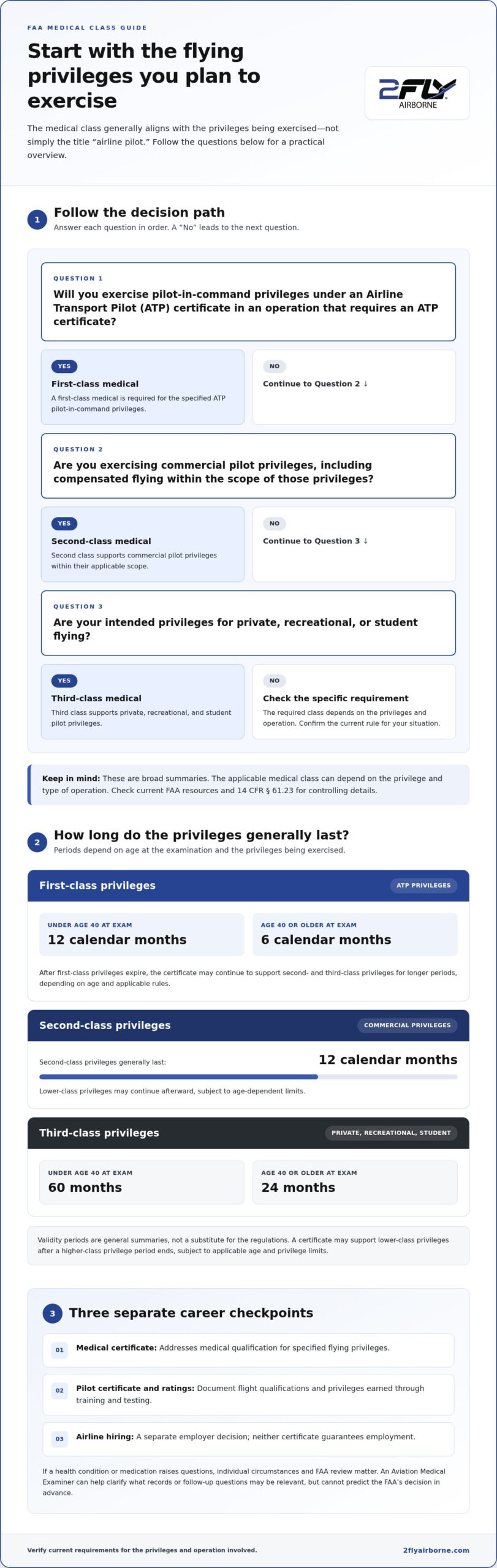
A first-class medical is generally required to exercise the pilot-in-command privileges of an Airline Transport Pilot (ATP) certificate. Pilot in command means the pilot responsible for the aircraft’s operation and safety. The exact medical class required depends on the privileges being exercised and the type of operation, so the term “airline pilot” alone doesn’t determine every requirement.
Medical certification is one professional checkpoint. An ATP certificate and any required ratings establish qualifications; airline hiring involves separate employer requirements and selection processes. A first-class medical by itself doesn’t establish flying proficiency or guarantee employment. For controlling details, consult current FAA medical certification resources and the applicable regulations, especially 14 CFR §§ 61.23 and Part 67.
Who should consider a first-class medical early?
Aspiring airline pilots may want to research medical certification while planning flight training, rather than treating it as an administrative detail for the end of training. An early conversation with an AME can help clarify what records or follow-up questions may be relevant to an individual application. It cannot predict the FAA’s decision in advance.
This can be particularly useful if you have a known health condition or take medication and are unsure how to prepare. A diagnosis or symptom alone doesn’t determine whether someone qualifies; individual circumstances and FAA review matter. Avoid drawing conclusions from another pilot’s experience. Gather your questions and review current FAA guidance before making major training decisions.
Keep these distinctions clear as you plan:
- Medical certificate: Addresses medical qualification for specified flying privileges.
- Pilot certificate and ratings: Document flight qualifications and privileges earned through training and testing.
- Airline hiring: Is a separate employer decision, not an outcome guaranteed by either certificate.
Considering these checkpoints early can help you make a more informed professional FAA training plan. Regulations and FAA procedures can change, so use current FAA materials for the details that apply to your circumstances.
FAA Medical Classes Compared: Why Airline Pilots Focus on First Class
FAA medical certificates come in three classes. The class needed depends on the pilot privileges being exercised. For an aspiring airline pilot, first class matters because of the medical requirement tied to certain ATP privileges, not because it guarantees medical eligibility or a job.
How do first-, second-, and third-class certificates differ?
This table provides a practical overview. Validity periods depend on the pilot’s age at the examination and the privileges being exercised. A certificate may continue to support lower-class privileges after its first-class privileges expire, subject to the applicable limits.
| Medical class | General purpose | Privilege period and step-down |
|---|---|---|
| First class | Supports specified Airline Transport Pilot privileges. | First-class privileges generally last 12 calendar months if the pilot was under 40 at the exam, or 6 months if age 40 or older. The certificate may then support second- and third-class privileges for longer periods, depending on age and the rules. |
| Second class | Supports commercial pilot privileges, including compensated flying within the scope of those privileges. | Second-class privileges generally last 12 calendar months. Lower-class privileges may continue afterward, subject to age-dependent limits. |
| Third class | Supports private, recreational, and student pilot privileges. | Generally 60 calendar months if under 40 at the exam, or 24 months if age 40 or older. |
These are broad summaries, not a substitute for the regulations. The applicable period can depend on the privilege and operation, so check the current rules in 14 CFR § 61.23 and the FAA’s FAA Medical Certification resources before relying on a certificate for a particular flight.
Does an airline pilot need a first-class medical?
A first-class medical is required to exercise ATP privileges as pilot in command in operations that require an ATP certificate. That makes the faa first class medical certificate for airline pilots an important planning consideration for pilots pursuing those responsibilities. The class needed for a specific operation depends on the applicable regulation and the privileges being exercised.
Medical privileges and hiring are separate. An airline may have its own employment standards and selection process, and holding a first-class medical doesn’t guarantee that an applicant meets them or will be hired. It also doesn’t replace the pilot certificates, ratings, experience, and testing required for the role.
For a broader view of professional training, 2FLY’s FAA airline pilot program outlines a career-training pathway. Use current FAA materials to confirm the medical rules that apply to your intended privileges, and treat medical certification as one checkpoint in a carefully planned progression.
Medical Certificate vs. Pilot License and Airline Hiring: What Each One Proves
These checkpoints serve different purposes. A medical certificate addresses medical qualification for specified flying privileges. Pilot certificates and ratings document qualifications earned through training and testing, while airline hiring is a separate employment decision. Understanding the distinction helps you plan without treating one approval as a substitute for another.
What does a medical certificate establish, and what doesn’t it?
A medical certificate indicates whether an applicant meets the applicable medical standards for the privileges they intend to exercise. It doesn’t demonstrate flight skill, award a pilot certificate, or guarantee employment. The FAA’s FAA Guide for Aviation Medical Examiners describes the standards and procedures used in aviation medical examinations.
| Checkpoint | What it establishes | What it doesn’t establish |
|---|---|---|
| Medical certificate | Medical qualification for privileges allowed by the applicable rules and certificate class. | Flight proficiency, pilot certification, or an airline job offer. |
| Pilot certificate and ratings | Flight qualifications and the privileges associated with certificates and ratings earned. | Medical qualification for every privilege or selection by an airline. |
| Airline hiring decision | An employer’s decision about whether to select an applicant for a role. | A replacement for required FAA pilot certificates, ratings, or medical qualification. |
Where does medical certification fit in FAA pilot training?
Think of medical certification as a parallel planning checkpoint, not a flight-training milestone. As you consider training, research medical requirements alongside decisions about instruction, knowledge preparation, flight experience, and the tests needed for each pilot certificate or rating. The right sequence and timing depend on your circumstances and the privileges you’re working toward.
For example, passing a flight test demonstrates performance against the test’s standards; it doesn’t resolve a separate medical certification question. Likewise, receiving a medical certificate doesn’t replace the instruction, knowledge, experience, and testing needed to earn pilot qualifications. The faa first class medical certificate for airline pilots is one part of a larger professional pathway, not a shortcut through it.
Airline employers make their own hiring decisions, so neither medical certification nor pilot credentials alone guarantee selection. Keep each step distinct and use current FAA requirements when planning. If you’re mapping a training progression, explore 2FLY’s FAA pilot training programs to see how structured training can lead through professional pilot certifications.
How to Prepare for the FAA First-Class Medical Application and AME Exam
A clear process starts before the examination. To apply for the faa first class medical certificate for airline pilots, use the FAA’s MedXPress portal to submit Form 8500-8 electronically, then provide the confirmation number to an FAA-designated Aviation Medical Examiner (AME). Review current FAA instructions before beginning because requirements and procedures can change.
What should applicants do before an AME examination?
Start with the FAA’s current medical certification information and follow its directions for completing the application. Make sure your answers are accurate and complete, and gather relevant medical records or other documents if they apply to your history. If a condition, medication, or past treatment raises questions, consult current FAA guidance and discuss your situation with an AME rather than relying on assumptions.
- Review current instructions. Read the FAA’s medical certification guidance and the instructions in MedXPress before submitting anything. Check which information and records are relevant to your circumstances.
- Complete the application online. Submit Form 8500-8 through MedXPress. After submission, retain the confirmation number and provide it to the AME. The application is valid for 60 days, so complete the examination within that period.
- Attend the AME examination. The examination must be conducted by an FAA-designated AME, a physician authorized to perform aviation medical examinations. Bring relevant documentation and be prepared to answer questions about your application.
Answer every application question truthfully and carefully. If you’re unsure how to report a detail, don’t guess or leave it out simply because it seems minor. Seek clarification through the current FAA process or with an AME. The examination and any additional information requested can vary by individual case.
What can happen after the medical examination?
An AME may issue a medical certificate when authorized and when the applicable requirements are met. If the AME can’t issue it at the examination because further review is needed, the application may be deferred to the FAA. A deferral is not a denial; it means the FAA needs to review the case before making a final decision.
If your application is deferred, follow the instructions you receive and respond to requests for information through the appropriate process. Don’t assume a deferral predicts the final outcome, and don’t rely on a general estimate for how long review will take. Check current FAA instructions for case-specific next steps.
Medical preparation is one part of a carefully planned career pathway. As you coordinate certification questions with your training goals, explore 2FLY’s FAA airline pilot training program and reach out to a 2FLY Training Advisor with questions about the training sequence.
Plan Your Airline-Pilot Training Around Medical Certification
Medical certification is one planning checkpoint, not a verdict on your ambition or a substitute for flight training. Research current FAA requirements early enough to understand what questions you may need to resolve, especially if your health history or medication raises concerns. There’s no single application timeline for every aspiring pilot, so base your next steps on current information and your circumstances.
When should medical certification enter a training plan?
Consider medical requirements while comparing training pathways and before making major commitments. If you have questions about your specific situation, review current FAA resources and discuss them with an AME. This can give you a clearer basis for planning without assuming a particular diagnosis or symptom predicts the FAA’s decision.
As you map the path ahead, keep these milestones distinct:
- Medical certification addresses medical qualification for the privileges you plan to exercise.
- Flight training and testing develop and assess the knowledge and practical skills required for pilot certificates and ratings.
- Employment decisions are made separately by airlines and aren’t guaranteed by medical or pilot certification.
Considering these steps together can help you ask focused questions and build a plan that accounts for certification requirements and training progression. Revisit FAA information as your plans develop, since regulations and procedures may change.
How can a prospective pilot take the next step?
Once you understand how medical certification fits into your goals, consider how structured flight training can support your progression. 2FLY’s FAA training pathway includes private, commercial, and flight instructor certifications. Each milestone develops a different level of qualification, but completing training doesn’t guarantee medical approval or airline employment.
For a broader view of the professional training pathway, explore 2FLY’s FAA airline pilot training program. Consider how the training stages relate to your career goals while continuing to address medical questions through current FAA information and appropriate medical guidance.
The key takeaway is to treat medical research, flight training, and airline hiring as connected but separate parts of your plan. Approach each step with accurate information and a commitment to safe, structured training. Reach out to a 2FLY Training Advisor with questions about planning your training progression.
Take the Next Step With Confidence
Your airline-pilot goal deserves a plan built on sound information and steady decisions. Treat the faa first class medical certificate for airline pilots as an early career-planning consideration, and use current FAA resources to guide questions specific to your circumstances. Medical certification, flight training, and airline hiring remain separate parts of the journey.
As you consider your training pathway, choose a structured approach that keeps safety and preparation at the center. 2FLY Airborne’s management team brings more than 50,000 combined flight hours and 35 years of aviation experience to its training organization. That experience can inform your questions as you plan your next steps, without promising a particular medical or career outcome.
Ready to explore how flight training could fit your goals? Speak with a 2FLY Training Advisor about your pilot-training questions and take your next step with purpose.
Frequently Asked Questions
Do airline pilots need an FAA first-class medical certificate?
For the privileges of an Airline Transport Pilot certificate, FAA rules generally require a first-class medical. The faa first class medical certificate for airline pilots is therefore relevant to pilots exercising those privileges, but it doesn’t set every airline’s employment standards. When comparing potential roles, consider the FAA requirement for the intended operation separately from each employer’s published qualifications and hiring process.
How do I get an FAA first-class medical certificate?
Follow the current FAA medical certification instructions to complete the required electronic application and arrange an examination with an FAA-designated AME. Before submitting, check that your answers are complete and consistent with your records, and gather relevant medical documentation. Use the FAA’s instructions to verify current forms and procedures; additional steps may depend on information in your individual application.
What happens during an FAA medical exam with an AME?
An AME conducts an aviation medical examination and reviews the application against FAA standards. The assessment can include vision and hearing checks, and a first-class examination may involve an electrocardiogram based on the applicant’s age and examination history. Bring relevant records and answer questions accurately. The precise examination and any follow-up depend on the case, so a general description can’t predict an individual result.
Can a medical condition prevent me from becoming an airline pilot?
A health condition doesn’t produce the same certification outcome for every applicant. The FAA evaluates the condition and its circumstances under applicable standards; some cases may require additional evidence or consideration through a Special Issuance. That pathway isn’t an automatic approval. Review current FAA medical guidance and follow the process relevant to your case rather than drawing conclusions from a diagnosis, medication, or another pilot’s experience.
Is a first-class medical certificate the same as an ATP certificate?
No. The medical certificate concerns medical qualification, while an ATP certificate is a pilot credential earned through the applicable qualification process. Completing flight training and meeting pilot-test requirements addresses flying qualifications, not medical certification. Likewise, medical certification doesn’t award pilot privileges. Plan for both requirements as distinct parts of professional preparation, and don’t treat either as an airline hiring decision.
How long is an FAA first-class medical certificate valid?
There isn’t one validity period that applies to every pilot and every privilege. Age at examination and the privileges being exercised affect how long first-class privileges remain available, and a certificate may later support privileges of a lower class. Keep track of your examination date and the privileges you intend to use, then check the current regulation before relying on a certificate for a specific operation.
Should I get a first-class medical before starting pilot training?
Researching the requirements before committing to a training plan can help you identify questions that need individual attention. It doesn’t mean every prospective pilot must apply at the same stage, and general guidance can’t determine personal eligibility. Use current FAA information to inform major training decisions, then build a realistic plan around your goals and circumstances. For questions about structured pilot training, reach out to a 2FLY Training Advisor.

Article by
2FLY Airborne
2Fly Airborne is a professional flight training organization dedicated to developing the next generation of skilled, confident, and safety-focused pilots. With decades of combined aviation experience, our team of certified instructors provides structured, real-world training designed to prepare students for both checkrides and long-term success in the aviation industry.
Content Disclaimer
Some blog content is generated with the assistance of automated tools and may not always be fully accurate or up to date. Please verify all aviation-related information with official sources or a certified instructor. For additional guidance or clarification, we encourage you to contact one of our training advisors at 2Fly Airborne.