
What happens when a routine radio exchange turns into an unexpected situation and standard phraseology isn’t enough? The icao english language proficiency test for pilots assesses more than memorized aviation terms. It looks at how clearly you understand and communicate in both standard phraseology and plain English.
If you’re unsure what the proficiency levels mean, which communication skills matter, or whether every assessment uses the same format, you’re not alone. This guide explains what the assessment measures, what to expect, and how to practise in a focused way.
You’ll learn how the six skill areas, from pronunciation and fluency to comprehension and interaction, relate to practical aviation communication. We’ll also cover why test formats can vary, why the relevant licensing authority’s requirements matter, and how to practise for routine exchanges and less predictable situations.
Key Takeaways
- The icao english language proficiency test for pilots assesses practical aviation communication, not phraseology memorisation alone.
- The six skill areas work together: listening, understanding, and speaking all affect how well a message gets across.
- Assessment tasks and delivery can vary. The applicable licensing authority determines which requirements and assessments it accepts.
- Prepare with a routine that includes listening practice, explaining aviation situations aloud, feedback, and regular review.
- Clear English supports professional communication, while language assessments and pilot certifications serve distinct purposes.
What Is the ICAO English Language Proficiency Test for Pilots?
A pilot can know standard radio phrases and still face a moment that calls for words beyond the script. They may need to clarify an instruction, describe an unexpected event, or confirm what they understood. The icao english language proficiency test for pilots assesses aviation-related English communication, including the ability to communicate clearly when standard phraseology alone isn’t enough.
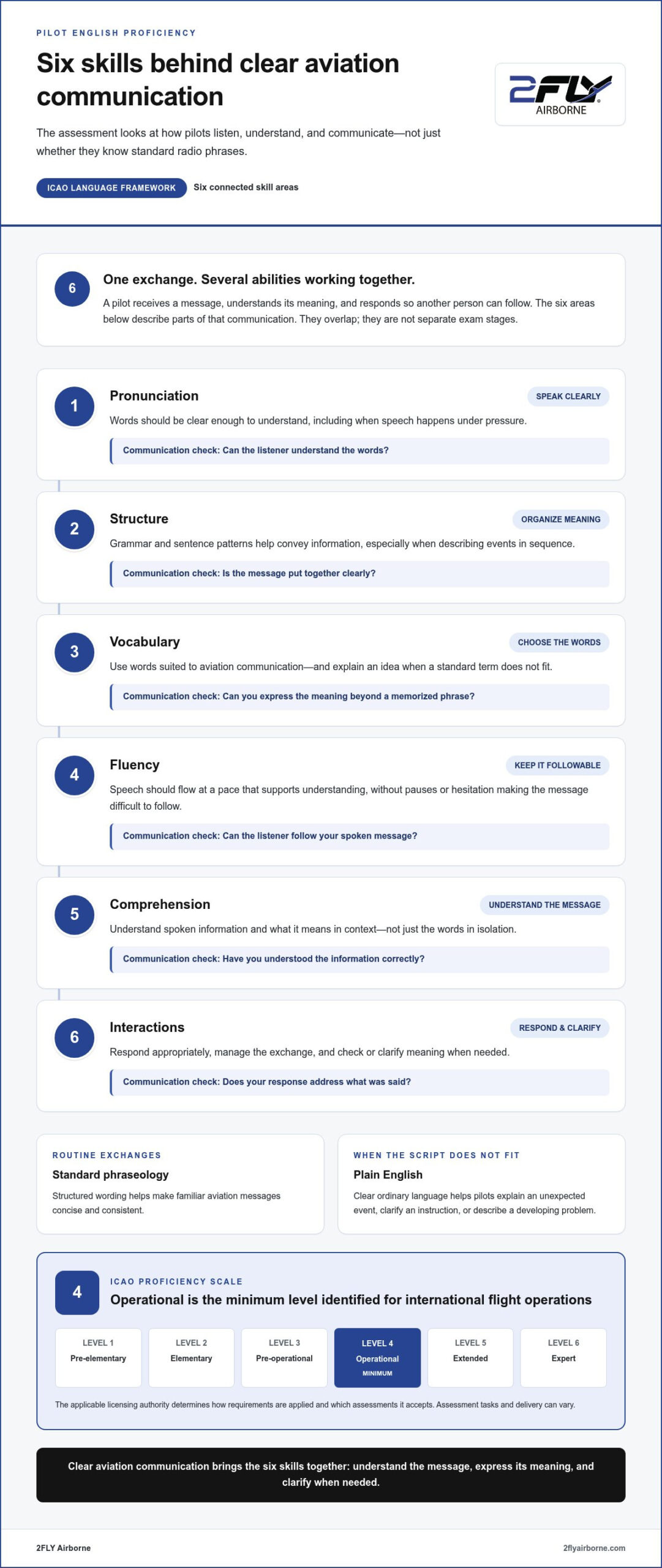
ICAO sets an international framework for assessing language proficiency. It identifies Level 4, called Operational, as the minimum operational proficiency level for international flight operations. The framework provides a common reference, while the applicable licensing authority determines how requirements are applied and which assessments it accepts.
For a concise background on the subject, see Aviation English on Wikipedia. For licensing decisions, refer to current information from the authority responsible for your licence.
This video introduces how aviation English differs from everyday English:
Why is English proficiency assessed in aviation?
Aviation communication depends on information being understood and conveyed accurately. Clear speech and attentive listening support exchanges between pilots and air traffic control, especially when an instruction needs clarification or an event doesn’t follow the expected pattern. The aim isn’t to sound like a native speaker; it’s to communicate meaning reliably.
Language proficiency is distinct from technical flying skill and aircraft knowledge. A pilot may understand aircraft systems and procedures but still need to demonstrate that they can explain a situation, understand spoken information, and respond appropriately in English. The assessment evaluates communication ability, not a pilot certification.
What does the ICAO proficiency scale mean?
The ICAO scale has six levels, progressing from Level 1 to Level 6. Their standard descriptors are Pre-elementary, Elementary, Pre-operational, Operational, Extended, and Expert. Level 4 is the minimum operational level identified by ICAO; the higher levels indicate stronger language performance.
These levels describe communication ability, not a pilot’s seniority, flight hours, or command experience. A Level 5 or Level 6 result doesn’t replace flight training, aircraft qualifications, or other pilot certifications. The icao english language proficiency test for pilots is one part of professional readiness: pilots need to understand and express information even when a conversation moves beyond familiar phrases.
The ICAO framework explains proficiency levels, but the applicable licensing authority’s current rules determine what applies to an individual licence. Requirements and assessment arrangements can vary, so use the relevant authority’s information when making licensing decisions.
Which English Skills Does the Pilot Language Proficiency Assessment Measure?
Aviation communication brings several abilities together in real time. A pilot hears and understands a message, interprets its meaning, and responds in language another person can follow. The ICAO framework assesses six language skill areas: pronunciation, structure, vocabulary, fluency, comprehension, and interactions.
In practical terms, the assessment considers how clearly a pilot pronounces words, uses grammar and vocabulary, speaks fluently, understands spoken language, and responds during an exchange. These skills overlap. Accurate vocabulary alone may not make a response effective if it’s hard to understand or doesn’t address the message received.
- Pronunciation: Speech is clear enough to be understood, including when words are spoken under pressure.
- Structure: Grammar and sentence patterns help convey meaning, particularly when describing events in sequence.
- Vocabulary: The speaker chooses words suited to aviation communication and can explain an idea when a standard term doesn’t fit.
- Fluency: Speech flows at a pace that supports understanding, without pauses or hesitation making the message difficult to follow.
- Comprehension: The listener understands spoken information and its meaning in context.
- Interactions: The speaker responds appropriately, manages an exchange, and checks or clarifies meaning when needed.
How do phraseology and plain English differ?
Standard phraseology is structured wording used for particular aviation communications. It helps make routine messages concise and consistent, but situations don’t always fit a familiar script. A pilot may need to clarify an unexpected instruction or describe a developing problem in ordinary, clear English.
Memorizing radio phrases alone doesn’t demonstrate overall language proficiency. Candidates should be ready to use both phraseology and plain English, choosing words that convey the message accurately when a prescribed phrase isn’t suitable.
How are speaking and listening demonstrated?
Assessment tasks vary by provider and applicable authority, so no single exercise should be treated as a universal exam question. Depending on the format, a candidate may listen to a prompt, explain a situation, or respond to follow-up questions. The important part is communicating clearly, not memorizing one provider’s sample task.
Illustrative scenario, not a standard test question: Imagine hearing an unclear message during a simulated flight-related exchange. You need to identify what you understood, ask for clarification directly, and respond to the clarified information. That exchange draws on comprehension, pronunciation, fluency, vocabulary, structure, and interaction together.
For practice, listen to spoken aviation material, identify its main information, and explain it aloud in your own words. Then check whether your response is clear, relevant, and easy to follow. This develops communication skills beyond rehearsed calls without relying on a particular provider’s test format.
Clear communication also develops alongside disciplined flight training. If you’re exploring that broader pathway, learn more about pilot training at 2FLY.
What Happens During an ICAO English Test for Pilots?
There isn’t one universal script for the icao english language proficiency test for pilots. ICAO provides the proficiency framework, while test structure, delivery method, and individual tasks can differ between providers and according to the applicable licensing authority. An assessment may involve an examiner-led conversation, recorded prompts, or structured scenarios.
These differences affect what a candidate experiences, not the underlying aim: assessing aviation-related English communication. Treat a sample test as an example of that provider’s approach, not a guarantee of what another assessment will include.
Are all ICAO English proficiency tests conducted the same way?
No. A shared assessment aim can be delivered through different procedures. A provider may conduct an interview in person or remotely, for example, but the delivery method doesn’t define a universal ICAO test format. The relevant licensing authority determines which assessment arrangements it accepts for its licensing purposes.
| Shared assessment aims | Provider-specific delivery details |
|---|---|
| Evaluate aviation-related English communication against proficiency criteria. | Whether the assessment is in person or online. |
| Consider a candidate’s ability to understand and communicate in relevant contexts. | The sequence, number, and style of prompts or tasks. |
| Use aviation communication as the context for assessing language ability. | Whether a task uses a listening prompt, examiner interview, or scenario discussion. |
Use the table to distinguish common assessment aims from details that can vary. Before arranging an assessment, review the current requirements and accepted arrangements published by the authority responsible for your licence. This helps you separate a provider’s process from a licensing rule.
What kinds of prompts might a pilot encounter?
Exact prompts depend on the provider, so the examples below are illustrative, not official or guaranteed exam content. A candidate might discuss flight experience, describe how clear communication supports a flight, or respond to an aviation-related scenario. The purpose is to demonstrate communication, not reproduce a memorized answer.
- Listening prompt: Hear a short spoken message, explain its key meaning, or respond to it.
- Spoken interview: Discuss familiar aviation topics or describe experience in your own words.
- Scenario discussion: Explain a possible course of action in a hypothetical situation and answer follow-up questions.
For any task, understand what was asked before responding. If a prompt is unclear, a concise request for clarification can be more effective than guessing. In a scenario discussion, organize your explanation so the listener can follow the situation, your response, and your reasoning.
Knowing how formats can differ helps you plan, but it doesn’t replace reviewing the licensing authority’s current requirements. For broader professional flight training, explore pilot training at 2FLY.
How Can Pilots Prepare for the ICAO English Language Proficiency Test?
Preparation is most effective when it builds flexible communication rather than a collection of memorized answers. For the icao english language proficiency test for pilots, practise understanding spoken information and explaining ideas clearly, alongside the standard phraseology used in aviation. The aim isn’t to eliminate your accent; it’s to make your meaning intelligible.
Preparation principle: prioritize clear meaning over a perfect accent or a rehearsed script. A consistent routine can help you identify what’s working and where focused practice may help, regardless of the provider’s prompts or format.
How can pilots practise aviation English consistently?
Use short, regular practice sessions that include both listening and speaking. Choose aviation material you can understand, listen for its key information, then summarize the main points aloud. Follow with a spoken explanation of a familiar flight situation, using complete sentences and a logical sequence. For candidates who want to refine their sentence construction, using an English grammar learning app can reinforce core rules and keep each idea clear and easy to follow.
- Establish a baseline. Record yourself explaining a familiar aviation topic or summarizing a short listening passage. Note where you hesitate, lose the thread, or struggle to find a clear word.
- Practise listening actively. Listen to aviation material and identify its main message and relevant details. Summarize what you understood aloud instead of replaying it only to memorize the wording.
- Explain situations in your own words. Describe a familiar flight situation from start to finish. Make the sequence clear, and explain unfamiliar details without relying on a set script.
- Get useful feedback. Ask a capable listener to note whether your meaning is clear, your response addresses what was said, and your speech is easy to follow. Focus feedback on clarity, comprehension, fluency, and interaction, not accent imitation.
- Review and adjust. Revisit your recording or feedback, choose one area to work on, and practise it in a fresh conversation. Change the topic or add follow-up questions so you’re communicating rather than reciting.
What common preparation mistakes should candidates avoid?
Don’t focus only on technical vocabulary or scripted radio exchanges. Phraseology is useful, but it won’t prepare you to explain an event in plain English or respond naturally when a conversation changes direction. A sample from one provider can help you understand that provider’s approach, but it can’t predict another assessment’s format or exact prompts.
Role-play can make practice more realistic: ask a partner to describe a situation, then explain what you understood and respond. Keep the exchange flexible by inviting follow-up questions. If you forget a word, try a simpler explanation instead of abandoning the message. This helps you practise communication that transfers beyond a rehearsed answer.
Clear communication develops alongside structured pilot training, but language assessment preparation is separate from flight instruction. To discuss your broader pilot training pathway, contact a 2FLY Training Advisor.
How Does English Proficiency Fit Into a Pilot Career Path?
English communication is one part of professional aviation readiness. A pilot’s ability to understand and convey information supports coordinated operations, while technical knowledge, aircraft handling, and pilot certifications develop through their own training and assessment pathways. Language proficiency complements those capabilities; it doesn’t replace them.
The icao english language proficiency test for pilots sits within a broader framework, but the requirements for an individual depend on the licensing authority and its current rules. Don’t assume one test, result, or process applies to every licence or career route. Treat language assessment and pilot qualifications as related but distinct parts of your development.
How does language proficiency relate to pilot training?
Flight training develops operational judgement alongside practical and technical skills. Clear communication belongs in that development too: pilots need to understand instructions, describe what they observe, and share information in a way others can follow. These abilities matter throughout training, not only when a language assessment is approaching.
2FLY Airborne’s training pathways include FAA training from private pilot through commercial pilot and flight instructor certifications, as well as an EASA-approved ATPL program that prepares students for a frozen ATPL. These are pilot-development pathways; language assessment requirements depend on the applicable licence and authority. Explore the FAA pilot training program to learn about structured professional flight training.
What should a candidate do after learning about the assessment?
Turn the overview into a practical plan. First, identify the authority responsible for your licence and review its current language assessment requirements. Then focus practice on your communication gaps rather than assuming a sample test predicts the format you’ll face.
- Review the applicable requirements: Confirm assessment and recognition rules with the relevant licensing authority.
- Set a focused practice plan: Work on the skills you find challenging, such as understanding spoken information or explaining a situation clearly.
- Keep the wider career plan in view: Consider language development alongside the pilot certifications and flight training relevant to your goals.
For aspiring pilots, a practical approach is to confirm the requirements, practise deliberately, and continue building aviation skills through safe, structured training. 2FLY’s FAA and EASA training pathways provide options for planning professional pilot training.
Clear communication supports a pilot’s development, but it’s only one part of becoming a qualified professional. If you have questions about pilot training pathways, reach out to a 2FLY Training Advisor.
Take the Next Step Toward Your Aviation Goals
Strong aviation communication supports a pilot’s professional development, working alongside training and qualifications rather than replacing them. Keep your next step focused: follow the current requirements relevant to your plans and build your skills through safe, structured training.
The icao english language proficiency test for pilots is part of a wider career journey. A clear, practical plan can help you move forward with purpose as your experience grows.
2FLY Airborne supports pilot development through FAA and EASA training pathways. Speak with a 2FLY Training Advisor about your pilot training goals and take your next step with confidence.
Frequently Asked Questions
What is the minimum ICAO English level for pilots?
ICAO identifies Level 4, Operational, as the minimum operational proficiency level. That general standard doesn’t by itself tell you which assessment or process applies to your licence. Authorities determine how requirements are implemented, so review their current guidance before booking an assessment or making licensing plans. Don’t rely on a provider’s result description alone to determine whether it meets your licensing needs.
Is the ICAO English test the same in every country?
No. A shared proficiency framework doesn’t mean every country or provider uses identical questions, delivery methods, or procedures. An online sample, for example, may illustrate one provider’s approach without showing how an assessment elsewhere is conducted. Identify the authority responsible for your licence and review its current requirements. This separates the common assessment purpose from local acceptance and provider-specific arrangements.
Can I pass the ICAO English test by memorizing aviation phraseology?
Memorized phraseology alone doesn’t demonstrate the full range of language proficiency. It can support familiar exchanges, but a pilot may also need to explain a situation in plain English, understand an unexpected detail, or respond to a follow-up. Practise conveying the same idea in more than one clear way. No particular technique guarantees a level or result, but flexible communication is more useful than relying on a fixed script.
How should pilots practise for an ICAO English proficiency assessment?
Build regular practice around listening and speaking. Listen to an aviation briefing or other suitable material, then summarize the key points aloud. Next, explain a familiar flight situation and respond to follow-up questions from a practice partner. Include standard phraseology, but also practise comprehension and natural interaction. Ask for feedback on whether your meaning is clear and intelligible. Since providers use different formats, develop transferable skills rather than rehearsing one sample.
Does an ICAO English proficiency test assess flying ability?
No. The assessment concerns language communication, not hands-on aircraft control or the award of a pilot certificate. A prompt might use an aviation context, such as discussing an operational situation, but that makes it a language task rather than a flight test. Flight training and certification processes develop and demonstrate flying competence. For a specific licensing process, consult the authority responsible for the licence.
Do ICAO English test providers use the same questions?
There’s no universal question list candidates can assume will appear across providers. A sample prompt or practice exercise published by a provider illustrates its own material, not guaranteed or official content for every assessment. Prepare to understand and respond to unfamiliar topics instead of memorizing a single set of answers. Reviewing examples can help you get comfortable speaking, but keep practice broad enough to handle follow-up questions and different wording.

Article by
2FLY Airborne
2Fly Airborne is a professional flight training organization dedicated to developing the next generation of skilled, confident, and safety-focused pilots. With decades of combined aviation experience, our team of certified instructors provides structured, real-world training designed to prepare students for both checkrides and long-term success in the aviation industry.
Content Disclaimer
Some blog content is generated with the assistance of automated tools and may not always be fully accurate or up to date. Please verify all aviation-related information with official sources or a certified instructor. For additional guidance or clarification, we encourage you to contact one of our training advisors at 2Fly Airborne.