What if your ability to fly wasn’t limited by the horizon or a clear blue sky? For many pilots, the transition from visual flight rules to instrument-only flying feels like learning to fly all over again. It’s natural to feel overwhelmed by the technical complexity of the FAA’s regulatory landscape or worried about choosing a flight school that lacks a clear, disciplined path.
Mastering the faa instrument rating syllabus part 141 is the first step in moving past that uncertainty. This structured curriculum isn’t just a regulatory requirement; it’s a definitive blueprint for professional cockpit discipline. It serves as the gateway to an international aviation career, replacing anxiety with the technical mastery required by the world’s leading airlines.
This guide provides a clear roadmap of what to expect during your journey toward professional mastery. You’ll gain a thorough understanding of the three training stages, the specific flight hour requirements, and the rigorous standards of the instrument checkride. By the end, you’ll have the knowledge needed to choose a training environment that prioritizes your development as an elite aviator.
Key Takeaways
- Understand how the faa instrument rating syllabus part 141 provides a highly structured, FAA-audited curriculum designed for rapid professional development.
- Discover the advantages of a stage-gate training system that ensures you master critical instrument skills before advancing to complex flight maneuvers.
- Learn why Part 141 programs offer a more efficient path to certification, often requiring only 35 hours of specialized instrument flight training.
- Identify the essential prerequisites, including your Private Pilot Certificate and the FAA Instrument Rating Knowledge Test, to start your training with confidence.
- See how mastering instrument flight serves as the definitive bridge between being a private pilot and becoming a career-ready professional in the global airline industry.
What is the FAA Instrument Rating Syllabus Part 141?
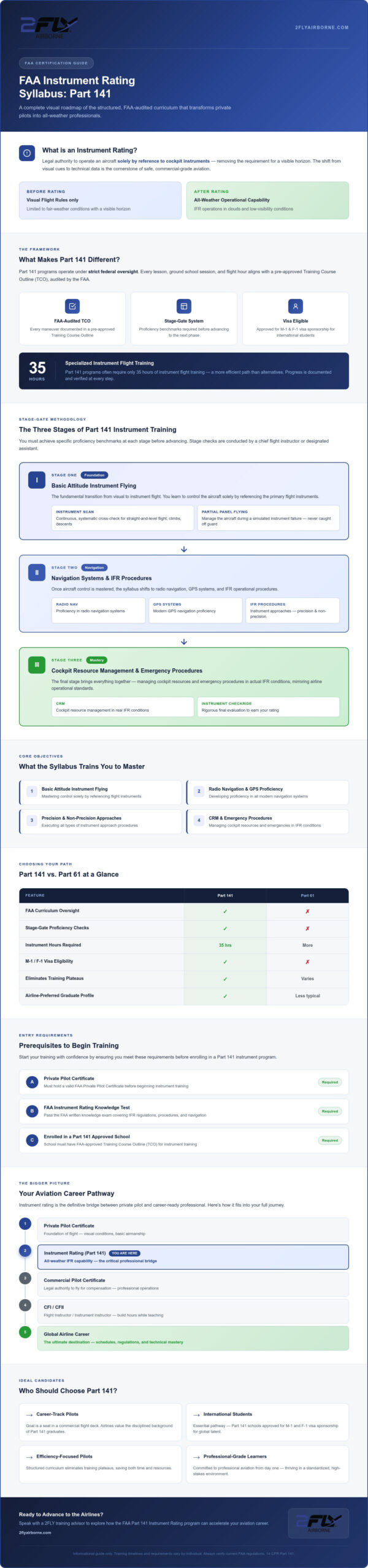
An instrument rating is the professional bridge between fair-weather flying and all-weather operational capability. It grants you the legal authority to operate an aircraft solely by reference to the cockpit instruments, removing the requirement for a visible horizon. This shift from visual cues to technical data is the cornerstone of safe, commercial-grade aviation. The faa instrument rating syllabus part 141 is the rigorous framework that guides this transformation. It isn’t just a list of flight hours; it’s a comprehensive, FAA-audited curriculum designed for absolute precision.
Unlike casual flight training, a Part 141 program operates under strict federal oversight. This ensures that every lesson, ground school session, and flight hour aligns with a pre-approved Training Course Outline (TCO). For the student, this creates a predictable and highly disciplined environment. You don’t just learn to fly in clouds. Instead, you master Instrument Flight Rules (IFR) within a system that mirrors the operational standards of major airlines. Precision is the goal.
The Purpose of a Structured Syllabus
The FAA mandates specific training blocks for Part 141 schools to ensure consistency across the board. Every maneuver and procedure is documented in the school’s TCO, which acts as a detailed roadmap for your success. This structure is vital because it eliminates the common “training plateaus” often found in less organized environments. By following a logical progression, you reduce the need for repetitive re-learning. This saves both time and resources while building deep technical proficiency. The core objectives of the syllabus include:
- Mastering basic attitude instrument flying.
- Developing proficiency in radio navigation and GPS systems.
- Executing precision and non-precision instrument approaches.
- Managing cockpit resources and emergency procedures in IFR conditions.
Who Should Choose a Part 141 Program?
If your goal is a seat in a commercial flight deck, a Part 141 program is often the superior choice. Airlines value the disciplined background of Part 141 graduates because they’ve already proven they can thrive in a standardized, high-stakes training environment. This path is also essential for many international students. Because Part 141 schools are highly regulated, they are often approved for M-1 or F-1 visa sponsorship, making them the primary gateway for global talent.
Choosing this path through an FAA Professional Pilot Program means you’re committing to professional-grade aviation from day one. It prepares you for the realities of a career where schedules, regulations, and technical mastery are the only things that matter. It’s the most direct pipeline to employment in the global aviation industry.
The Three Stages of Part 141 Instrument Training
The faa instrument rating syllabus part 141 is built on a rigorous “stage-gate” methodology. This system ensures that you don’t just “pass through” lessons. Instead, you must achieve specific proficiency benchmarks before moving to more complex tasks. Under 14 CFR Part 141 federal regulations, your progress is tracked through formal stage checks. These are conducted by a chief flight instructor or a designated assistant to ensure quality and consistency across the entire training path.
Professional flight academies integrate ground school, high-fidelity simulators, and actual flight hours into each stage. This multi-layered approach reinforces theoretical knowledge through practical application. It ensures you’re prepared for the high demands of a professional cockpit. Progress is never left to chance; it’s documented and verified at every step.
Stage I: Basic Attitude Instrument Flying
The first stage focuses on the fundamental transition from visual to instrument flight. You’ll learn to control the aircraft solely by referencing the primary flight instruments. The key here is mastering the “scan” technique. This involves a continuous, systematic cross-check of your instruments to maintain straight-and-level flight, climbs, and descents. You’ll also be introduced to partial panel flying. This critical skill teaches you to manage the aircraft during a simulated instrument failure, ensuring you’re never caught off guard in actual IFR conditions.
Stage II: Navigation Systems and IFR Procedures
Once you’ve mastered aircraft control, the syllabus shifts toward the technical aspects of navigation. You’ll gain proficiency in using various navigation aids. Key systems include:
- VOR (Very High Frequency Omnidirectional Range)
- GPS (Global Positioning System)
- ILS (Instrument Landing System)
This stage is about learning the “language” of the IFR system. You’ll practice holding patterns and procedure turns, which are essential for managing air traffic flow. You’ll also begin working with Standard Instrument Departures (SIDs) and Standard Terminal Arrival Routes (STARs). These are the standardized paths that commercial aircraft follow when entering or leaving busy terminal areas.
Stage III: Cross-Country and Advance Approaches
The final stage is where your training matures into professional-level operations. You’ll execute long-distance cross-country flights within the IFR system, handling real-world weather and complex ATC instructions. The focus here is on mastering both precision and non-precision instrument approaches under various conditions. This stage culminates in a comprehensive final review, preparing you for the FAA practical test. If you’re aiming for a career in the airlines, exploring a structured FAA Professional Pilot Program can help you navigate these stages with the support of expert mentors.
Part 141 vs. Part 61: Choosing Your Path
The choice between Part 141 and Part 61 is often the most significant decision a pilot makes after earning their Private Pilot Certificate. While both paths lead to the same rating, the journey and the professional outcomes differ substantially. The faa instrument rating syllabus part 141 is designed for those who view aviation as a career rather than a hobby. It offers a level of oversight and efficiency that a traditional, less structured environment simply cannot match.
One of the primary differences lies in federal oversight. Part 141 schools must undergo regular audits and meet strict FAA Part 141 federal regulations regarding their facilities, personnel, and curriculum. In contrast, Part 61 training is often more flexible and student-paced, which can be a benefit for some but often leads to longer training timelines for those seeking a professional career.
Hour Requirements and Efficiency
Efficiency is a hallmark of the Part 141 path. Under this syllabus, the FAA allows for a minimum of 35 hours of specialized instrument training. Comparatively, Part 61 requires 40 hours of actual or simulated instrument time. However, the real efficiency gain is found in the cross-country requirements. Part 61 candidates must accumulate 50 hours of cross-country flight time as Pilot in Command (PIC) before they are eligible for the rating.
A Part 141 program removes this 50-hour PIC requirement, focusing instead on the quality and structure of the training itself. This allows dedicated students to reach their checkride much faster. Advanced flight simulators play a crucial role here, allowing you to practice complex procedures in a controlled environment before ever leaving the ground. This combination of reduced hour requirements and high-intensity training makes the Part 141 syllabus the preferred choice for career-track pilots.
The “Structured Environment” Advantage
Airlines don’t just look for a certificate; they look for pilots who can thrive in a standardized, high-pressure environment. The Part 141 setting mimics the training style of major air carriers from day one. You’ll work under the supervision of a dedicated Chief Flight Instructor who ensures every lesson meets the highest standards. This level of accountability builds the professional discipline required for programs like the FAA First Officer Program.
By choosing the “gold standard” of training, you’re positioning yourself as a candidate who is ready for the rigors of the professional industry. This structured path reduces the likelihood of developing poor habits and ensures you’re prepared for the transition to commercial flight decks. It’s a strategic investment in your future as a professional aviator.
Key Requirements for the Instrument Rating Syllabus
To begin your journey through the faa instrument rating syllabus part 141, you must first hold a Private Pilot Certificate and a valid FAA medical certificate. These prerequisites ensure you have the foundational airmanship needed for advanced technical training. Unlike the more flexible Part 61 path, the Part 141 Training Course Outline (TCO) mandates a minimum of 35 hours of specialized instrument training. This experience is carefully tracked to ensure you meet every proficiency milestone before your final evaluation.
Before you can schedule your practical exam, you must conquer the FAA Instrument Rating Knowledge Test. This written exam consists of 60 multiple-choice questions covering everything from flight planning to emergency operations. Achieving a high score demonstrates your theoretical readiness for the cockpit. It serves as a critical filter, ensuring only those with a deep understanding of the IFR system move forward.
Aeronautical Knowledge Areas
Mastery of the syllabus requires more than just stick-and-rudder skills. You must become an expert in IFR weather theory, specifically identifying the hazards of structural icing and convective activity. Understanding the nuances of ATC communication protocols and the legalities of 14 CFR Part 91 is equally vital. These knowledge areas form the backbone of safe, professional flight operations.
The Instrument Checkride Standards
The final hurdle is the FAA Practical Test, commonly known as the checkride. This evaluation is governed by the Airman Certification Standards (ACS), which defines the specific tolerances for every maneuver. A Designated Pilot Examiner (DPE) will assess your ability to manage cockpit resources and maintain situational awareness under high workloads. Common pitfalls often include poor altitude management during approaches or a failure to properly brief an instrument procedure.
The 2025 Boeing Pilot and Technician Outlook projects a demand for 660,000 new pilots globally through 2044. This massive demand underscores the importance of meeting these rigorous training standards to ensure you are career-ready. To start your journey toward these professional standards, consider enrolling in an FAA Professional Pilot Program.
Advancing to the Airlines with 2FLY Airborne
The Instrument Rating (IR) is the most critical safety skill in a professional pilot’s arsenal. At 2FLY Airborne, we integrate the faa instrument rating syllabus part 141 into our comprehensive Professional Pilot Program to ensure you develop more than just technical proficiency. We focus on building the mindset of a commercial captain from your very first instrument flight. This structured approach ensures you aren’t just checking boxes but are preparing for the high-stakes environment of a modern airline flight deck.
Training in high-activity, multi-runway environments is essential for building true IFR proficiency. This exposure forces you to manage real-world ATC complexity and rapid weather transitions that simple rural airfields cannot replicate. It transforms a trainee into an industry-prepared professional who is comfortable navigating any global terminal area. The 2025 Boeing Pilot and Technician Outlook projects a demand for 660,000 new pilots globally through 2044. This massive requirement highlights the urgent need for pilots who have mastered the technical demands of instrument flight within a disciplined system.
From Instrument Rating to Commercial Pilot
The IR syllabus provides the technical foundation for the complex maneuvers required in commercial training. Mastering precise altitude and heading control under IFR makes the transition to high-performance aircraft much smoother. It’s about building a rock-solid base of situational awareness before adding the speed and complexity of commercial operations. You’ll find that the discipline learned during instrument training carries over into every subsequent phase of your career.
Maintaining IFR currency is vital throughout your professional development. Our FAA Airline Pilot Program ensures you stay sharp and ready for airline interviews and simulator evaluations. Constant practice in advanced simulators and glass-cockpit aircraft keeps your skills at peak performance. We prioritize the seamless integration of training stages to move you efficiently from a student pilot to a career-ready first officer.
Why 2FLY Airborne’s Mentorship Matters
Success in aviation often depends on the quality of your mentors. Our instructors bring real-world experience from international airline environments, providing practical insights that go far beyond standard textbook definitions. They understand the rigorous demands of a specialized career path and help you develop the executive decision-making skills needed for a commercial captaincy. This elite mentorship is what bridges the gap between basic certification and professional mastery.
We maintain a commitment to a safe, highly structured training environment that consistently exceeds basic FAA minimums. This disciplined approach is what sets our graduates apart in a competitive global market. You aren’t just learning to fly; you’re building the professional character required to lead in a modern, high-tech cockpit. To begin mapping out your journey, speak with a 2FLY Airborne Training Advisor about our professional programs and financing options.
Take Command of Your Professional Future
Mastering the faa instrument rating syllabus part 141 is about more than just earning a new rating; it’s about adopting the professional discipline required for a global aviation career. By following a structured, FAA-approved curriculum, you move through critical stages of technical mastery with the efficiency that major airlines respect. This path ensures you’re ready for the technical demands of a high-tech cockpit, replacing the uncertainty of fair-weather flying with absolute precision.
At 2FLY Airborne, we combine this rigorous syllabus with high-fidelity flight simulators and a proven airline career pipeline to prepare you for the next level. You don’t have to navigate these complex regulations alone. Our expert mentors provide the support needed to transition from a private pilot to a career-ready professional. If you have questions about the training process or requirements, we’re here to help.
Ready to master the instruments? Speak with a 2FLY Training Advisor today to begin planning your professional path. The horizon is no longer your limit; it’s the start of your journey toward the flight deck.
Frequently Asked Questions
Is the Part 141 instrument rating harder than Part 61?
It isn’t necessarily harder in terms of flight maneuvers, but it is significantly more disciplined. The faa instrument rating syllabus part 141 requires you to follow a rigid, FAA-audited schedule with frequent stage checks. While Part 61 offers more flexibility, the structured environment of Part 141 ensures you meet high professional standards. This rigor prepares you for the standardized training environments found at major international airlines.
How many hours are required for a Part 141 instrument rating?
Under a Part 141 syllabus, the FAA allows for a minimum of 35 hours of specialized instrument flight training. This is a reduction from the 40 hours required under Part 61. More importantly, Part 141 students don’t need to meet the 50-hour cross-country PIC requirement before starting. This efficiency allows dedicated students to progress toward their professional goals much faster while maintaining a high level of technical proficiency.
Can I use a simulator for my Part 141 instrument training?
Yes, high-fidelity flight simulators are a core component of the faa instrument rating syllabus part 141. These devices allow you to practice complex procedures, emergency scenarios, and instrument approaches in a controlled environment. Simulators are highly effective for mastering the scan technique without the distractions of actual flight. They also provide a cost-effective way to build proficiency before transitioning to the aircraft for final certification.
Do I need a commercial license to get an instrument rating?
No, you don’t need a commercial license to earn an instrument rating. In fact, the instrument rating is a prerequisite for the Commercial Pilot Certificate in most professional training tracks. You must hold at least a Private Pilot Certificate and a valid medical certificate to begin the syllabus. Most career-track pilots complete their instrument training immediately after their private certificate to build the foundation for commercial-grade flight operations.
What is a stage check in a Part 141 syllabus?
A stage check is a formal progress evaluation conducted at the end of each training block. Unlike regular lessons, these are typically performed by a chief flight instructor or a designated assistant. They ensure you’ve mastered the specific knowledge and skills required for that stage before you move on. This stage-gate system provides an objective measure of your proficiency and ensures you are on track for the final checkride.
How long does it typically take to complete the IR syllabus?
The timeline for completing an instrument rating varies based on student dedication and training frequency. In a full-time, structured program, many students complete the syllabus in two to three months. Because the Part 141 path removes certain hour requirements found in Part 61, it’s often the fastest route for those aiming for a professional career. Consistency is the most important factor in maintaining momentum and avoiding remedial training.
What happens if I fail an instrument stage check?
Failing a stage check isn’t the end of your training; it’s a diagnostic tool to identify areas that need improvement. If you don’t meet the standards, your instructor will assign remedial training focused on those specific weak points. Once you’ve regained proficiency, you’ll retake the stage check to ensure you’re ready for the next phase. This process ensures that every graduate meets the high safety standards required by the global aviation industry.
Is an instrument rating required for all airline pilots?
Yes, an instrument rating is absolutely mandatory for all airline pilots. Operating in the commercial environment requires the ability to fly in diverse weather conditions and navigate complex airspace solely by reference to instruments. It’s the most essential skill for maintaining airline safety and operational reliability. The 2025 Boeing Pilot and Technician Outlook projects a demand for 660,000 new pilots globally through 2044, all of whom will need this critical rating.
Article by
2FLY Airborne
2Fly Airborne is a professional flight training organization dedicated to developing the next generation of skilled, confident, and safety-focused pilots. With decades of combined aviation experience, our team of certified instructors provides structured, real-world training designed to prepare students for both checkrides and long-term success in the aviation industry.
Content Disclaimer
Some blog content is generated with the assistance of automated tools and may not always be fully accurate or up to date. Please verify all aviation-related information with official sources or a certified instructor. For additional guidance or clarification, we encourage you to contact one of our training advisors at 2Fly Airborne.