The 2025 Boeing Pilot and Technician Outlook projects a demand for 660,000 new pilots globally through 2044. For many aspiring aviators, the dream of a professional career begins in the United States, yet the financial barrier often feels like an insurmountable wall. Securing flight school loans for international students presents unique challenges, particularly when you’re excluded from federal aid and struggle to find a creditworthy U.S. based co-signer.
You likely feel the pressure of rising tuition costs and the complexity of cross-border financing. We agree that your ambition shouldn’t be grounded by administrative hurdles or the fear of unexpected price hikes during your training. This guide provides a strategic roadmap to master aviation financing, focusing on specialized international lenders and the security of fixed-price training models.
We’ll provide a curated list of lenders who accept international applicants and explain how fixed-price tuition protects your investment from market volatility. You will also find a comprehensive checklist for your visa and financial documentation to ensure you’re prepared for the flight deck. It’s time to transition from a trainee to an industry-ready professional with absolute confidence.
Key Takeaways
- Discover how to navigate the U.S. lending market and identify specialized flight school loans for international students that prioritize future earning potential.
- Compare fixed and variable interest rate structures from cross-border lenders to select a financing plan that aligns with your long-term career goals.
- Protect your investment from budget creep and economic volatility by utilizing a fixed-price tuition model for your professional pilot training.
- Identify international-friendly scholarship opportunities and master the strategic timing required to align funding with your visa application.
- Follow a disciplined roadmap to manage the SEVIS process and prepare the documentation necessary for successful M-1 or F-1 visa sponsorship.
Navigating the Landscape of International Flight School Financing
View flight training as a strategic capital injection into your future. It’s not a standard expense; it’s a calculated move to enter an elite global profession. For most aspiring aviators, this journey starts with flight school loans for international students to bridge the gap between their current location and the flight deck. You must understand that international candidates are ineligible for U.S. federal aid. This reality forces a reliance on private student loans, which carry different eligibility requirements than domestic options, such as the frequent need for a U.S. based co-signer or a demonstrated history of international credit.
The “Zero to Hero” model is the definitive path for those seeking rapid industry entry. These career-track programs take you from zero experience to a commercial pilot in a condensed, professional environment. Because these programs are intensive, they require significant upfront capital. Finding lenders who understand the unique needs of international pilots is the first step toward your first officer seat. To better understand the various ways you can fund your journey, watch this helpful breakdown:
Investment vs. Expense: The Global Pilot Mindset
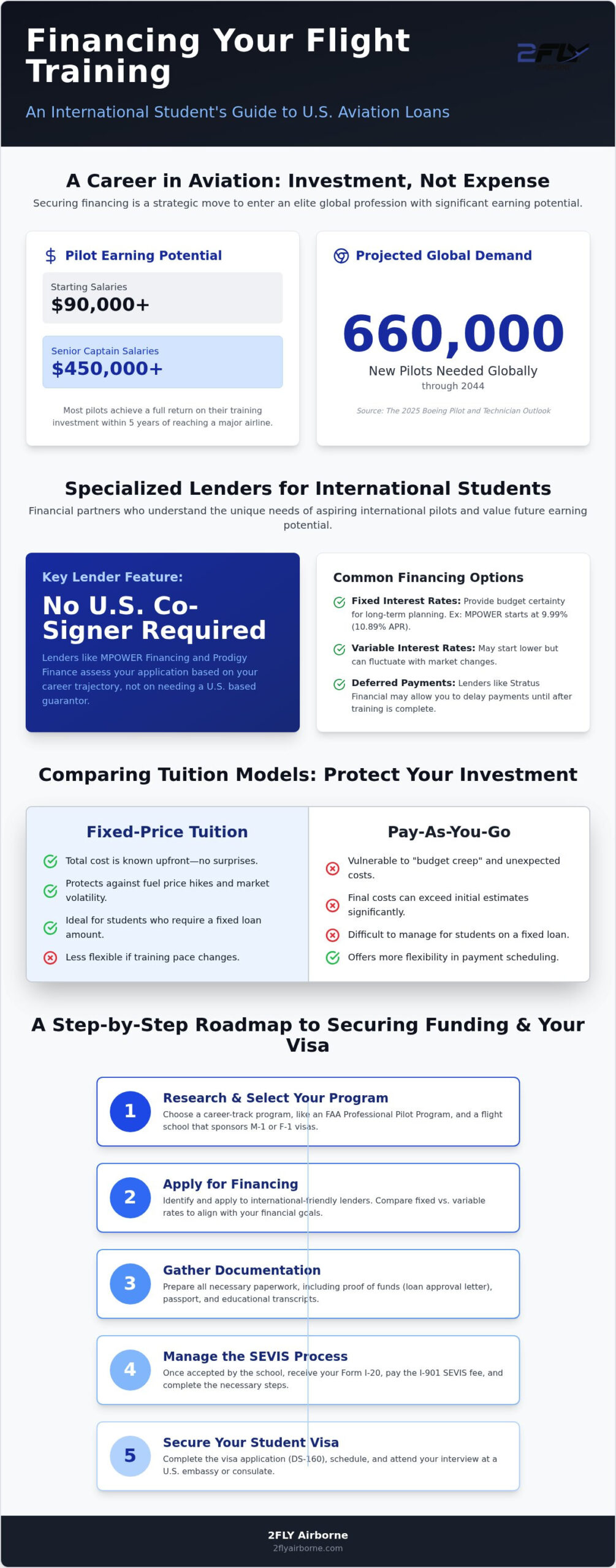
Starting salaries for pilots now exceed $90,000, with senior captains earning upwards of $450,000. This immense earning potential transforms your tuition into a high-yield professional investment. Delaying your training to save cash often costs more in lost seniority and lifetime earnings than the interest on a loan. Programs like the FAA Professional Pilot Program prioritize speed. They ensure you enter the workforce as quickly as possible to begin your return on investment. Most pilots achieve a full return on their investment within 5 years of reaching a major airline.
The Role of International Professional Mobility
Earning FAA certifications provides a level of global mobility that few other professions can match. U.S. based training remains the world’s gold standard for technical mastery and regulatory rigor. This global demand is supported by industry giants and clear data. The 2025 Boeing Pilot and Technician Outlook projects a demand for 660,000 new pilots globally through 2044. By securing financing today, you aren’t just paying for school. You’re securing your place in a stable, world-class setting for professional development. This focus on the end result—your professional career—is the primary anchor for your training strategy.
Specialized Lenders for International Student Pilots
Identifying the right financial partner is as critical as choosing your training academy. Since most candidates don’t meet U.S. federal student aid eligibility requirements, the market for flight school loans for international students has evolved with specialized providers. Companies like MPOWER Financing and Prodigy Finance offer solutions that don’t require a U.S. based co-signer. These lenders prioritize your future earning potential as a commercial pilot over your current assets or credit history.
Interest rate structures vary significantly between providers. Fixed rates, such as MPOWER’s starting rate of 9.99% (10.89% APR), provide long-term budget certainty. Conversely, variable rates might start lower but fluctuate with market indices. Specialized aviation lenders like Stratus Financial and Meritize often provide deferred payment options. This flexibility allows you to focus entirely on your technical mastery without the immediate pressure of full monthly installments while you’re still in the cockpit.
US Lenders vs. Home-Country Financing
Borrowing in U.S. dollars makes strategic sense because it aligns your debt with your tuition costs. This eliminates the risk of currency volatility that can suddenly increase the cost of your education. While home-country banks might offer lower rates if you provide local collateral, they often lack the specialized knowledge of the FAA certification timeline. U.S. based lenders understand that your training is a direct pipeline to a high-paying career, making them more comfortable with the vocational requirements of the aviation industry.
The Co-signer Strategy for International Applicants
A creditworthy U.S. citizen or permanent resident co-signer remains the most effective way to secure the lowest possible interest rates. Data from 2025 shows that students with a U.S. co-signer were nearly four times more likely to secure funding through traditional lenders like Sallie Mae. If you don’t have a U.S. contact, focus on lenders who specialize in no-cosigner loans for high-achieving international professionals. You can review our list of financial partners to determine which path best supports your international career goals.
Fixed-Price Tuition vs. Pay-As-You-Go Models
Selecting the right training model is just as vital as selecting your financial partner. Many aspiring pilots are drawn to “pay-as-you-go” modular training, assuming it offers greater financial flexibility. This path often exposes you to “budget creep.” Total costs balloon due to fluctuating aircraft rental rates and instructor fees. When you’re relying on flight school loans for international students, these unexpected price hikes can be devastating. They risk exhausting your funding before you’ve completed your certifications, leaving you with debt but no license.
A fixed-price tuition model serves as a definitive hedge against economic volatility. It locks in your investment at the start of your journey, shielding you from inflation and market shifts. This structure provides the certainty required for precise loan disbursement. Lenders prefer clear, predictable costs because it simplifies the repayment planning process. You aren’t just buying hours; you’re securing a guaranteed path to professional employment with a stable financial roadmap.
The Security of the Fixed-Price Advantage
Fixed-price programs are designed for high-achievers who value technical mastery and efficiency. These comprehensive packages typically cover everything from ground school and simulator sessions to the specific flight hours required for your ratings. Our FAA Professional Pilot Program is built on this principle of transparency. It removes the distraction of hourly costs, allowing you to focus entirely on meeting your training metrics. There’s a profound psychological benefit to knowing your entire syllabus is fully funded. You can concentrate on mastering complex maneuvers rather than worrying about the Hobbs meter ticking away your loan balance.
Hidden Costs in Modular Training Structures
Hourly rates often hide the true cost of becoming a professional pilot. Modular programs frequently omit essential expenses like examiner fees, landing charges, and digital materials. While organizations like AOPA provide excellent resources on AOPA flight training loans, these credit lines are still subject to the school’s pricing changes. You might start your training at one rate and find that fuel surcharges have increased your costs by 15% six months later. Weather-related delays also hit harder in hourly models. If you’re grounded for a week, you’ll likely need additional refresher hours to regain proficiency. These are costs that aren’t factored into “cheap” hourly quotes. A fixed-price model absorbs these variables, ensuring your flight school loans for international students cover the entire journey without surprise invoices.
Maximizing Scholarships and Alternative Funding
While flight school loans for international students provide the primary capital for your training, scholarships serve as a vital force multiplier. High-achievers don’t rely on a single funding source. Instead, they strategically “stack” multiple grants to offset the costs of specific milestones like the Instrument Rating (IR) or Multi-Engine Rating (ME). Organizations such as Women in Aviation International (WAI), the National Gay Pilots Association (NGPA), and the Experimental Aircraft Association (EAA) offer robust scholarship programs that explicitly welcome international applicants.
Timing is everything when aligning these funds with your training syllabus. Start your search at least 12 months before your intended start date. This proactive approach ensures that scholarship awards are documented in time for your visa interview. For those seeking the most comprehensive path, our Degree Program with Airline Pilot Training often unlocks access to academic-specific grants that are unavailable to vocational-only students. Surplus funds from these grants can be applied directly to the principal of your flight school loans for international students, accelerating your path to debt-free flying.
Crafting a Global Scholarship Personal Statement
Your personal statement is the definitive tool to showcase your international professional mobility. Don’t just list your hours. Highlight how your unique cultural background and global perspective will benefit the aviation industry. Secure letters of recommendation from aviation professionals in your home country to establish your commitment and vocational preparedness. This external validation proves to selection committees that you possess the requisite drive to succeed in a specialized, high-stakes career path.
Employer-Sponsored Training and Cadet Programs
The landscape of aviation financing is shifting toward direct industry pipelines. Many international airlines now offer cadet programs or sponsorship initiatives to secure their future talent. These programs often integrate training with a direct path to employment, significantly reducing the financial risk for the trainee. Networking within professional aviation events and recruitment offices can reveal private grants or sponsorship opportunities not advertised on public job boards. It’s about building a reputation as a world-class candidate before you even step into the cockpit.
Securing your future requires a disciplined, multi-faceted approach to funding. You can speak with our admissions team today to determine how to best combine loans and alternative funding for your professional journey.
A Step-by-Step Roadmap to Securing Funding
Your journey to the flight deck requires a disciplined financial strategy. Before applying for flight school loans for international students, conduct a rigorous self-assessment of your total capital needs. You must account for tuition alongside mandatory government costs, such as the $185 visa application fee and the $350 SEVIS I-901 fee. This comprehensive view ensures your funding covers every requirement of your professional syllabus. You can review our detailed breakdown of Flight School Financing and Costs to begin your preparation today.
Lenders require specific documentation to validate your vocational preparedness. You’ll need to secure an FAA medical certificate to prove you meet the physical standards of the profession. Additionally, a signed training contract from an accredited academy is essential to demonstrate your career path. These documents show financial institutions that you’re a high-achieving candidate ready for the rigors of an international career.
Coordinating Visa Support and Financial Approval
The intersection of visa issuance and loan finalization is a critical juncture for any international resident. You cannot receive an M-1 or F-1 visa without providing proof of funds to the U.S. Embassy. Conversely, many lenders require evidence of your intent to train before authorizing a final disbursement. This creates a complex timeline that requires expert administrative coordination. 2FLY Airborne provides comprehensive support throughout the SEVIS and visa sponsorship process to bridge this gap.
We ensure your financial plan aligns with the stringent requirements for visa issuance. Our global network of recruitment offices helps you navigate these regulatory standards with precision. By coordinating your loan approval with your I-20 issuance, we minimize the risk of administrative delays that could ground your training before it begins.
Closing the Deal: From Approval to the Cockpit
Review the fine print of your loan agreement with the same discipline you apply to a pre-flight checklist. Look for favorable terms like the absence of prepayment penalties and flexible repayment grace periods. Some specialized lenders offer interest-only payments while you’re still in training. These features protect your cash flow and allow you to focus entirely on your technical mastery.
Loan funds are typically disbursed directly to the academy to ensure training continuity and satisfy visa requirements. This structured flow of capital protects your investment and ensures you stay on schedule for your ratings. Once your funding is finalized and your visa is stamped, you’re ready to enter the cockpit. Reach out to a 2FLY Airborne Training Advisor today for a personalized cost breakdown and take the final step toward your professional future.
Launch Your International Aviation Career
Mastering the financial landscape of aviation is the final pre-flight check before you embark on a world-class training journey. You’ve learned that identifying specialized flight school loans for international students is a strategic process that prioritizes your future earning potential over current assets. By selecting a fixed-price model, you effectively shield your investment from the risks of market volatility and unexpected fuel surcharges. This disciplined approach ensures you remain focused on achieving technical mastery rather than managing budget creep.
Success in this specialized career path requires more than just drive; it demands a stable and world-class setting for professional development. Our Fixed-Price Professional Pilot Program and comprehensive administrative support for M-1 and F-1 visa sponsorship ensure your transition from trainee to industry-prepared professional is seamless. Leverage our global recruitment and career network to secure your place in the global pilot workforce and reach the highest levels of your profession.
Speak with a 2FLY Airborne Training Advisor about your financing options today and take the first step toward your future in the cockpit. The flight deck is within your reach.
Frequently Asked Questions
Can international students get loans for flight school in the USA?
International students can secure financing through specialized private lenders that focus on cross-border education. While U.S. federal aid is restricted to citizens, companies like MPOWER Financing and Prodigy Finance offer flight school loans for international students based on future career potential. These lenders understand the high ROI of a commercial pilot salary and provide the capital needed for professional training programs without requiring U.S. residency or a domestic credit history.
Do I need a US co-signer to qualify for a pilot training loan?
You don’t strictly need a U.S. co-signer to qualify, though having one often secures more favorable interest rates. Traditional lenders like Sallie Mae generally require a creditworthy U.S. citizen or permanent resident to back the loan. However, specialized aviation lenders now offer no-cosigner products for high-achieving international candidates. These options evaluate your academic merit and the global demand for pilots to determine eligibility and loan terms for your professional journey.
What is the average interest rate for international flight school loans in 2026?
Interest rates in 2026 vary based on the lender and your specific credit profile. Fixed rates for specialized international lenders like MPOWER Financing start as low as 9.99%, while traditional lenders offering variable rates might range from 3.75% to 16.95%. It’s essential to compare the representative APR, which for some cross-border providers sits around 13.38%, to understand the total cost of your investment in a specialized career path.
Does flight school financing cover housing and living expenses?
Most comprehensive flight training loans cover the full cost of attendance, which includes tuition, aircraft fees, and residential accommodation. 2FLY Airborne provides on-campus housing options that can be integrated into your overall financial plan to ensure a seamless training experience. Including these costs in your loan ensures training continuity by allowing you to focus entirely on your technical mastery without the distraction of managing separate monthly living expenses during your stay.
How does an M-1 visa affect my eligibility for financial aid?
Holding an M-1 visa confirms your status as a vocational student, which disqualifies you from U.S. federal student aid programs. However, this status is exactly what private aviation lenders look for when authorizing specialized vocational training loans. Your M-1 documentation, specifically the Form I-20, serves as critical proof of enrollment that lenders require to finalize your flight school loans for international students and initiate the fund disbursement process to the academy.
What are the benefits of a fixed-price pilot program for international students?
A fixed-price model provides absolute financial certainty by locking in tuition fees at the start of your training syllabus. This eliminates the risk of fuel surcharges or price hikes that often plague pay-as-you-go modular programs. For international students, this predictability is vital for satisfying U.S. Embassy requirements regarding proof of funds, ensuring that your visa application isn’t jeopardized by fluctuating training costs or unexpected invoices during your time abroad.
Are there scholarships specifically for international student pilots?
Numerous aviation organizations offer scholarships that specifically welcome high-achieving international applicants. Bodies such as Women in Aviation International (WAI) and the Experimental Aircraft Association (EAA) provide grants to help offset the cost of specific ratings like the Instrument Rating. High-achievers often stack these awards with their primary loans to reduce the total principal amount. Researching these opportunities 12 months in advance is recommended to align with your training timeline.
How long does the loan application process take for non-US citizens?
The application process for non-U.S. citizens typically takes several weeks due to the extensive documentation required for cross-border verification. Unlike domestic approvals that can happen in minutes, international applicants must provide proof of identity, FAA medical certification, and signed training contracts. Starting this process early is crucial to ensure your funding is secured before your scheduled visa interview at the U.S. Embassy, providing the reliability needed for professional development.
Article by
2FLY Airborne
2Fly Airborne is a professional flight training organization dedicated to developing the next generation of skilled, confident, and safety-focused pilots. With decades of combined aviation experience, our team of certified instructors provides structured, real-world training designed to prepare students for both checkrides and long-term success in the aviation industry.
Content Disclaimer
Some blog content is generated with the assistance of automated tools and may not always be fully accurate or up to date. Please verify all aviation-related information with official sources or a certified instructor. For additional guidance or clarification, we encourage you to contact one of our training advisors at 2Fly Airborne.