
You’ve reviewed the aircraft, practiced your maneuvers, and now you’re preparing to show what you can do. In FAA Part 141 training, a stage check combines ground and flight evaluations. Useful part 141 stage check preparation tips begin with knowing that the evaluator considers how you apply your knowledge, not just what you remember.
It’s natural to focus on flying, but the evaluation also tests your explanations and judgment. Preparing for both helps you show how your training supports safe, competent flying.
This guide explains what a stage check assesses and how to prepare for ground questions, flight maneuvers, and aircraft systems. Focused review and practice can help you demonstrate your progress with confidence.
Key Takeaways
- Prepare for the ground and flight portions as connected evaluations, and be ready to explain how your knowledge supports your actions in the aircraft.
- Practice answering oral questions by talking through your reasoning, especially when assessing weather, aircraft systems, and flight decisions.
- Use your aircraft’s approved materials to review its systems, performance data, and maneuver procedures rather than relying on memory alone.
- Turn self-review into focused practice by identifying weak areas and setting clear goals before the evaluation.
- Understand how stage checks fit into structured Part 141 training so you can use feedback to strengthen your progress toward a pilot certificate.
Ground and flight evaluation components
A Part 141 stage check combines ground questions with an in-air assessment. The evaluator looks at your knowledge, preparation, and ability to apply training safely.
Ground Evaluation Components
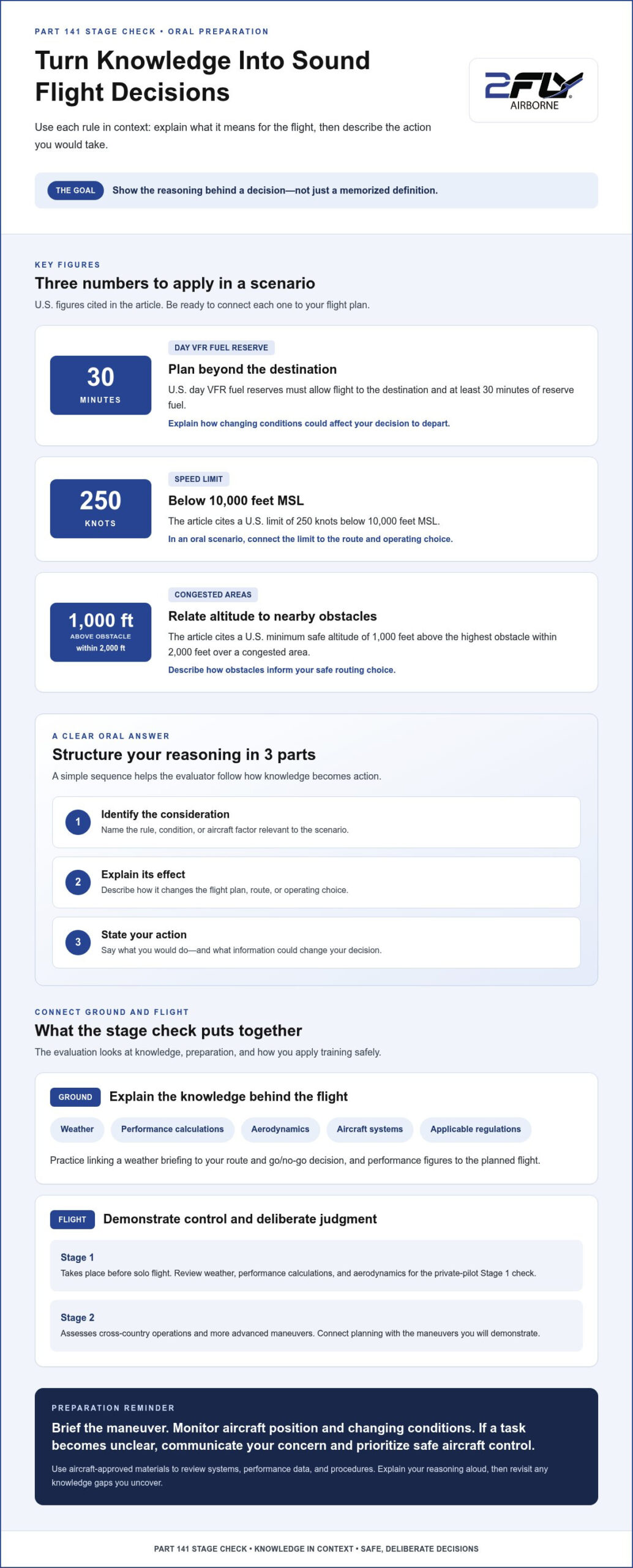
The ground evaluation tests whether you can explain the knowledge behind a flight. For a private-pilot Stage 1 check, topics include weather, performance calculations, and aerodynamics. These subjects connect directly to decisions made before takeoff, such as assessing conditions and aircraft limits. Clear explanations help show how you turn study into practical judgment.
For example, prepare to describe how weather information affects a planned flight, then explain the performance figures relevant to that plan. Review aircraft systems and applicable regulations alongside those topics. In the United States, according to the Federal Aviation Administration, an altimeter and pitot-static system inspection is required every 24 calendar months for IFR flight. That inspection requirement is a useful example of how aircraft equipment and operating rules intersect.
Flight Skills Assessment
The flight assessment observes how you perform and manage aircraft operations in real time. A Stage 1 check takes place before solo flight; a Stage 2 check assesses cross-country operations and more advanced maneuvers. The evaluator can observe how you prepare, follow procedures, control the aircraft, and respond as the flight develops. Each action should reflect deliberate training, not just memorized steps.
Use each maneuver to demonstrate control and sound judgment. Prepare the aircraft and brief the maneuver before beginning, then stay aware of the aircraft’s position and changing conditions. If a task becomes unclear, communicate your concern and prioritize safe aircraft control. Stage checks assess flying skills as well as ground knowledge, so explain your decisions when asked.
Weather, aircraft systems, and regulations can connect across both parts of the evaluation. A weather briefing, for example, informs your route and decision to proceed. Systems knowledge helps you explain what a control or instrument does, while regulations provide the operating context. Practice describing these connections in plain language using a specific flight scenario, not isolated definitions.
Before the evaluation, organize your review around the tasks for that stage. For each task, identify the related knowledge, procedure, and decision it supports. Then practice explaining an example aloud, such as how weather might change a cross-country plan. This helps you demonstrate consistent understanding on the ground and in flight.
- Review Stage 1 weather, performance calculations, and aerodynamics before a pre-solo check.
- For Stage 2, connect cross-country planning with the maneuvers you’ll demonstrate.
- Use aircraft-system examples to explain how equipment knowledge supports safe decisions.
Oral knowledge and aeronautical decision-making
Oral questions test whether you can explain the reasoning behind a flight decision. Strong answers connect regulations, aircraft operation, and a specific scenario rather than relying on isolated definitions. Practice explaining how you reach a decision, not just memorizing the answer.
Manage stage-check anxiety by pausing, listening to the whole question, and organizing your response. State what you know, explain your reasoning, and identify what information would resolve any uncertainty. Practicing aloud with a study partner can make your answers clearer and help you stay focused as questions shift between topics.
Use realistic scenarios to connect knowledge with action. For a planned day VFR flight, explain fuel planning, route choices, and what could change your decision to depart. According to the Federal Aviation Administration, U.S. day VFR fuel reserves must allow a flight to the destination and at least 30 minutes of reserve fuel. Explain how that reserve fits into the plan, including the choices you’d reconsider if conditions changed.
Regulations should guide decisions, not sit in memory as detached figures. According to the Federal Aviation Administration, U.S. regulations limit aircraft speed below 10,000 feet MSL to 250 knots. The Federal Aviation Administration also sets the minimum safe altitude over a congested area in the United States at 1,000 feet above the highest obstacle within 2,000 feet. In an oral scenario, connect each limit to the route or operating choice you would make.
Structure your answer in three parts: identify the consideration, explain its effect, and describe your action. For example, if a route crosses a congested area, discuss nearby obstacles and altitude before explaining your routing choice. This makes your reasoning easy to follow and shows how you apply knowledge to a practical situation.
- Fuel: Explain how destination, reserve, and changing conditions affect your plan.
- Speed: Apply the limit below 10,000 feet MSL to the scenario presented.
- Altitude: Describe how obstacles near a congested area inform safe routing.
- Decision: State what information would lead you to continue, adjust, or stop.
Knowledge and maneuver proficiency should reinforce each other. An evaluator may ask why a maneuver fits the task, which aircraft cues you’ll monitor, and how you’ll respond to a deviation. Before practicing, describe the maneuver’s purpose and key cues. Afterward, review which actions matched your plan and what needs refinement.
For self-practice, ask a partner to pose a question, then answer aloud without reading. Use a new scenario to connect a rule, your judgment, and the action you’d take. If your answer reveals a gap, revisit the relevant study material and explain the concept in your own words. This makes oral review active rather than passive rereading.
Study and preparation through self-review
Use self-review to find gaps before the evaluator does. Compare recent lessons with the stage objectives, then focus on skills or knowledge that need more work. Effective preparation starts with a clear understanding of what the evaluation expects.
Build a focused review plan
Part 141 schools use a written, FAA-approved Training Course Outline reflecting current industry and federal regulations. Use your school’s outline to organize review by lesson objective, ground knowledge, and flight task. For each item, mark what you can explain or perform confidently, what needs review, and what needs instructor practice. This turns a broad study session into focused priorities.
- Revisit: Read lesson notes and identify each task’s objective.
- Explain: Describe the procedure aloud without relying on notes.
- Apply: Explain how a scenario could change your decision or action.
- Practice: Target tasks you can’t yet explain clearly or perform consistently.
After a practice flight, record one strength and one specific area to improve. For example, note whether your setup, scan, or correction needs refinement. Turn the gap into a clear practice goal, such as explaining a procedure from memory. This keeps each study session purposeful instead of repeating material you already know.
Review your logbook and training documents
Read your logbook alongside training records and stage objectives. Check that entries reflect lessons and practice you remember, and note details to clarify with your instructor. An unsatisfactory Part 141 stage-check result may be identifiable in a pilot’s logbook, even without a pink slip. Review your entries carefully so you can discuss your training history accurately.
Gather lesson notes, aircraft study materials, and the course outline. Match each upcoming task with its reference, then note where your explanation needs work. If your description of an aircraft system feels vague, revisit the relevant material and explain its purpose in plain language. Keep your corrections together in a review sheet for quick reference.
If a check identifies deficiencies, record the feedback precisely rather than writing only “study more.” Remedial training after a stage check should usually be completed within 21 days. Use the evaluator’s comments to set specific practice goals, then track each goal against the relevant task. This creates a practical bridge from feedback to further preparation.
Finish by explaining priority items aloud and noting which questions need instructor guidance. Bring those questions to your next lesson, then use the answers to refine your review plan. A focused record of objectives, feedback, and practice goals keeps your preparation aligned with the training ahead.
Aircraft maneuvers and systems
A Part 141 stage check may cover aircraft systems, weather, regulations, and practical flying skills. Maneuvers vary by training stage, with cross-country operations and more advanced maneuvers included in the Stage 2 check.
Prepare to explain how aircraft data relates to safe operation. These figures apply to the aircraft you’re studying, not every training aircraft. Use the correct aircraft materials, and explain what each limit means before discussing how it affects flight decisions.
Review performance speeds as well as limits. The same study packet lists a Vso stall speed of 45 knots in the landing configuration and a Vy best rate-of-climb speed of 76 knots. Vso describes stall speed in that configuration; Vy identifies the speed for the best rate of climb. Practice locating both values and explaining when each is relevant, rather than treating them as interchangeable targets.
Crosswind planning also calls for aircraft-specific knowledge. The packet lists a maximum demonstrated crosswind of 17 knots. That figure describes what was demonstrated for the aircraft; it isn’t a guarantee that every pilot or condition makes the same crosswind appropriate. Review how wind direction, runway alignment, and your control inputs affect the approach. Talk through your plan before the maneuver, then evaluate your control and corrections afterward.
- Before a maneuver: Identify the task, aircraft configuration, and relevant performance information.
- During the maneuver: Maintain a deliberate scan and make smooth, purposeful control inputs.
- Afterward: Describe the result, any deviation, and the correction you would make.
Systems knowledge should guide your actions, not remain a list of component names. Choose one system from the aircraft study materials, describe its purpose, and explain which cockpit indication helps you monitor it. Then connect that knowledge to a practical decision, such as pausing a maneuver to assess an unexpected indication. Clear explanations show how you apply aircraft information in flight.
For preparation, review each maneuver against its lesson objective and practice describing the setup, key cues, and completion. In a cross-country exercise, for example, explain how you’ll manage navigation while maintaining aircraft control. During a maneuver review, identify where you’ll look, what you’ll monitor, and how you’ll respond if performance differs from your plan. This connects systems awareness with disciplined flying.
Use the aircraft assigned for training when studying speeds and limitations. Record questions about a specific figure or procedure, then resolve them using that aircraft’s materials and instructor feedback. A focused review of the 2,550-pound maximum weight, 154-knot Vne, 45-knot Vso, 76-knot Vy, and 17-knot demonstrated crosswind makes the packet’s data easier to apply accurately.
Part 141 stage checks
Stage checks are formal progress evaluations within structured Part 141 flight training. Their purpose is to assess whether you can meet the objectives for your current stage.
Part 61 programs don’t require stage checks, while FAA-structured Part 141 programs do. This difference means Part 141 students encounter planned evaluations as part of their course progression.
Part 141 rules require stage checks within the program and prevent your primary training instructor from conducting your evaluation. The school’s FAA-approved Training Course Outline sets out the course structure and reflects current industry and federal regulations.
A check may include a ground evaluation and flight tasks, with the applicable objectives depending on your training stage. For example, a private-pilot Stage 1 check takes place before solo flight, while Stage 2 assesses cross-country operations and more advanced maneuvers.
Grading and Standards
Stage-check grading compares your performance with the school’s standards for the assigned tasks. Understand how the evaluator assesses each task and which feedback means you need more practice.
Scoring methods can differ: one described evaluation assigns 90 points across 18 tasks, with 72 points as its passing score. Some schools require at least 80% to pass. Use your school’s rubric to understand how task performance, completion, and any deficiencies affect the result.
A stage check can receive an unsatisfactory grade. It may be marked incomplete if illness or time requires the student or evaluator to discontinue. If a task needs more work, focus on the recorded deficiency and make a specific practice plan. Don’t assume one school’s scoring scale applies at another.
Syllabus and Procedures
Your school’s written, FAA-approved Training Course Outline is the central reference for its Part 141 course structure. It matters because the outline connects lessons, stage objectives, and progress evaluations.
Use the outline alongside your school’s training materials and stage-check procedures. Compare the listed objectives with your lesson records, then note what the evaluation expects you to demonstrate. Your instructor can clarify how the school applies its procedures during training.
Students often ask how long a check takes and what it costs. Duration depends on the ground and flight tasks involved, as well as whether weather, scheduling, or an interruption affects completion. Cost varies by case and is provided after a quote request. Factors include the evaluation scope, aircraft use, and instructor time.
Before reviewing individual tasks, read the applicable stage objectives. Mark each objective as ready for demonstration or needing focused practice. Then use the school’s grading criteria to guide your review, and discuss specific gaps during instruction.
2FLY Airborne: FAA Professional Pilot Program
2FLY Airborne’s FAA Professional Pilot Program provides structured training for students working toward professional pilot qualifications. If stage-check preparation has clarified your next training goals, the program connects with the path from foundational flight skills to advanced certificates.
Training options include the Private Pilot Certificate (PPL), Instrument Rating (IR), and Commercial Pilot Certificate (CPL). Each develops different knowledge and flying capabilities, so consider which stage fits your current experience and long-term aviation goals. Reviewing feedback and practicing with clear objectives can support progress throughout flight training.
Explore the FAA Professional Pilot Program to understand how its training fits your goals. Contact 2FLY Airborne to discuss your next step.
Carry Your Progress Into the Next Stage
A stage check can shape how you approach the next phase of flight training. Treat each evaluation as a reference point for your development, then carry forward the habits that help you stay prepared, thoughtful, and focused on safe flying. The part 141 stage check preparation tips that fit your learning style can become part of a consistent routine, not just a checklist for evaluation day.
As your goals develop, consider how each lesson supports the pilot you’re working to become. Reflect on your progress and identify the next skill you want to strengthen. A deliberate approach helps build confidence through preparation and steady effort.
If you’re ready to explore your aviation training options, contact 2FLY Airborne about training. Keep moving forward with purpose, one well-prepared step at a time.
Frequently Asked Questions
What is a Stage Check in FAA Part 141 Training?
A Stage Check is a progress evaluation used within an FAA-structured Part 141 training course. It gives an evaluator other than your primary instructor an opportunity to assess your performance against the stage’s learning objectives. For example, a check may evaluate whether you can demonstrate a recently taught task and explain the knowledge behind it. The result helps identify readiness or areas that need more training.
What is a Part 141 flight school stage check?
A stage check is a school-administered evaluation of a student’s progress through a structured flight-training course. Unlike a lesson with your regular instructor, it provides an assessment from another evaluator and can include ground questions as well as flight tasks. The specific tasks depend on your course stage. A pre-solo check, for example, focuses on readiness before solo flight, while later checks can assess more advanced course objectives.
How should students prepare for a Part 141 stage check?
Match the upcoming check’s objectives with your recent lessons, then identify any task you can’t yet explain or perform consistently. Practice describing each task’s purpose, not just reciting steps. For instance, after a simulated diversion, explain what prompted the change and how you adjusted your plan. Use your instructor’s feedback to set a clear practice goal before the evaluation.
What documents and endorsements are required for a Part 141 stage check?
Your school’s written stage-check procedures determine which records and materials to bring. Prepare your logbook, relevant lesson records, stage objectives, and any school-provided evaluation forms so the evaluator can follow your training progress. Check your entries for accuracy and bring the aircraft or course references for that stage. Ask your instructor which endorsements or additional records apply to your evaluation.
What happens if you fail a Part 141 stage check?
An unsatisfactory result means you’ll need to address the identified deficiencies before progressing under your school’s procedures. The evaluator’s notes can guide focused remedial practice, and some schools may require students to repeat substantial portions of training. A check may instead be marked incomplete if illness or time requires the student or evaluator to discontinue. Review the outcome with your instructor and turn each noted weakness into a specific practice goal.
What FAA regulations govern Part 141 stage checks?
FAA-structured Part 141 programs require stage checks and must use a written, FAA-approved Training Course Outline reflecting current industry and federal regulations. The student’s primary training instructor cannot conduct the stage-check evaluation.

Article by
2FLY Airborne
2Fly Airborne is a professional flight training organization dedicated to developing the next generation of skilled, confident, and safety-focused pilots. With decades of combined aviation experience, our team of certified instructors provides structured, real-world training designed to prepare students for both checkrides and long-term success in the aviation industry.
Content Disclaimer
Some blog content is generated with the assistance of automated tools and may not always be fully accurate or up to date. Please verify all aviation-related information with official sources or a certified instructor. For additional guidance or clarification, we encourage you to contact one of our training advisors at 2Fly Airborne.