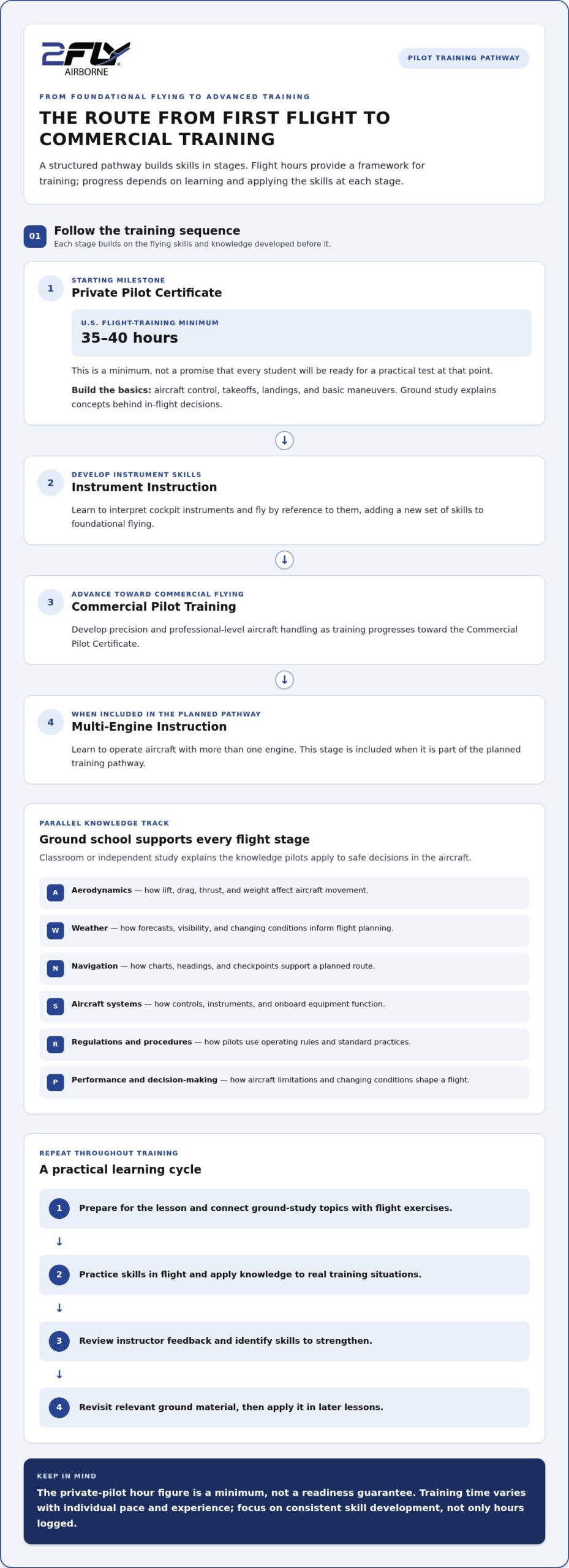
Your route from zero flight experience to a commercial pilot certificate starts with private pilot training. In the United States, earning a Private Pilot Certificate includes a minimum of 35 to 40 hours of flight training. This zero-to-CPL professional pilot program overview explains how that first milestone fits into the larger path toward commercial flying.
It’s natural to focus on the Commercial Pilot Certificate, but professional training develops in stages. Each certificate and rating builds skills for more advanced operations, while the time needed to progress depends on your training pace and experience.
Here, you’ll learn what private pilot training hours mean, how the route from private pilot to commercial pilot typically takes shape, and what the employment outlook says about commercial and airline pilot careers. You’ll have a clearer picture of the training commitment and the opportunities that may follow.
Key Takeaways
- See how private pilot training hours fit into the wider progression from beginner to commercial pilot.
- Understand how flight lessons and ground school work together to build practical skills and aviation knowledge.
- Learn which training and scheduling factors can shape the time it takes to complete a Zero to CPL program.
- Get a clearer picture of the certificates, ratings, flight experience, and medical considerations involved in professional training.
- According to the U.S. Bureau of Labor Statistics, airline and commercial pilot employment is projected to grow by 4 percent from 2024 to 2034, with approximately 18,200 annual openings over that period.
Private pilot training hours in the United States
For a student starting without flight experience, the Private Pilot Certificate is an early milestone on the route to commercial flying. In the United States, private pilot training includes a minimum of 35 to 40 hours of flight training. This figure describes a minimum, not a promise that every student will be ready for a practical test at that point.
Flight hours are only one part of learning to fly. Students develop skills through instruction and practice, then demonstrate that they can apply them consistently. One lesson might focus on aircraft control; later practice brings several skills together in a complete flight. Progress depends on mastering each stage, not simply logging time.
Think of flight hours as a framework for training. Their practical value lies in what each flight teaches: preparing for departure, maintaining control, responding to changing conditions, and completing a safe landing. Ground study supports this work by explaining the concepts behind in-flight decisions. Together, lessons and study prepare students to meet certificate training objectives.
A Zero to CPL pathway connects private pilot training with later professional development. Unlike modular training, which lets students complete separate certificates or ratings over time, a structured pathway organizes successive stages into a planned sequence. University aviation programs add an academic component to flight training. The right fit depends on whether you prioritize structure, flexibility, or a degree.
Financing and payment options vary by school and program. When comparing programs, consider eligibility, payment timing, and any scholarship conditions, then assess how the costs fit your financial plan.
To make the private pilot stage productive, establish a steady routine: prepare for each lesson, review instructor feedback, and connect ground-study topics with flight exercises. Keep a written list of questions and skills to revisit, so you can focus your next lesson. These habits also show how individual flights contribute to broader pilot qualifications.
The structured FAA pilot training pathway places private training within a longer professional sequence. As you read a zero to CPL professional pilot program overview, use the 35 to 40-hour minimum as a starting reference, then consider the skills and preparation each stage requires. The goal is sound progress from foundational flying toward advanced training.
These figures place private training in a wider aviation context. The United States had 691,691 active pilot certificates in 2020, and 103,879 active commercial pilot certificates in 2020. The totals offer a snapshot of the range of pilot certification, but they do not indicate how many training hours any individual needs. Later career planning can also account for employment rules: the Federal Aviation Administration sets a mandatory retirement age of 65 for commercial airline pilots in the United States. That age matters to long-term career expectations, not to the training hours required for a private certificate.
What flight training and ground school are included in a Zero to CPL program?
A Zero to CPL curriculum combines aircraft practice with classroom or independent study. Flight lessons develop hands-on judgment, while ground school explains the knowledge behind safe decisions. For example, preparing for a cross-country flight requires both navigation skills and planning for weather, fuel, and route choices.
Flight training progresses through stages rather than repeating the same lesson. Early flights focus on aircraft control, takeoffs, landings, and basic maneuvers. Later lessons develop navigation, communication, and decision-making in more complex situations. Students also apply instructor feedback, building on their performance in earlier flights.
As training advances, instrument instruction teaches pilots to interpret cockpit instruments and fly by reference to them. Commercial training develops precision and professional-level aircraft handling. Multi-engine instruction, when included in the planned pathway, covers operating aircraft with more than one engine. Together, these stages connect foundational flying with broader commercial operations.
Ground school provides concepts students apply in the aircraft. Lessons commonly cover:
- Aerodynamics: How lift, drag, thrust, and weight affect aircraft movement.
- Weather: How forecasts, visibility, and changing conditions inform flight planning.
- Navigation: How charts, headings, and checkpoints support a planned route.
- Aircraft systems: How controls, instruments, and onboard equipment function.
- Regulations and procedures: How pilots use operating rules and standard practices.
- Performance and decision-making: How aircraft limitations and changing conditions shape a flight.
For example, students can connect weather concepts such as clouds and wind to a preflight briefing. A navigation exercise can pair chart work with checkpoints observed during an actual cross-country lesson. This link between theory and practice turns technical material into usable cockpit knowledge.
Progress is assessed through practical demonstrations and knowledge checks throughout training. Instructors identify skills to strengthen, such as maintaining a selected heading or explaining a route decision. Students review the relevant ground material and apply it in later lessons. This cycle makes preparation an active part of flight training, not a separate task.
A structured professional pathway connects flight instruction, ground study, and advanced skills in a planned sequence. The airline pilot training outline illustrates how those stages contribute to professional preparation.
Progress can also be viewed as a sequence of readiness decisions. Use instructor feedback to identify knowledge that needs reinforcement before another practical exercise. This keeps classroom work tied to the next flight instead of treating syllabus completion as the only measure of progress. A pathway is most useful when its lessons match the qualifications and aircraft training you intend to pursue.
Pilot advisor Neha Banik says she has spent 12+ years helping leaders decide what to do next. That perspective can help students frame questions about which training path fits their goals. In the United States, an LSA (Light Sport Aircraft) license can be obtained with at least 20 hours of flight time. That minimum describes the LSA license, not the flight and ground-school sequence in a Zero to CPL program. Students should distinguish a separate credential from commercial-pilot training and check that a selected curriculum fits their intended qualification.
How long does it take to complete a Zero to CPL program?
A Zero to CPL program has no single calendar duration that applies to every student. The timeline depends on the training sequence, lesson frequency, progress in each skill, and time needed to prepare for assessments. A student who flies regularly and aligns ground study with lessons will follow a different schedule from someone whose training has frequent gaps.
Training typically progresses through distinct stages: private pilot skills, instrument training, commercial maneuvers, and any additional ratings included in the program. Each stage builds on earlier knowledge. For example, instrument lessons require students to control the aircraft while interpreting instruments, then demonstrate those skills consistently before advancing.
Lesson frequency is one of the clearest influences on calendar time. Regular flights help students carry skills from one lesson to the next; long intervals may mean revisiting previously learned material. Weather and aircraft scheduling also affect whether a planned flight can take place. A cancelled lesson can shift later training events, especially when stages depend on the same aircraft or instructor schedule.
Ground study also affects the pace. Students who review flight-planning concepts before a cross-country lesson can use aircraft time to practice applying them. Those who postpone study may need more review before demonstrating the same knowledge. Instructor feedback shapes the next lesson, too: a student may move on to a new maneuver or revisit a skill that needs more consistency.
For a realistic personal schedule, map the program around these practical factors:
- Weekly availability: Identify consistent windows for flight lessons, study, and preparation.
- Lesson continuity: Plan a rhythm that keeps previously learned skills active between flights.
- Stage readiness: Advance after demonstrating the required skills, not simply after completing a set number of calendar weeks.
- Schedule interruptions: Leave room for weather delays, maintenance scheduling, or changes in instructor availability.
- Assessment preparation: Set aside time to review maneuvers, flight planning, and knowledge before each evaluation.
These factors make a training calendar more useful than a broad estimate. A student with weekday availability, for instance, may arrange lessons differently from someone balancing work or school. Both need time for briefing, debriefing, independent study, and skill practice. Planning only around time in the aircraft can understate the full commitment.
As you compare program timelines, ask how the curriculum sequences flight lessons, ground preparation, and progress reviews. A clear plan shows what happens between certificates and where schedule flexibility matters. Track completed lessons and instructor feedback so you can discuss progress with specific examples, such as a maneuver needing more practice or a stage ready for assessment.
What FAA certificates, ratings, and flight-hour requirements are needed for a commercial pilot license?
A Commercial Pilot Certificate is a professional certificate, while ratings add qualifications for specific types of flying or aircraft. In a Zero to CPL pathway, students work toward the commercial certificate through staged training and evaluations. FAA requirements vary by certificate or rating, so program sequencing and regulatory eligibility are related but distinct.
Certificates and ratings serve different purposes. A certificate recognizes a pilot’s qualification level; a rating adds privileges or qualifications for a particular kind of flying. An Instrument Rating, for example, relates to flying by reference to cockpit instruments, while a Multi-Engine Rating relates to operating aircraft with multiple engines.
A professional training route may include milestones such as:
- Private Pilot Certificate: Establishes foundational pilot knowledge and flying skills.
- Instrument Rating: Develops instrument-based navigation and aircraft control.
- Commercial Pilot Certificate: Recognizes completion of the commercial certificate requirements.
- Multi-Engine Rating: Adds training in aircraft with more than one engine.
This sequence helps explain training, but it does not replace FAA eligibility requirements. Each certificate and rating has its own training and evaluation standards. Completing a course stage alone does not demonstrate readiness for the next qualification; students must meet the applicable requirements and show the necessary proficiency.
Flight-hour requirements are specific to each certificate or rating. A logbook records experience and training activity, helping students and instructors track progress against the applicable requirements. An instructor can review entries, for example, to see which activities a student has completed and which skills still need development. The total alone does not show whether a pilot can consistently perform each required skill.
As you review a training plan, separate three questions: which certificate or rating comes next, what experience it requires, and which skills you must demonstrate. Then compare your logbook with instructor feedback. If you have recorded relevant experience but still need more consistent performance, focus on developing the skill rather than simply adding entries.
Keep the commercial certificate distinct from ratings that may complement it. An Instrument Rating and a Multi-Engine Rating address different capabilities; neither is a Commercial Pilot Certificate. Understanding this distinction makes program milestones easier to interpret and connects each qualification to the professional flying goals it supports.
The pathway described includes a Private Pilot Certificate, an Instrument Rating, and a Commercial Pilot Certificate, with a Multi-Engine Rating as an additional qualification. Flight-hour requirements vary by certificate or rating. Pilots must meet the applicable experience requirements and demonstrate the required proficiency.
What are the admission requirements and medical certificate requirements for professional pilot training
Admission to professional pilot training and FAA medical certification are separate considerations. A school sets its own enrollment process, while the certificate path determines which aviation medical requirements apply. Before choosing a start date, plan for both processes so an administrative step does not disrupt your training.
Admission policies vary by school and program format. Common planning items include identity documents, education records, previous flight training records, and the ability to participate in classroom and flight activities. These are useful materials to organize, not a universal list of required documents. If you’re transferring from another program, gather your logbook entries and training records for review.
Use a simple preparation sequence:
- Identify the program route. Note whether you’re applying for a professional pathway, modular training, or an aviation degree program.
- Collect relevant records. Organize identification, education documents, and any existing pilot logbooks or certificates.
- Review medical certification. Understand how the intended flying privileges connect with the FAA medical certificate needed for that path.
- Plan for international study. If you’ll train in the United States from abroad, include student travel and enrollment paperwork in your preparation.
An FAA medical certificate is a separate part of readiness. Its relevance depends on the pilot privileges you’re pursuing, so don’t treat medical certification as interchangeable with school admission. Discuss your intended commercial flying path as you plan your training schedule, keeping the medical question tied to your career objective.
Medical certification involves an aviation-focused review of health information and fitness for the intended pilot activity. Prepare an accurate account of relevant medical history, medications, and previous evaluations. Clear, complete information helps the reviewing professional assess your case without avoidable gaps. Don’t rely on another pilot’s experience as a guide; applicants can have different histories and circumstances.
For international applicants, admission planning may involve coordinating school paperwork with travel preparation. When arranging flights and transit logistics for training abroad, services like Aerowave Air Travel and Logistics can help manage complex travel itineraries. Keep copies of identity and education records together, and track each document’s status. Visa processing is separate from flight instruction and medical certification, so include it in your overall plan rather than treating it as a flight-training milestone.
Sequence these decisions early: identify your training route, understand its medical implications, then prepare the application materials. If you have prior flight experience, include your existing records in that review; if you’re a beginner, focus on education and identity documents. This creates a clear starting point without confusing enrollment approval, FAA certification, and readiness for professional training.
2FLY Airborne: FAA Professional Pilot Program
2FLY Airborne’s FAA Professional Pilot Program gives aspiring pilots a structured route through key stages of professional flight training. It connects the foundational Private Pilot Certificate (PPL) with the Instrument Rating (IR) and Commercial Pilot Certificate (CPL), helping students understand how each milestone contributes to a commercial aviation pathway.
Consider a structured program when you’re ready to organize training around a professional goal rather than approach each certificate as an isolated step. Reviewing the sequence helps you see what comes next and how private, instrument, and commercial training build toward that objective.
For questions about the FAA Professional Pilot Program or its training pathway, contact 2FLY Airborne or visit 2flyairborne.com.
Turn your pilot ambition into a training plan
Your next step is to turn your career goal into a practical training plan. Consider how to organize study time, flight lessons, and personal commitments, then identify the questions you want answered before beginning. A zero to CPL professional pilot program overview can help frame those questions around your long-term direction.
Keep skill development and safe, structured training at the center of your planning. As you weigh your options, focus on the learning environment and the support you need to stay engaged through each stage. A thoughtful start can help you approach aviation training with purpose.
Ready to explore your next step? Contact 2FLY Airborne and speak with a 2FLY Training Advisor about your questions. Move forward with confidence.
Frequently Asked Questions
What is a Zero to CPL professional pilot program?
A Zero to CPL professional pilot program takes a beginner through the training stages leading to a Commercial Pilot Certificate. The pathway typically combines flight instruction, ground study, and progress evaluations, with certificates and ratings along the way. This zero to CPL professional pilot program overview explains the sequence, while the curriculum determines which stages are included and how they’re organized.
What jobs and career pathways are available after earning a CPL, and what additional qualifications are needed?
A Commercial Pilot Certificate can support work as a commercial pilot, while a Certified Flight Instructor certificate can open an instructional pathway. Some commercial roles may also require an Instrument Rating or Multi-Engine Rating, depending on the aircraft and operation. Airline careers involve further qualifications and experience beyond a CPL, including the Airline Transport Pilot certificate. Plan your next step around the type of flying you want to pursue.
Article by
2FLY Airborne
2Fly Airborne is a professional flight training organization dedicated to developing the next generation of skilled, confident, and safety-focused pilots. With decades of combined aviation experience, our team of certified instructors provides structured, real-world training designed to prepare students for both checkrides and long-term success in the aviation industry.
Content Disclaimer
Some blog content is generated with the assistance of automated tools and may not always be fully accurate or up to date. Please verify all aviation-related information with official sources or a certified instructor. For additional guidance or clarification, we encourage you to contact one of our training advisors at 2Fly Airborne.