
The TSA Alien Flight Student Program (AFSP) process now falls under the Flight Training Security Program (FTSP), the name used since January 26, 2022. If you’re not a U.S. citizen or national and plan to take flight training from an FAA-certificated provider, you generally need a security assessment before training begins. That can apply to private, instrument, and multi-engine training, so the timing of each request matters.
It’s understandable to assume one clearance covers every stage of flight training. The requirements depend on the training you plan to take, and you should submit fingerprints only after receiving the program’s instructions. Knowing what to request, when to start, and where fingerprinting fits can help you prepare without delaying your training.
This article explains how AFSP became FTSP, who generally needs an assessment, how to submit fingerprints, and when to request clearance for private, instrument, and multi-engine training. It also covers common exemptions and what to consider as you move from one stage of flight training to the next.
Key Takeaways
- AFSP is now called the Flight Training Security Program, but the security-screening process remains central to many international students’ training plans.
- Whether an assessment is required depends on your citizenship and the type and purpose of the flight training.
- Wait for the program’s fingerprint instructions before arranging fingerprint collection.
- Plan requests around your training sequence: private, instrument, and multi-engine training may involve separate clearance steps.
- Understanding these requirements can help you plan a structured path through 2FLY Airborne’s FAA Professional Pilot Program.
Transition from the Alien Flight Student Program to the Flight Training Security Program
The TSA’s Alien Flight Student Program (AFSP) is now administered under the Flight Training Security Program (FTSP). The change in name did not remove screening requirements for international students seeking covered flight training.
Application Requirements and Submission Steps
An AFSP application records a candidate’s identity and the specific flight training they plan to undertake. Accurate information matters: the training request must be validated before the payment and fingerprinting stages can proceed.
Applicants provide biographical and training details, along with clear color copies of their passport and visa. The application process generally follows this sequence:
- Create or access an account through the TSA flight-training candidate system.
- Submit the training request and required identity documents.
- Wait for the flight school to validate the request and email processing-fee instructions.
- After payment and acceptance, follow the fingerprint instruction email.
Wait for that email before arranging fingerprint collection. If your home country has no available fingerprinting agency, you can complete this step after entering the United States.
Approval Timing and Validity
Non-U.S. citizens or nationals generally need TSA approval before starting covered flight training. The requirement can also apply when training takes place outside the United States, if an FAA-certificated provider or instructor delivers training that could lead to an FAA rating.
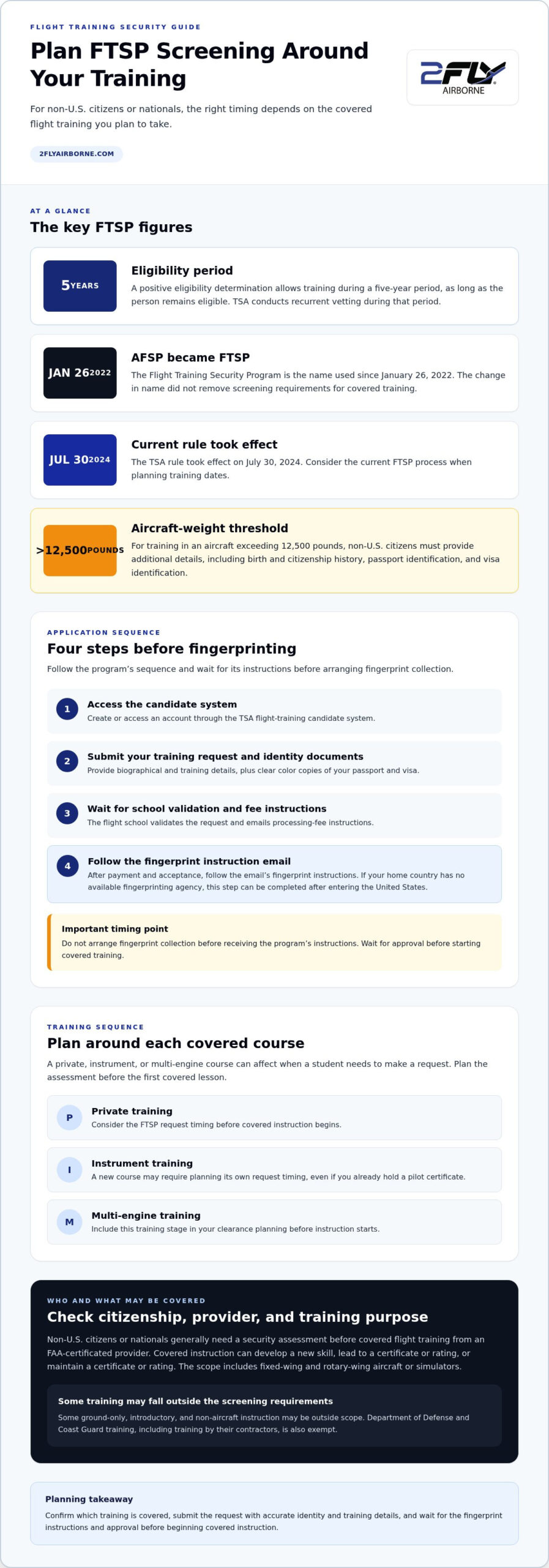
According to the Transportation Security Administration, a positive eligibility determination under the final rule allows training during a five-year eligibility period, as long as the person remains eligible. TSA conducts recurrent vetting during that period. Once eligibility expires, the student must obtain a new determination before relying on FTSP clearance.
Timing the request before the first covered lesson matters. The TSA rule took effect on July 30, 2024, and the current FTSP process should be considered when planning training dates. A private, instrument, or multi-engine course can each affect when a student needs to make a request.
Application Status, Delays, and Appeals
After submission, TSA reviews the training request and conducts the security threat assessment. Candidates can check the request’s status in their TSA account and respond to outstanding requirements. Wait for approval before starting training.
Common setbacks include missing identity documents, inconsistent application details, and starting fingerprinting before the instruction email arrives. If TSA denies a request, read the decision notice and follow any correction or review steps it provides. Do not assume that an appeal permits you to train before approval.
The program covers defined candidates and providers. Candidates generally include non-U.S. citizens or nationals seeking covered instruction; providers include individual instructors certificated under 14 CFR parts 61, 121, 135, 141, or 142. FAA-related training can fall within scope even outside the United States.
Not every aviation lesson is covered. Some ground-only, introductory, and non-aircraft instruction may fall outside flight-training screening requirements. Department of Defense and Coast Guard training, including training by their contractors, is also exempt. For a structured overview of FAA pilot training pathways, consider how your planned course fits its regulatory requirements.
Security threat assessments for non-U.S. citizen candidates
A TSA security threat assessment evaluates eligibility for covered flight training before instruction begins. Under the existing U.S. program, non-citizen flight trainees are screened, along with other people TSA designates. The decision concerns access to flight instruction, not the student’s flying ability or progress toward a certificate.
Both citizenship and the planned training matter. TSA conducts assessments for non-U.S. citizens or nationals seeking flight instruction or recurrent training from FAA-certified providers. For example, a non-U.S. citizen starting an instrument course may need an assessment before training begins, even if they already hold a pilot certificate.
The training’s purpose helps determine whether it falls within the rule. Covered instruction can develop a new skill or lead to a certificate or rating; it can also maintain a pilot certificate or rating. TSA’s scope includes training in fixed-wing and rotary-wing aircraft or simulators. Ground instruction alone does not meet this definition of flight training.
Aircraft weight changes the information required for some requests. For training in an aircraft exceeding 12,500 pounds, non-U.S. citizens must provide additional details, including:
- Birth and citizenship history
- Passport identification
- Visa identification
These details supplement the candidate’s identity and training information. If you plan to train in a lighter aircraft, don’t assume the same additional-information requirement applies.
The assessment process has a legislative history. The Vision 100 – Century of Aviation Reauthorization Act transferred responsibility for foreign flight-student security threat assessments from the Department of Justice to the Department of Homeland Security. TSA administers the Flight Training Security Program, applying that security-screening responsibility to covered training.
The training location can also matter. A non-U.S. citizen or national seeking instruction from an FAA-certificated facility, provider, or instructor may need to submit a request even if training takes place outside the United States, when it could lead to an FAA rating. Whether you plan to earn an FAA rating is therefore relevant when determining if screening applies.
Some exclusions depend on the type or purpose of instruction, not just the student’s citizenship. A discovery flight, for example, is exempt, while training for a new rating may require an assessment. Distinguish an introductory experience from a course intended to build qualifications before setting a training start date.
If you’re an international candidate, identify the aircraft, training objective, provider, and intended FAA certificate or rating before scheduling instruction. These details help clarify whether a security threat assessment applies and what information the application requires.
AFSP purpose and scope
The Alien Flight Student Program was created after the September 11, 2001 attacks to screen people seeking flight training at FAA-approved schools for security risks. The program is now called the Flight Training Security Program, but the screening purpose remains relevant to international flight students.
For U.S. citizens, the assessment described here focuses on a different group: people who are not U.S. citizens or nationals, as well as other individuals TSA designates. This distinction defines who may need an assessment; citizenship does not replace other flight-training requirements.
Covered instruction includes training in fixed-wing or rotary-wing aircraft, or in an aircraft simulator, when it supports a new skill, certificate, or type rating. It also includes training to maintain a pilot certificate or rating. This can include initial certification, instrument and multi-engine ratings, type ratings, and recurrent training to maintain or renew a type rating.
The purpose of the training matters. A candidate pursuing an instrument rating or a new certificate is seeking a qualification; a pilot maintaining a rating may be taking recurrent training. Both can fall within the program’s scope, so a student’s existing certificate alone doesn’t determine whether screening applies.
Aircraft weight is another factor. The earlier AFSP categories included training in aircraft with a maximum certificated takeoff weight above 12,500 pounds, as well as Category 3 training for non-citizens in lighter aircraft. Category 3 examples included Private Pilot, Instrument Rating, and Commercial training.
The TSA Flight Training Security Program rule took effect on July 30, 2024. Under the final rule, the former numbered training categories were replaced by requirements focused on training events that substantially enhance a pilot’s skills, with defined notification and recordkeeping duties for providers. The weight threshold remains useful context, but students should understand the current program through its training-event framework.
Some instruction is excluded from the definition of flight training. Examples include ground training alone, discovery flights, and instruction in balloons, gliders, ultralights, or unmanned aircraft. If you attend only ground lessons, for example, you are not taking the aircraft or simulator instruction described by the definition.
Other exclusions depend on who provides the training. Instruction from the U.S. Department of Defense, the U.S. Coast Guard, or their contractors is exempt; a person endorsed by the Department of Defense is also exempt. Foreign military personnel endorsed for U.S. training under the International Military Education and Training Program fall within a specific exception.
Fingerprint instructions and submission timing
Fingerprinting provides biometric information for the TSA security assessment. It supports identity screening, but it is not the eligibility decision. Submitting fingerprints does not authorize flight training; TSA approval is a separate milestone before covered instruction can begin.
Use the fingerprint instruction email as your guide for the collection step. It links the biometric submission to your specific training request, not to a general inquiry or another student’s application. Keep the email accessible when arranging your appointment and follow the instructions for that request.
The location of fingerprint collection affects timing. If no fingerprinting agency is available in your home country, you can complete this step after entering the United States. Account for that possibility when planning travel and course dates, since fingerprint collection still needs to fit within the process for your intended training.
Fingerprint timing also matters if your training plan changes. You might begin with private-pilot instruction and later plan an instrument or multi-engine course. Keep your original request details and TSA messages organized so you can identify the training and assessment each record relates to. A fingerprint appointment is not a substitute for the applicable approval.
Fingerprint records can remain relevant beyond an initial course. TSA’s updated Alien Flight Student Program records-retention schedule sets retention at 80 years to support fingerprint reuse for recurrent flight training during a covered individual’s life. This long retention period is a records policy, not an indication that a student’s eligibility determination lasts for the same period.
For recurrent training, distinguish stored fingerprints from ongoing eligibility screening. TSA conducts recurrent vetting of people covered by the program. The retained biometric record can support later screening, while vetting assesses whether new information affects eligibility. These related parts of the security system serve different functions.
Before your appointment, review the email and make sure you understand its instructions. Keep the appointment details and any confirmation records with your training paperwork. If your schedule changes, use your TSA account and application messages to track the request. An earlier appointment does not necessarily resolve later training requirements.
Treat fingerprinting as one defined step in the security assessment, not as final clearance. This distinction helps international students coordinate biometric collection and training dates with the separate approval required before covered flight instruction begins.
When to request private, instrument, and multi-engine TSA clearances
Plan TSA requests around the next training milestone that requires a security assessment. Your training sequence may include private-pilot, instrument, and multi-engine instruction, so map out each course before setting its start date. The key rule is simple: obtain the applicable approval before beginning covered training.
For private-pilot training, make the initial request part of your preparation for flight instruction. The TSA Alien Flight Student Program (AFSP) process can move forward while an international student applies for a visa. Align the request with your intended course rather than waiting until lessons are about to begin.
Instrument training is a later checkpoint in many students’ plans. Address its TSA requirements before the course starts. Don’t treat the TSA Alien Flight Student Program (AFSP) process for an earlier stage as a substitute for planning the requirements connected with subsequent training.
Use the same advance-planning approach for multi-engine instruction. Add the course to your training sequence early, then address its required security steps before instruction begins. This applies whether multi-engine training follows instrument training or comes at another point in your plan.
Build a simple course calendar around training milestones, not just enrollment dates. For each stage, record the course, its expected start, and whether an assessment or notification is needed. This makes it easier to see when to begin the relevant request and leaves time to complete required steps before instruction starts.
- For private-pilot training, plan the initial request before the first covered lesson.
- For instrument training, identify its requirements before the instrument course begins.
- For multi-engine training, schedule its clearance planning before multi-engine instruction.
You can plan a private-pilot TSA request while handling visa application steps, then address instrument and multi-engine requirements later in your training sequence. This separates immediate preparation from later milestones while keeping them on your radar. Keep your planned progression up to date if training dates or course order change.
The current FTSP framework also focuses on training events that substantially enhance a pilot’s skills. When planning a course, consider the event and its place in your training progression rather than relying only on older category labels. Follow the TSA requirements relevant to the event you intend to begin.
A training advisor can help connect your course sequence with a structured professional pathway. As you map the next milestone, explore structured pilot training and keep each clearance step aligned with the instruction it precedes.
2FLY Airborne: FAA Professional Pilot Program
2FLY Airborne’s FAA Professional Pilot Program gives aspiring pilots a structured path through key FAA pilot certifications. Students can progress from a Private Pilot Certificate (PPL) to an Instrument Rating (IR) and Commercial Pilot Certificate (CPL), aligning training stages with their professional goals.
For international students, understanding TSA clearance requirements is an important part of planning each training stage. Map your intended sequence alongside application and approval milestones to see what needs to be completed before covered flight instruction begins.
If you’re ready to plan your next step toward a professional aviation career, contact 2FLY Airborne with your questions or visit 2flyairborne.com.
Turn Your Training Goals Into a Clear Plan
Your next step is to connect your aviation ambitions with a practical training plan. Treat the TSA Alien Flight Student Program (AFSP) process as one part of preparing for your professional future, alongside decisions about your learning path, travel, and career direction. A deliberate plan keeps administrative preparation aligned with your reasons for pursuing flight training.
As you shape your plan, consider what you want your training to make possible and how each stage supports that goal. Clear priorities can help you approach your next decisions with purpose, whether you’re starting aviation training or building toward a professional career. Plan before your next milestone approaches.
For guidance on connecting your goals with a structured training path, contact 2FLY Airborne for help. Take the next step with focus and confidence, and keep your aviation ambitions moving forward.
Frequently Asked Questions
What is the TSA Alien Flight Student Program (AFSP)?
AFSP is the earlier name for TSA’s screening program for certain flight-training candidates. The current name is Flight Training Security Program (FTSP). A security eligibility determination is separate from FAA pilot certification: it doesn’t award a certificate, rating, or instructor qualification. For example, a candidate may meet TSA security requirements but must still complete the applicable FAA training and certification requirements.
Who must apply for AFSP approval before flight training?
Check the candidate’s citizenship, the training objective, and the provider’s FAA status together. An FAA-certificated instructor can fall within the provider definition, including instructors under 14 CFR parts 61, 121, 135, 141, or 142. Training outside the United States can also be relevant if it could lead to an FAA rating. These details help distinguish covered instruction from an exempt activity.
How does the AFSP fingerprinting process work, and where can applicants get fingerprinted?
Follow the fingerprint instructions sent for your specific training request, since that email tells you what to do next. If no fingerprinting agency is available in your home country, you can complete this step after entering the United States. Keep the instruction email and any appointment confirmation with your application records so you can track which request the fingerprint submission supports.
What are the current AFSP fees and processing times?
Under the current final rule, an eligible applicant pays a one-time fee for training during the five-year eligibility period; don’t rely on older per-request fee figures as the current fee structure. Security assessments typically take 5 to 15 business days, and additional vetting can extend that time. Include both payment and assessment review in your course-planning calendar before setting a firm training start.
What must a flight school do to verify AFSP approval before training begins?
A school must verify a candidate’s TSA approval before providing covered training and meet FTSP notification and recordkeeping requirements for applicable events. The rule also requires flight-training providers to give employees initial and biennial security-awareness training. For students, the practical takeaway is to coordinate the course start with the school’s approval and documentation process, not simply with enrollment or arrival dates.
Article by
2FLY Airborne
2Fly Airborne is a professional flight training organization dedicated to developing the next generation of skilled, confident, and safety-focused pilots. With decades of combined aviation experience, our team of certified instructors provides structured, real-world training designed to prepare students for both checkrides and long-term success in the aviation industry.
Content Disclaimer
Some blog content is generated with the assistance of automated tools and may not always be fully accurate or up to date. Please verify all aviation-related information with official sources or a certified instructor. For additional guidance or clarification, we encourage you to contact one of our training advisors at 2Fly Airborne.