
Have you ever looked at a commercial jet and wondered how you could be the one in the captain’s seat within just a few years? The journey from zero experience to a professional flight deck often feels like flying through heavy fog. You might feel overwhelmed by the choice between FAA and EASA standards or worry about the hidden costs that often plague traditional flight schools.
Securing high-quality ab initio flight training usa programs is the first step toward a global career, but you need a roadmap that removes the guesswork. We understand that the 1,500-hour rule and complex visa requirements for international students can feel like significant barriers. It’s natural to seek certainty when you’re investing in your future as a commercial pilot.
This guide provides a definitive look at a structured professional pilot program designed for the 2026 industry landscape. You’ll discover how fixed-price tuition and a clear certification timeline can turn your ambition into a predictable investment plan. We’ll break down the strategic phases from your first solo flight to earning your Multi-Engine Instructor rating. This article ensures you have the confidence and professional support to launch your international aviation career.
Key Takeaways
- Learn the fundamental differences between a casual flying hobby and an integrated career path that streamlines your journey to the flight deck.
- Discover how ab initio flight training usa programs provide a structured roadmap through essential certifications like the Private Pilot Certificate and Instrument Rating.
- Master your financial planning by understanding the strategic advantages of fixed-price tuition models compared to traditional pay-as-you-go flight schools.
- Identify the critical prerequisites for international students, including FAA First Class Medical requirements and M-1 visa sponsorship details.
- Gain a clear understanding of the 1,500-hour rule and how hour-building packages help you bridge the gap to a professional airline role.
Understanding the Integrated Path from Zero to Airline Pilot
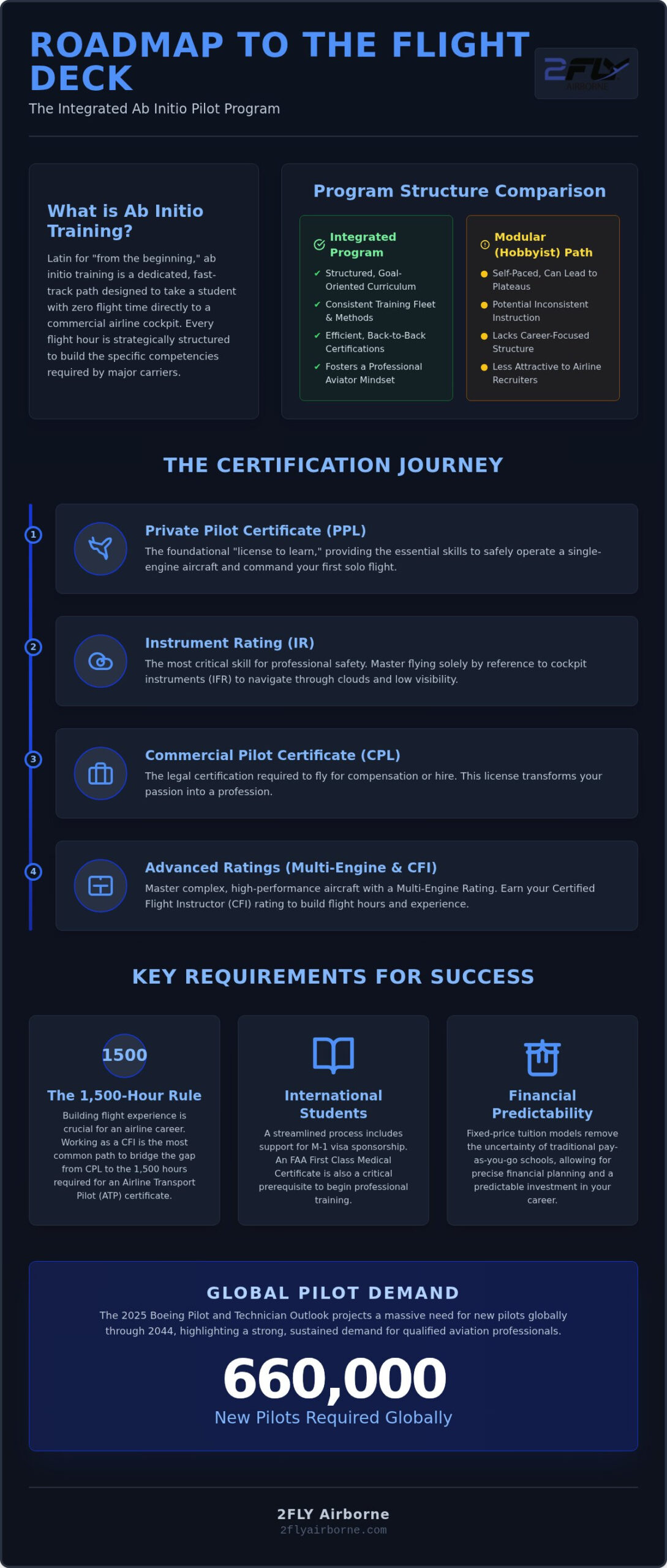
The term “ab initio” is Latin for “from the beginning.” In the context of ab initio flight training usa, this represents a specialized philosophy where a student with zero flight time is placed on a dedicated, fast-track path toward a commercial cockpit. Unlike hobbyist training, every hour in the air is designed to build the specific competencies required by major carriers.
To better understand this concept and see what the journey looks like from the cockpit, watch this helpful video:
Choosing a professional career track requires a significant psychological shift. You aren’t just learning to handle an aircraft; you’re adopting the rigorous safety standards and operational discipline of an airline pilot. This integrated approach ensures you meet the milestones of Understanding Pilot Certification through a seamless, goal-oriented curriculum.
The Concept of Ab Initio Training
Ab initio training removes the uncertainty of self-paced learning. By following a structured syllabus, you avoid the common learning plateaus that often stall casual students. This method treats you as a professional aviator from your first solo flight, fostering a mindset of technical mastery and vocational preparedness. It’s a direct pipeline designed for those who view aviation as a high-level profession rather than a weekend pursuit.
Why Integrated Programs Outperform Modular Paths
Integrated programs provide a level of consistency that modular paths simply cannot match. You train on a standardized fleet with instructors who follow a unified teaching methodology. This efficiency allows for back-to-back certifications, moving you rapidly from your Private Pilot Certificate to your Commercial Pilot Certificate. Airlines prioritize graduates from these structured environments because they demonstrate the discipline needed for high-pressure flight operations.
Success in this industry depends on hitting specific markers with precision. A professional FAA Airline Pilot Program maps out these requirements from day one. You’ll progress through several core milestones:
- First Solo Flight: The foundational moment of commanding an aircraft alone.
- Instrument Rating (IR): Gaining the ability to fly safely through clouds and low visibility.
- Commercial Pilot Certificate (CPL): The legal certification required to fly for compensation.
- Multi-Engine Rating: Mastering the complexities of high-performance, twin-engine aircraft.
This structured progression ensures that you don’t just collect flight hours. Instead, you build a professional portfolio that makes you an attractive candidate for international airline recruitment. By the time you reach the commercial deck, you’ve been groomed for the specific demands of the modern aviation industry.
Core Phases of the FAA Professional Pilot Program
Progressing through ab initio flight training usa requires a methodical approach to certification. Each phase is a building block that transforms a novice into a highly skilled aviator capable of managing complex systems. You’ll move from basic maneuvers to advanced instrument navigation and multi-engine operations.
Foundational Certifications: PPL and Instrument Rating
The Private Pilot Certificate is your entry point into the world of aviation. It’s often called a “license to learn” because it provides the basic skills needed to operate a single-engine aircraft safely. While this is your first major hurdle, the Instrument Rating (IR) is arguably the most critical skill for professional safety.
During IR training, you’ll transition from Visual Flight Rules (VFR), where you fly by looking outside, to Instrument Flight Rules (IFR). This allows you to fly solely by reference to cockpit instruments. Mastering IFR is essential for maintaining schedules in varying weather conditions, which is a non-negotiable requirement for airline operations.
Commercial Pilot Certificate and Multi-Engine Mastery
Once foundational skills are set, you move toward the Commercial Pilot Certificate (CPL). This stage demands professional-grade precision and adherence to strict FAA standards. You can find more details on these requirements in the FAA Professional Pilot Program guidelines. At this level, maneuvers must be executed with tighter tolerances and a deeper understanding of aircraft systems.
Strategic importance then shifts to the Multi-Engine Rating (ME). Most commercial airliners have at least two engines, so mastering twin-engine aircraft like the Piper Seminole is vital. You’ll learn to manage the increased workload and handle engine-out procedures, which are critical for airline eligibility. If you’re ready to start this journey, you might explore the structured curriculum of a professional academy.
The Instructor Path: CFI, CFII, and MEI
Achieving the 1,500-hour airline minimum is a significant milestone for those pursuing ab initio flight training usa. Becoming a Certified Flight Instructor (CFI) is the industry-standard way to bridge this gap. This role allows you to gain valuable experience while helping new students achieve their goals. It’s a dual benefit: you build hours and master complex aviation theory through teaching.
Instructors are in demand. Regional carriers are actively looking for qualified candidates to fill their ranks. The 2025 Boeing Pilot and Technician Outlook projects a demand for 660,000 new pilots globally through 2044. This long-term need highlights why completing your instructor ratings is a strategic move for career longevity.
Adding the CFII (Instrument) and MEI (Multi-Engine) ratings makes you even more marketable to regional carriers. These advanced instructor roles demonstrate a high level of technical mastery and leadership. By the time you reach the 1,500-hour mark, your time as an instructor will have prepared you for the rigorous demands of a commercial flight deck.
Evaluating the Financial and Time Investment for 2026
The cost of flight training is often the primary source of anxiety for aspiring aviators. Traditional schools use a pay-as-you-go model that leaves you vulnerable to sudden price hikes or instructor turnover. In 2026, choosing a structured path for ab initio flight training usa provides the financial clarity you need to focus on your studies.
Budgeting for your career must go beyond tuition alone. A professional pilot pathway requires a plan for housing, administrative fees, and medical certifications. Addressing these costs upfront prevents the financial “stop-and-start” cycle that often delays certification at smaller, less organized flight schools.
The Fixed-Price Advantage for Financial Security
A fixed-price tuition model protects you from the volatility of fuel surcharges and economic inflation. This pricing typically covers your flight hours, simulator sessions, and required ground school. It’s a comprehensive approach that removes the fear of hidden fees commonly found in modular training tracks.
When Evaluating the Financial and Time Investment, you must consider the total value of your training environment. Many students explore financing options to manage this investment effectively. Having a set cost from day one allows for precise long-term planning without the stress of variable hourly rates.
The decision to invest in a pilot career is backed by robust industry data. The 2025 Boeing Pilot and Technician Outlook projects a demand for 660,000 new pilots globally through 2044. This sustained demand ensures that your financial commitment is a strategic gateway to a high-growth international profession.
Timeline Expectations: Fast-Track vs. Sustainable Learning
An intensive ab initio flight training usa program usually spans a 6 to 12 month window for initial certifications. This fast-track approach requires full-time immersion in a professional flight academy environment. While speed is a significant benefit, you shouldn’t sacrifice technical mastery of the FAA Airplane Flying Handbook.
Several factors influence your progression through the training syllabus:
- Regional weather patterns and seasonal visibility.
- Individual aptitude and dedicated study habits.
- Aircraft maintenance schedules and fleet availability.
Balancing these variables is easier in a structured program that prioritizes student progress over casual rentals. Full-time immersion allows you to live and breathe aviation, which speeds up the learning curve. This professional environment helps you maintain momentum and ensures you’re ready for the airlines as quickly as possible.
For those looking to research their training options, you can visit Flight School USA to see how a professional academy manages these variables through structured, career-focused programs.
Essential Prerequisites and International Student Support
Starting your aviation journey involves more than just a passion for flight; it requires meeting specific regulatory and physical standards before you ever step into a cockpit. Ensuring you meet these prerequisites early protects your investment and sets the stage for a smooth transition into professional aviation. Preparing for ab initio flight training usa means checking these boxes well before your arrival date.
Medical and Educational Standards
The FAA First Class Medical Certificate is the gold standard for commercial aviators. A qualified Aviation Medical Examiner (AME) conducts this comprehensive examination to evaluate your vision, hearing, and cardiovascular health. You should secure this certificate before beginning your flight training to confirm your eligibility for a commercial career. It ensures you have the physical capability to handle the rigors of the flight deck for years to come.
Academic and language standards are equally vital for your success. Most professional academies require a high school diploma or its international equivalent for enrollment. Since English is the universal language of the skies, international candidates must achieve ICAO Level 4 proficiency or higher. This standard ensures clear and safe communication with air traffic control regardless of where you fly in the world.
Visa Sponsorship and Administrative Support
International students must navigate the M-1 or F-1 student visa process to train in the United States. This procedure begins with SEVIS registration and involves a mandatory interview at a U.S. Embassy in your home country. As an M1 visa approved flight school, we provide the dedicated administrative support needed to manage these legal requirements efficiently. We also assist with the mandatory TSA Flight Training Security Program (FTSP) application, which is a required threat assessment for all non-U.S. citizens.
Living on-campus offers a strategic advantage that many students overlook. Our residential accommodation places you in a dedicated environment where you can focus entirely on your training syllabus. This immersion fosters a culture of peer mentorship and removes the stress of a daily commute. You’ll live and study alongside other high-achievers who share your ambition to reach the commercial flight deck.
Global demand for skilled aviators continues to rise across all international markets. Meeting these prerequisites now positions you to fill these roles and secure your place in the future of the industry. If you have questions about your specific eligibility, you should contact an advisor to discuss your documentation.
Transitioning from Student Pilot to Industry Professional
Earning your commercial license is a monumental achievement, but it’s only the halfway mark in a professional pilot’s journey. To move from the training environment to the flight deck of a major carrier, you must bridge the experience gap required for an Airline Transport Pilot (ATP) certificate. This transition is where strategic ab initio flight training usa proves its long-term value.
Building Flight Hours and the 1,500-Hour Rule
The 1,500-hour rule is a significant regulatory milestone for all aspiring first officers in the United States. After completing your initial certifications with approximately 250 hours, you need a structured plan to accumulate the remaining flight time. High-quality ab initio flight training usa provides the foundation for this hour-building phase, ensuring you remain sharp and professional. Many graduates choose to become flight instructors or utilize specialized FAA First Officer Program pathways to gain this critical experience.
Hour building isn’t just about quantity; it’s about the quality of the time spent in command. Instructing others or flying in complex environments reinforces your technical knowledge and decision-making skills. This phase prepares you for the high-pressure operations of a regional or major airline. It’s a period of professional growth that transforms a skilled student into a seasoned aviator.
The 2FLY Airborne Mentorship and Placement Ecosystem
Securing a position at a leading airline requires more than just meeting the hour requirements. You need to excel in technical interviews, simulator evaluations, and psychological assessments. The 2FLY Airborne academy provides a dedicated mentorship ecosystem designed to prepare you for these rigorous selection processes. We treat your training as a direct pipeline to employment through our global recruitment network.
Graduates of the FAA Airline Pilot Program benefit from an international perspective that many domestic schools lack. This global mobility allows you to leverage your FAA certifications for opportunities across different regions and markets. You’ll enter the job market with the technical mastery and professional polish that top-tier recruiters demand.
The current industry landscape provides a historic window of opportunity for new professionals. By aligning yourself with a structured mentor-led environment, you ensure you’re ready to meet this demand. Your journey from a student pilot to an industry-prepared professional is a carefully managed progression toward a lifelong career.
Launch Your International Aviation Career
The journey to the commercial flight deck is a rigorous but rewarding pursuit that requires a clear, structured roadmap. By selecting a specialized program for ab initio flight training usa, you’ve already taken the most critical step toward ensuring your professional mobility. You now understand how fixed-price tuition protects your investment and how an integrated syllabus streamlines your path through every certification.
Our status as an M-1 visa approved flight school means we’re uniquely equipped to help international students navigate the complexities of training in the United States. With a global recruitment network and a proven mentorship model, we don’t just teach you how to fly; we prepare you for a lifelong career in the skies. Every phase of our training is designed to transform your ambition into technical mastery and vocational preparedness.
If you’re ready to move from the classroom to the captain’s seat, the next step is to secure your place in our next intake. You can speak with a 2FLY Training Advisor to start your journey today. Your future in international aviation starts with a single, decisive action.
Frequently Asked Questions
How long does a zero to airline pilot program actually take?
A structured ab initio flight training usa program typically takes 6 to 12 months to complete all certifications from Private Pilot through Commercial Multi-Engine. After this phase, most pilots spend an additional 12 to 24 months building the 1,500 hours required for an Airline Transport Pilot certificate. Your individual timeline depends on training frequency, weather conditions, and personal aptitude. Full-time immersion in a professional academy is the most efficient way to maintain momentum.
Can I get financial aid for a professional pilot program in 2026?
While traditional federal student loans are often reserved for degree-granting institutions, many students secure financing through specialized private lenders. 2FLY Airborne works with partners who provide loan options specifically tailored for the FAA Professional Pilot Program. These loans can cover tuition, housing, and administrative fees. It’s essential to have a solid financial plan before you begin. Speaking with a training advisor can help you explore current funding pathways for your career.
What is the difference between FAA and EASA pilot training?
FAA certifications are issued by the United States, while EASA standards govern European aviation. FAA training is recognized for its efficiency and is a popular choice for ab initio flight training usa due to the vast airspace and lower costs. Many international pilots choose the FAA path first and later convert their licenses to EASA if they plan to fly for European carriers. 2FLY Airborne supports both regulatory standards through its global network.
Do I need a college degree to become an airline pilot?
You don’t need a college degree to earn your FAA pilot certificates or to work for regional airlines. However, many major legacy carriers still prefer or require a four-year degree for competitive hiring. If your goal is to reach the highest levels of the profession, a degree can be a valuable asset. We offer degree-linked programs for students who want to combine their flight training with an academic qualification to maximize their career options.
Is there an age limit to start a zero to airline pilot program?
There is no upper age limit to begin flight training, but you must consider the mandatory retirement age for airline pilots. You can earn a Private Pilot Certificate at 17 and a Commercial Pilot Certificate at 18. However, FAA regulations require airline pilots to retire at age 65. If you’re starting later in life, you should calculate your career longevity and ensure you have enough time to recoup your training investment before retirement.
What happens if I fail my FAA medical exam?
Failing an FAA medical exam doesn’t always end your career. If the examiner finds a disqualifying condition, you may be able to apply for a Special Issuance medical certificate or a waiver. This process involves providing additional medical documentation to the FAA for review. It’s critical to obtain your First Class Medical Certificate before you start a professional program. This ensures you’re physically eligible for a commercial career before investing in training.
How much do entry-level commercial pilots earn after graduation?
First-year first officers at U.S. regional airlines in 2026 typically earn total compensation packages between $90,000 and $110,000. These figures include base hourly pay, signing bonuses, and retention incentives. While initial pay as a flight instructor is lower, the rapid transition to a regional airline allows you to recoup your training costs quickly. The current pilot shortage has driven salaries to historic highs, making the profession more financially viable than ever.
Can international students work in the US after flight training?
International students can apply for practical training after completing their studies at an M1 visa approved flight school. This allows you to work as a flight instructor to build the flight hours required for higher certifications. The F-1 visa offers even more flexibility for work and study. Our administrative team provides full support for visa sponsorship and SEVIS registration. This helps international aviators transition smoothly from student status to professional roles within the industry.
Article by
2FLY Airborne
2Fly Airborne is a professional flight training organization dedicated to developing the next generation of skilled, confident, and safety-focused pilots. With decades of combined aviation experience, our team of certified instructors provides structured, real-world training designed to prepare students for both checkrides and long-term success in the aviation industry.
Content Disclaimer
Some blog content is generated with the assistance of automated tools and may not always be fully accurate or up to date. Please verify all aviation-related information with official sources or a certified instructor. For additional guidance or clarification, we encourage you to contact one of our training advisors at 2Fly Airborne.