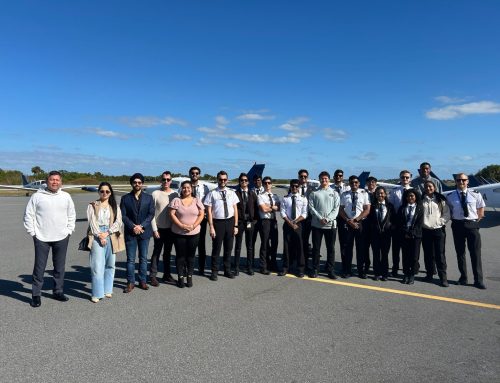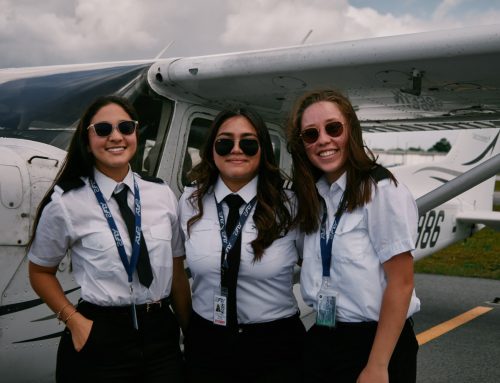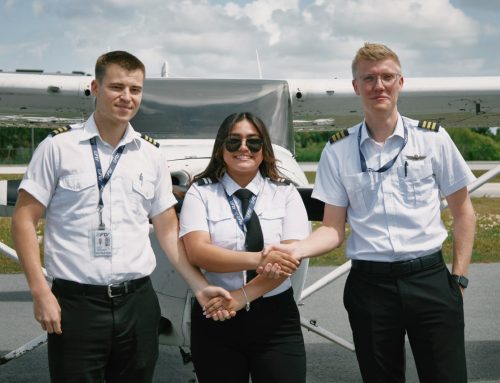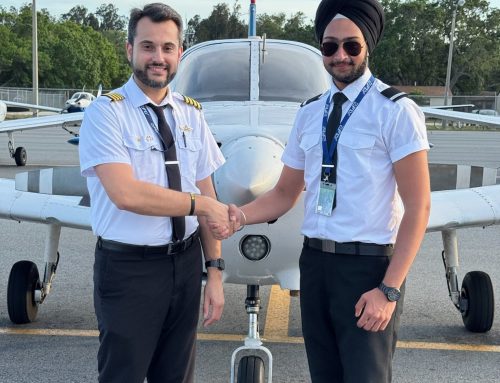
The leap from flying for leisure to flying for a living is defined by more than just a new certificate; it requires a fundamental shift in professional accountability. You’ve likely felt the weight of the significant investment required or felt overwhelmed by the maze of complex FAA regulations. It’s natural to worry whether your training will actually make you airline ready or if you’ll be left navigating the industry alone after graduation.
We understand these challenges because we’ve guided countless high-achievers through the same journey. This guide will demystify the commercial pilot license course, providing you with a clear, authoritative roadmap to bridge the gap between a private certificate and a professional career. You’ll gain a precise understanding of the requirements and the confidence to choose a training path that leads directly to an international cockpit.
We’ll break down the specific flight hour benchmarks, compare the advantages of different training structures, and provide practical insights for mastering the transition to professional aviation. By the end of this guide, you’ll have a structured plan to turn your ambition into a world-class career.
Key Takeaways
- Understand the legal transition from recreational flying to professional compensation under FAA standards.
- Discover how a comprehensive commercial pilot license course focuses on advanced aircraft systems and professional-grade precision.
- Evaluate the strategic importance of multi-engine ratings in meeting the entry-level requirements for major airline carriers.
- Map out the essential prerequisites and realistic timelines for transitioning from a private pilot to a commercial aviator.
- Learn why choosing a structured training environment is critical for building the discipline and safety standards expected by the aviation industry.
Defining the Commercial Pilot License Course (CPL)
Earning a Commercial Pilot License (CPL) marks the definitive boundary between aviation as a hobby and aviation as a profession. While a Private Pilot Certificate allows you to share the joy of flight with friends, the CPL provides the legal authority to receive compensation for your services. It’s the foundational requirement for any pilot aiming to turn their passion into a paycheck.
The CPL is the legal gateway to professional mobility. It allows you to act as pilot-in-command of an aircraft for hire, provided you meet the specific category and class ratings. This certificate serves as the anchor of your professional identity, enabling you to work in roles like aerial photography, banner towing, or corporate transport.
To better understand the high standards required in this professional curriculum, watch this overview of the training process:
Holding a commercial certificate is a major milestone, but it’s rarely the final step. Most high-level careers, especially with major airlines, require you to pair this license with an instrument rating and multi-engine privileges. You should view the CPL as the cornerstone of a larger, more complex professional architecture.
The Transition from Private to Professional
Moving into a commercial pilot license course requires a significant mental shift. You’re no longer just responsible for your own safety; you’re preparing to carry the weight of passenger expectations and strict cargo deadlines. This transition demands a level of discipline that goes far beyond the basics of flight.
Precision becomes your new standard. The FAA expects much tighter tolerances for maintaining altitude, heading, and airspeed than those required for private pilots. You’ll move beyond basic maneuvers to master complex aircraft operations, including the management of advanced systems and high-performance engines. You are evolving from a student pilot into an industry-prepared professional.
FAA Part 61 vs. Part 141 Training Environments
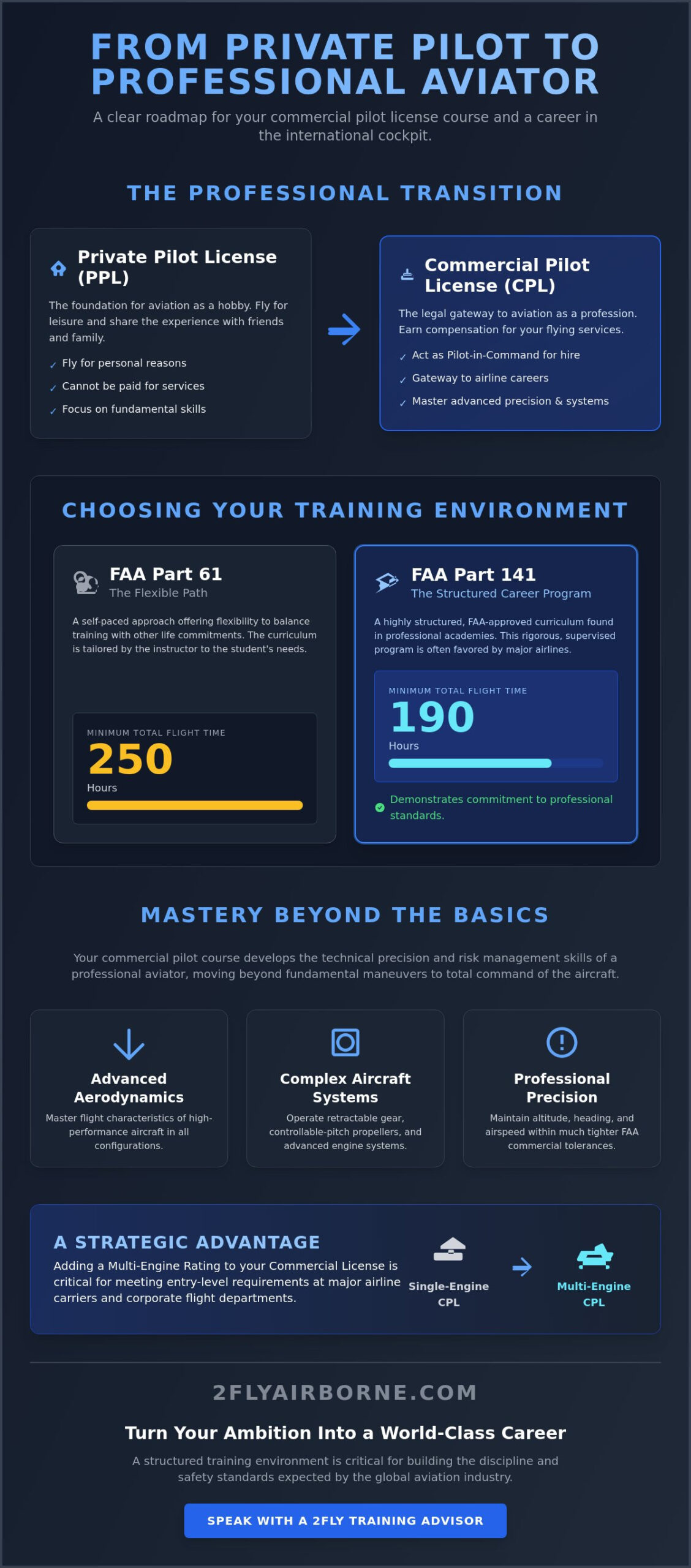
Choosing the right training environment is a strategic decision for your future career. Part 61 training offers a flexible, self-paced approach that’s often used by those who need to balance flight hours with other commitments. Under Part 61, you typically need 250 total flight hours to qualify for your commercial checkride.
In contrast, Part 141 programs follow a highly structured, FAA-approved curriculum often found in career academies. These programs can reduce the total hour requirement to 190 hours because of their intense, supervised nature. Major airlines often favor candidates from these structured environments because it demonstrates a commitment to the rigorous standards found in commercial flight decks. Selecting a commercial pilot license course that aligns with these professional expectations is the first step toward an international aviation career.
Mastery Beyond Basics: What You Learn in a Professional Flight Course
A commercial pilot license course is designed to strip away any remaining amateur habits. You move beyond basic stick-and-rudder skills to develop the technical precision of a professional technician. This stage of training emphasizes total command over the airframe and its systems in every phase of flight. You’ll learn to manage the aircraft with a level of foresight that identifies and mitigates risks before they become emergencies.
Risk management becomes a central pillar of your daily operational routine. Professional weather planning involves more than checking a local forecast; it requires analyzing atmospheric trends and making “go/no-go” decisions based on strict safety margins. You’ll also refine your communication skills to meet the demands of high-density airspace. Clear, concise radio work is essential when operating in professional environments where speed and accuracy are non-negotiable.
Advanced Aerodynamics and Aircraft Systems
Mastering high-performance engines and retractable gear systems is vital for any aspiring captain. You’ll study the intricate mechanics of constant-speed propellers and hydraulic systems to ensure you can troubleshoot complex issues while in flight. This technical depth allows you to interpret performance charts with absolute certainty rather than estimation. Understanding weight and balance is no longer just a classroom exercise; it’s a critical safety protocol for every professional departure. According to current FAA standards, a complex aircraft is defined as an airplane that has retractable landing gear, flaps, and a controllable pitch propeller, including airplanes equipped with a full-authority digital engine control (FADEC).
Commercial Maneuvers and Precision Flying
The flight deck of a major carrier requires exceptional hand-eye coordination and constant situational awareness. To develop these traits, you’ll practice specific commercial maneuvers like Chandelles, Lazy Eights, and Eights-on-Pylons. These aren’t just display flights; they test your ability to manage energy, orientation, and aircraft limits simultaneously. These standards are strictly outlined in the FAA’s Airman Certification Standards (ACS), which provides an integrated approach to testing your knowledge and risk management skills during the checkride.
Perfecting these maneuvers ensures you are ready for the diverse career paths for commercial pilots available in the modern industry. Whether you aim for corporate flight departments or regional carriers, this technical precision is your professional calling card. If you’re ready to start this transformation, exploring a structured FAA Professional Pilot Program can provide the rigorous environment needed for long-term success.
Strategic Choices: Single-Engine vs. Multi-Engine Commercial Ratings
Choosing between a Single-Engine Commercial (CSEL) and a Multi-Engine Commercial (CMEL) rating is a pivotal decision that shapes your early career trajectory. While both certifications are obtained through a commercial pilot license course, they serve different strategic purposes. A single-engine rating is often a cost-effective starting point for those aiming to build initial hours through flight instruction or aerial survey work. However, the path to a major airline cockpit almost always requires multi-engine expertise.
Most commercial carriers require a multi-engine rating for entry-level First Officer positions because it demonstrates your ability to manage more complex systems. 2FLY Airborne integrates these ratings strategically within its professional programs to maximize your career mobility from day one. By combining these certifications, you avoid training bottlenecks and ensure you’re eligible for a wider range of high-paying opportunities as soon as you graduate.
The choice you make also influences your “hour building” phase, which is the period spent reaching the 1,500-hour requirement for an Airline Transport Pilot certificate. Obtaining a CMEL early allows you to pursue a Multi-Engine Instructor (MEI) rating. This qualification is highly sought after, as it enables you to accumulate valuable multi-engine time while being compensated to teach others.
The Multi-Engine Advantage
Flying twin-engine aircraft is a non-negotiable prerequisite for the heavy jets used by global carriers. This training introduces you to the challenges of asymmetric thrust and the critical importance of engine-out procedures. You’ll learn to maintain control and performance when the aircraft’s center of thrust shifts unexpectedly. Reviewing the Commercial Pilot Certificate requirements will show you that while the hour minimums are set, the quality of those hours depends on the complexity of the aircraft you fly. For a deeper look at this requirement, explore our guide on why you need a multi-engine rating for airlines.
Career Trajectories for CPL Holders
Initial jobs for those who have completed a commercial pilot license course often include flight instruction, pipeline patrol, or regional cargo operations. These roles are essential for developing the real-world experience that airlines value. Working as a Certified Flight Instructor (CFI) remains one of the most reliable ways to build hours while refining your own technical knowledge. A structured professional program streamlines this jump from trainee to industry professional by providing a clear, supervised pipeline to your first commercial job.
Navigating Prerequisites and the Training Journey
Have you ever wondered why some pilots seem to glide through their checkrides while others struggle to meet the standard? The difference often lies in how they navigate the rigorous prerequisites before ever stepping into the cockpit for their final test. A commercial pilot license course is not just a series of lessons; it’s a regulated progression toward professional mastery that demands discipline from the very first day.
To begin this journey, you must be at least 18 years old and demonstrate proficiency in reading, speaking, and understanding English. While a private pilot only needs a third-class medical, you must obtain at least a second-class medical certificate to exercise commercial privileges. This ensures you meet the physical standards required for the safe operation of revenue-generating flights. You’ll also need to pass a comprehensive FAA knowledge test, which covers advanced topics like federal aviation regulations and professional-grade navigation.
The 2025 Boeing Pilot and Technician Outlook projects a demand for 660,000 new pilots globally through 2044. This massive requirement highlights the importance of moving through your training milestones efficiently. Starting with no experience, it takes approximately two and a half years to become an airline pilot. This timeline includes about twelve months for initial training and another 18 months to build the required flight hours.
Flight Hour Requirements and Milestones
Reaching the finish line requires meeting specific flight hour benchmarks that prove your reliability. Under Part 61, you’ll need a total of 250 flight hours, whereas Part 141 programs allow for a more streamlined 190 hours. These hours aren’t just for time-building; they include mandatory cross-country flights, night operations, and solo time to prove your independence. Understanding these Commercial Pilot License Requirements Explained helps you manage your expectations and budget as you progress toward your goals.
The Commercial Checkride Experience
The checkride is the ultimate hurdle in your commercial pilot license course. It begins with an oral examination where a Designated Pilot Examiner (DPE) will challenge your knowledge of aircraft systems and risk management. This isn’t a simple question-and-answer session; it’s a test of your professional judgment and pilot-in-command authority. You must demonstrate that you can make safe, legal decisions under pressure.
Once the oral portion is complete, you’ll take to the skies to demonstrate the maneuvers you’ve perfected. Success depends on maintaining composure while executing precision maneuvers to the specific tolerances of the Airman Certification Standards. Treat the examiner like a passenger or a chief pilot to showcase your professional conduct throughout the flight. If you’re ready to commit to this level of excellence, consider enrolling in our FAA Professional Pilot Program to begin your advancement.
Advancing Your Career with a Structured Professional Pilot Program
Completing a commercial pilot license course is a significant achievement, but how you choose to complete that training dictates your long-term career stability. Many aspiring aviators consider a modular or “pay-as-you-go” approach to save on immediate costs. While this offers flexibility, it often lacks the consistency and rigorous oversight required to meet the high standards of major international carriers. A structured program ensures that every hour spent in the cockpit builds toward professional readiness rather than just checking a box.
A comprehensive training environment focuses on more than just flight hours; it cultivates the professional mindset necessary for a high-stakes career. By training in a setting that mirrors airline operations, you develop the discipline to follow complex procedures and safety protocols instinctively. This vocational preparedness is what separates a graduate who is merely licensed from one who is truly industry-ready. 2FLY Airborne bridges this gap by providing a direct pipeline from initial training to professional employment, ensuring you possess the technical mastery sought by recruiters worldwide.
The global aviation industry is currently facing a period of unprecedented expansion. The 2025 Boeing Pilot and Technician Outlook projects a demand for 660,000 new pilots globally through 2044. For those who have committed to a professional path, this represents a unique window of opportunity for rapid career advancement and international mobility.
Integrating CPL into an Airline Pilot Track
The most efficient way to reach the flight deck is through a dedicated FAA Professional Pilot Program. This track integrates your commercial training with advanced ratings, ensuring your skills remain sharp and your progression stays on schedule. Training within an environment that utilizes Standard Operating Procedures (SOPs) prepares you for the specific workflow of a commercial flight deck. To help manage the cost of this intensive professional development, several financing options are available to support your investment in a lifelong career.
Mentorship and Professional Mobility
Transitioning into a First Officer role requires more than just technical skill; it requires the guidance of those who have already navigated the industry. A global network of mentors and recruitment support can provide the edge you need during competitive hiring phases. Your commercial license is not the end of your education; it’s the start of a lifelong commitment to safety, precision, and excellence. As you move toward the airlines, remember that the foundation you build today determines the heights you will reach tomorrow.
Summary of Key Takeaways:
- The CPL is the essential legal requirement for receiving compensation as a pilot.
- Structured training environments are preferred by airlines because they instill professional discipline and SOP adherence.
- Strategic rating choices, like obtaining a multi-engine rating early, significantly increase your career mobility.
- Building 1,500 hours is a marathon that requires a safe, structured foundation to ensure long-term success.
Safe, structured training is the only reliable path to a successful aviation career. If you have any remaining questions about how to start your journey, please reach out to a 2FLY Training Advisor to discuss your professional goals.
Charting Your Path to the Captain’s Seat
The journey from a private flyer to a professional aviator is defined by the quality of your foundation. You’ve learned that mastering advanced maneuvers and choosing a multi-engine path are critical steps toward a major airline career. A commercial pilot license course serves as the definitive bridge to a world where your skills are recognized and compensated on an international scale.
Success in this industry requires more than just meeting minimum hour requirements. It demands a commitment to the rigorous standards and safety protocols that top-tier carriers expect. Since 1994, we’ve used our international training expertise to guide high-achievers through this transition. With fixed-price tuition options and a global recruitment network, you can focus on technical mastery while we help you navigate the route to employment.
Your ambition deserves a training partner that understands the demands of the modern cockpit. Speak with a 2FLY Training Advisor to plan your professional pilot career and take the first step toward your future. Please reach out to a 2FLY Training Advisor with any remaining questions you have about the training process.
Frequently Asked Questions
What can I do with a commercial pilot license?
A commercial license allows you to legally receive compensation for your services as a pilot. You can pursue various career paths including aerial photography, corporate transport, agricultural aviation, or banner towing. Many pilots also choose to work as flight instructors after obtaining additional certifications to build the experience required for major airlines.
This transition into professional transport is a significant step; similarly, those looking to enter the logistics industry on the ground can find training at eastusatrucking.com to secure their commercial driving credentials.
How many hours do I need for a commercial pilot license course?
You need a minimum of 250 flight hours under Part 61 regulations or 190 hours if you’re enrolled in a Part 141 commercial pilot license course. These hours must include specific milestones like 50 hours of cross-country time and 10 hours of training in a complex or technologically advanced aircraft. Meeting these benchmarks ensures you have the technical proficiency required for professional operations.
Is the commercial pilot written exam difficult?
The exam is more rigorous than the private pilot test because it requires a deeper understanding of complex systems and professional regulations. It consists of 100 questions covering topics like high-altitude operations, advanced navigation, and commercial flight rules. Most students find success by using structured study materials and dedicated ground school sessions to master the technical content.
Can I get a job immediately after getting my CPL?
Yes, you can find employment in several entry-level sectors as soon as you receive your certificate. Common first jobs include flying for aerial survey companies, pipeline patrol, or regional cargo carriers. Working as a Certified Flight Instructor is another popular choice, as it allows you to earn a living while accumulating the 1,500 hours required for an airline career.
Do I need a college degree to be a commercial pilot in 2026?
A college degree isn’t an FAA requirement to hold a commercial license or work in many aviation sectors. However, many major airlines still prefer candidates with a four-year degree when hiring for First Officer positions. You can often find professional programs that offer degree-integrated tracks to help you meet these competitive hiring standards while you complete your flight training.
What is the difference between a CPL and an ATP license?
A CPL allows you to fly for money, while an Airline Transport Pilot (ATP) license is required to act as a pilot for a scheduled airline carrier. The primary difference is the experience level; a CPL requires 190 to 250 hours, whereas an ATP requires a minimum of 1,500 hours. Think of the CPL as the professional starting point and the ATP as the final credential for airline captains.
How much does a commercial pilot license course cost?
The total investment for a commercial pilot license course varies based on your previous flight experience and the training location. Many career-focused students choose programs that offer fixed-price tuition options to ensure financial predictability throughout their training journey. It’s helpful to speak with a training advisor to get a clear breakdown of costs and explore available financing support for your professional path.
Can I fly international routes with a US commercial pilot license?
FAA pilot certificates are recognized globally because they meet or exceed the standards set by the International Civil Aviation Organization (ICAO). You can fly N-registered aircraft anywhere in the world, though specific countries may have additional requirements for local operations. This global recognition is why many international students choose to complete their professional training in the United States.
Article by
2FLY Airborne
2Fly Airborne is a professional flight training organization dedicated to developing the next generation of skilled, confident, and safety-focused pilots. With decades of combined aviation experience, our team of certified instructors provides structured, real-world training designed to prepare students for both checkrides and long-term success in the aviation industry.
Content Disclaimer
Some blog content is generated with the assistance of automated tools and may not always be fully accurate or up to date. Please verify all aviation-related information with official sources or a certified instructor. For additional guidance or clarification, we encourage you to contact one of our training advisors at 2Fly Airborne.