Why the Piper Seneca is the Premier Choice for Multi-Engine Training
The moment a pilot transitions from a single-engine aircraft to a twin is a defining step in their career. Suddenly, the checklist doubles, the systems become more complex, and the responsibility of managing two powerplants demands a higher level of skill and discipline. For aspiring airline pilots, choosing the right aircraft for this phase is not just about earning a rating—it’s about building the foundational habits of a professional aviator.
While many flight schools use lighter trainers, the Piper PA-34 Seneca stands out as the aircraft of choice for serious, career-focused multi-engine training. It represents a significant step up in performance, complexity, and real-world handling characteristics. Airlines recognize that pilots who have mastered an aircraft like the Seneca have not just learned procedures; they have developed the systems management and decision-making skills required for the commercial flight deck.
This demanding yet rewarding aircraft serves as the perfect bridge between initial training and the operational environment of a regional or major airline, making “Seneca time” a valuable asset in any pilot’s logbook.
The Bridge to Commercial Aviation
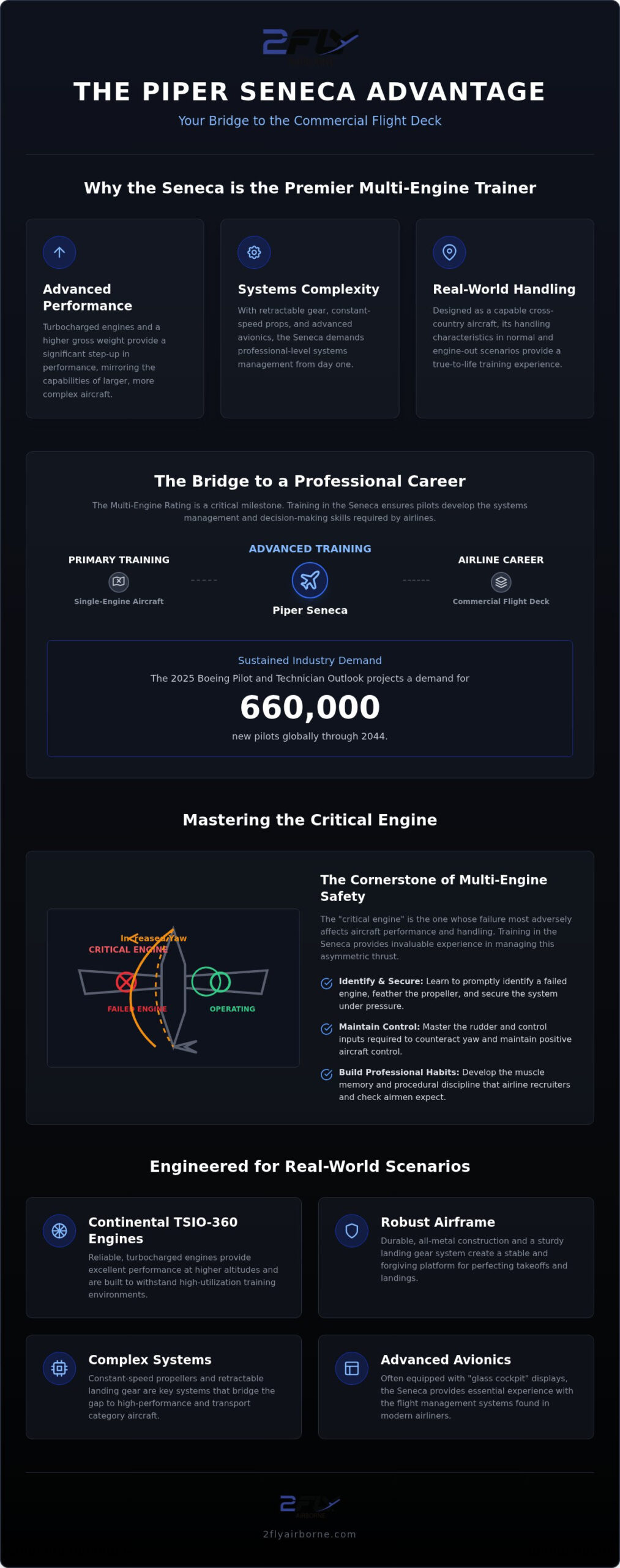
The Piper Seneca is more than just a training aircraft; it is a direct link to the systems logic and performance standards found in larger, more complex commercial airplanes. Its turbocharged engines, higher gross weight, and sophisticated systems require a level of management that closely mirrors the duties of a first officer.
Earning a Multi-Engine Rating (ME) is a critical milestone for any pilot aiming for an airline career. It is the certification that unlocks the door to flying aircraft with more than one engine, a fundamental requirement for nearly all commercial passenger and cargo operations. The quality of the training for this rating directly impacts a pilot’s readiness for their first airline job.
The need for well-trained pilots remains a constant in the aviation industry. The 2025 Boeing Pilot and Technician Outlook projects a demand for 660,000 new pilots globally through 2044. This sustained demand underscores the importance of high-quality, relevant training that prepares candidates for the technical and procedural challenges of the modern cockpit.
A Global Standard for Professional Flight Academies
The Seneca’s reputation as a robust and capable training platform has made it a staple in leading flight academies around the world. Its presence signifies a commitment to providing advanced, career-oriented instruction that goes beyond the minimum requirements.
Standardizing on a proven and powerful airframe like the Seneca allows students to build on their skills progressively. The transition from primary single-engine trainers to a high-performance twin feels like a natural and challenging step up, rather than a lateral move to a less demanding aircraft.
The Seneca is powered by reliable Continental TSIO-360 turbocharged engines, known for their performance at higher altitudes and their durability in the high-utilization environment of professional flight training. This reliability ensures aircraft availability, keeping students on track toward their career goals.
Engineering for the Real World: The Seneca Advantage
Unlike many light twins designed specifically for initial training, the Piper Seneca was built to be a capable cross-country and light charter aircraft. This design philosophy gives it handling characteristics and performance metrics that provide a more realistic training experience. One of the most important aspects of this is how it handles engine-out scenarios.
Most Seneca models feature two engines that rotate in the same direction (typically clockwise). This conventional design creates an aerodynamic reality known as the “critical engine”—a concept professional pilots must master. Training in an aircraft with a critical engine is invaluable preparation for flying the vast majority of multi-engine aircraft in the world.
The Seneca’s stable flight characteristics and predictable handling, even during single-engine operations, make it an exceptional platform for learning these advanced skills safely and effectively.
Mastering the Critical Engine
A “critical engine” is the engine whose failure would most adversely affect the performance or handling of the aircraft. In an aircraft with clockwise-rotating propellers, this is almost always the left engine. Its failure results in a more significant yawing motion that the pilot must counteract with rudder.
Learning to manage this asymmetric thrust is a cornerstone of multi-engine training. The Seneca provides the perfect environment to practice these skills. Students learn to promptly identify and secure a failed engine while maintaining positive aircraft control, building the muscle memory and procedural discipline that airline recruiters look for.
By training on an aircraft with a critical engine, pilots develop a deeper understanding of multi-engine aerodynamics. This allows them to focus on mastering precise control inputs and emergency procedures, preparing them for any twin-engine aircraft they may fly in their future careers.
Robust Airframe and Advanced Systems
The Seneca’s all-metal construction is built to withstand the demands of both cross-country flying and the repetitive maneuvers of a training environment. Its durable landing gear and robust structure provide a stable and forgiving platform for students perfecting takeoffs and landings.
Furthermore, the Seneca is a systems-rich aircraft. With features like turbocharged engines, constant-speed propellers, retractable landing gear, and advanced avionics, it requires students to develop a professional-level cockpit workflow. This complexity is a feature, not a bug; it forces students to learn efficient systems management from day one.
The aircraft’s predictable stall characteristics, even in complex configurations, are another vital safety benefit. Instructors can safely demonstrate stalls and recovery techniques, ensuring students are fully prepared for the full flight envelope before their checkride.
From Advanced Avionics to the Commercial Flight Deck
Today’s airline cockpits are dominated by “glass” displays and integrated flight management systems. Gaining proficiency with these systems early in a pilot’s training is a significant career advantage. The Piper Seneca, often equipped with modern avionics suites, provides this crucial experience.
Training in a glass cockpit environment dramatically enhances a student’s situational awareness. Information that was once spread across a dozen individual instruments is now logically presented on large, easy-to-read displays. This allows the pilot to process critical flight data more quickly and make better-informed decisions, especially during high-workload situations like an engine failure.
Digital engine monitoring systems provide precise, real-time data on both powerplants, helping students learn to manage engine parameters with the accuracy expected of a professional pilot. This technology reduces pilot workload and allows for a greater focus on flying the aircraft and managing the mission.
Modern Avionics and Situational Awareness
A modern avionics suite is typically organized around a Primary Flight Display (PFD) and a Multi-Function Display (MFD). The PFD shows attitude, airspeed, altitude, and heading, while the MFD displays navigation routes, weather, traffic, and engine information.
Many systems also include Synthetic Vision Technology (SVT), which creates a 3D virtual depiction of the terrain and obstacles ahead. This is an incredible safety tool, especially when training in marginal weather or unfamiliar areas, giving the pilot a clear view of their surroundings regardless of outside visibility.
Learning to integrate GPS navigation with the autopilot is another core competency for airline pilots. The Seneca provides the ideal platform for mastering these automated systems, building a foundation for the highly automated environment of a modern jetliner.
Preparing for the Modern First Officer Role
Experience in an advanced, glass-cockpit twin like the Seneca is directly transferable to the role of a First Officer. Airlines value pilots who arrive with a strong understanding of flight deck automation and crew resource management (CRM).
Learning to manage the Seneca’s complex systems is a key airline competency. Pilots who are comfortable with automated checklists, flight planning, and performance management in the Seneca will find the transition to a jet’s Flight Management System (FMS) far more intuitive.
This experience significantly reduces the time and stress involved in an airline’s new-hire training and type rating process. A pilot with a deep logbook of high-quality Seneca time is not just a multi-engine pilot; they are an airline-ready candidate.
Master the Multi-Engine Rating: What to Expect
The FAA multi-engine checkride is one of the most demanding practical tests in a pilot’s career. It requires a thorough understanding of aerodynamics, systems, and emergency procedures, all demonstrated with a high degree of precision. Training in the Piper Seneca is excellent preparation for this challenge.
A central focus of the training is the Vmc demonstration. Vmc (Minimum Controllable Airspeed) is the speed below which the aircraft can no longer be controlled if the critical engine fails. In the Seneca, students learn to recognize the onset of Vmc and recover safely and promptly.
Developing disciplined “flow” patterns—a systematic way of moving through cockpit checks and procedures—is essential in a multi-engine aircraft. The Seneca’s cockpit layout encourages the development of these professional habits, which are critical for safe single-pilot and crew operations.
Key Training Maneuvers
A crucial skill is learning to “feather” a propeller. This involves changing the blade angle of the propeller on a failed engine to be parallel with the wind, dramatically reducing drag. Students practice the “identify, verify, feather” sequence until it becomes second nature.
Managing an engine failure after takeoff is perhaps the most critical emergency procedure. The Seneca’s performance allows pilots to practice this scenario realistically, learning to maintain control, clean up the aircraft configuration, and execute a plan to return for a safe landing.
Finally, students will spend significant time mastering single-engine approaches and landings. This involves calculating new performance speeds and managing the aircraft’s energy and flight path with only one engine providing thrust, a true test of a pilot’s skill.
The Multi-Engine Checkride Prep
Success on the checkride begins on the ground. Mastering the Seneca’s weight and balance calculations is essential, as the aircraft can carry more passengers and fuel than a typical trainer, creating more complex loading scenarios.
A deep knowledge of the Pilot’s Operating Handbook (POH) is required for the oral exam portion of the checkride. The examiner will expect you to be the expert on the aircraft’s systems, limitations, and emergency procedures.
For additional regulatory context, aspiring pilots should familiarize themselves with the FAA’s Airplane Flying Handbook, which provides detailed guidance on multi-engine maneuvers and aerodynamics. For a comprehensive look at the training process in Florida, explore our guide to Multi-Engine Commercial Pilot Training in Florida.
Elevating Your Career with 2FLY Airborne’s Multi-Engine Training
Choosing the right flight school is as important as choosing the right aircraft. At 2FLY Airborne, our multi-engine training program is built around the Piper Seneca, providing the advanced, career-focused instruction needed to succeed at the airlines.
We maintain our fleet to the highest standards, ensuring our aircraft are safe, reliable, and available. This commitment to maintenance means our students avoid unnecessary delays and can progress efficiently through their training syllabus.
The multi-engine phase is a core component of our integrated FAA Airline Pilot Program. We don’t just teach you to pass a checkride; we immerse you in a professional environment that fosters a culture of excellence, safety, and airline readiness.
Structured Pathways to the Airlines
At 2FLY, Seneca training is seamlessly integrated into a complete career pathway, from zero experience to becoming a certified flight instructor and, ultimately, an airline pilot. This structured approach ensures no skill gaps and builds a strong foundation for your entire career.
Training in a professional, airline-oriented environment gives you a competitive edge. Our curriculum, instructors, and operational procedures are all designed to prepare you for day one of your airline career. We also offer a range of financing options to help make your professional pilot goals a reality.
Your Next Step Toward the Flight Deck
The Piper Seneca represents the gold standard for advanced multi-engine training. Its combination of real-world performance, complex systems, and robust safety features makes it the ideal platform for forging professional pilots.
By choosing a flight academy with a proven curriculum and a fleet of advanced aircraft like the Seneca, you are making a direct investment in your future career. You are choosing to build the skills and discipline that airlines demand.
Take the next step on your professional aviation journey. Speak with a 2FLY Training Advisor today to plan your path to the flight deck.
Article by
2FLY Airborne
2Fly Airborne is a professional flight training organization dedicated to developing the next generation of skilled, confident, and safety-focused pilots. With decades of combined aviation experience, our team of certified instructors provides structured, real-world training designed to prepare students for both checkrides and long-term success in the aviation industry.
Content Disclaimer
Some blog content is generated with the assistance of automated tools and may not always be fully accurate or up to date. Please verify all aviation-related information with official sources or a certified instructor. For additional guidance or clarification, we encourage you to contact one of our training advisors at 2Fly Airborne.